JavaScript for Line of Business Applications
606.5K views | +22 today
JavaScript for Line of Business Applications
Keeping track of current JavaScript Frameworks that help design your clientside Business Logic Layers.
Curated by Jan Hesse
Beam to my Inbox:
Your new post is loading...

Popular Tags - Filter using the Funnel

Scoop.it!

Building Modular JavaScript Projects with RequireJS

Building Modular JavaScript Projects with RequireJS | JavaScript for Line of Business Applications | Scoop.it

With so much emphasis being laid upon providing a smoothly flowing User Experience in any web project, the client side codebase is now a very considerable chunk of the overall codebase. However, this opens up a host of problems with managing dependencies in the JavaScript code base. In this article, we will look at the usage ofRequireJS, which makes these dependencies easier to manage, and as a result, less soupy code. Mmmm… soup!

No comment yet.
Scoop.it!

partial.js / web application framework for node.js

partial.js / web application framework for node.js | JavaScript for Line of Business Applications | Scoop.it

Free web application framework for building Web sites and Web applications using JavaScript, HTML and CSS. From web developer for web developers.


Framework supports perfect URL routing and compliances friendly url.
You can write own route to WebPage or WebSocket.


View engine contains many features and supports condition.
You can render view in view with model.


Write LESS and do more. Framework supports simple LESS CSS and
automated CSS vendor prefixes.


Automatically compress HTML, JS and CSS one time and save to temporary cache.
Client receives a small data via GZIP compression.

No comment yet.
Scoop.it!

JavaScript Patterns

JavaScript Patterns | JavaScript for Line of Business Applications | Scoop.it

A JavaScript pattern and antipattern collection that covers function patterns, jQuery patterns, jQuery plugin patterns, design patterns, general patterns, literals and constructor patterns, object creation patterns, code reuse patterns, DOM and browser patterns (upcoming).

* General Patterns
* jQuery Patterns
* jQuery Plugin Patterns
* Literals and Constructor Patterns
* Function Patterns
* Object Creation Patterns
* Code Reuse Patterns
* Design Patterns

No comment yet.
Scoop.it!

Handlebars.js Tutorial: Learn Everything About Handlebars.js JavaScript Templating

Handlebars.js Tutorial: Learn Everything About Handlebars.js JavaScript Templating | JavaScript for Line of Business Applications | Scoop.it

(This is a Handlebars.js Tutorial and a Handlebars.js Reference)

This is a complete tutorial, and indeed a reference, on Handlebars.js templating and, principally, JavaScript templating. Handlebars.js is a client-side (it can be used on the server, too) templating engine for JavaScript. It is a JavaScript library that you include in your page just like you include any .js files. And with it, you can add templates to your HTML page that will be parsed and interpolated (values of properties inserted in place) with the values from the data you passed to the Handlebars.js function.

No comment yet.
Scoop.it!

Some AngularJS pitfalls

Some AngularJS pitfalls | JavaScript for Line of Business Applications | Scoop.it

In the past few months I've been heavily using AngularJS. It's a marvelous framework for modern web applications. But as with every new toy, there are some rough edges that you have to be aware of. In this post I'll round up some gotcha's I encountered. Assuming you already know your way around Angular, these may be helpful.

* The flickering UI

*jQuery and Angular

* Minification

* Directives are never 'done'


No comment yet.
Scoop.it!

AngularJS Testing

AngularJS Testing | JavaScript for Line of Business Applications | Scoop.it

“AngularJS was designed from ground up to be testable” in the presentation above HPSW's Eitan Peer shows how to test angular.js apps intuitively with Jasmine.


This presentation covers Jasmine, testing angular.js with Jasmine and even a small exercise (+solution)


Enjoy

No comment yet.
Scoop.it!

Getting started with AngularJS Unit Testing

Getting started with AngularJS Unit Testing | JavaScript for Line of Business Applications | Scoop.it

As you probably know by now I have been doing a lot with AngularJS at work and even outside of work. The one thing I have been lacking is the riggers of Unit Testing, because honestly unit testing in JavaScript seemed scary. I had the help of a fellow co-worker take the scariness away.

My exposure to AngualrJS testing first began with the PhoneCat example where I was running scripts and things just automatically happened. This tutorial will show you how to start from scratch. I hope to show you that JS testing doesn't have to be scary but can actually be exciting! (well at least for me).

No comment yet.
Scoop.it!

ECMAScript 6 Generators

We’ve seen the implementation of Array Comprehensions introduced in JavaScript 1.7 where we can easily construct a new array based on the contents of another using a “comprehension.” Comprehensions are great for small arrays without a heavy memory footprint but the reality is that they can be expensive when applied to larger arrays. The main reason for the degradation of performance is attributed to the additional overhead created when computing the result of the comprehension during runtime.

No comment yet.
Scoop.it!

Why does Ember.js rock?

Why does Ember.js rock? | JavaScript for Line of Business Applications | Scoop.it

In response to this blog post about why Angular.js rocks, I thought I'd write something similar about Ember.js.

But how? Ember.js uses Handlebars for two-way data binding. Templates written in handlebars get and set data from their controller (which will be automatically generated with smart defaults if you don’t write it yourself, as it was here). Every time we type something in our input, the name property of our controller is updated. Then, automatically, the template is updated because the bound data changed.

Jan Hesse's insight:

answer to http://angular-tips.com/blog/2013/08/why-does-angular-dot-js-rock/

No comment yet.
Scoop.it!

Ember.js Persistence Foundation

Ember.js Persistence Foundation (epf) is a robust and stable framework for syncing client state with a persistent backend such as a REST API or socket connection. Defining characteristic of epf include:

Correctness is paramount. All other features, including performance, are important, but secondary.

Built around synchronization. Models are never locked and framework semantics assume updates are always coming in from a backend.

Full support for relationships. Related models can be saved concurrently and the framework will automatically order requests around foreign key dependencies.

Robust handling of conflicts and errors.

Forking models is first-class within the framework.

All operations are structured around javascript promises.

Epf is a functional alternative to ember-data and is used in production at GroupTalent with dozens of inter-related models.

No comment yet.
Scoop.it!

Directories for JavaScript resources

Directories for JavaScript resources | JavaScript for Line of Business Applications | Scoop.it

I recently asked on Twitter whether people knew any good directories for JavaScript libraries and got several good answers.

Obviously, you can always directly browse the registries of package managers.

No comment yet.
Scoop.it!

JavaScript in your Postgres

The same JavaScript engine that powers the web today is now available in your database.

This is one more step in evolving a data platform to meet all of your data needs. With a key/value store inside Postgres you gained agility in working with your schema. This agility was further improved with the JSON data type in Postgres 9.2. With geospatial support you removed the need for relying on additional tools for building location based apps. And today we’re continuing to expand, going beyond SQL bringing the full power of the V8 JavaScript engine to your Heroku Postgres database. 

No comment yet.
Scoop.it!

ember.js | notify other components on one component action

ember.js | notify other components on one component action | JavaScript for Line of Business Applications | Scoop.it

in the components section at Ember's guides there a demo of Post Summary Component, clicking on one Post Summery title opens its content below it.

I would like to add the functionality to close any other opened Post summaries at the same time.

The purpose on my question is the understand how ember speaks between components without sacrificing isolation.

the solutions I thought about are:

have some wrapper component that handles it in some way

firing an event like 'post-summery:open' and make other components close themselves on it (but then it can Collide with other places on the app using the same components for diffecnt uses

No comment yet.
Scoop.it!

Using Custom Directive in AngularJS to create reusable JavaScript components for your ASP.NET MVC app

Using Custom Directive in AngularJS to create reusable JavaScript components for your ASP.NET MVC app | JavaScript for Line of Business Applications | Scoop.it

Today we’ll see how to use a feature called Directives in Angular JS. Directives allow you to encapsulate custom behavior in an HTML element, attribute, classes and even comments. For example, the ng-app attribute that we use to define the scope of our Angular App is in fact a Directive, because there are no HTML5 attributes by that name! It’s Angular who interprets the attribute at runtime. 

Apart from helping add custom attributes, directives can also be used to create the server side equivalent of ‘tag-libraries’ on the client. Those familiar with WebForms or JSP development will remember you could create server side components with custom Tags like <asp:GridView>…</asp:GridView> where the GridView rendering logic was encapsulated in a server component. Well, Directives allow you build such components, but on the client. 

No comment yet.
Scoop.it!

7 steps for building a secure web application

7 steps for building a secure web application | JavaScript for Line of Business Applications | Scoop.it

For years, security experts have warned of vulnerabilities in web applications. And these warnings are unfortunately coming to fruition. Today, the headlines are dominated with news of a hacker successfully infiltrating one web application or another. We cannot hack or firewall our way to become impenetrable – hackers have proved that – so what can be done to secure these often critical applications?

Thankfully, it is possible. Here are seven steps to security-centric computer programming necessary to build low-risk web-based applications.

Step 1: Query Parameterisation
Step 2: Secure Password Storage
Step 3: Contextual Output Encoding XSS Defence
Step 4: Content Security Policy
Step 5: Cross Site Request Forgery
Step 6: Multi Factor Authentication
Step 7: Forgotten password security design

No comment yet.
Scoop.it!

Try, Catch, Fail: AngularJS: $watch, $digest and $apply

Try, Catch, Fail: AngularJS: $watch, $digest and $apply | JavaScript for Line of Business Applications | Scoop.it
While browsing reddit, I read an article I felt over-complicated an explanation of $watch, $digest and $apply, and perhaps gave people a little bit of the wrong idea about what it is.What is a $watch?What is $digest?What is $apply?So when does a $digest/$apply happen?How do $watch, $digest, and $apply relate to updating my view?Why does Angular work this way?
No comment yet.
Scoop.it!

How AngularJS Made Me a Better Node.js Developer

Over the past 6 years I’ve used Ruby on Rails, Backbone.js, Node and AngularJS. RoR reinforced my knowledge of Model View Controller (MVC) while Backbone.js did the same for my knowledge of Publish/Subscribe. Like many who made the switch to Node, my first instinct was to try and apply MVC to my Node.js apps - however, it felt unnatural. Taking a “class”-based approach, using CoffeeScript, didn’t feel entirely natural either.

While I enjoyed developing in JavaScript, I always felt I was missing something - that is until I started developing with AngularJS. AngularJS uses both dependency injection and promises extensively, both of which have greatly improved my code. In this article, I’ll focus on dependency injection, and discuss promises in my next article.

No comment yet.
Scoop.it!

Angulartics | Web analytics for AngularJS applications

Angulartics | Web analytics for AngularJS applications | JavaScript for Line of Business Applications | Scoop.it
Angulartics is an AngularJS module that lets you implement web analytics using the vendor of your choice.
No comment yet.
Scoop.it!

Tom Dale, Peter Cooper and Rob Conery; Cage Match - EmberJS vs. Angular

This is a battle between EmberJS and Angular. Tom Dale (project lead for EmberJS) vs Rob Conery (angular). The fight is hosted by Peter Cooper. You don't want to miss this!

No comment yet.
Scoop.it!

Init.js: A Guide to the Why and How of Full-Stack JavaScript

Init.js: A Guide to the Why and How of Full-Stack JavaScript | JavaScript for Line of Business Applications | Scoop.it
Have you explored the full JavaScript stack? Init.js lets you instantly initialize and deploy apps built with Backbone, Node, Mongo, Grunt, Mocha, and more.

The core of the idea is to have a single project to start them all, to let the developer or the technical founder make all of these essential decisions at once, and receive an appropriate starting template based on those decisions. I know what detractors are going to say, “One solution can’t apply to every problem” (haters gonna hate). And they might be right. But we can do our best to create an approximate solution, and I think Init comes pretty close.

To best achieve this objective, we have to keep a few key ideas in mind. When developing Init, I considered:

* Components

* Ease of Development

* Community

Keeping these goals in mind, I’ll next show you how I made my own decision decisions in creating Init...

No comment yet.
Scoop.it!

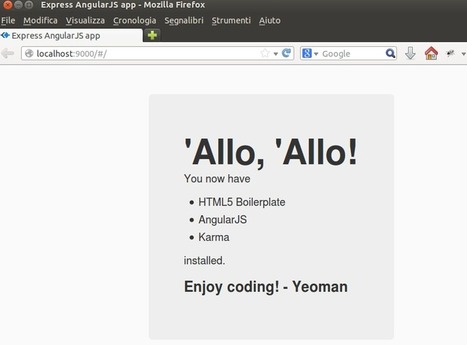
Yeoman, Express and AngularJS

Yeoman, Express and AngularJS | JavaScript for Line of Business Applications | Scoop.it

I already used yeoman for AngularJS applications: now I want to build a NodeJS/Express application powered by AngularJS with all the goodies provided by yeoman.

And... before searching for and trying an existing express-angularjs yeoman generators I'd like to do it by hand, just for fun and for diving into NodeJS/grunt & co.

  • AngularJS setup with yo
  • Express initialization
  • Express integration with AngularJS
  • Fix grunt build
  • Grunt server and livereload


No comment yet.
Scoop.it!

Plato - JavaScript Introspection

Plato - JavaScript Introspection | JavaScript for Line of Business Applications | Scoop.it

JavaScript source code visualization, static analysis, and complexity tool

No comment yet.
Scoop.it!

Unit Testing KnockoutJS and Web API

Unit Testing KnockoutJS and Web API | JavaScript for Line of Business Applications | Scoop.it

So, for the past couple of months I’ve been investigating a variety of topics from top-to-bottom, including HTML5 and CSS3, Bootstrap, ASP.NET MVC, Entity Framework (including Repository, Unit of Work, and Service patterns), Dependency Injection, JavaScript (including the Module and Revealing Module patterns) and jQuery, KnockoutJS, and finally QUnit.

One topic I thought I’d blog about is how to unit test client-side JavaScript code, specifically ViewModels used by KnockoutJS that communicate with a Web API endpoint. To help illustrate these techniques I’ve created an ultra-simple ASP.NET MVC application that uses both Web API and KnockoutJS. Shockingly, it’s a to-do application.

No comment yet.
Scoop.it!

Javascript Functions for PostgreSQL

Javascript in Postgres has gotten a good bit of love lately, part of that is from Heroku Postgres recently adding support for Javascript. In a recent conversation it was pointed out that it seems a bit of headache to have to create your own functions, or at least having an initial collection would make it that much more powerful. While many can look forward to PostgreSQL 9.3 which will have a bit more built in support for JSON a few functions can really help make it more useful today.

These are courtesy of Will Leinweber. For each of the following functions I’ll highlight an example of using it as well. To get an idea of the data its being run on:

No comment yet.
Scoop.it!

Lets set up Ember.js

Lets set up Ember.js | JavaScript for Line of Business Applications | Scoop.it

Ember.js is an interesting creature. This is the first client-side MVC I’ve looked into. Apparently calling these applications “single page apps” are looked down upon, even though they are driven from a single HTML page. Single DOM applications seems more appropriate.

Before this understanding occurs, everything is magic. I don’t like programming that runs on magic as magic is rather unpredictable.

With Ember.js, I struggled to follow how the examples and samples pulled everything together, but then I read the Naming Conventions document, and everything became clear.

To be honest, the Ember guides are quite good. They take a conversational approach to documentation instead of a fact based approach.

This sample App is supposed to be simple and will help show off different parts of Ember such as routes and how they connect the model to the template.

No comment yet.