JavaScript for Line of Business Applications
606.6K views | +21 today
JavaScript for Line of Business Applications
Keeping track of current JavaScript Frameworks that help design your clientside Business Logic Layers.
Curated by Jan Hesse
Beam to my Inbox:
Your new post is loading...

Popular Tags - Filter using the Funnel

Scoop.it!

NodeJS: the good parts? A skeptic’s view

NodeJS: the good parts? A skeptic’s view | JavaScript for Line of Business Applications | Scoop.it

Chris Richardson, founder of the original CloudFoundry.com, is a server-side Java developer who wasn't too thrilled about JavaScript in the browser, let alone on the server. In fact, he might even suggest that we are slaves to JavaScript because people have simply started to accept its weirdness and flaws, much like a Stockholm Syndrome phenomenon. Despite his misgivings, Chris has discovered an appreciation for Node.JS. In this talk from JAXConf 2013, Chris will walk you through the consequences of combining the event-driven programming model with a prototype-based, weakly typed, dynamic language. Ultimately, however, you will learn how to effectively use Node in modern, polyglot applications.

Oriol Lluch's curator insight, October 6, 2013 4:09 PM

Some of the architectural concepts behind node.js

Scoop.it!

BrowserStig = Developer Friendly Browser Automation

BrowserStig = Developer Friendly Browser Automation | JavaScript for Line of Business Applications | Scoop.it

Although BrowserStig may be used for other automation purposes, it's main purpose is to be used for functional testing. As mentioned before, you can use browserstig.js standalone without the cli. This would allow you to import browserstig.js into any javascript testing framework. However, the stig cli is designed to help you start testing immediately with minimal setup.

If you have used the karma test runner, you will be familiar with the stig cli. Really, the stig cli just wraps the karma test runner. The supported test styles are 'mocha', 'jasmine' and 'qunit'. However, this documentation only covers testing with mocha.

No comment yet.
Scoop.it!

Creating a Markdown Tag with Polymer

Creating a Markdown Tag with Polymer | JavaScript for Line of Business Applications | Scoop.it

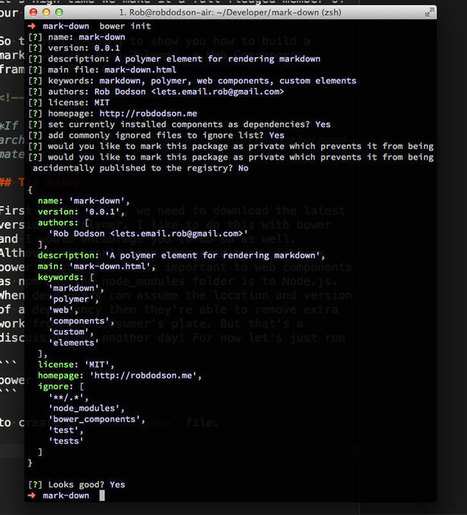
Ah Markdown… Such an amazing tool. I honestly would not be writing this blog post if Markdown did not exist. I tried many times to get in to blogging but I always found the writing experience, whether it be in a GUI or WordPress’ HTML mode, too limiting. Markdown changed all of that for me and I think it’s high time we make it a full fledged member of our developer toolbox.

So today I’m going to show you how to build a Markdown tag using Polymer, a Web Components framework from Google.

No comment yet.
Scoop.it!

Diving Into KnockoutJS - Houston TechFest 2013 Screencast

Diving Into KnockoutJS - Houston TechFest 2013 Screencast | JavaScript for Line of Business Applications | Scoop.it

Presentation Layout (0:00 - 1:30)
What is Knockout, Why should I use it? (1:30 - 8:57)
Basic Examples (8:57 - 19:27)
Working with Arrays (19:27 - 26:40)
ViewModel Structures (26:40 - 34:10)
Custom Binding Handlers (34:10 - END)
Why Use Custom Binding Handlers? (34:10 - 37:14)
The ko.bindingHandlers Interface (37:14 - 39:50)
Augment Existing Binding Handlers (39:50 - 46:40)
Common UI Formatting (46:40 - 54:40)
Existing Widgets and Building Widgets (54:40 - END)

No comment yet.
Scoop.it!

Meteor.js Fundamentals for Single Page Applications

Meteor.js Fundamentals for Single Page Applications | JavaScript for Line of Business Applications | Scoop.it

This course was a really fun course to put together, because Meteor is just an awesome platform.  After using Meteor, I actually am starting to like JavaScript.  I really like the idea of being able to build an entire application in a single language and to be able to use a single platform that takes care of all the plumbing for me.

The technology is still in its infancy, but I think it has huge potential.  Not very often I get this excited about a technology.

So, if you are interested in Meteor and want to see how you can create single page applications entirely in JavaScript with relatively little code, compared to other solutions, check out this course

No comment yet.
Scoop.it!

Embersmith - Static HTML and JSON generator for Ember.js projects

Embersmith is a Node.js application that takes Markdown files from your project's /contents directory and converts them toHTML & JSON in /public directory.

No comment yet.
Scoop.it!

AngularJS-ish filters in KnockoutJS

AngularJS-ish filters in KnockoutJS | JavaScript for Line of Business Applications | Scoop.it

As I learn more about AnuglarJS, I find filters to be one of the most exciting features of the framework. Filters allow common, mostly-simple display-level modifications to expressions in a view without having to include that logic in the model (i.e. $scope).

Applying a filter to an expression in an Angular view is super easy: {{ expression | filter }} and you’re done. Angular comes with a handful of filters for scalar values (number, currency, date) and arrays (filter, limit, order) but it’s also pretty easy to write your own.

In addition to “write once, use everywhere” convenience, filters are also chainable. This is particularly useful with Angular’s array filters...

No comment yet.
Scoop.it!

The two minute guide to AngularJS for .NET developers

While the allure of writing applications - and not just web sites - in HTML5 and JavaScript reaches a lot of developers, we've experienced that a number of developers are rather frightened by the idea of creating large applications in a dynamic language. In addition to the dynamic nature of JavaScript, the lack of a container-based GUI framework (which isolates causes and effects to individual controls, as it is done in the .NET Framework) and the general overarching flexibility and lack of guiding principles didn't make this environment too appealing for a lot of business developers.

We think that AngularJS can change this and we'd like to present a small sample of AngularJS code, the underlying markup and the resulting mini-application. (We're not going to talk too much about the individual steps in this sample, as this would be the focus of the next chapter.)

No comment yet.
Scoop.it!

Resources to Get You Up to Speed in AngularJS

Resources to Get You Up to Speed in AngularJS | JavaScript for Line of Business Applications | Scoop.it

I wanted to complile a list of resources which I've found that I'll be leveraging as I go down the path of learning AngularJS and which I thought might be useful to Tuts+ readers. I've broken them down by categories and included both commercial and freely available resources.

And to be clear, this isn't the end-all, be-all of resources. Invariably, someone will ask why I didn't include a specific resource and that's okay. Just realize this list isn't all-inclusive and solely meant to kickstart my AngularJS learning effort.

* AngularJS Official Resources
* Online AngularJS Courses
* AngularJS Community Resources
* AngularJS Books
* Way More Stuff Available

No comment yet.
Scoop.it!

AngularJS for jQuery Developers

AngularJS for jQuery Developers | JavaScript for Line of Business Applications | Scoop.it

AngularJS is a sweet web app framework. It comes with decent official documentation and samples, it looks superior among a large number of frameworks in an almost-real-world application test (the famous TodoMVC project), and there are cool presentations and screencasts about it all over the web.

But for a developer who has not used frameworks similar to Angular before, and has mostly worked with JavaScript libraries like jQuery, there may be some difficulty in shifting from the jQuery mindset to the Angular mindset. At least there was for me, and I’d like to share some notes–maybe this will be useful to someone.

No comment yet.
Scoop.it!

Challenges & solutions - Architecture of a Modern Web Application - Mobile App

Challenges & solutions - Architecture of a Modern Web Application - Mobile App | JavaScript for Line of Business Applications | Scoop.it

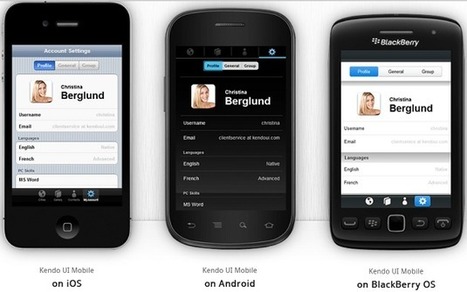
In this article we will learn to write mobile apps using native, hybrid and responsive development techniques for popular device platforms like iOS & Windows Phone for now and later Android & Black Berry.

The summary of the topics covered:

iOS Native App -> with Intro to Objective-C
Windows Phone Native App -> with Pricing, Device Overview and VS2012 Windows Phone Project
Mobile App Development - Possible Paths -> Native, Hybrid, HTML5
Hybrid Mobile App -> with PhoneGap, jQuery Mobile, KendoUI Mobile, Sencha Touch, HTML 5 Responsive Website

Scoop.it!

React: Rethinking Best Practices

React is a different way to write JavaScript apps. When it was introduced at JSConf US in May, the audience was shocked by some of its design principles.

We’re trying to push the limits of what’s possible on the web with React. My talk will start with a brief introduction to the framework, and then dive into three controversial topics: Throwing out the notion of templates and building views with JavaScript, “re-rendering” your entire application when your data changes, and a lightweight implementation of the DOM and events.

No comment yet.
Scoop.it!

Building Multiplayer Games with Node.js and Socket.IO

Building Multiplayer Games with Node.js and Socket.IO | JavaScript for Line of Business Applications | Scoop.it

With the release of the Ouya, Xbox One and PS4 this year, couch-based console gaming appears to be as popular as ever. Despite the proliferation of multi-player games available on mobile devices, and even the advent of multi-player experiences available on the web, sitting next to the person you’re playing a game with is still an irreplaceable experience. While experimenting with Node.js and the Socket.IO library, I found a perfect opportunity to not only learn some interesting new technologies, but also experiment with using the web and common devices (computers and mobile phones) to replicate a console-like gaming experience.

This article will give a brief overview of the fundamental concepts of the Socket.IO library in the context of building a multi-player, multi-screen word game. A web browser on a large screen device, such as a TV or computer will be the ‘console’ and mobile browsers will act as the ‘controllers’. Socket.IO and Node.js will provide the necessary wiring for all the browsers to share data and provide a cohesive, real-time game experience.

No comment yet.
Scoop.it!

JavaScript Testing Tactics

JavaScript Testing Tactics | JavaScript for Line of Business Applications | Scoop.it
A different approach to JavaScript testing

This talk is the missing manual to writing great JavaScript tests. I'm very excited to share it with you, because I really believe it can change how you approach writing software; this journey certainly has for me.

This talk, as delivered at DevReach in Sofia, Bulgaria, is the culmination of years of practicing to write beautiful JavaScript tests that provide just the right feedback to prompt me to take actions which dramatically improve the design of my code. As a result of my singular focus, my approach is very different than what you'd find searching for a tutorial or a README about JavaScript testing, TDD, or unit testing in general.

No comment yet.
Scoop.it!

Pie and Donut Charts in D3.js

Pie and Donut Charts in D3.js | JavaScript for Line of Business Applications | Scoop.it

In this tutorial, we are going to show how to create pie charts and donut charts, which are very similar to pie charts with only one difference, their centre is hollow. Those two charts are built using SVG paths. The SVG path is a more advanced shape compared to circles and rectangles, since it uses path commands to create any arbitrary shape we want. So, as you can see in the above figure, a donut chart is composed of multiple arc-like paths, with a different fill colour. Fortunately, d3.js provides a helper functions to draw arcs. Arcs are drawn using 4 main parameters: startAngle, endAngle, innerRadius and outerRadius. The angles are given in radians rather than degrees, so a full circle is 2 π instead of 360 degrees. Bear with me for now, and I will show you a way to enter angles using more meaningful ways later on. - See more at: http://schoolofdata.org/2013/10/01/pie-and-donut-charts-in-d3-js/#sthash.WZNPAwEi.KjhuVNNO.dpuf

No comment yet.
Scoop.it!

Logging Client-Side Errors With AngularJS And Stacktrace.js

Logging Client-Side Errors With AngularJS And Stacktrace.js | JavaScript for Line of Business Applications | Scoop.it
Ben Nadel demonstrates how he logs errors in his AngularJS applications using Stacktrace.js, and how he posts the error data to his server.
No comment yet.
Scoop.it!

Step by Step Guide for Unit Testing ExtJS Application using Jasmine

Step by Step Guide for Unit Testing ExtJS Application using Jasmine | JavaScript for Line of Business Applications | Scoop.it

This article is a Step by Step guide on how to do Unit testing of ExtJS application using Jasmine Framework. The MVC approach of ExtJS along with the ‘Behavior Driven Testing’ approach of Jasmine Framework enables independent testing of ExtJS model, store and controller.

No comment yet.
Scoop.it!

Have Javascript Frameworks Made Developers Dumber?

Have Javascript Frameworks Made Developers Dumber? | JavaScript for Line of Business Applications | Scoop.it

You can’t argue that Javascript frameworks have been an incredibly massive help in the Javascript community. Thanks to John Resig and jQuery, we have many things to be grateful for including helping standardise annoying browser quirks and abstracting complicated methods of which require tens of lines of code. As much as Javascript frameworks have helped, have they made developers dumber?

If you are only learning the framework, are you learning the language it is built on-top of? You kind of are, I mean jQuery doesn’t completely replace Javascript with its own methods and ways of doing things, you still set arrays like you normally would, you still set variables, setTimeout and setIntervals, closures and other things in standard Javascript syntax, but is it enough? I am willing to bet there are web developers out there right now who wouldn’t be able to read half the things in the jQuery source code.

No comment yet.
Scoop.it!

Getting MEAN With MongoDB and AngularJS

Getting MEAN With MongoDB and AngularJS | JavaScript for Line of Business Applications | Scoop.it

MEAN is a full app development stack including MongoDB, Express, Node.JS and AngularJS. In this hour we'll visit with Valeri Karpov of MongoDB who first coined the term. He'll cover background on why he selected these components and why other developers might choose the same stack. From there, we'll chat with Ward Bell from IdeaBlade discussing how BreezeJS makes managing data simpler in large applications. Our last speakers are from StrongLoop. They'll present on how MEAN can work for mobile enterprise environments. We'll end with a short Q&A.

No comment yet.
Scoop.it!

Ultimate guide to learning AngularJS in one day

Ultimate guide to learning AngularJS in one day | JavaScript for Line of Business Applications | Scoop.it
TerminologyAngular has a short term learning curve, and it's mainly getting to grips with the terminology and "thinking MVC". MVC meaning Model-View-Controller. Here are the higher level and essential APIs that Angular comes with and some terminology.

MVC

You've probably heard of MVC, used in many programming languages as a means of structuring/architecting applications/software. Here's a quick breakdown of meanings...


The key rule concept here is the $scope concept, which you'll tie to all your functions inside a specific controller. The $scope refers to the current element/area in the DOM (no, not the same as this), and encapsulates a very clever scoping capability that keeps data and logic completely scoped inside elements. It brings JavaScript public/private scoping to the DOM, which is fantastic.

The $scope concept may seem scary at first, but it's your way in to the DOM from the server (and static data if you have that too)! The demo gives you a basic idea of how you can 'push' data to the DOM.

No comment yet.
Scoop.it!

Buster.JS - A Browser and NodeJS JavaScript testing toolkit.

Buster.JS - A Browser and NodeJS JavaScript testing toolkit. | JavaScript for Line of Business Applications | Scoop.it

Buster.JS is a JavaScript test framework for node and browsers.

It does browser testing with browser automation (think JsTestDriver), QUnit style static HTML page testing, testing in headless browsers (PhantomJS, jsdom), and more. Write your test case with Buster.JS and run it both in Node.js and in a real browser.

There’s a public API for almost everything. You can write reporters for customizing the output of buster test (we already have xUnit XML, traditional dots, specification, tap, TeamCity and more), write extensions that wrap other testing frameworks (we already have buster-jstestdriver), add your own testing syntax (we ship with xUnit and BDD), and much more. Again, the overview lists many of these things.


No comment yet.
Scoop.it!

How to integrate AngularJS with Rails 4

How to integrate AngularJS with Rails 4 | JavaScript for Line of Business Applications | Scoop.it

Building most single-page applications (SPAs for short) is a two-step process: first you create a JSON API in a backend technology of choice and then you use that API in the JavaScript application. Here we'll be using Ruby on Rails on the backend and AngularJS on the frontend.

The main pain point of any kind of integration is making sure that everything fits together well. This post will not take you through building the whole application. Instead, it will focus on making sure all the integration points are handled properly. I will also share with you some practical advice on the topic.

Code examples used in this post come from a Todo list management application. This text summarizes all the lessons learned during writing of that app.

No comment yet.
Scoop.it!

Top JavaScript Frameworks for Mobile Web Development

Top JavaScript Frameworks for Mobile Web Development | JavaScript for Line of Business Applications | Scoop.it

The selection of the right JavaScript framework for developing mobile apps is critical and an important task in mobile application development. Developers use frameworks with pre-implemented functionalities to reach their mobile development goals efficiently. These pre-implemented components motivate the use of design patterns and best practices to support the developers and facilitate the development of apps in a standardised way. Most importantly, it structures the development process proficiently.

But why JavaScript frameworks for mobile development?

The framework supports multiple mobile device platforms such as Android and iOS to allow you to get your app spread to a wide range of users

They optimise the touchscreen device system. Mobile web development frameworks provide standard User-Interface elements and event-handling specifically for mobile platforms
The majority of the mobile devices possess web browsers that support CSS3 and HTML5. With frameworks taking advantages of new features available in W3C, they make user experience even better

However, with bandwidth limitations, the focus should be on reducing the file weight placed into mobile web application frameworks.

So, here are the top JavaScript frameworks for your next mobile web development. I am sure you would love to work with these frameworks to build your mobile well apps.

No comment yet.
Scoop.it!

Ajax Control Toolkit Now Supports jQuery

Ajax Control Toolkit Now Supports jQuery | JavaScript for Line of Business Applications | Scoop.it

This release of the Ajax Control Toolkit introduces a new jQueryExtender base class. This new base class enables you to create Ajax Control Toolkit controls with jQuery instead of the Microsoft Ajax Library.

Why are we rewriting Ajax Control Toolkits with jQuery?

There are very few developers actively working with the Microsoft Ajax Library while there are thousands of developers actively working with jQuery.

Because we want talented developers in the community to continue to contribute to the Ajax Control Toolkit, and because almost all JavaScript developers are familiar with jQuery, it makes sense to support jQuery with the Ajax Control Toolkit.

Also, we believe that the Ajax Control Toolkit is a great framework for Web Forms developers who want to build new ASP.NET controls that use JavaScript. The Ajax Control Toolkit has great features such as automatic bundling, minification, caching, and compression. We want to make it easy for ASP.NET developers to build new controls that take advantage of these features.

So in a jQuery world why is the Ajax Control Toolkit needed at all? Why not just use jQuery plugins instead of the Ajax Control Toolkit?

For example, there are lots of jQuery ToggleButton plugins floating around the Internet. Why not just use one of these jQuery plugins instead of using the Ajax Control Toolkit ToggleButton control?

There are three main reasons why the Ajax Control Toolkit continues to be valuable in a jQuery world:

1. Ajax Control Toolkit controls run on both the server and client

jQuery plugins are client only. A jQuery plugin does not include any server-side code. If you need to perform any work on the server – think of the AjaxFileUpload control – then you can’t use a pure jQuery solution.

2. Ajax Control Toolkit controls provide a better Visual Studio experience

You don’t get any design time experience when you use jQuery plugins within Visual Studio. Ajax Control Toolkit controls, on the other hand, are designed to work with Visual Studio. For example, you can use the Visual Studio Properties window to set Ajax Control Toolkit control properties.

3. Ajax Control Toolkit controls shield you from working with JavaScript

I like writing code in JavaScript. However, not all developers like JavaScript and some developers want to completely avoid writing any JavaScript code at all. The Ajax Control Toolkit enables you to take advantage of JavaScript (and the latest features of HTML5) in your ASP.NET Web Forms websites without writing a single line of JavaScript.


No comment yet.
Scoop.it!

TodoMVC-EAK - EmberJS TodoMVC app port to use Ember App Kit

TodoMVC-EAK - EmberJS TodoMVC app port to use Ember App Kit | JavaScript for Line of Business Applications | Scoop.it

This is a simple demo implementation of the official Ember's Todo MVC app from the guides section using theEmber App Kit to organize the files and build the project.

A guide explaining the differences between the official guide vs using App Kit should be coming soon.

No comment yet.