
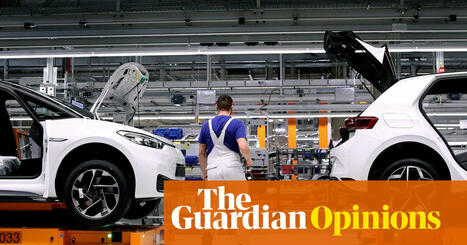
Germany was once an economic model to emulate but its reliance on industries past their sell-by date is costing it dear


|
Scooped by
Graham Watson
onto International Economics: IB Economics September 1, 2024 7:09 AM
|
 Scoop.it!
Germany was once an economic model to emulate but its reliance on industries past their sell-by date is costing it dear

 Your new post is loading...
 Your new post is loading...
Your new post is loading...
Scoop.it!

From
www

The current level of tariffs charged on goods entering the US from the EU is 15%, under a deal negotiated last July.
Graham Watson's insight:
The US President is going to increase the tariff on EU cars to 25% next week, presumably on the basis of some perceived sleight - real or imagined. As a result, the EU is considering its next move, US consumers will face higher prices. Both sides claim the other is breaching the terms of last year's EU-US trade deal.
Scoop.it!

From
www
The US president said he would lift restrictions on Scotland's ability to work with the state of Kentucky on whisky and bourbon.
Graham Watson's insight:
And the very opposite of certainty, with the news that President Trump has removed tariffs on whisky in the wake of the King's visit to the US. It's significant because the US represents the largest foreign market for Scotch whisky and it also allows Kentucky bourbon manufacturers to work with UK-based manufacturers to whom they sell around £200m worth of barrels per year.
Scoop.it!

ECB interest rate decision looms as growth across bloc stumbles and price rises gather pace, up from 2.6% in March and 1.9% in February
Graham Watson's insight:
As with other developed economies, the Eurozone has been impacted by the Iran war, with inflation up from 1.9% in February to 2.6% in March to 3% in April.
This comes in a week when the European Central Bank meets to determine interest rates, but I suspect that like the Fed and the Bank of England, the decision will reflect a "Wait and See" approach.
Scoop.it!

From
www
The BBC takes a look in charts at what the UAE's departure could mean for the oil cartel and more widely.
Graham Watson's insight:
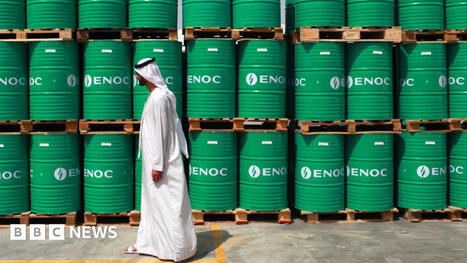
The BBC clip look at the wider implications of the UAE's decision to leave OPEC, identifying all OPEC members, how much oil it currently produces and how its influence over the global market for oil has diminished from around half in the 1970s to around a third today.
Another article to complement the two articles I've scooped earlier today.
Scoop.it!

Oil prices surged as talks on reopening of strait of Hormuz remain gridlocked, sending prices $1 higher than last year
Graham Watson's insight:
This could easily go on the Microeconomic board, but I'll put it here because of its implications for US inflation, and perhaps as significantly, the forthcoming mid-term elections.
Scoop.it!
From
www
It will have little effect on the current oil blockades, but it could change everything afterwards.
Graham Watson's insight:
Faisal Islam explains why the UAE's decision to leave OPEC is such a big deal, highlighting the fact that although it's the 4th largest producer of oil, it has the 2nd highest spare capacity and thus has considerable ability to increase its output and in doing so lowering the global price of oil.
This will be accentuated if they develop pipelines that bypass the Strait of Hormuz, and start producing at, or close to, full capacity. It strikes me that the Emiratis have taken the view that as fossil fuels fall out of fashion, they may as well maximize their oil revenues now rather than later, and even with a lower oil price, they're insulate against the worst effects of this because they've already started to diversify, unlike some.
I like this article - it's excellent and also includes one of the most apposite quotes regarding the sector: as former Saudi oil minister, Sheikh Yamani said ""The Stone Age did not end because the world ran out of stones. The Oil Age will not end because the world runs out of oil."
Scoop.it!

Critical week for global economy as banks expected to issue warnings over conflict driving up prices
Graham Watson's insight:
The Guardian observes that this week sees a number of central banks making interest rate decisions, with the consensus being that many, if not all of them, are going to hold borrowing costs where they are, as they wait and see what's going to happen next.
Scoop.it!

Exclusive: International Energy Agency’s Fatih Birol, the world’s leading energy economist, also says UK should largely forgo North Sea expansion
Graham Watson's insight:
The head of the International Energy Agency, Fatih Birol fears that the Iran war signals the beginning of the end for fossil fuels, suggesting that consumers will have lost trust in the ability of the global economy to supply them without interruption. He notes that renewables represent a "no-regrets alternative", and that the implications of the war for related markets in helium, fertiliser and food are going to be long-lasting.
Scoop.it!
US president accuses UK of thinking it can ‘make an easy buck’ from US tech companies, weeks after warning that UK–US trade deal can be changed
Graham Watson's insight:
Oh, here he goes again, the orange blowhard...
President Trump has accused the UK of thinking it can 'make an easy buck' from US tech firms operating here by imposing a digital services tax on them. As a result, he's threatening retaliatory tariffs, changing the nature of the proposed UK-US trade deal.
Of course, the President is likely to be unaware that in the absence of the digital services tax, US firms might think that they can 'make an easy buck' in the UK.
In short, he wants the playing field in every market to favour the United States, which in his mind will benefit the US but is likely to reduce the level of trade, and actually have adverse effects for everyone.
Scoop.it!

The president’s proposed $445bn increase in military spending would batter popular domestic programs as millions struggle
Graham Watson's insight:
Just a classic case of the opportunity cost of higher defence spending, with President Trump wanting to increase the Pentagon budget to $1.5 trillion - a $445bn increase - at the expense of domestic spending at a time when a cost of living crisis is just starting to bite.
It seems that leading the Board of Peace is a surefire recipe to increase the number of wars you intend to prosecute.
Scoop.it!

Americans having fewer kids plus an ageing population could be a recipe for disaster that further erodes social stability
Graham Watson's insight:
This article looks at the implications of falling fertility rates for the US economy, implying an ageing population. It's not uncommon across the developed world, but this time Eduardo Porter suggests that there's a chance that higher costs to look after the elderly might be offset by AI increasing productivity to the extent that this offsets the adverse implications of this situation for the public finances.
Scoop.it!

Rachel Reeves joins global finance chiefs in highlighting how households and businesses are feeling the pain of higher energy prices
Graham Watson's insight:
Not much in the way of theory more a taking of the global temperature, with the ongoing Iran conflict hanging over the global economy as the world's Finance Ministers met at the annual IMF gathering in Washington last week. It's clear that uncertainty is here to stay and that the distributional effects of the conflict have yet to unwind and, frankly, aren't fully appreciated.
Scoop.it!

US calls free-market capitalism ‘surest path to prosperity’ and seeks to forgo direct aid to developing countries
Graham Watson's insight:
A fairly straightforward article that compares the effectiveness of trade versus aid, a standard developmental topic.
As the a spokesman at the State Department has stated: “'The idea that trade and free market capitalism is the surest path to prosperity has been proven by the facts and by history,' Pigott said, adding that those calling for 'aid not trade' were 'really arguing for lining the pockets of a corrupt NGO industrial complex'."
|
Scoop.it!

From
www
A shortage of fertiliser due to the Iran conflict could reduce crop yields and push prices higher, says the boss of Yara.
Graham Watson's insight:
This could easily be a Microeconomic scoop, but I've put it here to reflect the developmental implications of what Svein Tore Holsether, the chief executive of Yara told the BBC.
He has emphasised that the interruption of the Iran war to the fertiliser supply chain could, at some point, start to cost the global economy up to 10 billion meals a week, and that those costs are going to fall most heavily on the global poor.
Without fertiliser, there's a real risk to food security, especially in sub-Saharan Africa, but more widely, there's going to be considerable food price inflation to come.
Scoop.it!

From
www
The zero-tariff regime gives China's soft power a boost, but may lead to uneven gains, say analysts.
Graham Watson's insight:
It has been argued that the country that has gained the most from the war with Iran is China, in as much as it benefits from the lack of certainty being provided by the United States, and can present itself as a counterpoint to that.
So, if you want certainty, then here's a lovely way of achieving that. China has announced that it is going to scrap tariffs on every African nation bar Eswatini. You should be able to draw how this might affect the price of African goods in Chinese markets, and the potential implications for economic welfare.
However, you have to bear in mind that China is already running a significant trade surplus with Africa, and given supply constraints, the size of the effect on African economies probably isn't as large as it might otherwise be.
Scoop.it!

Fed officials cite elevated inflation, slow job growth and uncertainty in Middle East as reasons for holding rates
Graham Watson's insight:
Jerome Powell last interest rate decision as Chair of the Federal Reserve, after the confirmation of Kevin Warsh as his successor, sees the Fed keep rates unchanged at 3.5% to 3.75%.
In spite of the endless criticism of the outgoing Chair by President Trump, such a decision doesn't seem controversial, given that only one of the 12 members of the Fed board voted against leaving the rate unchanged. The President, of course, wants lower rates; however, he'd be wise to reflect upon the relative success that the Fed has had in bringing down inflation from 9.1% in the post-Ukraine period.
Scoop.it!

Fishing companies can also access subsidies in loosening of state aid rules to cover fuel and fertiliser price rises
Graham Watson's insight:
The EU is trying to ameliorate the worst of the effects of the Iran conflict, with a minimum of paperwork by allowing individual firms to claim "up to 70% of the extra cost of fuel and fertilisers" and for energy-intensive firms in steel, chemicals and rail "able to claim up to 70% of the extra electricity cost of eligible consumption".
Their UK counterparts must be delighted; as should Brexit Leave voters who presumably weighed up the opportunity cost of lost EU state aid before voting.
Scoop.it!
From
www
Several warning lights are flashing that have some wondering whether we are in the foothills of another financial crisis.
Graham Watson's insight:
I'll leave this here without comment: today's must read. Are we on the brink of another financial crisis? It couldn't come at a worse time...
Scoop.it!

Big win for Donald Trump, who has accused organisation of ‘ripping off the rest of the world’ by inflating oil prices
Graham Watson's insight:
Wow! This could perhaps be the most significant economic effect of the Iran war, with the United Arab Emirates announcing that it intends to quit OPEC (the Organisation of Petroleum Exporting Countries), the cartel which plays a major role in determining global oil prices by establishing production quotas.
The UAE has been an OPEC member since 1967, but argues that leaving OEPC gives it greater flexibility as well as having negligible effect on the market in the immediate term. Longer-term it would allow the country to increase production calling into question the sustainability of the cartel going forward.
Scoop.it!
From
www
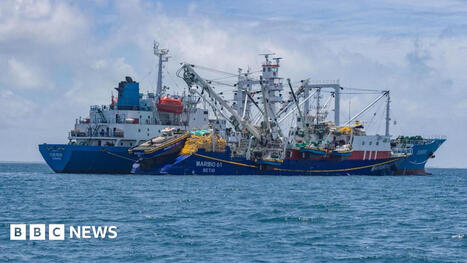
Tuna populations around the Pacific Islands could move away as ocean temperatures increase.
Graham Watson's insight:
This BBC article highlights the very real costs of climate change for the Pacific islands of Kiribati, with the prospect of higher sea temperatures driving tuna away from the islands and reducing the revenues earned from selling fishing licenses. It's a stark reminder of how reliant some states are on one commodity, how this may represent a barrier to development.
Scoop.it!

From
www
With the price of fuel rising China's BYD says it is positioning itself to benefit from the global shift away from fossil fuels.
Graham Watson's insight:
A demonstration of lots of themes: shifting economic gravity, the green transition, the drawbacks of tariffs and the lack of innovation from established car manufacturers. However, in this article China's BYD are bold in effectively announcing that they don't need access to US markets to thrive: and they're right.
China is the world's largest market and with other economies growing why would they want to pay high tariffs to gain access to US market when they're already in a situation where demand for their cars outstrips supply at the current price.
And for America? Less choice and higher priced electric vehicles, which, if they ever want to take climate change seriously, they'll need to adopt at some point, and at the moment they're losing ground to Chinese manufacturers. economic grq
Scoop.it!
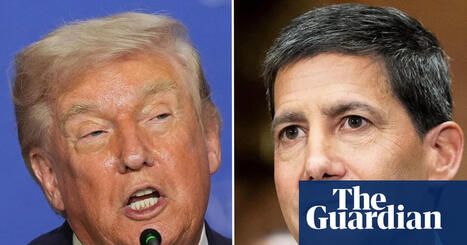
Kevin Warsh, Trump’s ‘central casting’, has a long road ahead of convincing board members to lower interest rates
Graham Watson's insight:
President Trump seems to think that the Governor of the Federal Reserve can unilaterally set interest rates. If this is the case, then - as is not uncommon - he over-estimates the power of the individual.
As this article points out, Kevin Warsh might seem like the President's patsy, but this might not be the case. It even argues that Warsh's damascene conversion from inflation hawk to inflation dove might have a degree of validity if AI can deliver significant productivity gains. However, the uncertainty associated with the Trump regime won't make his job easier. However, even then to changing interest rates requires a majority of the board members to vote for it, and whilst two of them are Trump appointees, the other five aren't.
Scoop.it!

Claims system launches months after supreme court ruled Trump had no legal authority to impose tariffs
Graham Watson's insight:
The Trump administration has established a digital platform to refund tariff revenue to some of the affected parties, although, as the article notes "The only companies legally eligible to claim are those that officially paid the tariffs – predominantly importers and large corporations. The broader population who absorbed the cost through higher prices on everything from electronics to clothing has no direct recourse."
In short, it's up to individual corporations to decide what they are going to do with the refunded money, with consumers not overly impressed by those who have said that they are going to use the refund to offer cheaper price going forward.
Scoop.it!
From
www
As supply disruptions and infrastructure damage tied to the US-Israel war with Iran ripple across the global economy, countries are being forced to find alternatives to natural gas, potentially reshaping the future of energy.
Graham Watson's insight:
This Bloomberg clip looks at the implications of the Iran conflict for the global economy, via the effects of the war on the supply of liquified natural gas (LNG).
The Iranian attack on the Qatari Ras Laffan Industrial City has significantly reduced the ability of the plant to supply LNG, and this has implications for those economies that have pivoted towards LNG, and the other goods that are dependent upon a steady supply of the gas.
Scoop.it!

The war in Iran has exposed our dependencies. Europe, including the UK, must be bold about change, so nobody can blackmail us, says Lars Klingbeil, Germany’s finance minister and vice-chancellor
Graham Watson's insight:
Crikey! The German Finance Minister, and Vice Chancellor, Lars Klingbeil, writes in the Guardian about the need to reform the Germany economy - he highlights both exogeneous factors that affect the economy, the need for infrastructure improvements and a relaxation of the debt brake, a fiscal tool which limits the ability of the government to run a budget deficit to finance capital expenditure. Other reforms proposed include a reform of childcare, making the tax system more progressive and increasing labour market flexibility to encourage more female participation.
|






Larry Elliott looks at the ongoing problems facing the German economy arguing that whereas it was a role model in the latter part of the 20th century, it's inherent weaknesses have been revealed in the 21st century.
He argues that the Germans have been complacent, and invested too little in all forms of infrastructure, as well as human capital. He sees the economy as over-reliant upon sunset industries, and although they've done remarkably well to integrate the former East Germany, current rates of growth are low.