
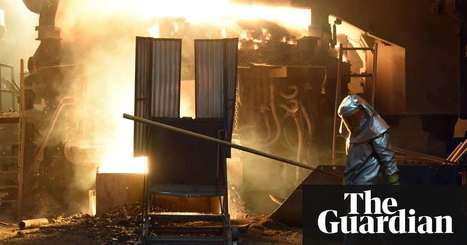
Workers in Pennsylvania, once a steel hub, are conflicted about the tariffs proposal and fear Trump could just be playing politics


|
Scooped by
Graham Watson
onto International Economics: IB Economics March 11, 2018 1:14 PM
|
 Scoop.it!
Workers in Pennsylvania, once a steel hub, are conflicted about the tariffs proposal and fear Trump could just be playing politics

 Your new post is loading...
 Your new post is loading...
Your new post is loading...
Scoop.it!

The president’s ultimate goal is to push the Fed – among other independent US institutions – to bend to his will
Graham Watson's insight:
In the week that the Chair of the Federal Reserve moves from Jerome Powell to Kevin Warsh, Eduardo Potter argues that the US central bank is in danger of losing its independence. He cites the other examples where the current President has subjugated previously independent institutions to his own will but speculates that whilst he might try to do this to the Federal Reserve, it will be harder because the Federal Open Markets Committee, like the Monetary Policy Committee in the UK, has 12 members who all vote on interest rates, and currently only two of them are Trump appointees.
For what it's worth, I'm looking forward to an economically illiterate President calling for interest rate cuts as inflation rises.
Scoop.it!
From
www

Rare earths are the backbone of modern technology, and China has cornered the global market for the commodity. The country produces and processes more than 80% of the world’s supply. As it uses that dominance as geopolitical leverage, can other countries break its grip?
Graham Watson's insight:
This clip doesn't contain much economic theory - apart perhaps from looking at protectionism, and the US-China trade war - and possibly a look at monopoly power. However, it's essential viewing if you want to know about the economic significance of rare earth metals in the modern economy.
Scoop.it!

From
www
Modi has urged Indians to save dollars as war and oil shocks strain the rupee and economy further this year.
Graham Watson's insight:
This article looks at the impact of the Iran war on the Indian economy, with most analysts of the view that the effects have yet to be felt in any meaningful sense.
However, given that India imports 90% of its oil and half of its natural gas, the concern is that India is going to see its forex reserve dwindle in the months ahead; consequently, Narendra Modi has asked Indians to travel less and buy less gold, both of which require dollars. That also explains why the government has increased import duties on gold and silver to 15%.
Furthermore, the Indian budget deficit is forecast to be higher than the expected 4.3%, and when this is coupled with a current account deficit of $70bn, and the depreciation of the rupee, some are concerned that despite 6-6.5% growth, Indian consumers are soon going to be experiencing harsher times - and much higher inflation.
Scoop.it!

From
www
mweThe key measure of US inflation rises its highest level since May 2023 as consumers feel the impact of the Iran war.
Graham Watson's insight:
Dear me! I'd feel some sympathy for President Trump if I thought he had even the first inkling about cost-push inflation, but he clearly doesn't. Apparently, the key to securing a deal appears to be inflicting economic pain on yourself with no obvious end to the conflict in sight and the regime change you wanted seemingly as far away as it was before the conflict, if not even further.
But for the average American consumer, April's 3.8% inflation figure reflects higher prices of fuel. How ironic it would be if the new Chairman of the Federal Reserve, Kevin Warsh, had to raise interest rates in his first month in charge. That really would show how intellectually bankrupt the President is.
Scoop.it!
From
www
A surge in energy prices caused by the Iran war is rippling through global supply chains for common consumer goods, making materials like chemicals and plastics more expensive and pushing up manufacturing and transportation costs.
Graham Watson's insight:
This Reuters clip is ostensibly American but it has wider implications - it's a simple primer showing how central oil is to the global economy - there are some nice examples of derived demand, including food and plastic packaging. It's worth a quick look.
Scoop.it!

Instead of obsessing over rules that have ceased to matter, we must consider giving Beijing a dose of its own medicine, says Mark Leonard of the European Council on Foreign Relations
Graham Watson's insight:
Again, not much in the way of theory but a perspective on the global economic order and the implications of the rise of China, for the rest of the world. Mark Leonard argues that China has adapted best to the realities of the new world order and is favourably placed with regard to ownership of raw materials, trade policy and so forth.
He calls the current state, the age of un-order. It's an interesting conceit.
Scoop.it!

The economic warnings are bleak, but full extent of shortages are still not felt for many European countries
Graham Watson's insight:
This Guardian article looks at the ramifications of the Iran war and wonders whether the world's economies are fully prepared for them. The suggestion is that there's a disconnect between the current state of affairs and what's coming down the track.
The suggestion is that the supply-side shock is going to see significant rises in inflation as a result of disruption to the global supply chain, and that we've done seen anything yet.
Scoop.it!

Owner IAG expects to recover 60% of additional fuel bill caused by Iran war through ‘revenue and cost management’
Graham Watson's insight:
The owner of British Airways is facing a £1.7bn fuel hit cost but is looking to pass this on to consumers by raising fares. However, I note that the article finishes with the following paragraph: "The company reported a pre-tax profit of €422m during the three months to the end of March, up 77% on the same period a year earlier. Revenue rose 1.9% to €7.2bn"
However, have a look at the company's annual report - how much does it have in cash, cash equivalent and interest-bearing deposits? Over €10billion.
Really?
Scoop.it!

From
www
Trump's deadline to the European Union came as a trade court ruled his global tariff policy violated US law.
Graham Watson's insight:
Yet more uncertainty for EU-US trade, with the threat of the US ratcheting up tariffs if the EU doesn't drop its tariffs on US goods, and, simultaneously, a US court ruling that the President's 10% tariff is illegal.
You cannot script it. It's almost as if the President doesn't have a coherent policy, economically, domestically and in terms of foreign policy. or perhaps it's all "The Art of the Deal"?
Scoop.it!

Al Nahyans’ control over farmland in Europe has meant they receive proportion of payments to farms
Graham Watson's insight:
This article highlights the fact that large landowners reap significant benefits from owning farmland, with the UAE royal family being some of the largest beneficiaries of the EU's support for farmers. The article claims that they've earned more than €71m in the past six years.
They would argue that this is a fair return for being 'guardians of the environment' and generating positive externalities, perhaps by maintaining biodiversity or simply keeping the countryside 'pretty' - others might suggest that it's a way of maintaining their wealth in a sector which is, to all intents and purposes a risk-free form of investment.
Scoop.it!

G77 nations spend $8tn a year servicing debts, but analysis shows how comprehensive relief could benefit social spending
Graham Watson's insight:
A report for the UN Secretary-General argues that the G77 nations spend $8tn per year servicing their debts, and that if borrowing costs were lowered they could free up $900bn for development spending. It's a clear example of the opportunity cost of debt interest repayments, and intuitively it would seem to make sense.
However, you need to be careful: lowering debt service costs might trigger a moral hazard issue in encouraging developing economies to take on more debt that is economically rational, at that's undesirable too.
The biggest issue is perhaps the identity of the lenders, with private lenders renowned for refusing to write-off debt and as Oxfam's head of inequality notes, it seems perverse that they place greater store on debt repayments than paying for education and healthcare for some of the world's poorest citizens.
Scoop.it!

Jet fuel has doubled in price since the start of the war on Iran. How bad will the disruption get and could this accelerate the route to jet zero?
Graham Watson's insight:
Another reflection on how the higher price of aviation fuel is going to impact the world. Again, little in the way of theory but a very interesting look at the wider implications of the Iran conflict.
Scoop.it!

Study warns women face job losses and increased unpaid care duties as debt and conflict-driven turbulence force spending cuts
Graham Watson's insight:
Gender-based inequality in a developing context, with the UN Development Programme's research suggesting that the effects of a rising debt burden falls most heavily on women.
Not only are they more prone to job losses resulting from this but they're also expected to shoulder a greater burden in the form of increased care responsibilities.
|
Scoop.it!

State oil company fast-tracks previously undisclosed project, which is expected to double export capacity
Graham Watson's insight:
It seems as though the UAE is going to respond to the Iran conflict by increasing its capacity to export oil bypassing the Strait of Hormuz. It's building a second pipeline that's going to transport oil to the port of Fujairah, and is hopeful of completing it by 2027.
Scoop.it!

Many European motoring manufacturers are in retreat with plants to off–load – while China’s industry is on the march
Graham Watson's insight:
This is a fascinating article showing how dynamic markets are: it's quite remarkable that Chinese car sales are now nearing 10% of the Western European market, as last year saw a doubling of sales.
However, faced with increasing competition, and less demand for their vehicles, established manufacturers are faced with the problem of over-capacity. So, should they sell some of this to their upstart rivals? Or would this effectively be splitting their own throats.
The irony is that some Chinese manufacturers have suggested that these plants are old-fashioned; they're looking for many of their own plants. My take? We're about to see significant consolidation in the sector, and some of the established, traditional car manufacturers are going to disappear.
Scoop.it!
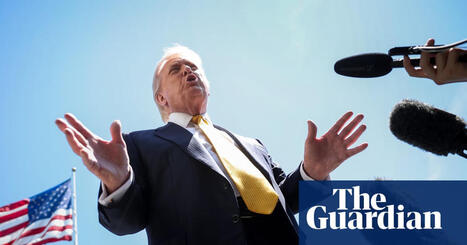
With US inflation at a three-year high, US president insisted he’s not focused on economic hardship sparked by the conflict
Graham Watson's insight:
This must be reassuring to all Americans - the President doesn't think about their financial situation. That said, I fear that the quote realistically should simply be the first three words.
Of course, this all comes against a background of rising prices and falling consumer confidence.
Scoop.it!

From
www
The effective closure of the Strait of Hormuz has severely disrupted global supplies of energy and petrochemicals.
Graham Watson's insight:
One of the more unusual unintended consequences of the ongoing Iran conflict has been the decision of Japanese snack giant, Calbee, to switch to black-and-white packaging for 14 of its products.
This is because disruption to the global oil market has adverse consequences for supplies of naptha, a by-product of oil refining used in inks and plastics. Since the start of the war, the price of naptha has almost doubled, and the region as a whole was dependent upon the Middle East for around 40% of its supplies of the product.
Scoop.it!

From
www
David Malpass also said that Beijing's claim to be a developing nation is no longer credible.
Graham Watson's insight:
I'm not sure what point David Malpass, former Head of the World Bank, is trying to achieve here, by suggesting that China should stop stockpiling food and fertiliser in response to the Iran conflict. Yes, there's a general point about resource allocation here, but the Chinese government is only responsible to its citizens, so isn't he also implying that other nations, such as the United States, should have similar-sized strategic reserves and that in doing do so, they've acted irresponsibly?
Scoop.it!

From
www
The first US presidential visit to China in almost 10 years will test a fragile tariff truce.
Graham Watson's insight:
Not much theory but a reminder of the current state of play regarding US-China relations - and the ongoing trade war. It's the sort of primer that the President ought to read - assuming that he can read - just to bring himself up to speed. I'm not sure that he'll be aware of the current level of tariffs on China and the to-ing and fro-ing that has occurred.
Scoop.it!

Norway’s energy minister says country has a ‘responsibility’ to address shortfalls caused by wars in Ukraine and Middle East
Graham Watson's insight:
The Norwegian government have announced that they are going to reopen three mothballed gas fields to make up for shortfalls from the Ukraine and Iran conflicts, and better guarantee Europe's energy security.
The trouble is that this conflicts with the advice of the country's environment agency, and again highlights a potential trade-off between economic growth and the environment.
Scoop.it!

From
www
The solid figures came despite rising gas prices and economic uncertainty sparked by the Iran war.
Graham Watson's insight:
Curiouser and curiouser, the latest US labour market data - or should it be labor market? - is stronger than expected with the US adding 115,000 jobs last month, despite the uncertainty caused by the Iran war.
Scoop.it!
CEO of Danish shipping group says increased costs due to higher fuel bills passed on to customers
Graham Watson's insight:
This is the sort of pronouncement from someone with a vested interest that should set alarm bells ringing among global policymakers: the reopening of the Strait of Hormuz will have "limited impact" on cargo flows because a more pressing problem is the rise in fuel costs.
It looks like global inflation might be baked in for longer than President Trump initially assumed. You might almost think that by now he's wondering whether the absence of a coherent plan just might have been a mistake.
Scoop.it!

From
www
Commentators say it will take years or even decades to repair the damage.
Graham Watson's insight:
Infrastructure damage, will have a significant effect on an economy because of its implications for net investment. you should be able to model this using AD-AS analysis, rather than by a PPC.
However, the rest of this is so blindingly obvious that it scarcely warrants saying unless, of course, you want to dig deeper and think about which regional economies are likely to be most affected and why. Think about dependence upon fossil fuel or a narrow range of exports, the implications for regional tourism and the impact of increased uncertainty on the region.
Scoop.it!
From
www
The global semiconductor industry powers everything from artificial intelligence to everyday electronics, and is on track to become a $1 trillion market. But its supply chain is under growing strain, as geopolitical tensions and rising demand force companies and governments to rethink how chips are made and where they come from.
Graham Watson's insight:
This brilliant Bloomberg clip looks at the global supply chain for semi-conductor, looking at why they are central to the global economy and our growth prospects and how growing demand for them, driven by AI, represents a threat to this.
Is this the greatest threat to continued prosperity.
Scoop.it!

Exclusive: Union body finds workers describing themselves as ‘gambling’ because wages felt like the outcome of chance rather than work
Graham Watson's insight:
The TUC are concerned that Uber drivers and others subject to so-called dynamic pay, determined by algorithms in much the same way as passenger fares are, might be being exploited by the companies that employ them.
Certainly, the extent to which there's a lack of clarity would be a concern, as not having certainty about one's earnings would create uncertainty and impose undue stress on drivers.
|





