Your new post is loading...

|
Scooped by
Institut de Chimie Physique
March 12, 3:22 AM
|
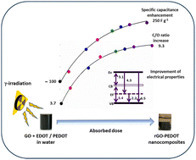
Souad Abou Zeid, Liran Hu, Samy Remita et leurs collaborateurs ont récemment publié un article dans Materials Chemistry Frontiers "Radiolytic synthesis of rGO–PEDOT nanohybrids with enhanced functional properties" Lien vers la publication Hybrid reduced graphene oxide–poly(3,4-ethylenedioxythiophene) (rGO–PEDOT) nanocomposites were synthesized via green gamma-radiolysis under ambient conditions, without dopants or catalysts. Three distinct synthesis routes—including one-step simultaneous radiation induced reduction of aqueous graphene oxide (GO) and EDOT monomers and two-step approaches involving the reduction of GO in the presence of pre-formed PEDOT oligomers or polymers—were explored to assess the impact of absorbed dose and polymerization stage on the physicochemical and functional properties of the resulting materials. Extensive characterization techniques revealed that gamma-irradiation promotes effective GO reduction and controlled PEDOT polymerization, leading to significant band gap narrowing, enhanced structural ordering, and substantial increase in the carbon-to-oxygen atomic ratio (from 3.7 to 9.3) indicative of effective reduction and improved conjugation within the nanocomposites. Visual evolution confirmed kinetic-controlled composite formation, yielding hydrogel-like aggregates. Morphological analyses showed well-dispersed PEDOT on rGO sheets, contributing to improved thermal stability, enhanced optoelectronic properties and superior electrochemical performance. The composites exhibited enhanced specific capacitances up to ∼248 F g−1, surpassing many reported PEDOT-based materials, attributed to the synergistic combination of rGO's conductive network and PEDOT's pseudocapacitance. This green, catalyst-free, and scalable methodology offers a promising platform for fabricating multifunctional hybrid materials with potential applications in flexible electronics, energy storage devices, and sensing technologies.
|
|
Scooped by
Institut de Chimie Physique
March 12, 3:15 AM
|
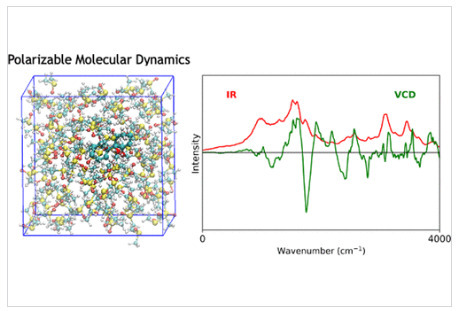
Emeline Boyer, Carine Clavaguéra et leurs collaborateurs viennent de publier un article dans The Journal of Physical Chemistry B "Modeling the Vibrational Circular Dichroism Spectroscopy of Phenylcyclohexanediol Solvated in Dimethyl Sulfoxide Using Polarizable Molecular Dynamics". Ce travail se place dans le cadre du projet ANR Dichrosol (ISMO, ICP, LIPhy, CPCV). Lien vers la publication Modeling vibrational circular dichroism (VCD) spectra in solution remains a complex task due to the intricate interactions involved. Recent advances in computational chemistry, particularly the implementation of polarizable force fields, have greatly improved the description of environmental effects in classical molecular dynamics simulations. In this study, we use the AMOEBA polarizable model to calculate VCD spectra through the expression of the electric and magnetic dipole moments developed recently [Bowles, J. . ChemPhysChem 2024, 25, e202300982.] in combination with the use of induced dipole models. This methodology enables the reliable treatment of flexible molecules and has been applied to the 1-Phenyl-1,2-Cyclohexanediol (PC) molecule solvated in dimethyl sulfoxide (DMSO). The computed infrared and VCD spectra provide detailed insights into molecular conformations and solute–solvent interactions. An in-depth investigation was conducted into the possible effects of system size, concentration, and spectral convergence. Comparison with experimental vibrational frequencies in deuterated solvent further supports the interpretation of spectral features, although residual differences in the spectral shifts and broadenings prove to be challenging for theory, especially in the case of VCD.
|
|
Scooped by
Institut de Chimie Physique
March 12, 3:41 AM
|
Roland Thissen et ses collaborateurs ont récemment publié un article dans Icarus "Ion induced formation of complex organic nitrogen molecules in solid-phase adenine" Lien vers la publication Complex organic molecules have been found in many space environments like meteorites and comets. There, they are subjected to various forms of radiation (photons, electrons, ions), opening the question of their behavior and chemical evolution, which may have played a crucial role in chemical processes of astrobiological interest. In this study, we investigate the irradiation of adenine (CHN) with oxygen and neon ions. The free parameters of the experiments include varying energies (30-70 keV), temperatures (150, 300 K), sample thicknesses (138-554 nm), and ion fluences (0.69-5 10 ions cm). In situ IR spectroscopy reveals the appearance of CN and N=C=N bands indicating the formation of new species. Ex situ ultra-high-resolution mass spectrometry shows the formation of new complex organic molecules that far exceed the molecular mass of adenine. These macromolecules show great chemical diversity and can be expressed as (HCN)R families, where z can reach 14 and R can be C, H, N, NH, CH or CN. In total, nearly 100 individual families have been identified, 28 of which can be found in every irradiated sample. Their aromaticity equivalent is higher than that in other N-rich samples such as Titan tholins and HCN-polymers, corresponding to polycyclic aromatic nitrogen-bearing hydrocarbons. The high amount of nitrogen in these molecules indicates a very efficient incorporation of nitrogen in the solid phase during the irradiation of adenine. The ease with which complex organic matter forms through irradiation highlights the relevance of these species in space environments.
|
|
Scooped by
Institut de Chimie Physique
March 12, 3:29 AM
|
Souad Abou Zeid, Liran Hu, Samy Remita et leurs collaborateurs ont publié un article dans Materials Chemistry Frontiers "Gamma-induced one-step synthesis of reduced graphene oxide–silver nanoparticles with enhanced properties". Lien vers la publication This study presents a novel gamma-induced one-pot synthesis of reduced graphene oxide–silver nanoparticle (rGO–Ag NPs) nanocomposites. Syntheses were conducted in a deoxygenated aqueous medium containing 0.2 g L−1 graphene oxide (GO), silver ions (10−3 or 10−2 mol L−1), and 0.2 mol L−1 isopropanol at ambient temperature and pressure. Multi-technique characterization confirmed the reduction of GO and silver ions, forming nanocomposites with significantly improved physicochemical and electrochemical properties compared to pristine GO, rGO alone, and rGO–Ag NPs prepared by other methods. UV-Vis absorption spectroscopy revealed tunable optical properties, while UPS measurements provided insights into the energy band structure, highlighting interactions between rGO and Ag NPs that enhance electronic properties. XPS and ATR-FTIR confirmed the successful reduction processes. SEM–EDX analyses demonstrated uniform silver nanoparticle distribution on rGO sheets. The C/O ratio significantly increased after irradiation, with values of 10.8 and 9.6 for composites synthesized with 10−3 and 10−2 mol L−1 in silver ions, respectively, compared to 11.2 for rGO alone. Raman spectroscopy showed a lower intensity ratio (ID/IG) between D and G bands (1.18 for nanocomposites vs. 1.40 for rGO), indicating fewer structural defects. Improved thermal stability was evidenced by reduced weight loss (10%) at 300–800 °C. Electrochemical studies revealed exceptional specific capacitance values of 218 F g−1 (10−3 mol L−1 Ag+ at 50 kGy) and 298 F g−1 (10−2 mol L−1 Ag+ at 70 kGy), surpassing the 125.4 F g−1 for rGO alone. These findings highlight the potential of gamma-induced synthesis for producing rGO–Ag NPs nanocomposites for high-performance supercapacitor applications.
|
|
Scooped by
Institut de Chimie Physique
March 12, 3:36 AM
|
Meriem Baziz, Liran Hu, Samy Remita et leurs collaborateurs ont publié un article dans Polmer Bulletin : "Elaboration of Novel Biocomposite Hydrogel Polymers made of Alginate and Sepiolite and endowed with Enhanced Properties" Lien vers la publication Nowadays growing attention is given to the design and development of novel interpenetrating polymer networks (IPN) from the combination of hydrogel polymers loaded with natural clay. In this work, we used the eco-friendly IPN strategy to develop novel hydrogel biocomposite beads, made of alginate (ALG), with improved clay dispersion, higher pH sensitivity, better stretchability and swellability, together with enhanced regenerability properties and delayed biodegradability. Fibrous clay, namely, sodium sepiolite (NaS), was loaded into alginate simple biocomposite network (SBN) beads, via manual co-grinding mixture/encapsulation method, at different sepiolite loads. Alginate double biocomposite network (DBN) beads were also prepared at different sepiolite loads, via the diffusion of acrylamide monomers (AAM) inside alginate single biocomposite network (SBN) beads, followed by external and in situ free radical polymerization of AAM into polyacrylamide (pAAM), using ammonium persulfate (APS) as polymerization initiator and N,N-methylenebisacrylamide (Bis) as covalent crosslinker agent. The as-elaborated SBN and DBN beads were then characterized by digital camera recording, XRD analysis, ATR-FTIR characterization and SEM observation. FTIR results showed that NaS and pAAM were successfully incorporated into DBN beads, while partially exfoliated morphology was obtained with XRD analysis, which revealed the enhancement of fibrous clay dispersion, even at relatively high sepiolite loads. Besides, SEM microscopy confirmed the porous spongious nature of DBN beads. The properties of the as-elaborated SBN and DBN beads were also evaluated by test touching, swelling rate measurements, adsorption/desorption experiments and biodegradability evaluation. DBN beads properties were always found enhanced in comparison with those of SBN beads. This suggests that the synergetic effect between IPN and biocomposite structure improves the stretchability of the DBN beads, their stability in water whatever the pH and their swelling behavior (up to 2000 g/g adsorbed water after 110 min, which was nevertheless found dependent on the pH and on sepiolite load). Moreover, DBN beads displayed enhanced adsorption/desorption properties toward methylene blue (MB) dye (no reduction in MB adsorption capacity after 5 cycles), very good regenerability (ethanol being used as effective eluting agent) and delayed biodegradability (complete degradation only after 8 days in the presence of sepiolite). In summary, this work showed an interesting and safe IPN/biocomposite approach to develop high-performance alginate biocomposite polymers as a promising system toward their use in eco-friendly processes.
|
|
Scooped by
Institut de Chimie Physique
March 12, 4:08 AM
|
ICP agenda - Journées scientifiques de l'ICP les 16 et 17 mars 2026
Les journées scientifiques de l'ICP auront lieu les 16 et 17 mars 2026 salle MAGAT bât 349. Les thèmes "Analyse chimique et biologique", "Nano-objets" et "Développements méthodologiques innovants" seront à l'honneur. Claire de March (ICSN) donnera une conférence intitulée "L’odorat sous le microscope : le rôle méconnu des récepteurs olfactifs". Différentes activités seront proposées : Lundi après la pause de midi : photo des groupes scientifiques et de l'institut ; Lundi 17h30 à 18h30 : visites de MUSIICS, CLIO et ELYSE ou escape game du FEBETRON ; Mardi après les présentations : TP "comptes HAL et fonctionnalités" ou escape game du FEBETRON
|
|
Scooped by
Institut de Chimie Physique
March 13, 2:44 PM
|
ICP agenda - FEF-AI4SD international conference in Paris from 29 June to 3 July 2026
The next FEF-AI4SD international conference will be held in Paris from 29 June to 3 July 2026.The event will bring together experts, policymakers, researchers, entrepreneurs, and innovators to discuss and develop AI-driven solutions for sustainable development, with particular focus on applications in healthcare, environmental sustainability, agriculture, arts, and scientific research. The Paris conference aims to further strengthen international partnerships and foster collaborative projects that harness artificial intelligence to address global challenges. Information et inscription
|
|
Scooped by
Institut de Chimie Physique
March 12, 4:00 AM
|
ICP actualité - Financements PEPR LUMA
Deux financements ont été obtenus dans le groupe CAPRI via le PEPR LUMA : 1) Bourses jeunes & mobilité sortante : Jean-Xavier Bardaud a obtenu une bourse de mobilité pour un séjour de 65 jours à Hambourg (Allemagne). 2) Bourses et plateforme : Le deuxième financement a été obtenu en collaboration avec Salomé Poyer à l'ICSN à Gif sur Yvette, Bourses Jeunes et plateformes (8.4 k€) pour installer un système de microfluidique en couplage à l'IRMPD pour la compréhension des cycles catalytiques avec notamment l’identification structurale d’intermédiaires.
|
|
Scooped by
Institut de Chimie Physique
March 12, 3:55 AM
|
ICP actualité - Inauguration de la plateforme MUSIICS
La plateforme MUSIICS a été inaugurée le 19 décembre 2025 en présence de Camille GALAP, Président de l'Université Paris-Saclay, Sandrine Sagan, Directrice de CNRS Chimie, Loïc Bertrand, représentant du DIM Patrimoines matériels, Alessandro Morbidelli du PEPR Origins, et Olivier Mousson de la Région Ile de France. L'inauguration a été complétée par des visites de plateformes et des présentations scientifiques illustrant le large éventail de possibilités de recherche offertes par MUSIICS.
|
|
Scooped by
Institut de Chimie Physique
March 12, 3:49 AM
|
ICP actualité - Soutenance HDR Fabien Cailliez
Fabien CAILLIEZ du groupe ThéoSim a soutenu avec succès lundi 12 janvier 2026, son habilitation à diriger les recherches. Titre de l'exposé : "Quelques apports de la simulation moléculaire pour l'étude de systèmes complexes : développements méthodologiques et applications". Félicitations Fabien !
|
|
Scooped by
Institut de Chimie Physique
March 13, 2:35 PM
|
ICP actualité - The FEF-AI4SD mini-conference at KNUST in Kumasi - 17–19 February 2026
A three-day mini-conference was held at Kwame Nkrumah University of Science and Technology (KNUST) in Kumasi, Ghana, as part of the France–Ghana bilateral programme under the Fonds d’Expertise et de Formation – Artificial Intelligence for Sustainable Development (FEF-AI4SD) initiative. The FEF-AI4SD mini-conference brought together researchers, academics, and institutional partners from both France and Ghana to explore how artificial intelligence (AI) can contribute to sustainable development across multiple sectors. The event served as a platform for knowledge exchange, interdisciplinary dialogue, and the strengthening of academic partnerships between the two countries. The three main partners of the FEF-AI4SD project are the Institut de Chimie Physique of the Université Paris Saclay, the Kwame Nkrumah University of Science and Technology, Kumasi, Ghana and the Ghana Atomic Energy Commission.
|
|
Scooped by
Institut de Chimie Physique
March 12, 4:23 AM
|
UPSaclay - Journée Initiatives Pédagogiques JIP 2026 le 1er Avril 2026
La Journée Initiatives Pédagogiques JIP 2026 organisée par l’Université Paris-Saclay se tiendra le mercredi 1er avril 2026 à l'ENS Paris-Saclay. Le thème de cette journée est "De la ressource à la capacité : favoriser le pouvoir d'apprendre et le pouvoir d'agir". Pour cette 11ème édition, Solveig Fernagu, Directrice de recherche en sciences de l’éducation et de la formation est l'experte invitée. Programme et inscription
|
|
Scooped by
Institut de Chimie Physique
March 12, 5:15 AM
|
UPSaclay - International School on Ultrafast X-ray and Attosecond Science, June 2026
Applications are now open for The International School on Ultrafast X-ray and Attosecond Science 2026 June 1-5, 2026 on the Paris-Saclay Campus. Detailed information on application requirements and deadlines is available on the event website
|
|
Scooped by
Institut de Chimie Physique
March 12, 5:58 AM
|
DCP(SCF/SFP) : Campagne des Prix 2026 de la Division Chimie Physique (SFC/SFP)
|
|
Scooped by
Institut de Chimie Physique
March 12, 7:17 AM
|
Evénement - Chimie au féminin (SCF) - 26 mars 2026 à Paris
La Société Chimique de France organise "Chimie au féminin" : une matinée consacrée à la mise en lumière de parcours féminins inspirants dans les sciences chimiques. Cet événement s'inscrit dans une dynamique plus large de valorisation des femmes chimistes, portée notamment par notre participation au projet des 72 femmes de sciences sur la Tour Eiffel, ainsi que par le numéro n°512 de l'Actualité Chimique qui consacré aux femmes chimistes. 📅 jeudi 26 mars 2026, de 9h à 13h 📍Amphithéâtre Charpak – Sorbonne Université – Campus Pierre et Marie Curie, Paris Pour plus d'informations et pour participer
|
|
Scooped by
Institut de Chimie Physique
March 12, 7:25 AM
|
Evénement - Journée de l'AFSEP "Analyse des fluides biologiques" le 1er avril 2026 à Paris
Le Club Île de France et le Groupe electrophorèse capillaire de L’ASSOCIATION FRANCOPHONE DES SCIENCES SÉPARATIVES (AFSEP) organisent une journée de conférences scientifiques le 01 avril 2026 à l'IPGG, 10 rue jean Calvin 75005 Paris avec comme thématique : Analyse des fluides biologiques. L’ AFSEP a pour buts : – de promouvoir les méthodes physico-chimiques de séparation dans tous les domaines d’activité – de contribuer à leur développement, de favoriser les échanges entre personnes des secteurs public et privé qui les conçoivent, les développent, les utilisent et construisent des instruments basés sur elles – de promouvoir la formation initiale et continue en sciences séparatives et l’insertion professionnelle des jeunes diplômés dans cette spécialité. Pour participer aux journées thématiques, il faut adhérer à l'association dont les tarifs sont les suivants : Plein tarif 170€ Post-doctorat ou Attaché Temporaire d’Enseignement et de Recherche 50€ Étudiant 15€
|
|
Scooped by
Institut de Chimie Physique
March 12, 6:39 AM
|
Le PEPR DIADEM co-organise le symposium « Data-based methods and AI for the development and processing of advanced materials » lors de la conférence E-MRS Spring 2026 à Strasbourg du 25 au 29 mai. Le symposium proposé sera consacré aux dernières avancées en matière d'accélération de la découverte de matériaux : 1. Modélisation et simulation multi-échelles 2. Plateformes d'accélération des matériaux 3. Application de l'IA à l'analyse du cycle de vie Informations
|
|
Scooped by
Institut de Chimie Physique
March 12, 7:00 AM
|
Evénement - Ecole thématique PhotoElectro 2 du 31 mai au 5 juin 2026 à Oléron
Le GDR PES organise une école d'été du dimanche 31 mai au vendredi 5 juin 2026 sur le site du village de vacances du CNRS d’Oléron. Cette école a pour objectif de donner aux personnels impliqués dans la recherche (doctorantes et doctorants, chercheuses et chercheurs, enseignants-chercheurs, ingénieurs) les fondamentaux et des outils plus avancés en photochimie et électrochimie, à la fois théoriques et expérimentaux, nécessaires pour apporter des réponses à ces enjeux. Renseignements et inscriptions.
|
|
Scooped by
Institut de Chimie Physique
March 12, 7:20 AM
|
Evénement - Journée thématique GdR ImaBio « Sondes pour l'imagerie super-résolution » le 8 juin 2026 à Paris
La journée thématique du GdR ImaBio consacrée aux « Sondes pour l'imagerie super-résolution » se tiendra le 8 juin 2026 à l'Université Sorbonne, à Paris. Vous trouverez le programme détaillé ainsi que l’ensemble des informations pratiques sur le site dédié ici
|
|
Scooped by
Institut de Chimie Physique
March 12, 6:49 AM
|
Evénement - 4èmes Rencontres Rayonnement Radiochimie (R3C) du 8 au 11 juin 2026 à Orsay
La sub-division "Chimie sous Rayonnement Radiochimie" (SCF/SFP) organise son congrès autour des thématiques de la radiochimie, de la chimie sous rayonnement. Les 4èmes Rencontres Rayonnement Radiochimie (R3C) auront lieu du 8 au 11 juin 2026 à l'Université Paris-Saclay (Orsay). Dates clés : - décembre 2025 : Ouverture des pré-inscriptions et dépôts d'abstracts - 6 mars 2026 : Clotûre des dépôts d'asbtracts - 31 mars : fin des tarifs "inscription anticipée" - avril 2026 : Notifications aux auteurs - 30 avril 2026 : Date limite d'inscription Informations et inscription
|
|
Scooped by
Institut de Chimie Physique
March 12, 7:06 AM
|
Evénement - Forum des Microscopies à Sondes Locales du 8 au 12 juin 2026 à Saint-Rémy-lès-Chevreuse
Le Forum des Microscopies à Sondes Locales se tiendra du lundi 8 au vendredi 12 juin 2026 au Domaine de Saint-Paul à Saint-Rémy-lès-Chevreuse. Informations et inscription - 6 mars 2026 : Date limite de soumission des résumés - 31 mars 2026 : Fin du tarif réduit - 30 avril 2026 : Clôture définitive des inscriptions
|
|
Scooped by
Institut de Chimie Physique
March 12, 7:12 AM
|
Evénement - Réunion Plénière du GDR EMIE du 8 au 12 Juin 2026 à Toulouse
La prochaine réunion plénière du GDR EMIE aura lieu du 8 au 12 Juin 2026 à Toulouse. Les inscriptions sont dès à présent ouvertes Informations et inscription DATES A RETENIR : Ouverture des inscriptions: 15 Février 2026 Date limite d'inscription : 8 Avril 2026 Date limite de soumission des contributions orales : 8 Avril 2026 Date limite de soumission des contributions par posters : 11 Mai 2026
|
|
Scooped by
Institut de Chimie Physique
March 12, 6:06 AM
|
Evénement - 2nd European Meeting on Infrared Nanospectro-Imaging on 17–19 June 2026 at Sapienza University of Rome
|
|
Scooped by
Institut de Chimie Physique
March 12, 6:24 AM
|
Evénement - Congrès SCF à Bordeaux du 22 au 24 juin 2026 à Bordeaux
La Société Chimique de France (SCF) a le plaisir d’annoncer la tenue de son prochain congrès national, SCF 2026, du 22 au 24 juin 2026 à Bordeaux. L’appel à résumés est désormais fermé. Notification des auteurs - 17 mars 2026. Date limite d'inscription Early bird - 17 avril 2026. Date limite d'inscription - 15 mai 2026. De plus, adossé au congrès SCF26, un week-end Grand Public sur le thème « Entre terre et Océan : la chimie qui façonne notre région » aura lieu les après-midis du samedi 20 et dimanche 21 juin 2026, dans les locaux de Cap Sciences à Bordeaux. Informations et inscription
|
|
Scooped by
Institut de Chimie Physique
March 12, 5:38 AM
|
Actions - Soutien aux chercheuses en post maternité
APPEL A CANDIDATURE destiné aux chercheuses en chimie ayant interrompu pendant plusieurs mois leurs activités de recherche en raison d’un congé pour maternité. La Fondation de la Maison de la Chimie offre de les aider lors de la reprise de travaux scientifiques et de mettre à leur disposition, pendant un an, les moyens de recruter un(e) chercheur(se) post-doctorant(e) choisi(e) par elles, dans les six mois qui suivent la fin du congé de maternité. Dossier de candidature à soumettre avant le 20 mars 2026. Informations pratiques
|