Your new post is loading...
Naive CD4+ T cells differentiate into specific effector subsets—Th1, Th2, Th17, and T follicular helper (Tfh)—that provide immunity against pathogen infection. The signaling pathways involved in generating these effector cells are partially known. However, the effects of mutations underlying human primary immunodeficiencies on these processes, and how they compromise specific immune responses, remain unresolved. By studying individuals with mutations in key signaling pathways, we identified nonredundant pathways regulating human CD4+ T cell differentiation in vitro. IL12Rβ1/TYK2 and IFN-γR/STAT1 function in a feed-forward loop to induce Th1 cells, whereas IL-21/IL-21R/STAT3 signaling is required for Th17, Tfh, and IL-10–secreting cells. IL12Rβ1/TYK2 and NEMO are also required for Th17 induction. Strikingly, gain-of-function STAT1 mutations recapitulated the impact of dominant-negative STAT3 mutations on Tfh and Th17 cells, revealing a putative inhibitory effect of hypermorphic STAT1 over STAT3. These findings provide mechanistic insight into the requirements for human T cell effector function, and explain clinical manifestations of these immunodeficient conditions. Furthermore, they identify molecules that could be targeted to modulate CD4+ T cell effector function in the settings of infection, vaccination, or immune dysregulation.
Via Denis Hudrisier

|
Scooped by
Gilbert C FAURE
February 26, 2018 2:40 PM
|
bioRxiv - the preprint server for biology, operated by Cold Spring Harbor Laboratory, a research and educational institution
|
|
Scooped by
Gilbert C FAURE
February 25, 2018 1:20 PM
|
As we grow older, our muscular function declines. A new study shows how an unexpectedly high number of mutations in the stem cells of muscles impair cell regeneration. This discovery may result in new medication to build stronger muscles even when in old age.
|
|
Scooped by
Gilbert C FAURE
February 25, 2018 4:08 AM
|

|
Suggested by
LIGHTING
February 22, 2018 2:49 AM
|
The assembly of the NLRP3 inflammasome can promote the release of IL-1β/IL-18 and
initiate pyroptosis. Accordingly, the dysregulation of NLRP3 inflammasome activation
is involved in a variety of human diseases, including gout, diabetes, and Alzheimer’s
disease. NLRP3 can sense a variety of structurally unrelated pathogen-associated molecular
patterns (PAMPs) or danger-associated molecular patterns (DAMPs) to trigger inflammation,
but the unifying mechanism of NLRP3 activation is still poorly understood.
|
|
Suggested by
LIGHTING
February 22, 2018 2:48 AM
|
Lymph nodes (LNs) are at the center of adaptive immune responses. Various exogenous substances are transported into LNs and a series of immune responses ensue after recognition by antigen specific lymphocytes. Although humanized mice have been used to reconstitute the human immune system, most lack LNs due to deficiency of the interleukin (IL)-2Rg gene (cytokine common g chain, gc). In this study, we established a transgenic strain, NOG-pRORgt-gc, in the NOD/shi-scid-IL-2Rgnull (NOG) background, in which the gc gene was expressed in a lymph-tissue inducer (LTi) lineage by the endogenous promoter of RORgt. In this strain, LN organogenesis was normalized and the number of human T cells substantially increased in the periphery after reconstitution of the human immune system by human hematopoietic stem cell transplantation. The distribution of human T cells differed between NOG-pRORgt-gc Tg and NOG-non Tg mice. About 40% of human T cells resided in LNs, primarily the mesenteric LNs. The LN-complemented humanized mice exhibited antigen-specific IgG responses together and an increased number of IL-21+–producing CD4+ T cells in LNs. This novel mouse strain will facilitate recapitulation of human immune responses.
|
|
Scooped by
Gilbert C FAURE
February 19, 2018 11:11 AM
|
CD8+ T cells responding to infection differentiate into a heterogeneous population composed of progeny that are short-lived and participate in the immediate, acute response and those that provide long-lasting host protection. Although it is appreciated that distinct functional and phenotypic CD8+ T cell subsets persist, it is unclear whether there is plasticity among subsets and what mechanisms maintain subset-specific differences. Here, we show that continued Id2 regulation of E-protein activity is required to maintain the KLRG1hi CD8+ T cell population after lymphocytic choriomeningitis virus infection. Induced deletion of Id2 phenotypically and transcriptionally transformed the KLRG1hi “terminal” effector/effector-memory CD8+ T cell population into a KLRG1lo memory-like population, promoting a gene-expression program that resembled that of central memory T cells. Our results question the idea that KLRG1hi CD8+ T cells are necessarily terminally programmed and suggest that sustained regulation is required to maintain distinct CD8+ T cell states.
|
|
Suggested by
LIGHTING
February 16, 2018 1:05 PM
|
In this issue of JEM, Boucher et al. (<https://doi.org/10.1084/jem.20172222>;) report isolation of active caspase-1 from macrophages after inflammasome activation. Surprisingly, they find that caspase-1 is quickly inactivated upon autoproteolytic processing.
Natural killer (NK) cells are a subset of innate lymphoid cells that target virally infected and malignant cells. An education process ensures that activating receptors promote NK cell activation in response to infected or abnormal cells and that inhibitory receptors prevent inappropriate NK cell activation by healthy cells. Cells that lack inhibitory receptors are hyporesponsive. Staaf et al . found that the activating receptor NKp46 and the inhibitory receptor Ly49A exhibited dynamic movements in the plasma membrane that differed between educated and hyporesponsive NK cells. Although both receptors were generally restricted to membrane microdomains, NKp46 molecules spent less time in an individual microdomain and diffused faster on educated cells compared to hyporesponsive cells. Conversely, Ly49A molecules were overall more constrained and diffused more slowly on educated cells. Interfering with receptor dynamics reduced signaling by NKp46, indicating that the dynamic movements of these receptors are likely important determinants of NK cell responsiveness.
Via Krishan Maggon
Editorial
Tumours from multiple cancer types can be infiltrated by CD8+ T cells (TILs) (Spranger et al, 2016). TILs are thought to be suppressed by multiple immune inhibitory molecules in the tumour microenvironment, and this suppression has been associated with tumour progression (Gajewski et al, 2013). Therefore, despite tumour infiltration, almost all tumours containing TILs will progress if not treated.
Via Krishan Maggon
|
|
Scooped by
Gilbert C FAURE
February 15, 2018 2:10 AM
|
Seasonal influenza vaccines have been recommended for decades, but studies focused on antigen-specific lymphocytes in humans are sparse. Koutsakos et al. examined longitudinal samples of influenza-vaccinated individuals to determine what responses generate protective immunity. Vaccination could induce circulating T follicular helper memory cells, antibody-secreting cells, and memory B cells, but did not seem to affect other types of lymphocytes. Existing anti-influenza antibodies at the time of vaccination dampened these responses. They probed different types of human tissues to hunt for influenza memory B cells, thereby showing that the memory response exists outside the circulation. Better targeting these cells could improve influenza vaccine efficacy.

|
Suggested by
Société Francaise d'Immunologie
February 14, 2018 1:33 PM
|
For understanding the rules and laws of adaptive immunity, high‐throughput profiling of T‐cell receptor (TCR) repertoires becomes a powerful tool. The structure of TCR repertoires is instructive eve
|
|
Scooped by
Gilbert C FAURE
February 13, 2018 2:08 PM
|
|
|
|
Suggested by
LIGHTING
February 27, 2018 1:21 PM
|
IL-7 is essential for the development and homeostasis of T and B lymphocytes and is critical for neonatal lymph node organogenesis because Il7−/− mice lack normal lymph nodes. Whether IL-7 is a continued requirement for normal lymph node structure and function is unknown. To address this, we ablated IL-7 function in normal adult hosts. Either inducible Il7 gene deletion or IL-7R blockade in adults resulted in a rapid loss of lymph node cellularity and a corresponding defect in lymphocyte entry into lymph nodes. Although stromal and dendritic cell components of lymph nodes were present in normal numbers and representation, innate lymphoid cell (ILC) subpopulations were substantially decreased after IL-7 ablation. Testing lymphocyte homing in bone marrow chimeras reconstituted with Rorc −/− bone marrow confirmed that ILC3s in lymph nodes are required for normal lymphocyte homing. Collectively, our data suggest that maintenance of intact lymph nodes relies on IL-7–dependent maintenance of ILC3 cells.
|
|
Scooped by
Gilbert C FAURE
February 25, 2018 1:26 PM
|
Besides their prominent role in the elimination of infected or malignantly transformed cells, natural killer (NK) cells serve as modulators of adaptive immune responses. Enhancing bidirectional crosstalk between NK cells and dendritic cells (DC) is considered a promising tool to potentiate cancer vaccines. We investigated to what extent direct sensing of viral and bacterial motifs by NK cells contributes to the response of inflammatory DC against the same pathogenic stimulus. We demonstrated that sensing of bacterial and viral PAMPs by NK cells contributes to DC cytokine production via NK cell-derived soluble factors. This enhancement of DC cytokine production was dependent on the pattern recognition receptor (PRR) agonist but also on the cytokine environment in which NK cells recognized the pathogen, indicating the importance of accessory cell activation for this mechanism. We showed in blocking experiments that NK cell-mediated amplification of DC cytokine secretion is dependent on NK cell-derived IFN-γ irrespective of the PRR that is sensed by the NK cell. These findings illustrate the importance of bidirectional interaction between different PRR-expressing immune cells, which can have implications on the selection of adjuvants for vaccination strategies.
|
|
Scooped by
Gilbert C FAURE
February 25, 2018 1:17 PM
|
Citation: Hoving JC (2018) Pneumocystis and interactions with host immune receptors. PLoS Pathog 14(2): e1006807. https://doi.org/10.1371/journal.ppat.1006807 Editor: Donald C. Sheppard, McGill University, CANADA Published: February 22, 2018 Copyright: © 2018 Jennifer Claire Hoving.
|
|
Scooped by
Gilbert C FAURE
February 22, 2018 10:32 AM
|
Industry-leading Tools for Analysis of Autophagy - Autophagy (literally “self-eating”) is a lysosome-mediated intracellular bulk degradation pathway employed by eukaryotic cells when subjected to certain hostile conditions (such as nutrient deprivation) that triggers digestion and recycling of cellular contents.
|
|
Suggested by
LIGHTING
February 22, 2018 2:49 AM
|
It has long been known that cancer arises when genes mutate and start producing abnormal proteins, or no protein at all. However, our latest research, published in PNAS, suggests that there is another, equally important mechanis
|
|
Scooped by
Gilbert C FAURE
February 19, 2018 1:15 PM
|
In the classical complement pathway, the C1 initiation complex binds to danger patterns on the surface of microbes or damaged host cells and triggers an immune response. Immunoglobulin G (IgG) antibodies form hexamers on cell surfaces that have high avidity for the C1 complex. Ugurlar et al. used cryo–electron microscopy to show how a hexamer of C1 complexes interacts with the IgG hexamer. Structure-guided mutagenesis revealed how C1 is activated to trigger an immune response.
Science , this issue p. [794][1]
[1]: /lookup/volpage/359/794?iss=6377
|
|
Scooped by
Gilbert C FAURE
February 19, 2018 9:14 AM
|
In this issue of JEM, Álvarez-Prado et al. (https://doi.org/10.1084/jem.20171738) designed a DNA capture library allowing them to identify 275 genes targeted by AID in mouse germinal center B cells. Using the molecular features of these genes to feed a machine-learning algorithm, they determined that high-density RNA PolII and Spt5 binding—found in 2.3% of the genes—are the best predictors of AID specificity.
|
|
Scooped by
Gilbert C FAURE
February 16, 2018 4:01 AM
|
Immune cells help to marshal the body’s soldiers against tumours.
Via Krishan Maggon
|
|
Scooped by
Gilbert C FAURE
February 15, 2018 2:44 AM
|
In this discovery talk, Dr. Ruslan Medzhitov provides a historical perspective that frames his involvement in the discovery of Toll-Like Receptors.
|
|
Suggested by
LIGHTING
February 14, 2018 1:37 PM
|
![Figure][1]
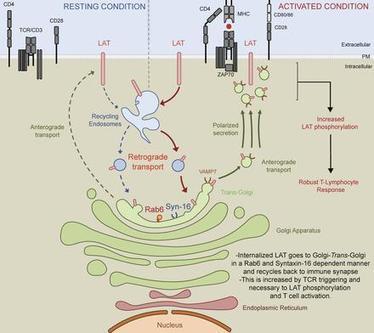
The adapter molecule linker for activation of T cells (LAT) orchestrates the formation of signalosomes upon T cell receptor (TCR) stimulation. LAT is present in different intracellular pools and is dynamically recruited to the immune synapse upon stimulation. However, the intracellular traffic of LAT and its function in T lymphocyte activation are ill defined. We show herein that LAT, once internalized, transits through the Golgi–trans-Golgi network (TGN), where it is repolarized to the immune synapse. This retrograde transport of LAT depends on the small GTPase Rab6 and the target soluble N -ethylmaleimide-sensitive factor attachment protein receptor (t-SNARE) Syntaxin-16, two regulators of the endosome-to-Golgi/TGN retrograde transport. We also show in vitro in Syntaxin-16– or Rab6-silenced human cells and in vivo in CD4+ T lymphocytes of the Rab6 knockout mouse that this retrograde traffic controls TCR stimulation. These results establish that the retrograde traffic of LAT from the plasma membrane to the Golgi-TGN controls the polarized delivery of LAT at the immune synapse and T lymphocyte activation.
[1]: pending:yes
|
|
Scooped by
Gilbert C FAURE
February 13, 2018 2:09 PM
|
|