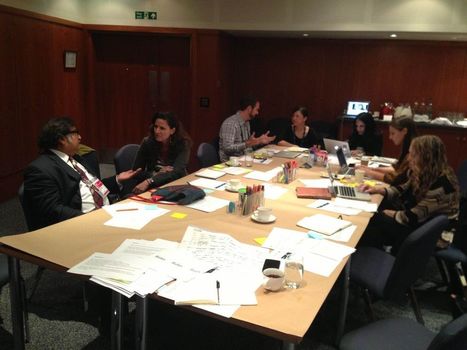
A theme that kept emerging among the talk about new technology, cutting edge innovation and emerging behaviour was understanding, respect and empathy.
And I think empathy is being undervalued in business terms. If you’ve been reading Wieden+Kennedy, Portland creative director Dan Hon’s daily newsletter you’ll know empathy is something of a crusade of his. (If you’re not signed up, you should be. It’s excellent.)
Empathy, he argues, should be something embedded into companies from the ground up, and should be part of every interaction between a company and its customers.
Have you ever witnessed a company that has managed to embody an attitude so completely that it appears to carry effortlessly throughout all aspects of its business? Empathy is one of those attributes that has a lead role at both SEER Interactive and Moz.
Their cultures boast more than just top-down affirmations of empathy; these teams rely heavily on trust and feedback to make it work. What follows is a look at how empathy flows freely through their culture, their clients, and their community.
This digital bonanza is freaking us out. What kind of humans are we becoming when our faces are smashed into screens? Will technology make us a more or less empathetic society?
Can computers feel love? The time for hand wringing or opting out is over. The sooner we realize that we can’t stop this speeding bus -all we can do is try to drive it where it needs to go – the better off we will be.
Recently I gave a seminar for the top 100 or so leaders of a global manufacturing company, at the invitation of the head of HR. It was their annual leadership development meeting...
I’ve never seen a list of a great leader’s abilities that did not include impactful communication. And that requires empathy – the third domain of emotional intelligence. There are two specific kinds of empathy; one is cognitive empathy, understanding how others think about the world. Once you know their mental models you can put what you have to say in terms that will make most sense to them.
At Start Empathy we believe everyone can master empathy. It can guide our daily thoughts, words and actions. It can alter our character. And it can also inspire and improve our work.
Last year, 60 Minutes did an interview with David Kelley, CEO and founder of IDEO, the world’s leading innovation and design firm. David Kelley took host Charlie Rose on a tour through his design thinking while entertaining stories of the Apple products on which he and colleague Steve Jobs collaborated.
What sets Kelley’s business apart and what allows IDEO to flourish is the practice of seeing design through an empathetic lens, making products intuitive and accommodating for consumers.
Empathetic people are superb at recognizing and meeting the needs of clients, customers, or subordinates.
They seem approachable, wanting to hear what people have to say. They listen carefully, picking up on what people are truly concerned about, and respond on the mark. Most of the mistakes that have been made in the world have been through a lack of empathy. If one can identify with someone else and empathize with them, the biggest mistake of repeating mistakes can be avoided. To learn from somebody you need empathy. Empathy in the broadest sense refers to the reactions of one individual to the observed experiences of another.
Tom Monahan serves as the Chief Executive Officer and Chairman of CEB.
What would you say ‘empathy’ really means for you – personally and professionally – in the course of your life?
Two things in particular: one, we’re a company that has invented a new set of business models over the past 25-30 years. Most of them are built upon working backward from our perception of a need rather than looking forward from something that we knew how to do.
So the first step is to empathize with the needs of the market, and usually if we’re doing our job right, empathize with the higher order needs of the market — asking ourselves not what product or service someone wants, but rather what ambitions do they have, and what do they want to get done?
The 29 Quality Assurance Mistakes to Avoide-book and self-assessment includes the question “Do you include the customers’ rating of agents’ empathy to their situation as part of your current quality process?” The e-book contains reflective questions designed to uncover opportunities with Quality Assurance programs within contact centers. Identifying opportunities or detecting weaknesses is a critical step on the journey to elevate your contact center to one of undeniable importance to the organization. Let’s not get too focused on finding answers in a benchmarking report.
Technology is definitely key in CfA’s work helping government become more engaging, but there’s also a secret sauce that makes it work – empathy.
These efforts to understand user needs and observe users were basically efforts to empathize with the users, or in other words to “gain empathy to who they are and what is important for them.” As Jacob Solomonputs it: “An empathetic service would ground itself in the concrete needs of concrete people. It’s not about innovation, big data, government-as-a-platform, transparency, crowd-funding, open data, or civic tech. It’s about people.”
=======================
What the team learned in this process was that the ideal experience for would be “direct, empathetic and would meet clients where they are.”
Become the other person and go from there is the best piece of coaching advice I ever received, and it applies equally to influence, negotiation... BY GINNY WHITELAW
deep empathy conveys its insights in a flash, and our ability to empathize deepens with practice, as we learn to quiet our own inner state...
=====================
Extending this empathetic approach, person by person, group by group, through your world, you can see where your actions start to be informed by an ever larger context.
Focuses on the value and impact of empathy and related skills, particularly in health care settings. Topics will include clinician-patient communication, patient-centered care, patient activation, health behavior change and clincian-patient relationships.
"So you think you can actually teach empathy to doctors?"
This is a question I have been asked scores of times during my 30+ years as a a medical educator. And my answer is:
Mindful Awareness practices and trainings have spread widely with great implications for effective leadership. So many leadership models talk about "what to do" and "how to achieve" goals or "how to influence" people to follow them.
Empathy is one of the most important parts of understanding your audience. We can't expect to resonate with customers unless we understand their behaviors
How are you connecting with your audience?
I’ll admit that empathy is not generally associated with business. As time goes on, however, the importance of connecting with your customers on a deeper emotional level is becoming more and more evident.
Empathy is one of the most important parts of a larger conversation about the emotions of buyers and the need for brands to be human.
After all, we cannot expect to resonate with our audience unless we first understand who they are and what’s important to them.
Watch the full Keiser Report: Saturday In this episode of the Keiser Report, Max Keiser and Stacy Herbert discuss the warning from legendary stock market spe...
Understanding how people experience the world is key to developing new services.
The Empathy map, based on a template developed by Osterwalder and Pigneur, in Business Model Generation, 2010, enables people commissioning and designing services to walk in the shoes of potential service users, and consider those excluded from current service provision.
You can down load an Empathy Map A2 - it can also be printed at A3 size.
Tools needed – Maps and ‘sharpie’ type pens. Can be done individually or in groups of up to six people. Time – between 30-60minutes.
Empathy maps are a powerful tool for understanding your users and learning how they experience your product, service or a problem you're looking to solve.
Since we published last month’s article on Personas we’ve had a few questions asking what the difference is between personas and empathy mapping.
CCAD President Denny Griffith has a knack for accomplishing an aggressive agenda while convincing those who make the changes it was their own idea all along.
Griffith told me his management credo boils down to building an open culture, listening and celebrating. Collected from interviews with Griffith and others, here are elements of his leadership style:
Connect: “I manage from a position of empathy,” Griffith said. “It’s a lot more like being a mayor than a CEO. You can’t always give the constituents everything you want, but you can be as transparent as possible.”
Empathy among corporate managers is in short supply, according to a survey of more than 600 employees by talent mobility consulting firm Lee Hecht Harrison.
The survey found that 58 percent of managers fail to show the right level of understanding toward their employees.
Lee Hecht Harrison surveyed 626 workers throughout the U.S. via an online poll asking,
EMPATHIC ENGAGEMENT: True engagement leads to lasting connection. But it cannot be attained with reports and quant data. We help companies to gain real insight on their target consumer and open the door to true engagement. Then, our Studio team, an in-house team of designers and storytellers, brings it all to life.
We always try to make new products and services with users, not just for them. Again and again, we have seen that this is the best way to ground your own ideas in their needs and behaviours.
Here are a number of tools and techniques we use to do this:
1 - Workshops...
2 - In depth user interviews...
3 - Mapping existing user journeys...
4 - Observations...
5 - Low fidelity sketches...
6 - Live prototypes: ‘sketching with software'....
For some employees, a typical day at the office might begin with a barrage of work-related questions from impatient colleagues who have been awaiting their arrival.
For others, it might start off with a series of cheerful greetings from co-workers, questions about how their family members are doing or perhaps an offer to grab a quick cup of coffee before the daily work deluge begins.
According to Wharton management professor Sigal Barsade, there is reason to believe that the latter scenario — which illustrates what she refers to as “companionate love” in the workplace — is not only more appealing, but also is vital to employee morale, teamwork and customer satisfaction.
=======================
“companionate love” in the workplace — is not only more appealing, but also is vital to employee morale, teamwork and customer satisfaction.
To get content containing either thought or leadership enter:
To get content containing both thought and leadership enter:
To get content containing the expression thought leadership enter:
You can enter several keywords and you can refine them whenever you want. Our suggestion engine uses more signals but entering a few keywords here will rapidly give you great content to curate.


 Your new post is loading...