Part 1 – The importance of incorporating empathy into one’s management practices.
The underlying assumption of empathy-based management is that connection to other people—rather than correction—is required for professional growth and long-term motivation to occur. Therefore, during every interaction with each employee throughout each day, build on your relationships and provide the emotional support required for each person to be engaged and succeed at their jobs.
The goal is to have each employee:
1. Be productive and enjoy their accomplishments;
2. Grow both personally and professionally;
3. Be successful on the job and in life;
4. Be ethical; and
5. Become motivated to achieve self-actualization or reach one’s potential in life.
Having employees grow, mature, and reach their potential is in the best interest of the company. Competent, capable, ethical, and committed employees will make any organization successful. And these goals become possible through incorporating empathy into your organization’s management practices.
========================
And these goals become possible through
incorporating empathy into your
organization’s management practices
=============
George Langelett is a professor of management and economics at South Dakota State University in Brookings,
Wharton’s Sigal Barsade says demonstrating “companionate love” in the workplace is vital to employee morale, teamwork and customer satisfaction.
Already, though, the research seems to be pointing to a strong message for managers in all industries, Barsade says: tenderness, compassion, affection and caring matter at work. “Management can do something about this,” she says. “They should be thinking about the emotional culture. It starts with how they are treating their own employees when they see them.
==========================
tenderness, compassion, affection and caring matter at work.
========
Are they showing these kinds of emotions? And it informs what kind of policies they put into place. This is something that can definitely be very purposeful — not just something that rises organically.
The rush to secularize and commodify mindfulness into a marketable technique may be leading to an unfortunate denaturing of this ancient practice, which was intended for far more than helping executives become better focused and more productive.
Suddenly mindfulness meditation has become mainstream, making its way into schools, corporations, prisons, and government agencies including the U.S. military. Millions of people are receiving tangible benefits from their mindfulness practice: less stress, better concentration, perhaps a little more empathy. Needless to say, this is an important development to be welcomed -- but it has a shadow.
If you're using only mindfulness for the sake of attaining corporate profits or higher salaries, it shows how little you actually understand mindfulness and how very unmindful you are.
It's about being aware of yourself in the grandest scheme of things, beyond money and beyond your own individual self.
It's that simple.
And yet so many powerful people don't, won't and/or can't get these basic concepts down.
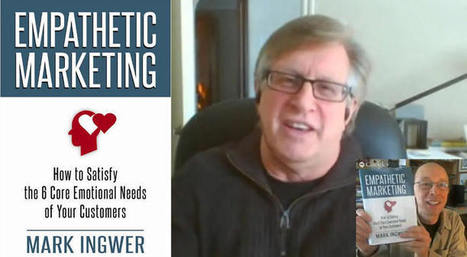
Mark Ingwer is a business psychologist and the founding partner of Insight Consulting Group, a global marketing and strategy consultancy specializing in consumer and business insights. He has over 25 years experience applying his unique blend of psychology, marketing, and business acumen to helping companies optimize their brand and marketing strategy based on an in-depth understanding of their customers.
========================
The business community... often it fails to practice empathy in
its marketing and thus falls short
of truly connecting with customers.
=========
Mark is author of Empathetic Marketing: How to Satisfy the 6 Core Emotional Needs of Your Customers. He writes, "A business that invests in empathy devotes itself to understanding the emotional needs and motivations of its customers, and aligns itself to meet them. Companies have increasingly embraced the role of emotion in selling products and services, but often merely pay lip service to its importance without understanding how to harness it."
The Institute of Design (D.School) at Stanford has become one of the most talked about institutions recently because of the methodology they are spreading around the world to improve our lives through a collaborative approach that inspires human centered innovations. Last week I had the absolute privilege of being a part of the Design Thinking Hawaii boot camp which was focused on improving the education system in Hawai’i.
==================
What is empathy?
To feel what someone else feels.
To walk in another’s shoes.
=============
The 3 ways to empathize
Immerse: Become the user and actually live their experiences. A great example of this comes from Tim Brown’s book “Change by Design” when IDEO was designing for Robert Porter who is the CEO of the SSM DeParul Health Center in Saint Louis. Their challenge was to design a better experience for ER patients. Instead of analyzing and brainstorming new ideas automatically, they actually had one of their designers become a patient in the emergency room and see what the patient experience was like.
Useful, especially when it comes to working practically with people, rather than over them as "superiors." Human beings (especially Americans) don't always respond well to power, especially when it's illegitimate and not directed towards their well being, health and quality of life.
I'm sure this is culture sensitive. But for the US, this could work.
A look at why not to be like the Wolf of Wall Street, why you should make your workplace more like a video game and more advice for business owners.
Lack of empathy has recently been on cringe-worthy display among young tech CEOs and programmers," says Michael Coren, founder of digital-publication platform Publet.
"It's a deadly flaw for founders who want to build products that people actually buy."
Empathy: Connecting with a multitude of diverse, demanding, and sometimes unpredictable constituencies is an inescapable reality of today's world. This point was driven home time and again at Davos 2014. In a networked environment relationship management can hold the key to unlocking value in an infinite variety of ways -- with customers, colleagues, subordinates, strategic partners, unions, activist investors and corporate board members.
Possessing the ability to really put yourself in the shoes of another individual and understand where they're coming from, how they're feeling, what they're thinking, what their underlying agenda is and motivations are all key leadership requirements. There are two sides to empathy. One is cognitive empathy, the ability to understand what another individual is thinking. Second is emotional empathy, the ability to understand how another person is feeling.
========================
Empathy shouldn't be confused with
its' first cousin, compassion.
A compassionate leader 'can
help set the right cultural tone
in an organization.
==============
Empathy shouldn't be confused with its first cousin, compassion. A compassionate leader can help set the right cultural tone in an organization. But too much compassion can actually be counterproductive for a leader, particularly when tough interpersonal decisions need to made that will inevitably cause collateral damage.
It’s time to identify key customer experience trends for next year. We did a pretty good job of identifying 13 CX trends for 2013 and many of those trends will continue on into 2014, so they remain on this year’s list.
We expect CX to gain even more momentum next year as 2014 brings us deeper into what Temkin Group has labeled the Era of CX Professionalism.
Based on what we see emerging in CX, we believe that 2014 will be The Year of Empathy, which is the 14th trend. Here are 14 CX trends to watch for in 2014, followed by some advice for each item:
Martin Luther King Teaches CX + Empathy
Join Me in Making 2014 the Year of Empathy
14 Customer Experience Trends for 2014 (The Year of Empathy)
A&W Canada Sparks Customer Empathy With Real-Time Feedback
In the end, cultivating empathy within yourself and among a team takes time, focus, and effort and often can’t be quantified.
In an environment full of deadlines, it can be easy to be lazy and not think about the customers or teammates carrying you forward. We hope that sharing our steps to improve empathy can inspire you to improve your business and make choices to spend the resources to cultivate empathy. Let me know if you agree/disagree in the comment
I meet a fair number of business leaders who say they are empathy-challenged.
Empathy is the ability to recognize and identify the emotions being experienced by another person. It’s one of the five components of Emotional Intelligence. Because it enables others to feel like you connect with them, it is an important skill set for leaders who want to create an inclusive work environment.
Showing peers and those who report to you that you get them, you understand their experience, even if what they’re going through is something you’ve never experienced, builds positive mutually beneficial connections
Emotional Intelligence is a key skill for leadership and the reason is pretty clear. Understanding and responding to followers emotions is critical to engaging them. Understanding the experiences of followers enables leaders to identify the strategies, messages and actions that will appeal to , motivate, and inspire followers.
Study after study has shown that listening is critical to leadership effectiveness. So why are so few leaders good at it?
Too often, leaders take command of conversations and spend too much time worrying about what they’ll say next in defense or rebuttal. Leaders can also react too quickly, get distracted during a conversation or fail to make the time to listen to others. Finally, leaders can be ineffective at listening if they’re overly competitive, multitask too much or if they let their egos get out of hand.
Research shows that listeners listen best with
they exhibit genuine empathy for
other people’s perspectives.
Henry Ford once said that if there is any
great secret for achieving success, it lies in
the ability to put oneself in another
person’s place and see things
from his point of view -
as well as from one’s own.
Christine M. Riordan is the provost and a professor of management at the University of Kentucky.
Every decision we make affects the way real people experience our products. We’ve all heard the rallying cry for user-centered design, but even those of us who ascribe to that ideal often fall back on our own biases and instincts when it comes to making decisions about how people experience our content and our services.
Sadly, this often means we make decisions we think will be good for our "users"—that anonymous, faceless crowd—rather than actually trying to understand the perspectives, surroundings, capabilities, and disadvantages of the actual people who we are here to serve.
In this session, Aaron Gustafson explores why empathy is a good thing, how empathy empowers creativity, and how we, as a community, can inject more empathy into our work.
============================
Aaron Gustafson explores why empathy is a good thing, how empathy empowers creativity ===========
Research says you can be compassionate at work and boost the bottom line
Being "pro-social"— helping out an overloaded co-worker, say, or forgiving another for mistakes—stimulates the reward centers in the brain. That was one takeaway from a CCARE Compassion and Business Conference held last spring. And when we give to others, it feels good, a study in the physiological effects of altruism found; the same brain areas light up when we receive money (or food, or sex).
This week, I’m headed to the Future of Storytelling summit, an unusual cross-disciplinary unconference exploring exactly what it says on the tin. Among the presenters is neuroeconomics pioneer Paul Zak, director of the Center for Neuroeconomic Studies and author of The Moral Molecule: The Source of Love and Prosperity.
======================
this short film on empathy,
neurochemistry, and the dramatic arc
=============
In this short film on empathy, neurochemistry, and the dramatic arc, directed and edited by my friend Kirby Ferguson and animated by Henrique Barone, Zak takes us inside his lab, where he studies how people respond to stories.
Below are three ideas Cx professionals can adopt to try to gain executive attention on, and empathy for, the customer experience at your company.
Listen In
One simple approach is to host an event where your executives spend time listening to customer calls or visiting your locations to observe customers interacting with staff.
The designer uses a simulation device to gain first-hand insights into particular impairments or disabilities, for example clouded glasses to simulate sight loss or weighted gloves to reduce dexterity.
=========================== The experience of using such a device can prompt an empathic understanding of users with disabilities
or special conditions, ===============
The experience of using such a device can prompt an empathic understanding of users with disabilities or special conditions, and a greater appreciation of how inappropriate design can disable.
Clients as well as designers can benefit from such tools. However this method complements but does not replace speaking to real people with disabilities. Also described as role playing.
Learn how to capture users' feedback to build a better experience using this free UX tool from Tadpull.
Our take on the Empathy Map came about as a way to distill and organize qualitative data. We start every project by interviewing and observing current and potential customers to better understand their pain points and aspirations.
========================
Our take on the Empathy Map came
about as a way to distill and organize
qualitative data.
==============
Then, as we sift through pages of raw notes, sketches, audio/video files and photos, we use the empathy map to glean the juicy parts and make it visual to help drive the User Persona and eventually the Creative Brief.
A study from Rice University finds that engineering students are less concerned about the welfare of others after graduating college than they were when they entered.
The author, Erin Cech, an assistant professor of sociology at the Houston school with a degree in electrical engineering, surveyed 300 students from four U.S. engineering schools before they started their degree program and again after they graduated. Both times they were asked to rate the importance of matters that show compassion, such as wanting to improve society, being active in their communities, and helping those in need.
1. Remember that kids are modeling you. They learn by watching what you do. And so … make sure to be nice to the “invisible” people. The waitress, the bus driver, the store clerk. If you say ‘Thank you” and “Please” to them, so will your children.
This one-day workshop will be held as part of the CHI 2014 annual ACM SIGCHI Conference on Human Factors in Computing Science, held in Toronto, Canada between the 26th April and 1st May 2014.
The role of empathy has come to prominence in HCI as the community deals with issues in medical, health and emotionally charged contexts. In such settings empathizing with others is crucial in understanding the experience of living with specific conditions or to be sensitive to the emotions of potentially vulnerable participants. HCI also becomes implicated in designing new tools and technologies that support empathic relations. This workshop aims to develop a richer conceptual and practical understanding of empathic engagement and design methods in this context to support and shape an agenda for future research.
================
Enabling Empathy in Health and Care:
Design Methods and Challenges
============
W31: Enabling Empathy in Health and Care: Design Methods and Challenges
Anja Thieme - Newcastle University, United Kingdom
John Vines - Newcastle University, United Kingdom
Jayne Wallace - University of Dundee, United Kingdom
Rachel Clarke - Newcastle University, United Kingdom
Petr Slovák - Vienna University of Technology, Austria
John McCarthy - University College Cork, Ireland
Michael Massimi - Microsoft Research, United Kingdom
Andrea Grimes Parker - Northeastern University, USA
By combining our unique skills and expertise with an empathetic approach to our member and community interactions, we can better anticipate their needs and the needs of those they serve, work with our members as a true partner, and ultimately create transformational, positive change in healthcare, education, and our communities.
To get content containing either thought or leadership enter:
To get content containing both thought and leadership enter:
To get content containing the expression thought leadership enter:
You can enter several keywords and you can refine them whenever you want. Our suggestion engine uses more signals but entering a few keywords here will rapidly give you great content to curate.


 Your new post is loading...