The area where we have the most work cut out for us is embracing the role of empathy in leadership. Why is empathy important to leadership? Because it is the primary skill behind inspiring and motivating others. We need to put ourselves in others’ shoes to understand their internal states and effectively frame, time, and deliver our messages to them.
Empathy is wildly underemphasized at Wharton. Whether we are joking about the welfare moms with whom we ride the bus, telling the Occupy Wall Street protestors to “get a job” or trivializing their message because of their “trustafarian” backgrounds, we consistently fail to take very real power differences and experiences of people outside our circles seriously. By allowing this behavior to continue, we send the message that empathy is not a core component of leadership.
But what do creativity, imagination, and project-based learning have to do with empathy? A lot actually. When Ashoka Fellow Kiran Bir Sethi, founder of the Riverside School in Ahmedabad, India, set out to teach a group of 5th graders about human rights, she had them spend a day rolling incense sticks, discovering firsthand what it was to be a child laborer. As Kiran explains in her popular TED Talk, it was only after they had literally “stepped into another’s shoes” that they were able to effectively envision solutions and put those solutions into action, convincing their community that it was time to abolish child labor.
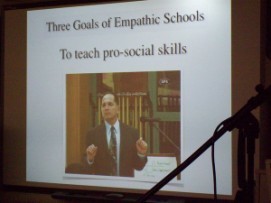
Principal Michael McDermott spoke to parents and teachers about how they can combat bullying through empathy.
On the heels of a New York Times and TIME article dealing with the concept of bullying, as well as countless suicides as a result of bullying, Scarsdale Middle School’s Principal Michael McDermott held a presentation about his school’s implementation of a proactive approach to bully prevention.
One word: empathy.
By using implicit techniques such as having students work with elderly persons on a project or learning sign language at the New York School for the Deaf to communicate with hearing-impaired students, McDermott feels that empathic tendencies can subconsciously be infused into his students.
The Healing Species - Rescued Animals helping Heal the Human Heart
Healing Species is the first student intervention program in the nation addressing issues of the heart to overcome violence, bullying and crime – with the assistance of rescued dogs – dogs nobody else wanted. Healing Species is the “first of its kind” and paving a new standard among results-oriented programming...
Our proven-effective and evidence-based program is an in-depth and interactive approach to:
Students at Clearview Middle School are learning to have more empathy for their peers through the “Walk a Mile in My Shoes” project organized by the faculty and staff this month.According to Assistant Principal Kathy McKinney, teachers and counselors first brought in pairs of their own shoes, along with a written description of an event that affected them in middle or high school, and arranged the shoes and stories in a display near the school’s entrance. Then, each student wrote about their own experiences — anonymously — on paper sneakers that are now displayed throughout the hallways.
At a time of contentious debate over how to reform schools, “social emotional learning” may be a key part of the solution. ..
Brackett quickly learned that developing empathy in kids requires working on their teachers first. Ten years ago, he and his colleagues introduced a curriculum about emotions in schools, asking teachers to implement it in their own classrooms. When he observed the lessons, he was struck by the discomfort many of the instructors showed in talking about emotion. “There was one teacher who took the list of feelings we had provided and crossed out all of what she perceived of as ‘negative’ emotions before asking the students to identify what they were feeling,” Brackett says. “We realized that if the teachers didn’t get it, the kids never would.”
Innovation comes in many forms and this year, for only the third time in its 30-year history, the Ernest C. Manning Awards Foundation has recognized social innovation, placing a spotlight on the contribution of Roots of Empathy
President/Founder Mary Gordon. A profile of Ms Gordon and the Roots of Empathy program - along with the other award recipients - will be published in the October 17th special innovation issue of Maclean's magazine, Canada's current affairs weekly, available on newsstands October 6th.
Empathy – Understanding and sharing another’s thoughts and feelings.
Caring School Community: Teaches social skills to children and increases their responsibility, helpfulness, and respect toward others in order to build strong community in classrooms
No Bully: Partners with schools and school districts to help them implement the key building blocks to create bully-free learning communities. Empathy-based program
Roots of Empathy: Through classroom visits by a trained facilitator, mother and infant, children learn to identify and reflect upon their thoughts and feelings and those of others.
Second Step: Provides curricula that foster social-emotional development and prevents violence and bullying among children.
College kids just don’t feel the pain of others like they used to. At least that is what a University of Michigan study presented to the Association of Psychological Science in 2010 revealed.
The study, which followed 14,000 people for 30 years, found that college students today are much less empathetic than those from two and three decades ago, and the largest drop in empathy came after the year 2000.
“Many people see the current group of college students — sometimes called ‘Generation Me’ — as one of the most self-centered, narcissistic, competitive, confident and individualistic in recent history,” Sara Konrath, a researcher at the University of Michigan Institute for Social Research ...
There are those who seem to feel more deeply for others, to the point of experiencing others emotions or sensations. Several theories exist regarding this.
Probably the most common type of naturally occurring ability to sense things related to others is intuitive empathy, also known as psychic empathy. While some are uncomfortable with the word psychic, it is simply used to refer to information that is hidden from what we consider our “normal” senses.
Yet often it could be considered a normal sense in itself. That is the case with intuitive or psychic empathy. This is when an individual shares the same emotions or sensations, such as pain, as another individual.
Bullying is a problem that has a lot of parents worried. According to a recent Harris survey, 67 percent of parents of 3- to 7-year-olds worry that their children will be bullied.Bullying damages the physical, social and emotional well-being of its victims. It also hurts the children who bully, as well as those who watch it happen.
Fortunately, encouraging empathy in young children can discourage such behavior. Empathy is defined as the ability to put oneself in another person's shoes and recognize and respond to what that person is feeling. Building empathy helps children to consider other people's feelings and offer expressions of understanding.
Parents are encouraged to visit www.SproutOnline.com to add their child's act of kindness to the Kindness Counter.
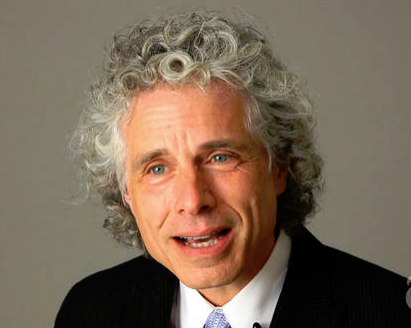
Dr. Pinker finds an explanation for the overall decline of violence in the interplay of history with our evolved minds. Our ancestors had a capacity for violence, but this was just one capacity among many. “Human nature is complex,” he said. “Even if we do have inclinations toward violence, we also have inclination to empathy, to cooperation, to self-control.”..
“Better Angels” has impressed many experts on historical trends of violence. “Steven Pinker’s great achievement is to weave these trends into a much larger pattern of reduced violence, greater empathy and, indeed, a comprehensive civilizing process,”
Mind with Heart is a European network for teachers from all backgrounds interested in practicing mindfulness and empathy in the classroom.
Teachers and education professionals can now benefit, for the first time in the UK and in Europe, from three-day breaks on cultivating mindfulness and empathy in the classroom. The breaks are offered by Mind with Heart and take place in London on 11-13 February and 2-4 April 2012.
No, those more-than-100 babies aren't for some strange diaper commercial or a Johnson & Johnson ad, they're on a mission: to cure classrooms of bullying forever. The program, Roots of Empathy, employs 150 baby volunteers in attending classrooms in an effort to reduce student agression, BBC reports.
Build school connectedness by incorporating compassion and empathy into everyday routines. Your students--and your school's climate--will thank you!...
The following excerpt comes from Chapter 1 of 55 Teaching Dilemmas: Ten Powerful Solutions to Almost Any Classroom Challenge, by Kathy Paterson (Pembroke Publishers, 2005; distributed in the U.S. by Stenhouse Publishers). The book sells for $18 on the Stenhouse Web site.
This excerpt suggests easy ways in which educators can build compassion and empathy into their everyday routines, in order to benefit colleagues, students, the larger school climate and even themselves...
On Tuesday night, at Scarsdale Middle School’s PTA meeting, Mr. McDermott delivered his presentation: The Roots of Empathy: One School’s Story. He describes what it’s like to change the school’s mindset, create new programs and reshape the existing curriculum to create a more empathetic community.
In his dynamic presentation which had video clips, animation and music (inspired by Steve Jobs, according to McDermott), the principal explained that as humans we are wired to experience what others experience and as a society we have a drive to belong. “Developing empathy is like giving your school a heart transplant,” he says.
Working with our global network of Ashoka Fellows and other partners, we aim to create a world committed and equipped to ensuring that every child masters empathy.
Ashoka's Empathy Initiative is a collaborative platform for social entrepreneurs and others who share this vision of a world where every child masters empathy and who have the insights and innovations that will make that vision a reality. Through this platform, we are mobilizing a global team of teams to collaborate toward realizing a society in which empathy learning is as fundamental as reading and math in early education, where parents insist that their children develop empathy, where institutions cultivate empathy learning and practice.
American education is broken and no one knows how to fix it.
Empathic Education is a belief that our schools must help the children this aspire to be collaborative and cooperative human beings who interact in a world where energy sources are diminishing, commerce has become global and the rise of social media has made our "neighbor" not just someone who lives down the block, but also across the globe.
Empathic Education is a system of education where empathy, the "walking in the shoes of others, " is taught through reflection and immersion. In Empathic Education, students read about empathy, they write about empathy, and they actually delve into the world of others and experience the joy and pain of people who are "not exactly like me."
Consider what an “official” of the curriculum company told an AJC reporter: “It’s important for kids to have some empathy for other people in the world.”
Really? When did schools get into the empathy business? But this official’s admission illustrates how prevalent this belief is among educators. Educators have swung sharply from what most citizens believe schools should be doing, and that is imparting knowledge objectively, and teaching students how to present written and oral arguments using logic and evidence.
Welcome to the email forum for those interested in Nonviolent Communication in education. This group is designed to encourage dialog and sharing among its members.
The intent is also to keep you informed about what is happening in schools, provide a way you can connect with others working in schools, to exchange educational ideas, to create an archive of resource materials to support NVC in education, and to help create networking opportunities.
“As a teacher, empathy comes to mind. It’s hard to teach empathy to little kids. You can only try to explain it, but I felt they truly gained empathy. We turned it around from tears and fighting, and they realized that cancer is a scary thing.”
“It’s going to go for research, to help get machines and more stuff for testing,” one of the boys said of their contribution. Another quietly said he was thinking of the boy’s mother when he put money in the jar. A third said he hoped their efforts would bring the honorary “Blue Jay Banner,” featuring the school’s mascot, to their classroom.
Psychology Students' Association We will consider both descriptive questions as to the nature of empathy, sympathy, compassion, and the like, and also normative questions as to when these things are good, and when they are bad. This is in contrast to the blanket assumption that empathy is intrinsically virtuous, etc.
To get content containing either thought or leadership enter:
To get content containing both thought and leadership enter:
To get content containing the expression thought leadership enter:
You can enter several keywords and you can refine them whenever you want. Our suggestion engine uses more signals but entering a few keywords here will rapidly give you great content to curate.


 Your new post is loading...