A set of techniques we call empathic design can help resolve those dilemmas. At its foundation is observation—watching consumers use products or services. But unlike in focus groups, usability laboratories, and other contexts of traditional market research, such observation is conducted in the customer’s own environment—in the course of normal, everyday routines. In such a context, researchers can gain access to a host of information that is not accessible through other observation-oriented research methods.
The techniques of empathic design—gathering, analyzing, and applying information gleaned from observation in the field—are familiar to top engineering/design companies and to a few forward-thinking manufacturers, but they are not common practice. Nor are they taught in marketing courses, being more akin to anthropology than marketing science.
In fact, few companies are set up to employ empathic design; the techniques require unusual collaborative skills that many organizations have not developed. Market researchers generally use text or numbers to spark ideas for new products, but empathic designers use visual information as well. Traditional researchers are generally trained to gather data in relative isolation from other disciplines; empathic design demands creative interactions among members of an interdisciplinary team.
Present the idea “How might we end Cyberbullying?” Explain the Design Thinking Process: Empathize, Define, Ideate, Prototype,
Show Video: Delete Cyberbullying
Tell students they are going to be interviewing each other to find out what their peers know/have experienced about cyberbullying. Divide students into groups of three. Students interview each other for 4 minutes each.
Student A interviews student B, Student C scribes Student B interviews student C, Student A scribes Student C interviews student A, Student B scribes
How Can a Designer Capture an Individual's Experience?
Patricia Moore disguised herself as an 80-year old woman with the intention of better understanding the elderly, and finally, to design products that would not alienate them. Image courtesy of www.dezeen.com.
In 1979, Patricia Moore, a young industrial designer living in New York City, decided that she needed to gain a deeper understanding of what it was like to live as an elderly person. She had a passion for the elderly and wanted to design products that did not alienate them1. She wrestled with the challenge of how she could better understand the world from their perspective and ultimately decided to prosthetically disguise herself as an 80-year old woman.
In addition to makeup and prosthetics, Moore used a variety of clothing and props that gave her the appearance and physical limitations as an elderly woman of various socioeconomic statuses. She traveled to over 100 cities throughout the United States and Canada experiencing life as an elder, enduring the good and the bad.
Are you trying build engagement and energy around your customers to inspire innovation?
Come experience & learn how to plan and facilitate an EMPATHY SAFARI. An Empathy Safari is an immersive activity for groups of people to gain empathy and inspiration through observing and experiencing the customer experience and analogous experiences as sources of inspiration and insight.
This learning experience is extremely valuable for UX researchers, Designers, Product Managers, Innovation Catalysts, Strategists, Startup Founders and Company Leaders. It pulls from ethnographic tools in a UX researcher's toolkit AND from various tools in a Design Thinking toolkit.
This is what empathy is all about. Not just sympathy for someone else’s circumstances, but the deep intuition for what it feels like to live their lives. When they sign up to follow a child for a full day during the week, these school leaders are clearing their calendars to commute to school, attend classes, and eat lunch alongside their students to see the entire school experience through their eyes.
The organizers of the challenge — IDEO, the Stanford d.school, and the Hewlett Foundation — are providing resources to help school leaders, who are asked to hack potential solutions where they find a need during their days as students.
There’s a big idea here for all of us who play a leadership role (and most of us do in some way lead others) — to try shadowing our own “student” for a day. Of course, it doesn’t have to literally be a student, per se, but someone who you may have responsibility for, someone whose daily work life you haven’t experienced.
Empathy is one way of thinking about the difference between art and design. If art is about exploring the possibility of human imagination and expressing this through physical media, design is about exploring the possibility of human imagination and connecting this to the reality of people’s lives.
Design is about being helpful and useful as well as being provocative and surprising. Design makes “the art of the possible” a collective endeavor.
But how can you promote empathy in your designs? Here, I’ll be running you through some of the ways we promote empathy among our designers and with our clients in workshops.
EVIL UX
Therefore, it’s time to tap into your inner supervillain and think specifically about bad ideas. Turn the brainstorm on its head, and instead of searching for the one true good idea, ask yourself the following:
STINKY FISH
Stinky Fish is a short activity. It focuses on sharing fears and anxieties the group may have about a project – their smelly fishes – and laying them bare for all to see. Some people may find this uncomfortable at first but it’s worth it – trust me.
THE OBITUARY The obituary is the final empathy-building workshop I’ll be outlining today. This one is a little more morose, but it’s a great way of meeting your users halfway.
Applied Empathy is a monthly conversation series held at Sub Rosa’s studio in Manhattan. Each discussion features individuals who incorporate empathic behaviors into their professional and personal lives. In conjunction with a Sub Rosa moderator and audience, they discuss a unique theme pertaining to empathy and their respective careers.
This month, Michael Ventura speaks with social justice comedian Negin Farsad and Ari Kuschnir, founder of the new wave production and entertainment company m ss ng p eces. Together, they explore the theme “Getting Really Real: The Art and Science of Communicating With Empathy.”
Empathetic design practices urgently need to be incorporated into the interactive design process, ensuring that product design is informed by the day-to-day realities of our users. As a student and researcher in a leading UX program, I believe that this is the next frontier, though have found that a limited number of practitioners are incorporating empathetic design practices into their design process. By ignoring users in their most fragile moments we have failed them....
At the heart of it empathetic design is knowing your users, researching and predicting their most stressful moments, and designing and testing for them. This can be accomplished through the creation of diverse user personas, being intentional in design, and conducting user research where your users are, both physically and emotionally.
Design thinking is the biggest buzzword in the design world since flat design. Everyone is talking about it… even non-designers. So what is design thinking? Is it important? Should you care?
Here’s the good news: design thinking is something that’s probably part of what you “just do” even if you didn’t have a name for it. Design thinking is another way to think about problem-solving. Let’s take a closer look, and delve into what it means, and why it can be useful!
My first understanding of the word empathy began with my second grade teacher’s concrete explanation—empathy is about being in someone else’s shoes, having a walk around in them to get a sense of the world from their point of view.
Empathy it turns out, is complicated—much of it has little to do with our conscious minds. Whether or not we’re able to express empathy for someone depends on our innate, lizard brain perceptions of others as either belonging to the same group we belong to (us) or people belonging to an outgroup (them).
As designers, it’s vital that we continue to question our process.
Do we have enough information to make meaningful user personas?
Or are we just drawing pretty pictures on the whiteboard?
Empathy should undergo the same scrutiny, because in design there should be no sacred cows.
I am not arguing for the abandonment of empathy in the design process. Such a declaration would ignore the nuance of product design, and empathy itself. But we must use caution — if we are not careful about empathy’s role, we will drift further from the solution we are searching for, or worse, create a solution for one
The fundamentals of design thinking: A nonlinear process
Design thinking needn’t be a solitary task. The process is iterative, flexible and should be focused on collaboration between professionals, business owners, marketing managers, and the users (whether they are using a website, product or service). Emphasis your efforts on bringing the ideas to life based on how real people think, feel and behave.
You can tackle this complex task in a simple way.
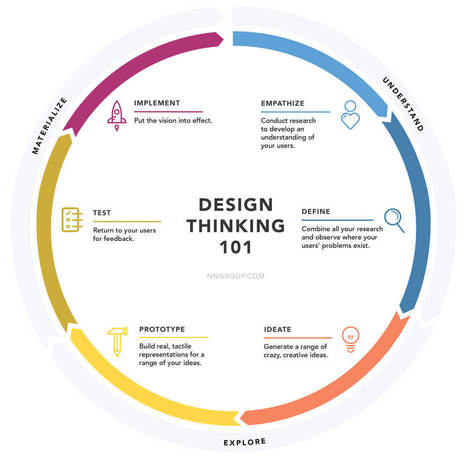
Empathise – deeply understanding the human needs involved
Define – with empathy on your side, it’s time to redefine or reframe the problem in human-centric ways
Ideation – Create as many ideas as you and your team can in ideation sessions
Prototype – roll out scaled down versions of the product or new feature
Test – rigorously test the completed product or feature and make alterations and refinements as necessary
Interview: Groups will break into pairs and interview each other about their BTSN experience as a teacher, as a parent, etc. One pair will look at parent survey feedback. '
Empathy Map:
After the interviews, participants will fill out an Empathy Map summarizing what they heard in the interview into four quadrants:
Say - What are some quotes and defining words your interviewee said?
Do - What actions and behaviors did you notice? Think - What might the interviewee be thinking (that s/he didn’t say)?
Feel - What emotions might your interviewee be feeling
The foundation of human-centered design (see image above), empathy is the process of developing a deep understanding of an application’s intended users, their behaviors, and their true motivations. Because people often don’t know, or can’t articulate, these things explicitly, empathy emerges through techniques such as close observation of users and their behaviors in context, and open, unstructured interviewing. The goal is to gain insights into how users think and feel, and why they behave in certain ways.
The process of developing empathy for users is paramount to successful application design and development. After all, the problems your development team is trying to solve are rarely their own. They belong to a particular group of users; and to effectively design for them, your team must gain empathy for who they are and why they have these problems. Empathy helps the team to view problems with a fresh set of eyes in order to “go wide” in the ideation and prototyping stages, with the goal of identifying impactful solutions that truly resonate with users.
Empathy: The Ultimate Classroom Management Skill Meet Mary, a high school teacher serving "at risk" students in Phoenix. She has been struggling with her classroom. Students were being distracted and causing distractions. Students were blasting their music from their phones, talking to each other (not related to any learning), texting friends, and terribly unengaged in general. It spread and worsened throughout the year. She tried strategy after strategy... nothing was working. It was a strange year indeed, she never had these kinds of issues, and she felt stuck and disempowered in her own classroom.
Feeling stuck is usually a sign that we are seeing the world from a limited perspective. By expanding our perspectives, we can expand our options, and then make more empowered choices. One way to include new perspectives is developing deep empathy for someone, stepping into the shoes of another person, and seeing the world from their point of view. Gaining understanding of why Mary's students were disengaged can help Mary gain the perspective she needs to get unstuck.
In a 10-week design journey, The Teachers Guild asked its network of optimistic educators across the country to design and share ideas to cultivate empathy in their classrooms. This project generated over a hundred solutions, sparked active conversations on and offline about the limits of empathy in schools, and the role that student voice plays in building bridges across divides in classrooms today.
We launched this project because we believe in the power of empathy to positively transform student and teacher experience. If you’ve been in a school for any length of time, you know that whether you’ve asked for it or not, you’re bound to encounter extremely vulnerable situations.
What is empathy? Many people often confuse empathy with sympathy, but the two aren’t the same thing – far from it, in fact. Sympathy is the act of understanding a person's perspective, but empathy goes further: it is the identification of and experience of feeling the emotions of another. It’s the identification part that’s key. The object and the subject never become one, but they can understand one another.
Empathy is all about convergence, whereas sympathy is experienced from more of a distance. It’s because of this that empathy is of the utmost importance for designers; with empathy, you can identify the problems your users might face and provide practical solutions from a designer’s perspective.
Creativity needs to be informed by real perspectives and grounded in a real-world context.
If you want to change the way people drive, you need to fully understand how they drive now, what they find challenging, and why they drive in the first place.
Ultimately, good design means creating something that people actually want to use. It's really quite simple in theory: If you consider the unique pain points and experiences of those around you, you're better able to devise creative, applicable solutions to their problems.
The big challenge lies in stepping outside of your own calcified biases to adopt a more empathic perspective.
An empathetic person traditionally may practice active listening, asking questions, and looking to connect to the feelings of another person. This all makes sense in a situation where the architect and the building’s users are neuro-typical functioning individuals, and the largest hurdles may be overcome through discourse and further clarification.
When it comes to designing for children with autism, we must overcome communication challenges while simultaneously accounting for the fact that the child’s sensory experience is vastly abstracted and magnified in comparison to the neuro-typical adult. White may become blinding; green may become red; and a simple wall sign may become the difference between a successful and unsuccessful trip to the bathroom.
Between the communication barrier and differing experience of the world all-together, achieving an empathetic design must look to additional methods to cater to these users.
Let’s talk a bit about the key principles design thinking principles that make it stand out from other methodologies:
Empathetic It generates solutions based on an empathetic understanding of the people who’ll be affected, as well as the context in which those people find themselves.
Methodical: It promotes a methodical approach to idea generation, rather than luck and inspiration.
Holistic: It’s a big-picture methodology, focusing on the sweet spot where user goals, technical abilities, and business goals meet, rather than championing one at the expense of the others.
Iterative: It encourages an cyclical prototyping methodology and continual improvement.
Collaborative: It’s a participatory, team-based practice that seeks input from multiple sources. (It’s not about rockstars or gurus.)
Optimistic: It’s based around fundamentally positive philosophy that assumes even seemingly impossible problems can be made better, and that even unusual ideas are worth considering.
A true listening culture generates better ideation.
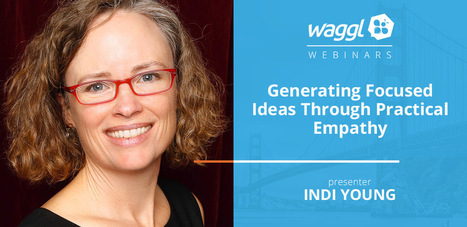
We are thrilled to welcome Indi Young as our August Waggl webinar guest. Indi is a data scientist, researcher, author, and the co-founder of UX Agency Adaptive Path. Her two books, “Practical Empathy” and “Mental Models” were published by Rosenfeld Media, and have been utilized by thousands of practitioners across multiple curriculums.
Indi has dedicated her career to bridging the gap between what teams know, and what they are ultimately trying to accomplish. She will explain how empathy can provide real benefits, like focused ideation, inside every organization.
What is Design Thinking? Design Thinking is a mindset transformation method to realise Human Centric intelligent society in the early stages of Human Centric Innovation; a mechanism to discover, create, and realise customer experience value at a high level.
The key to successful digital transformation comes from knowing that value is created from connectivity and putting people at the centre of digital technologies. Human Centric Innovation is an approach to creating business and social value by empowering people with digital technology.
Design Thinking draws upon ideas, logic, imagination, intuition, empathy and reasoning, to match people’s needs and business viability with what is technologically feasible. It’s all about people, technology and business – all centred around the customer. Fujitsu can facilitate Design Thinking workshops and boot camps which can be tailored to individual organisational needs.
To get content containing either thought or leadership enter:
To get content containing both thought and leadership enter:
To get content containing the expression thought leadership enter:
You can enter several keywords and you can refine them whenever you want. Our suggestion engine uses more signals but entering a few keywords here will rapidly give you great content to curate.


 Your new post is loading...