Your new post is loading...

|
Rescooped by
Edwin Rutsch
from Empathy Movement Magazine
January 30, 2018 12:02 PM
|
The Benefits of Empathic Design
Beyond the simple aim of empathic design to create an emotional relationship between the consumer and the product, empathic design can help companies in multiple disciplines. Conducting the proper research to target empathic design not only can build this connection but also can help a company innovate new products or solutions for problems the user never asked for or never thought could be solved. For some products, innovation does not require creating a new product but rather improving an existing product in order to meet the current consumer needs.
From a marketing context, empathic design can lead to acquiring market segments through the exploration of unexpected and unmet needs of the end consumer.
|
|
Rescooped by
Edwin Rutsch
from Empathy Movement Magazine
January 27, 2018 11:29 PM
|
Empathy generation is pivotal to the Design Thinking process, and an essential capacity to ensure successful execution across all phases of the Design Thinking Framework.
In this article, we will highlight where and why in the design process empathy might best be applied. We will share how to engage a deeper level of empathy that enables you to better discover innovative design opportunities.
To be effective (in work and in life) requires empathy with yourself, your team, clients and participants.
To empathise with self ensures consistency and is a basis for empathic accuracy, that is your ability to accurately infer the thoughts and feelings of others. To empathise with your team enables a cohesive and coordinated effort. To empathise with clients and stakeholders ensures your project is on track and relevant.
Design Thinking is a framework that has human-centric design at its core. By default then, empathy forms part of a design thinking exercise. This is because it involves connecting to and understanding peoples’ wants, needs, goals and desires. By understanding these, we can then define and co-create desirable solutions and experiences that add value to peoples’ lives. Empathising with users, stakeholders and colleagues during a Design thinking exercise helps bring about this deeper understanding. But of course, as we will point out later, empathy is first about tuning in to self.
|
|
Rescooped by
Edwin Rutsch
from Empathy Movement Magazine
January 26, 2018 7:08 PM
|
Why Use Empathy Maps
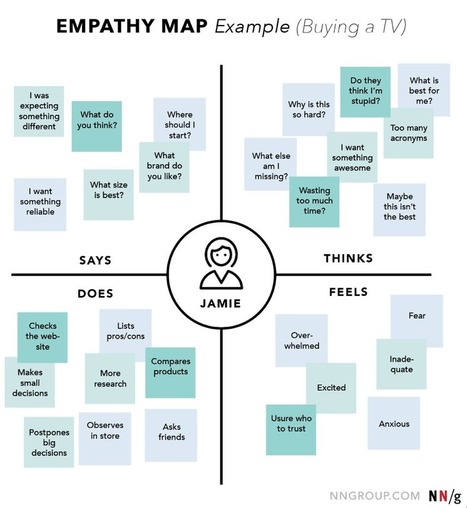
Empathy maps should be used throughout any UX process to establish common ground among team members and to understand and prioritize user needs. In user-centered design, empathy maps are best used from the very beginning of the design process.
Both the process of making an empathy map and the finished artifact have important benefits for the organization:
Capture who a user or persona is
The empathy-mapping process helps distill and categorize your knowledge of the user into one place. It can be used to: - a. Categorize and make sense of qualitative research (research notes, survey answers, user-interview transcripts)
- b. Discover gaps in your current knowledge and identify the types of research needed to address it. A sparse empathy map indicates that more research needs to be done.
- c. Create personas by aligning and grouping empathy maps covering individual users
Communicate a user or persona to others
An empathy map is a quick, digestible way to illustrate user attitudes and behaviors. Once created, it should act as a source of truth throughout a project and protect it from bias or unfounded assumptions.
|
|
Rescooped by
Edwin Rutsch
from Empathy Movement Magazine
January 16, 2018 5:12 PM
|
More and more evidence suggests that empathy improves patient outcomes and practitioner well-being, yet the extent to which practitioners express empathy is variable. This workshop will cover the theory and practice of empathy in healthcare, showing how individuals can enhance empathy in own work and in their organisations. Who is this course for? Practitioners and managers in health and social care who want to further understand and develop empathy based practice. During this workshop you will - Review the evidence linking empathy with improved patient, practitioner, and system outcomes.
- Provide healthcare practitioners with personalised evidence-based empathy techniques they can use in their practice to improve patient outcomes as well as their well-being.
- Create strategies to form ‘empathy habits’.
- Develop a personal plan to enhance empathy in your day-to-day work.
|
|
Scooped by
Edwin Rutsch
January 12, 2018 12:59 PM
|
Benefits of empathy maps in UX design
The reason we use empathy maps is because they allow designers to see and understand the worldview of their users. Other benefits include: - Quick and cheap to create
- Fit into your prototyping workflow
- Can be iterated upon with real data
- Identify key insights
- Understand target personas better
Whether it’s creating a new website or product, if you don’t design with empathy, there’s a risk that your product will not meet your user’s needs, and this will result in a product that fails.
Sure, an empathy map won’t be the key to total business success but when you’re able to assuage any problems or frustrations in your user, you’re on step closer to that success regardless. It’s one less hurdle.
|
|
Scooped by
Edwin Rutsch
January 2, 2018 7:39 PM
|
Empathy is an important element in Design Thinking and Human-Centred Design. What is empathy exactly? Why is empathy so important to designing solutions that actually work for people? Here, we’ll not only look at what empathy means, but will also look at how it helps design thinkers create solutions that work and, conversely, how a lack of empathy can result in product failure. We’ll also come to understand the empowering notion that everyone can master empathy and design truly human-centred solutions.
What Is Empathy Exactly?
In a general sense, empathy is our ability to see the world through other people's eyes, to see what they see, feel what they feel, and experience things as they do. Of course, none of us can fully experience things the way someone else does, but we can attempt to get as close as possible, and we do this by putting aside our own preconceived ideas and choosing to understand the ideas, thoughts, and needs of others instead.
|
|
Rescooped by
Edwin Rutsch
from Empathy Movement Magazine
December 31, 2017 3:09 PM
|
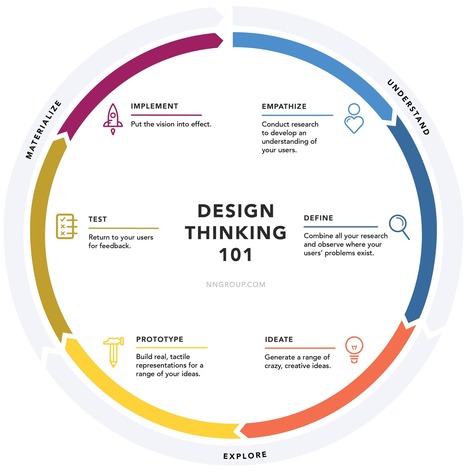
Empathize: Conduct research in order to develop knowledge about what your users do, say, think, and feel.
Imagine your goal is to improve an onboarding experience for new users. In this phase, you talk to a range of actual users. Directly observe what they do, how they think, and what they want, asking yourself things like ‘what motivates or discourages users?’ or ‘where do they experience frustration?’ The goal is to gather enough observations that you can truly begin to empathize with your users and their perspectives.
|
|
Rescooped by
Edwin Rutsch
from Empathy Movement Magazine
December 21, 2017 2:48 PM
|
Empathy Maps for Beginners
Empathy comes naturally to some people more than others, but the good news is that it’s something that can be developed and practiced with some simple mapping exercises.
Mapping encourages everyone to think about feelings, emotions and behaviors. It allows your team to delve into what a user’s considering when they engage with your product or service. They can then visualize their needs in a more detailed, informed way.
It’s useful to use empathy maps before you launch marketing campaigns and finalize product requirements. The most useful point is when you’re conducting your user research. Ideally you want to be using real data from qualitative interviews, customer feedback and your existing insights.
|
|
Rescooped by
Edwin Rutsch
from Empathy Movement Magazine
December 11, 2017 4:29 PM
|
Definition of Empathy
Empathy is the capacity to understand or feel what other person is experiencing from within the other person’s frame of reference, i.e., the capacity to place oneself in another’s position.
Why do we stress empathy in User Experience Design?
As a UX designer, when you begin to design a web or app, it is a necessary step for you to do a user experience research and evaluation by using some methods like user interview, usability testing, or focus group.
No matter what method you use, you must take stakeholders (clients, users) into consideration. They are different on background, experience, knowledge. We all know user centric design thinking, user is who will buy the product or service, client is who will produce, sell it, and earn profit from it. Importantly, it is client who pays you reward. So you know you need to interview with them to hear voices from both of them, then get a balance, try to find a sweet spot to satisfy them. How to execute empathy in User Experience Design?- 1.Don’t be too self-righteous.
- 2.Honesty and Self-Reflection.
- 3.Role Play.
- 4.Test Test Test.
- 5.Be Polite and respectful.
Empathy is an important emotional ability for us especially designers. You need to practice it again and again.
|
|
Rescooped by
Edwin Rutsch
from Empathy Movement Magazine
December 1, 2017 12:24 PM
|
|
|
Rescooped by
Edwin Rutsch
from Empathy Movement Magazine
November 30, 2017 8:52 PM
|
While working as a senior designer at a non-profit organization I had the pleasure of collaborating with like-minded designer, Sarah Fathallah. We both felt that the term empathy is often overused, and sometimes we, as designers, don’t have the ability to truly empathize with those we are researching or trying to better understand. She mentioned perspective-taking, a term used in psychology which really resonated with our conversation and how it’s often conflated with the term empathy. Perspective-taking, or rather perspective building as I like to call it, is another crucial part of understanding a person’s situation. The best way to build that perspective is to immerse yourself in the environment of the person or people you are trying to better understand. To meet them in their context and community in order to pick up on the rich set of symptomatic meaning all around us and help build perspective for us to truly and more deeply feel their pain, challenges, successes and joys.
|
|
Rescooped by
Edwin Rutsch
from Empathy Movement Magazine
November 20, 2017 8:00 PM
|
|
|
Rescooped by
Edwin Rutsch
from Empathy Movement Magazine
November 9, 2017 11:45 AM
|
This story exemplifies one type of empathic design, namely by a user-designer who combines deep knowledge of product use with the ability to foresee new possibilities for it. Another well-documented way to achieve the same outcome is through ethnographic research — surveying and studying the behavior of potential or actual users — which design companies such as IDEO have used to great effect in projects as various as coasting bicycles to redesigning patient experience at Kaiser Permanente... What all five of these modes of empathic design have in common is: - An emphasis on seeking out unarticulated needs and desires so as to get the job done — whatever that job may be — creatively
- Looking at the world through the eyes of the customer. Of course, there are often different sets of users, whose priorities differ and must be negotiated into some overall compromise.
- An emotional connection between design and its users. By definition, empathy includes emotion — a connection beyond satisfaction with the operational.
Dorothy Leonard
|
|
|
Rescooped by
Edwin Rutsch
from Empathy Movement Magazine
January 30, 2018 12:56 AM
|
Design Thinking can help us to achieve empathic design which helps to understand the unmet needs of users to address it in the product design. Empathic design is an approach that aims to go beyond the numbers and understand the people’s problem by putting our ourselves in their shoes, learn more about their lives, what they love and hate, and how their lives can be improved through design. The empathic design focuses more on the emotional experience that the users have when facing a specific problem. Why Should we Care about Empathy?The nowadays competitive market increased the challenges for firms especially the small and medium enterprises (SMEs) to achieve success. Many companies are focusing on innovation in order to add new values to their product. However, many products are introduced with new features that no one wants, it makes the product more complex and less usable. Introducing a new product that doesn’t really touch people’s real-life needs can turn to be a failed product; an end that no company wants to reach. As described by the IDEO paper, Empathy on the Edge, what empathic design do is to respond to people’s unexpressed and unmet needs. The output of understanding the user empathy can be transformed to a value proposition that can be added to the project business canvas model and plan. This added value can have a positive impact on the product innovation and subsequently the profitability that business can achieve from the newly offered product or feature. Rafiq Elmansy
|
|
Rescooped by
Edwin Rutsch
from Empathy Movement Magazine
January 26, 2018 7:08 PM
|
Using Empathy in Design to Foster Interest in Social Issues Opoku, Kofi. West Virginia University, ProQuest Dissertations Publishing, 2013. 1523561.
|
|
Rescooped by
Edwin Rutsch
from Empathy Movement Magazine
January 16, 2018 5:13 PM
|
Process: How to Build an Empathy Map
Go through the following steps to create a valid and useful empathy map:
1. Define scope and goals
a. What user or persona will you map?
Will you map a persona or an individual user? Always start with a 1:1 mapping (1 user/persona per empathy map). This means that, if you have multiple personas, there should be an empathy map for each.
b. Define your primary purpose for empathy mapping.
Is it to align the team on your user? If so, be sure everyone is present during the empathy-mapping activity. Is it to analyze an interview transcript? If so, set a clear scope and timebox your effort to ensure you have time to map multiple user interviews.
|
|
Rescooped by
Edwin Rutsch
from Empathy Movement Magazine
January 16, 2018 5:11 PM
|
4 Modes for Developing Your Practice
If you're considering how to embrace design thinking in your school culture, I believe you should focus on four critical modes underlying the process:
1. Lead with empathy.
Empathy is, of course, the root of human-centered design. Leading with empathy builds on the classic definition of "walking in someone else's shoes" to get us out of our own heads and into the lived reality of others so that we can understand the implicit needs and root causes of the situations in which we work. Leading with empathy means pushing yourself to get closer to people, and to do so consistently, publicly, and with conviction.
How do you do it? Listen more; talk less. Immerse yourself in how others experience your school or program. Adopt a beginner's mind and use all of your senses to notice what's happening around you. At the d.school, we believe in these practices so much that we're issuing a Shadow a Student challenge from our School Retool project to illuminate the power of leading with empathy. If you want to step into empathy, it will be a great way to get started.
|
|
Scooped by
Edwin Rutsch
January 12, 2018 12:58 PM
|
Empathy Maps for Public Advocacy
A number of our projects are also in the realm of public advocacy. Advocacy work is all about changing attitudes and behaviours, sometimes of specific people, sometimes of groups of people, and sometimes of organizations or government.
The benefit of using an Empathy Map in this type of scenario is to understand what your stakeholder's needs are outside of your context: what is the experience of a dignitary in the Ministry of Trade, and how can you speak to that experience as you try to shift their attitude toward your proposed policy?
Another great example of this is in our community engagement work with libraries. We sometimes have patrons, or staff members fill out empathy maps speaking to their experiences and needs in their community more broadly. The leadership teams from those libraries say that they often bring out those empathy maps at the beginning of meetings to ground their discussions and decisions in the experiences and needs of the people they serve.
|
|
Rescooped by
Edwin Rutsch
from Empathy Movement Magazine
December 31, 2017 3:09 PM
|
Empathy makes you a better innovator – Satya Nadella, CEO, Microsoft
The greatest gift human beings have received from GOD is the power of empathy. Empathy is a combination of three things – seeing with the eyes of another, listening with the ears of another and feeling with the heart of another.
Inculcating this as a habit is of tremendous value as it can help innovators discover “real opportunities”that are underserved. Providing creative solutions for these underserved opportunities can result in the next breakthrough innovation companies are looking at.
In this article we explore the importance of developing deep empathy for customers and the “how to” of it.
|
|
Rescooped by
Edwin Rutsch
from Empathy Movement Magazine
December 31, 2017 3:03 PM
|
Creativity needs to be informed by real perspectives and grounded in a real-world context. If you want to change the way people drive, you need to fully understand how they drive now, what they find challenging, and why they drive in the first place.
Ultimately, good design means creating something that people actually want to use. It's really quite simple in theory: If you consider the unique pain points and experiences of those around you, you're better able to devise creative, applicable solutions to their problems. The big challenge lies in stepping outside of your own calcified biases to adopt a more empathic perspective.
|
|
Rescooped by
Edwin Rutsch
from Empathy Movement Magazine
December 20, 2017 1:37 AM
|
THE CRITICAL IMPACT OF CORPORATE CULTURE ON DESIGN THINKING
Empathy. Ideation. Collaboration. Iteration. These are not the typical terms in the everyday conversations of executives at a large corporation. Instead, top executives are likely to be focused on the top and bottom lines, market share, return on investment, share price and employee retention. But empathy? Not in most big companies.
Yet empathy, ideation, collaboration and iteration are critical aspects of design thinking. For executives who want to install design thinking as a source for their companies’ successes, knowing and understanding terms like this, and the practices and processes behind them, are important for achieving those other key measures of success.
|
|
Rescooped by
Edwin Rutsch
from Empathy Movement Magazine
December 7, 2017 12:07 AM
|
I support their list of key requirements for you as an aspiring design thinking leader or entrepreneur. I’ll paraphrase and outline the top ten from my perspective:
Use empathy to understand the experiences of others. By understanding experiences, you will better understand the needs of people around you, including your customers and partners. That leads to trust, motivation, and a greater ability to convince them of your point of view, and follow you despite the pain of change and innovation.
|
|
Rescooped by
Edwin Rutsch
from Empathy Movement Magazine
December 1, 2017 12:24 PM
|
Simple tests can be used to provide an empathetic experience. Shutting off your office lights, or your computer monitor, and navigating a website using only the keyboard, can help simulate what using that technology is like with blindness or low-vision. Using a single hand to navigate your smartphone may simulate a loss-of-limb, or wearing latex gloves to snap a selfie with your camera can simulate doing it with diminished fingertip sensitivity. As technology advances, we’re seeing more and more sophisticated means for performing such simulations, as well.
Designers and developers are in a unique position – from the very earliest stages of product development – to create products which can truly be used by everybody. Stepping outside our individual experiences, and using empathy in design, is a powerful way to seize that opportunity.
|
|
Rescooped by
Edwin Rutsch
from Empathy Movement Magazine
November 21, 2017 6:26 PM
|
Fill in the empathy maps (15 min)
Divide the group into pairs or trios. Work out which sub-group tackles which persona, and allow 10 - 15 mins minutes to fill in their empathy map, depending on the number of small groups you have (the more small groups the less time – you'll need to leave more time for everyone to share their maps with the larger group).
Remember, you can create empathy maps for an existing product to better understand how your personas feel about it right now. Or, you can create the map with a new design in mind to help articulate how you want customers to feel about it in it's future state.
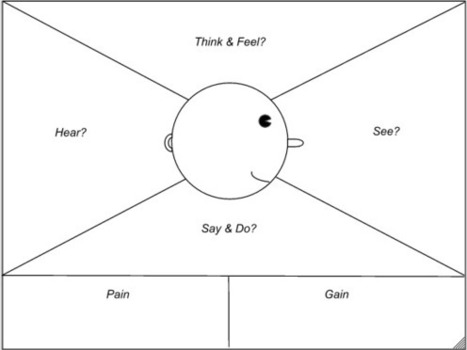
Pay special attention to pain points. The whole point of your project is to improve a product or service, right? Think about what the persona hears from friends or says about the product in terms of the pain they experience when using it.
|
|
Rescooped by
Edwin Rutsch
from Empathy Movement Magazine
November 9, 2017 12:26 PM
|
This is a talk for IT Next 2015 by HC, Joe and Kaba.
Whether it's radical innovation or incremental innovation you are looking for, empathy and experiment are always the core of what you need to do. And the space and culture are also very important for making the magic happen. The USER model, User & Empathy, Space & culture, Experiment and Repeat, is the way we think could really foster innovation.
|