Q: How can design be empathetic to a user who “doesn’t want to be there,” or who is grudgingly engaging with the site/product?
This question comes up fairly often and in different forms, and it seems to be rooted in the idea that empathetic design and creatively engaging design are mutually exclusive. I wince a little whenever I hear it asked because that’s an intrinsically false pretense but, I digress...
This iteration of the question stuck with me, because it captures an important point about designing with empathy: Not every person that is engaging with your product may be happy to be doing so.
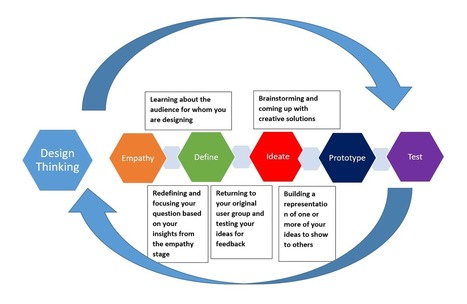
When introducing Design Thinking to children, it’s important to include the “empathy” part of the process. Sometimes, it is easier for students to practice this with fictional characters before they begin applying it to real people.
I’ve curated a collection of both free (green) and paid (purple) resources that offer character cards you can print out to distribute to students so that when they are designing they have a “client” in mind.
If you would like some suggestions for books and videos to help teach empathy, Joelle Trayers has several blog posts that address this topic.
Customer-centric solutions demand empathy. But, how we employ this principle within design thinking is as critical—if not more—as what we do in the process.
Certain slices can be easily repeated—that’s the science part. However, not everything fits neatly into a template. More than anything else, we rely on our creativity to accurately frame a problem and discover the attached opportunity. That’s the art of customer empathy within design thinking.
In my previous post, I discussed three factors that are critical turning empathy into an obsession when developing customer-centric innovations Opens in a new window. I want to expand on this topic and elaborate on how it can also be applied to our everyday work as well.
Customer empathy is not inherited or repeated-it’s continuously learned
If it’s important for patient care to be compassionate and empathetic at its core, it follows that these qualities should also be at the core of emerging health & wellness practices. It is design that allows innovation, technology and engineering to be empathy driven. Practices and processes of design are human centered and based on insights into people’s experiences.
Design allows innovation to become more powerful, creating touchpoints between technology and people rather than merely creating ‘tech for its own sake’.
Changing an organization’s vision and culture takes a long time and tremendous commitment, but design thinking can help lead the way.
Among Tides’ participants, the work on empathy, prototyping, and collaborative problem solving was particularly illuminating.
“The word empathy is ubiquitous and very easy to say, but really digging in and putting yourself in someone’s shoes, asking big, open-ended questions, and listening can be harder to do,” said Kim Sarnecki, Tides’ director of administration and real estate. “The design thinking approach helps us relate to each other.”
Use this tool at the beginning stages of product development, a redesign, a 2.0, or a shift in your marketing strategy. If you’ve involved all of your key players, their approach will become more customer centric. That next feature they want to add may better fit your customer’s needs, leading to higher satisfaction, and a potential boost in your ROI.
Empathy. It’s a virtue. It’s a valuable quality in any human being. It’s a distinct advantage in connecting to people. It’s also kind of the latest design buzzword. But it’s not just a trend.
You see, designers are figuring out that being able to empathize with and understand other people leads to creating better interfaces for them. ...
Empathy can help you make better designs, but it will…also enrich your life
1. TRAVEL A BIT, IF YOU CAN
Before we get to design-specific considerations, there are more general ways to develop empathy....
2. VOLUNTEER AND/OR SOCIALIZE Find a cause you believe in (preferably one that involves helping humans), and dedicate some time to it....
3. TALK TO THE PEOPLE YOU’LL BE DESIGNING FOR Okay, so on big projects, you might actually be able to get a budget for user research....
4. CONSIDER EMOTIONAL CONDITIONS Many writers have discussed the importance of dealing with things beyond your control....
5. METHOD ACTING Become the user. Spend a day or so every month using the web with an older device, or throttled speeds....
To deliver innovative, customer-centric solutions through design thinking, we must begin with empathy.
In its simplest and purest form, empathy enables us to not only experience and understand another person’s circumstances, but it also puts us in our customers’ shoes to experience what they are feeling.
This is where we find the innate struggle born out of user frustrations and bound to the intrinsic value chain of the user experience.
Without a doubt, empathy is the most important design thinking principle I will cover in this series. Its universal application offers infinite promise.
Customer-centric design is about looking out from the inside, rather than outside in
What is Design Thinking? Human-centered design is all about building a deep empathy with the people you’re designing for; generating tons of ideas; building a bunch of prototypes; sharing what you’ve made with the people you’re designing for; and eventually putting your innovative new solution out in the world.
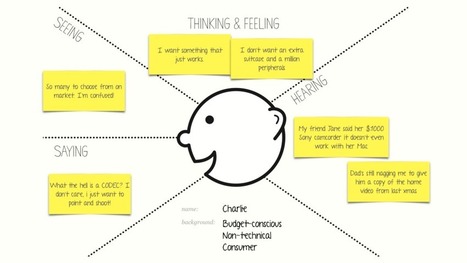
The Customer Empathy Map is a tool used to increase your Understanding of your customer. By putting yourself in his own shoes, you will be able to truly understand the client's buying behaviour. Ultimately, it is often used to improve the customer experience.
Having recently joined IDEO, I was fascinated by the way design researchers can enter any situation, and instantly make people feel at ease. They can interview anyone, from wounded veterans to wedding planners, and encourage them to open up and share their unfiltered opinions. These genuine encounters are incredibly important to our work because they allow us to develop the empathy we need to design for specific user groups. Empathy is essential for uncovering deep insights and ultimately creating novel, game-changing products and services.
Hacking Empathy: Demystifying the Most Powerful Skill for Future Design Leaders
Thursday, May 25, 2017, 7:00 PM
ZGC Innovation Center @Silicon Valley 4500 Great America Parkway Santa Clara, CA
69 Igniters Attending
Early Bird $10
Learn about Empathy & The Future of Creative Leadership
How human beings create new products and experiences is changing breathtakingly fast. Startups and designers have more resources at their fingertips than ever before. Bringing new ideas to the masses requires an evolving tool kit that enables creative leaders to connect and le...
Learn about Empathy & The Future of Creative Leadership
How human beings create new products and experiences is changing breathtakingly fast. Startups and designers have more resources at their fingertips than ever before. Bringing new ideas to the masses requires an evolving tool kit that enables creative leaders to connect and lead people from disparate backgrounds and all walks of life.
At the heart of this emerging skill set lies a controversial, underestimated, and often times misunderstood ability: empathy. Please join Greg as he mixes some of the most outlandish stories of working with designers and startups for 17 years with the unfiltered instructions on how to successfully integrate empathy into your life, work, and company.
EMPATHIZE WITH CUSTOMERS, EMPLOYEES, AND OTHER END USERS.
One way to develop more empathy with—and gain new insights about—your customers is to look beyond the narrow definition of your offering and consider the customer’s total experience. The more broadly you define the customer experience, the more opportunities you can identify for improvement.20
Say, for example, you make interior house paint. You could focus narrowly on the characteristics of the product itself, on making the paint less drippy or making it cover a surface in a single coat. But you’ll find many more opportunities for innovation if you think about the arc of the customer experience. In something as simple as repainting a bedroom, there are probably a dozen steps (each one of which is a chance to innovate): from getting customers to realize that it’s time to repaint, to helping them choose the color, to shortening the preparation and cleanup time, to keeping track of which colors are on which walls for future reference when it comes time for touch-up.
Empathy is the first step in design thinking because it is a skill that allows us to understand and share the same feelings that others feel. Through empathy, we are able to put ourselves in other people's shoes and connect with how they might be feeling about their problem, circumstance, or situation. Some questions to consider:
What is the person feeling?
What actions or words indicate this feeling?
Can you identify their feelings through words?
What words would you use to describe their feelings?
..5. Test
During testing, empathy plays a key role in shaping of the user's experience. Focus on showing and not telling. This helps the users to create their own experiences, and also helps us to identify how to improve their experiences next time. The opportunity for empathizing is important at this stage, because one is able to see the user's experience and hear his or her thoughts, feelings, and ideas. Testing also helps to shape our point of view in relation to the user's point of view.
Empathy. It’s an unavoidable word in the world of user experience design. Too often it is applied to designs in too narrow a fashion. Your empathy should come from the problem your design is solving, not measured in the level of frustration or delight experienced with your design.
Ariel Kennan is the Director of Design and Product at the New York City Mayor's Office for Economic Opportunity. She has been working on the HOME-STAT initiative which is an effort of the City of New York to properly provide services to the city’s homeless population.
A community of experts and learners came together at Cleveland Clinic’s eighth annual Patient Experience Summit: Empathy + Innovation to examine how the concept of design thinking can improve healthcare.
Organized along its “Empathy by Design” theme, the conference focused on topics ranging from quality and safety, high-reliability organizations, burnout and engagement to end-of-life perspectives – all in the context of a constantly changing healthcare environment.
Dave’s point really resonated with me and prompted me to think more about how product managers can best protect customers and their needs. I believe this begins with the need to fully understand your customers; “customer empathy” is something that comes to mind here:
What’s customer empathy (1)?
– In the dictionary, empathy is typically defined as “the ability to understand and share the feelings of another.” In contrast, sympathy is about feeling bad for someone else because of something that has happened to him or her. When I think about empathising with customers, I think about truly understanding their needs or problems.
To me, the ultimate example of customer empathy can be found in Change By Design, a great book by IDEO‘s Tim Brown. In this book, Brown describes an IDEO employee who wanted to improve the experience of ER patients. The employee subsequently became an emergency room patient himself in order to experience first hand what it was like to be in an ER.
In this exercise, you'll take all the knowledge you have of your stakeholders and categorize them in an empathy map. This will help you focus on each aspect of your stakeholders before you begin to build personas.
Throughout the 3-Day Community Challenge, the team interviewed Stout and a number of others who had previously gone through the NMF application, and had their project volunteer hours and monetary budgets matched by the City of Grand Rapids.
A majority of the first two days was spent on empathy, and discovering pain points applicants experienced within the system.
Community members use design thinking to create a better experience for those applying for the Neighborhood Matching Fund.
Emotional exploration is emphasized over solutions-based thinking, and any thread of a story is pulled on until it reveals further feeling, or opportunity to discover additional frustrations. A big part of empathy in product development is making the user the hero of the story that a product will help guide through difficulties.
The Customer Empathy Map is a tool used to increase your Understanding of your customer. By putting yourself in his own shoes, you will be able to truly understand the client's buying behaviour. Ultimately, it is often used to improve the customer experience.
While this fairly new method got its start in business, as educators we have seen a real desire and need for it in schools as well. This is especially true as we work to create learning environments that teach students to have empathy and be productive and engaged members of their community.
After learning about Design Thinking, we thought the method would naturally fit into the curriculum for the business course we teach to 10th- and 11th-graders at Mercy Career & Technical High School in North Philadelphia.
We chose to introduce our students to Design Thinking because of its focus on empathy and its ability to teach students how to practically apply the skills they were learning in the classroom to a real-world situation.
Tech in Motion Silicon Valley presents Greg Aper, Director of Business Development & Industrial Designer at Whipsaw, presenting his talk on "The Unrealized Dream: Empathy & The Future of Creative Leadership."
Greg infuses his work along with pop culture references to demonstrate why empathy is so valuable to the future of creative leadership.
Want to efficiently put yourself in someone else’s shoes? Try taking a deep breath.That’s because this new study has found that people who are better at being more physically aware of themselves through meditation or mindfulness are more empathetic and understanding of others.
According to these researchers from the Department of Psychology at Cambridge University, the process of breathing deeply and bringing awareness to the body is called a “state of interoception”. Their published study shows that people who induce interoceptive states are more empathetic than those who aren’t as aware of their internal functioning.
To get content containing either thought or leadership enter:
To get content containing both thought and leadership enter:
To get content containing the expression thought leadership enter:
You can enter several keywords and you can refine them whenever you want. Our suggestion engine uses more signals but entering a few keywords here will rapidly give you great content to curate.


 Your new post is loading...