Now that you have a rough sketch of what your ideal customer looks like, you have sufficient direction to take this outline and flesh out a deeper, more useful persona.
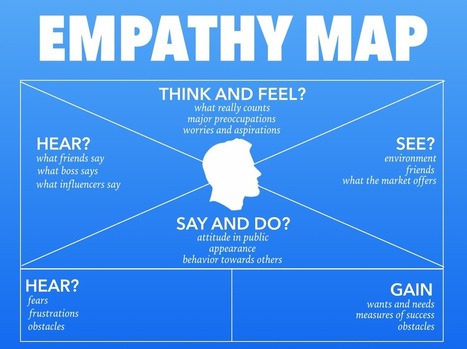
The exercise that will help to best achieve this goal is called the customer empathy map. True to its name, this exercise will force you to empathize with your customers on a deep level in order build out a robust profile of what they experience and feel on a daily basis.
Whereas the MVP only asked about your audience in rough terms, the customer empathy map helps drill down specific, categorical insights into the thoughts and feelings of your ideal customer.
Depending on the variability of your audience, you might need to complete more than one empathy map.
*Presented at the UX Cocktail Hour in June 2015 at Philips Headquarters, Amsterdam*
We create things for other people. When we feel what others are feeling, we understand them and connect much more deeply than with just market research or personas.
Empathy allows us to forge these deep connections by understanding people on a personal level. This talk discusses why empathy is important as well as how we can feel empathy ourselves, how we can help others feel it, and how we can create things that help people empathize with each other.
The saying goes, “to walk in someone’s shoes is to understand her.” What most people miss is that there is no way to walk in someone’s shoes if you don’t know what that person is thinking or feeling. Instead, you make assumptions and let those assumptions guide your behavior and decisions. Worse, you don’t realize you’re doing it, which makes assumptions pernicious.
What if you could become more skillful at recognizing and dispelling your assumptions? What if you could gather reliable understanding about how another person reasons, in order to have smoother collaboration and richer creative ideas? Cognitive empathy is about having a curious mindset, interested in understanding how another person reasons.
This workshop is not about team-building, conflict-resolution, or culture change. There is no group-sharing. It is about practical abilities that you can develop as a part of your own skillset. You’ll be cultivating abilities that can ultimately bring about a new way of collaborating within your organization.
My gut tells me that while we can try, pure empathy is unlikely, in design and in management. So, we came up with a modification: Problempathy. Where empathy is about putting yourself in the user’s shoes,
Problempathy is about putting yourself in the problem’s shoes; e.g., when we are redesigning an app, we take on the perspective of the app. Problem statments now sound like this: “I wish I could do more, but my designer forgot a feature that would have really helped the user,” or “I’m embarrassed I keep crashing.”e
There’s one skill that every wildly successful product manager, UX designer, businessperson, and leader has in common. It helps them unite teams and ship products that customers love time and time again. What could possibly unite all these technologists?
It’s conscious and deliberate empathy.
Most people believe empathy is just about being compassionate, like lending your friend a shoulder to cry on when they’re going through a breakup. Others dismiss it altogether as a distraction, because they believe it’s more important to be efficient, focus, and get stuff done!
Well, it just so happens that when a company is plagued by lack of motivation, missed deadlines, and high employee turnover, often it’s because employees feel that their teammates, bosses, and management don’t “get them.”
Helping organizations create empathy with the people for whom they design solutions means being totally present with the widest cross-section of humanity imaginable.
Given the variety of clients, we have the privilege to meet a lot of people – from soldiers to housewives, chemists to poets, wealthy to subsistence-level poor, athletes, butchers, warehouse workers, doctors, CEOs, you name it.
Typically, the more you constructively engage people with creative endeavors, in an air of respect, they open up. The trade term is empathy; however, empathy is such a clinical-sounding phrase. How about humanizing instead of empathy?
Understanding is what designers should be striving for as the backdrop for products.
Empathy is hot right now. It’s being posited as one of the key characteristics that sets designers apart. (As though we have a monopoly on it.) But empathy is only a stepping stone on the way to a more important place: understanding.
Understanding encompasses not only the experience of being the user (empathy), but also the forces working against the user, be they technology, business, other people, or culture.
Empathy will get you to see the problems from the users’ perspective, but not the solutions. If users could design a solution to their problems, they would. But that’s your job as the designer.
Users know everything there is to know about their situation, but might not have the overall understanding of the space that you should have because you’re looking at the problem from many angles, not just from one (the user’s).
I recently connected with veteran designer Scott Jenson, who is currently developing the Physical Web Project with the Chrome team at Google. We’ve been talking quite a bit about empathy in the past few months here at O’Reilly, and Scott’s recent blog post, The Paradox of Empathy, caught my attention. I sat down with him to learn more about his thinking around empathy and to talk about his work on the Physical Web Project.
Empathy is part of every great designer’s toolkit
Jenson is often asked for recommendations for learning the next tool, or program. but as he explains, learning how to empathize is fundamental to product design:
When I reflected on what I wanted people to understand, what the core thing was, it wasn’t a technique. It wasn’t a visual style. It wasn’t learning a certain program. The core thing was making sure that you never thought about the product from your point of view, but from somebody else’s point of view. That’s what prompted the [The Paradox of Empathy] post.
perhaps the single most important difference between traditional UX and UX for EdTech is how empathy with users differs.
Empathy is always of paramount importance in the UX process; it should be able to help the UX team and its organisation go beyond the “what” of requirement analysis and understand the “why” of it better:
“Empathic design is the process of developing an understanding of users, not just their overt needs, but of their constraints, practices, problem-solving approaches, contexts, and the interrelations between people as a whole.”...
Empathic and caring design are, of course, no substitute for the aforementioned practical design guidelines and traditional design knowledge. However, they are principles that can facilitate and greatly enhance the UX design tradecraft, and significantly benefit the learners.
The best product managers, designers, product teams, and leaders are experts at practicing empathy. But empathy is not what you think.
Ask anyone what empathy is, and they'll say it means to walk in someone else's shoes. And that is part of it. But walking in someone's shoes is how you apply empathy.
First, you need to develop empathy. In this on-demand webinar, Indi Young shows you practical ways your team can develop and practice empathy to help understand your users and make better decisions.
This webinar is for anyone who is working to deliver useful products, content, and experiences that delight their customers.
The Empathy Map is a powerful tool to visualise and project yourself into your ideal audience/customers shoes and understand them deeply within a particular environment/context.
How To Create An Empathy Map 1. Give your empathy map a name (like Phil or Susie), just any name that matches your ideal customer. 2. Then using a mind map, divide it into 6 sections with each one answering these following questions:
SEE: What does this person see? What does it look like? Who surrounds them? What problems does she see?
Empathy is a capability of experiencing the world as another person would. It is one of seven mindsets that make human centered design a unique way of solving problems
Human centered design elevates design from functionality and aesthetics or a study to creating for the experience of a person and sometimes to an approach to life - a design way of seeing life.
It ensures that the person we are designing for is our point of reference in seeing and understanding the problem and coming up with a solution.
Could a greater miracle take place than for us to look through each other’s eyes for an instant? Henry David Thoreau
Recent studies have shown a drop in empathy in the past 30 years among college students, and especially in the last 10 years. (Konrath et al., 2011.) Lack of empathy is a social problem, because we lose the capacity to connect with each other and therefore the ability to communicate, share, and solve problems together. Many facets of society are affected by empathy.
As people are losing their empathy, they are becoming indifferent to the difficulties and sufferings of the others. This results in lack of altruistic behavior.
This project starts from this point of view. Empathy is one of the vital emotions for well-being life as well as an essential component of human social life. This is therefore not only a personal problem, but becomes a very important social issue.
A look at how empathy is needed in all domains these days, especially for business innovation and design thinking.
EMPATHY IN MARKETING In the advertising world for instance, there is a lot of talk about finding “the story”, because stories help us relate and empathize...
EMPATHY IN DESIGN In realm of design, design-thinking is rooted in empathy, where you try to see from the perspective of a user of a given design or product. There is a lot more to design thinking than that, but in a nutshell it is about human centered design where empathy is king...
EMPATHY IN HUMAN SERVICES In the social services field I’ve been striving to lead new thinking in, there is also a focus on empathy when designing quality support services...
EMPATHY IN CREATIVE FIELDS One last example I have for this whole empathy thing being a big deal for creativity and innovation is something Greg Saunier of the band Deerhoof said in an interview I did with him a while back....
Design thinking is a concept that centers around applying creativity and innovation to our actions, decision making, and problem solving as human beings. More significantly, it focuses on the impact that this creative and innovative thinking has on individuals.
As a concept, design thinking can be used pedagogically to enhance our teaching practices. As a tool, it can be used to foster and teach empathy in the classroom.
The core principles of design thinking are to empathize, define, ideate, prototype, and test. Teaching design thinking can be a powerful way of teaching students empathy in that it teaches them how to solve another person’s problems by providing creative and innovative solutions that relate to his or her needs.
Scheduled for Jun 24, 2015 Join UX Melbourne live online at our June Book Club where Indi Young will be joining us in this Hangout to discuss her latest book, "Practical Empathy". 25 June at 08.15am AEST
I was recently blind for five minutes and felt as though my eyes had never been more open. I didn't have some freak accident or momentary medical issue; I was participating in a mini human-centered design challenge at an event hosted byIDEO.org and NY+Acumen to introduce basic concepts of human-centered design.
In addition to putting humans at the center of product and systems design, we need to bring back human-centered community.
The immersion process of human-centered design enables empathy, which as Reboot, the social impact design firm says, "enables the insights that drive breakthrough solutions;" but it also enables happiness, personal fulfillment and a greater sense of community.
So why not put ourselves in the shoes of our friends, families and communities and bring empathy and humanity back to the center of our products, services and personal connections?
Felicity Mitchem explores the human-centred design and empathy, bringing it all together with cows.
Empathy is a social skill that has become a buzzword in the design world.
The idea of using empathy as a design advantage is not new. Twenty years ago we began to see a shift from design having an objective perspective, where designers would work from their own assumptions, to a human-centred perspective, in which designers involved users in the process and put them at the heart and centre of the process.
Empathy is one of multiple ‘mindsets’ that form the Human-Centred-Design (HCD) methodology.
One particular case that illustrates the power and simplicity of using empathy is from Temple Grandin, a professor of animal science. Temple is famous for innovating in the livestock industry.
A design process paved with empathic observations will lead you, slowly and iteratively, to a better product.
If I’m ever asked what’s most important in UX design, I always reply “empathy.” It’s the core meta attribute, the driver that motivates everything else. Empathy encourages you to understand who uses your product, forces you to ask deeper questions, and motivates the many redesigns you go through to get a product right.
But empathy is a vague concept that isn’t strongly appreciated by others. There have been times when talking to product managers that my empathy-driven fix-it list will get a response like, “We appreciate that Scott, but we have so much to get done on the product, we don’t have time to tweak things like that right now.” Never do you feel so put in your place when someone says that your job is “tweaking.”
The best product managers, designers, product teams, and leaders are experts at practicing empathy. But empathy is not what you think.
Ask anyone what empathy is, and they'll say it means to walk in someone else's shoes. And that is part of it. But walking in someone's shoes is how you apply empathy.
First, you need to develop empathy. In this on-demand webinar, Indi Young shows you practical ways your team can develop and practice empathy to help understand your users and make better decisions.
This webinar is for anyone who is working to deliver useful products, content, and experiences that delight their customers.
The discipline of product management is shifting from an external focus on the market, or an internal focus on technology, to an empathetic focus on people.
While it’s not too difficult to rally people around this general idea, it can be hard at first to understand how to translate it into tactics. So in this article, I’ll walk through how we applied this approach to a particular product at a start-up, and how it led to large-scale adoption and, ultimately, the acquisition of the company...
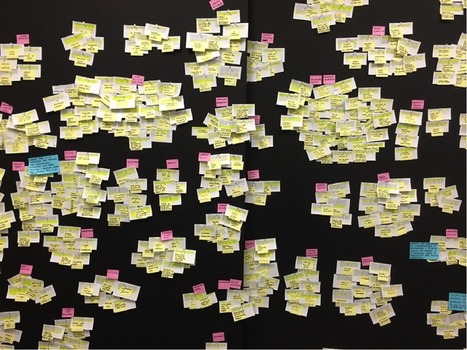
The input of our behavioral research is a profile of the type of people we want to empathize with. The output of our research is a massive data set of verbatim utterances, exploded into individual, moveable parts....
We build on our own life experiences, and as we leverage our student-focused empathetic lens, we make inferential leaps....
1. Collaborative and creative empathy doesn’t equal sympathy
When we think of empathy, most of us imagine having compassion for someone else’s situation. But when it comes to collaboration and creativity, empathy can be a bit different. In this context, the goal of empathy is to support and understand the intent and purposes of others, which in turn will help you obtain insightful feedback.
Proponents of Universal Design believe in the value of taking an inclusive perspective of what is “normal” for humans. NYC-based producers of kitchen utensils, office supplies and housewares, OXO, explains:
A.J. Paron-Wildes, architectural and design regional manager for Allsteel, as she talks about the personal inspiration behind her work with design empathy.
To get content containing either thought or leadership enter:
To get content containing both thought and leadership enter:
To get content containing the expression thought leadership enter:
You can enter several keywords and you can refine them whenever you want. Our suggestion engine uses more signals but entering a few keywords here will rapidly give you great content to curate.


 Your new post is loading...