Creating a Customer Empathy Map builds empathy towards your targeted audience to identify your users’ needs and pain-points to help your design process.
Although the two words sound the same, they mean two different things.
Empathy is when you feel and understand someone’s feelings, attitude, and experiences. It is the understanding of other’s experiences with everyday life events.
Sympathy is related to feeling sorry for another person’s grief and troubles.
When you walk into the large basement of the church and look at the faces and ages of the group, you are looking at the reality of homelessness in Washington, D.C. Each person’s story and struggle vary. As part of the Identity and Service Learning class, ninth grade students from St. Andrew’s Episcopal School in Potomac, Maryland are dining with the meal participants as a way to hear and understand the stories and apply a creative and empathic design process to solve some of the challenges they hear about.
...But schools today must do more than simply illicit emotion – they must inspire creativity and engage students in the process of empathic design....
We use empathy to guide research and creativity to design solutions. Through the design process, students can give tangible expression to the meaning they experience. Schools should be the place where students’ creativity is combined with deep content, relevant skills and innovative finesse.
Encouraging empathic engagement in this way brings out the best in our students, allows for creative thinking, and nurtures the well being of all involved.
In this article, they use the philosophy of "Design is the magic. Creativity is the mindset. Imagination is the root. Humanity is the purpose. Innovation is the result." I believe this philosophy is great to focus on encouraging students addressing meaningful problems in the community. They use empathy to guide research and creativity to design solutions.
Most companies consider strong product management to be the “glue” that holds together products. Modern startups have proven that industry disruption is possible not by focusing on adding features or improving sales, but instead by providing deep, meaningful engagement to the people that use the products or services.
Design leverages a certain way of thinking that ensures products have emotional appeal and a strong market fit. In this talk, you’ll learn how to apply that process yourself.
Working on and with the web is engaging in that most human of endeavors: Communication. Even so, it’s easy to forget that the people we interact with and those who access and interact with our creations are just that: People. Learn how to make empathy and acceptance driving forces for your interactions and designs to build great informational experiences for everyone.
On the outside, this flow seems like a simple concept. So why is it so hard for everyone to implement? The answer is both simple and complex but boils down to one simple fact. Empathic design requires empathy, and people who are involved in the technology industry suck at empathy. You and me both - double points if you are skipping lunch with your team to read this article.
We all suck at empathy The ability to understand and identify with another person's context, emotions, goals, and motivations
Like it or not, research confirms that people in IT suck at empathy. A survey of 441 people measured whether they were more “systemizers” or “empathizers”.
An opportunity maker has two elements that an opportunity taker lacks; initiative and innovation. These skills can be developed through combining empathy
An opportunity maker has two elements that an opportunity taker lacks; initiative and innovation. These skills can be developed through combining empathy and design thinking, creating a spiral of success. Genuine Opportunity Makers create opportunities for others to succeed. Making opportunities is not about an egotistical need to better oneself (although that implicitly occurs through developing empathy) nor is it about virtue. Rather, it’s about finding a need, empathising with those in need and making that need into an opportunity to use our learning for a purpose.
Developing empathy is vital. Developing empathy through design thinking is like poetic justice (pun intended). In this presentation, you’ll be immersed in out-of-the-box case-studies and practical strategies for developing empathy in your students, your colleagues and yourself.
What disrupts empathy? In the study by the Max Planck Institute, participants were paired up, and each person was shown an image that was either pleasant or unpleasant. At the same time, they were each given something equally pleasant or unpleasant to touch, such as soft fur or slime. (The tactile stimuli ensured that participants’ thoughts wouldn’t trump their emotions in subsequent decision-making.)
The outcome was striking: When experiencing different stimuli, the participants were more likely to project their feelings and circumstances onto the other person, rather than the other way around, confirming that empathy relies on being in a neutral or shared state.
“Up to now, the social neuroscience models have assumed that we mainly draw on our own emotions as a reference for empathy. This only works, however, if we are in a neutral state or the same state as our counterpart—otherwise, the brain must counteract and correct,” stated Tania Singer, who headed the research team.
We’re all aware by now that empathy is a hot topic in the design and technology world. VR, periscope, emojis, gifs, etc are technologies attempting to improve the human experience in a fundamental way: by allowing people to see and be seen emotionally by the world around them. Despite all the noise around this topic, it’s not always clear whether, as a community, we share a common understanding of its origins and how we might practice it.
A fellow collaborator and lead developer, Nick Cox, recently wrote about the origins of empathy, focusing on how recent neuroscience discoveries have shown that empathy is a real and tangible muscle in the brain, one that gets stronger the more it is exercised. But what does it mean to exercise our empathetic muscle? And if we exercised this muscle, might it actually bring lasting change in our work and in our teams?
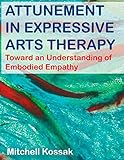
Attunement in Expressive Arts Therapy: Toward an Understanding of Embodied Empathy addresses how the arts in practice and in therapeutic contexts offer expanded ways of being attuned to emotional states and life conditions with individuals, relationships, groups, and communities.
Each chapter clearly articulates how to utilize the arts in order to tune in to self, other and a larger mystical, sacred or spiritual presence.
This book allows the reader to intimately enter into the core essence of what artists and arts based therapists experience in their studios and in the practice of expressive arts therapy.
Through a solid theoretical grounding that draws on an interdisciplinary understanding of how rhythm, resonance, improvisation, relational-attachment, intimacy, developmental play, transpersonal psychology and multiple intelligences contribute to an embodied experience of empathy, poignant stories from the author's 35 years as an artist and therapist come alive, allowing the reader to experience the spirit and essence of how the arts have been used throughout history to maintain healthy physical, emotional and spiritual well-being.
The most successful products are built by engaged and creative teams that are able to integrate a diverse set of voices throughout the development process. Through my work at Dev Bootcamp, I’ve come to realize that empathy, a driver of meaningful connection, is the key component in creating an inclusive, open and collaborative culture.
And as it turns out, empathy, just like coding, is something you can learn! In this talk I’ll give you some insight into how I teach it to our staff and students, and in the future, the tech community at large.
Empathy Doesn’t Have to Break the Bank Most of our partners have limited time and resources. Heck, don’t we all? That’s why we’ve crafted a four-week process we call the Workshop Phase, and the cornerstone of that process is empathy with touchpoints.
By timeboxing the empathy process, we force ourselves to get creative and use a mix of tools to accomplish initial validation.
Here are just a few:
Surveys. Sending web/social media surveys to current users/customers asking about key hunches and assumptions.
Observation. Choose a time and place to just sit and observe the problem as it’s happening (like my “visit” to the ER). Visits. Spend an hour in the home or other familiar-to-them place of a touchpoint. Chat with them. Ideate with them. You’ll get a well-rounded view of a few real people and their acute pain points.
Googling. Mine existing research touching on issues relevant to the problem statement.
Empathy is the ability to understand and share the perspective, beliefs and feelings of another person. Empathy is the foundation of good marketing, whereby a marketer has such deep understanding of the customer that they can build products and services that the customer wants and is willing to pay for.
Empathy is also crucial to entrepreneurs, leaders of all stripes, managers of people, salespeople, in fact, we need empathy in almost every role in society.
UDL requires the content, the creator, and the distributor of content must consider how ALL the people in the audience, including those with disabilities and special needs might access the information. By addressing any perceived limitations in your content, you are raising the quality and reach of your valuable content.
Consider the hard-of-hearing, visually impaired, those using pdf readers (include descriptions of visuals), visual learners, and those with other learning differences whenever creating new content. By extending and expanding your planning efforts, you will be helping those of us with disabilities to "get" your message too! We all appreciate you designing quality and caring content, and it helps those of us who are NOT disabled too!. ADA laws protect the rights of those with disabilities, but only content and website designers, teachers, performers, and programmers can make the important upgrades/differences in context and content that help make their creations really accessible! High contrast print, larger fonts, images with descriptions, captions for verbal speech in videos, these are the best place to start when improving your designs for curriculum.
The role of empathy in customer experience is an increasingly popular – and important factor – in how we understand and manage our customer relationships. Listed below are a few easy ways to start building customer empathy within your company:
Ethnographic research. Go out and observe the customer using your products and services. It can be very eye opening to observe this first hand, particularly if you have key leaders and decision makers participate.
Customer immersion rooms. Set up a room to include the various interaction points that customers use. This is becoming a great way for a broader internal audience to understand the customer experience in a first-hand way.
Sharing the customer journey. Customer journey mapping is a popular way many companies today are trying to understand customer experiences...
There are many ways to build empathy when stakeholders’ experiences are foreign to you. The best method is in-context research, which allows you to observe what users do and how their environment — other people, spaces, tools, sounds, etc. — impacts how they complete the task they intend to accomplish.
Why is the person attempting the task in the first place?
What makes the task easy or difficult?
What workarounds has the person invented?
How does the person feel physically and emotionally while working on the task?
Sometimes in-context research brings you to some fascinating or far-flung places, and combining observation with in-context interviewing provides a rich data set with which to design. (Note that interviewing alone, especially when done out-of-context, introduces social acceptance bias and misses out on the opportunity to spot elements the user sees as normal but you spot as pain points.)
Empathy is a critical ingredient especially when designing for an unfamiliar environment.
Therefore, after design researcher Helena Sustar’s keynote on design for immigrants, we jumped on a bus heading to the reception centre. Wandering around, observing, and interviewing the inhabitants and staff was an immersive, eye-opening experience. ...
Into the making mood
Based on the findings from the field study the teams created empathy maps and described the current user journeys of asylum seekers.
Having identified pain points, the teams went on to generate ideas for possible solutions, inspired by Phil Lindberg’s talk on Fjord Trends and the idea of Living Services.
User-Centered Design is surprisingly difficult. One of the biggest issues, certainly for those with no HCI or usability experience, is a lack of appreciation of how users think and work.
Their assumption is that users will approach and solve problems in the same way as the designers and developers of an interactive solution. Extreme examples of this self-as-user outlook is the belief that interaction problems are either the direct fault of users or the failure of users to follow instructions (the 'RTFM' syndrome [9]).
This paper explores a psychological explanation of the self-as-user outlook through Empathizing-Systemizing theory, including a large-scale study (n = 441) of men and women working in the Information Technology field.
The study found that men whose role was technological had significantly lower empathizing scores. The results of the study help to explain the self-as-user outlook and how it needs to be overcome in the design process.
When it comes to increasing your capacity for empathy, the journey can be a lot like chasing happiness or love or any other elusive and sometimes fleeting emotion. Empathy might find you, but sometimes you just have to choose it.
Science tells us that, in any given moment, we either feel empathy or we don’t—and that we’re even able to recognize when we’re not feeling empathy in a moment when we should and autocorrect. That’s because the brain’s capacity for empathy is elastic and when we believe we can be more empathetic, we can be.
"Empathy takes practice, empathy can be improved, and if you’re willing, it can transform all of us—both professionally and personally." Magali Charmot
Here are further ideas and resources for global scale Design Thinking projects:
"Empathy on the Edge": An essay on exploring how empathy Design Thinking works.
"Extreme By Design": An interactive experience designed for 4th through 12th grade students, to be completed after watching the Extreme By Design documentary. Learning Episode 1 ("Being an Innovator") will help students think and act like innovators using the design thinking approach.
"A Design Challenge to Students: Solve a Real-World Problem!": This blog provides a couple of design challenge ideas to use with elementary and high school students.
The Ethics Institute at Kent Place School: This innovative program will bring teams of educators and students from schools across the metro-New York area to the Kent Place School campus to develop new approaches and solutions to complex real-world issues within their respective school communities using methods adapted from the Ethical Decision-Making Model and Design Thinking.
"Design Thinking, Making, and Learning from the Heart": A blog highlighting the process of design thinking to redesign high school social studies curriculum.
Virtual reality is in the eye of the beholder. Filmmaker and entrepreneur Chris Milk optimistically calls VR an “empathy machine,” while the Wall Street Journal warns that VR’s “hype is about to come crashing down.” Across this spectrum of opinion, the only thing everyone can agree on is that it’s a newly accessible medium offering novel experiences for audiences. Do these experiences lead to empathy?
If you define empathy as, “knowing and feeling what another person knows and feels,” of course some VR stories do. So do some books, radio programs, and movies — each in their own way. Saying VR is an empathy machine is like saying a paintbrush is an art machine. There are myriad ways to generate aspects of empathy with media, just like there are infinite ways to create forms of art with tools.
In this next phase of the week we’ll start to step outside of the Drawing Board mindset and shift gears as a team. Keep that creative energy high by doing some much-needed research and extending the vision of the work you’re doing. It might sound scary, but this step is important! As you pair your problem with your hunches and start to think about how to research them, keep this simple idea in mind: Whenever you can, prove a hunch with a test...
Here are the ways we use to get there as a team.
Interviews — This should feel similar to the homework from Week 1, so continue to find people who can help you understand the problem deeper. ...
Co-Create — One simple way to keep learning is to invite others to design and think alongside you....
Analogous Research — Are you building a website? Or maybe it’s a service or program?....
Immersion — Maybe the simplest thing to do is to immerse yourself in your problem...
The goal of all of this outside learning is to try to get to a place where you can empathize with the people and problems more deeply.
Empathy is the one discipline that can make or break your innovation work. And, as Daniel Pink wrote,
"Not only is empathy hard to outsource and automate, but it makes the world a better place." So how do we make empathy a discipline when we are looking to accelerate and scale impact through innovation in our organizations, programs, and products?
We'll cover concrete ways that you can implement, and share lessons learned from years of experience.
Empathy They can see the world from multiple perspectives: children, parents, clients, entrepreneurs, users, etc. They take a “people first” approach in designing their solutions, notice things that others do not, and use insights to inspire innovation.
Integrative Thinking They do not only see a problem from one point of view, but they see all aspects—even the contradictory— to create novel solutions that go beyond and dramatically improve on existing alternatives.
20:55) So you talk about the role of empathy and that permeates this so tell us about empathy and why does that matter in all of this.
John Maeda:21:16) Well this is a very revealing and embarrassing to how little I know on Sundays is when Joe Gebbia one of the cofounders of Airbnb also a graduate of the school that I led would come to campus and talk about how important it is to design as empathy especially in Silicon Valley, and I totally didn’t know what he was talking about. Because to me it’s kind of obvious that you have to care what the customer feels well, you know.
(21:47) But, if you think about the word empathy, and the world of pure software engineers, you have to remember that empathy isn’t part of the goal. The goal is to execute on durable code, test it with code. Code that won’t fall down, like a bridge maker, like a person who designed a bridge wants to make sure number one, it doesn’t fall down. So engineers in Silicon Valley due the important job of making that it will scale and won’t break.
But while they are busy doing that they need to think about the person that’s going to cross the bridge. And designers in Silicon Valley, have been bringing in the viewpoint, which is obvious to everyone, but not the people with the hardware making the bridge stand that we have to ask the question, but how does a person crossing the bridge feel? Empathy.
So empathy is what designers bring to the table all the time. They ask how does that make you feel, and how can I make you feel better? How do I improve the experience?
To get content containing either thought or leadership enter:
To get content containing both thought and leadership enter:
To get content containing the expression thought leadership enter:
You can enter several keywords and you can refine them whenever you want. Our suggestion engine uses more signals but entering a few keywords here will rapidly give you great content to curate.


 Your new post is loading...