Your new post is loading...

|
Scooped by
Edwin Rutsch
September 20, 2016 1:05 PM
|
Empathy may feel like a buzzword these days, but its power is real. Like any skill, empathy requires some practice. This week, writer Jennifer Winter teaches us 3 exercises to teach empathy to teams. Teams benefit, too. One of the key factors for a successful team is the presence of empathy. Yet this skill isn’t always something that developers, designers, marketers, or managers are taught early on in their careers. So how do you help your team hone their empathetic skills? Like any skill, empathy requires some practice. Growing up, my parents taught me that qualities like toughness and persistence were most important. They’d convinced me that if I could survive a challenging situation or keep trying, I’d eventually reach my goals. This mindset can make the idea of empathy in business something that sounds nice in theory, but challenging in practice for some employees. - Exercise #1: Curious George or Georgina
- Exercise #2: Weekly highs and lows
- Exercise #3: Active listening
|
|
Scooped by
Edwin Rutsch
September 13, 2016 7:13 PM
|
In IBM’s design bootcamps, empathy—the ability to understand another’s feelings—has been a mantra for groups trying to better connect with colleagues and clients. They learn about rapid prototyping, team dynamics, problem solving, and how to tap into their customers’ and colleagues’ feelings and concerns to come up with better tech solutions.
|
|
Rescooped by
Edwin Rutsch
from Empathy Movement Magazine
September 4, 2016 1:30 PM
|
A workshop activity that forges alignment on user needs, goals, and pain-points, Persona Empathy Mapping bridges the gap between personas and design concepts. Empathy: it’s a buzzword in the UX design world. Everybody’s doing it! But what exactly are they doing? There isn’t a quick “Empathy Filter” that we can apply to our work or our team, no formula to pump out results, and no magic words to bring it forth. There is, however, a simple workshop activity that you can facilitate with stakeholders (or anyone responsible for product development, really) to build empathy for your end users. At Cooper, we call it Persona Empathy Mapping... Persona Empathy Mapping is a workshop activity that builds empathy, gains alignment around user needs, goals, and pain-points, and bridges the gap between personas and design concepts. For more information about bringing a Persona Empathy Mapping workshop to your company or other custom training programs, take a look at Cooper's current course offerings. by Nikki Knox
|
|
Rescooped by
Edwin Rutsch
from Empathy Movement Magazine
August 31, 2016 6:12 PM
|
In his book “Change by Design,” Tim Brown describes empathy as “the mental habit that moves us beyond thinking of people as laboratory rats or standard deviations.”
Unlike the marketing research that deals with numbers and facts, empathic design tries to meet users’ needs and even thinks in terms of what they may need to make their life much easier. Empathic design aims to build an emotional relationship between the end consumer and the product by achieving a better understanding of the user experience and users’ needs at an early stage of new product development (NPD).
While other marketing methods put a high priority on the product and its sales, empathic design puts the end user and building that emotional connection between the consumer and the product first. Putting the consumer first can be considered a strong marketing objective of empathic design. Rafiq Elmansy Further readings: Empathy on the Edge PDF (2014) by Battarbee K., Suri J., and Howard S. (IDEO) Change by Design (2014) by Brown, T. (IDEO) Spark Innovation Through Empathic Design by Leonard D. and Jeffrey R. (Harvard Business Review)
|
|
Rescooped by
Edwin Rutsch
from Empathy Movement Magazine
August 25, 2016 1:25 PM
|
At Sub Rosa, a Manhattan-based strategy and design studio, enabling employees to escape their biases and develop a more empathic form of reasoning is vital to the agency's core philosophy and daily practice. Not only have they launched a successful podcast on the topic, they've also made empathy an integral part of their office's culture.
Michael Ventura, Sub Rosa's founder and CEO, recognized a deficit in the way empathy was discussed and practiced in agency culture.
"So many of the articles that we read and see out in the world are very theoretical when they talk about empathy," Ventura said. "It sounds very squishy. It sounds very loose, sometimes a little hippy-dippy. We really wanted to think about how empathy can be practically applied, and what is the process that would take." by Karla Cook
.
|
|
Rescooped by
Edwin Rutsch
from Empathy Movement Magazine
August 25, 2016 1:25 PM
|
SAP has announced a new OpenSAP course around the topic of design called “Basics of Design.” This is not a technical class in nature, but it hits home on what I think is the most important part of designing interfaces for end users. What is that part you ask? Empathy!
There are lots of buzz words that float around the SAP Design Thinking space, however empathy should not be considered one of them.
To me one of the hardest and most interesting parts of leading a Design Thinking session is the empathy/observation phases. The empathy/observation phases can be very difficult for a design thinking session leader to get through, as it can go many directions. A few examples of the difficulties that arise during this phase can be:
|
|
Rescooped by
Edwin Rutsch
from Empathy Movement Magazine
August 25, 2016 12:46 PM
|
In a 2011 study for Social Psychological & Personality Science Journal, test subjects were asked to view a series of faces and then describe what emotion they saw in each face. The idea was to test their ability to imagine what another human is feeling – the characteristic we call empathy.
Although results naturally varied from person to person, most people showed good skill at correctly identifying the facial expression they saw. The interesting part came when analyzing the video recording of each user test. High-speed cameras revealed that, before answering, each test user momentarily copied the expression they saw in the photo. These so-called ‘microexpressions‘ were completely involuntary, unconscious and often barely perceptible to the naked eye, but seemed to help the subject make sense what they were seeing. The obvious question: what would happen if we blocked these microexpressions? Alex Walker
|
|
Rescooped by
Edwin Rutsch
from Empathy Movement Magazine
August 24, 2016 12:56 PM
|
When introducing Design Thinking, elementary school teachers often worry that younger students cannot truly engage in empathy - the first step in the process - because they lack the initial experiences. Julie Colantoni, a first-grade teacher in Medfield, MA, raised this concern during a Design Thinking introduction in an EdTechTeacher workshop. However, a few days later, when faced with a "bathroom challenge," she decided to trust the process. First, Julie presented to her students that a problem existed in the school's bathrooms. Though guided, the students began to engage in empathy.
- Why might this be a problem?
- Who does this problem impact?
- What could we, as first graders, do to fix this problem?
With those prompts, her students dove into the Design Thinking process. They came to their own realization that their actions impacted others and that this issue caused extra work for the school custodian. In essence, they defined the problem for themselves. By Beth Holland
|
|
Rescooped by
Edwin Rutsch
from Empathy Movement Magazine
August 16, 2016 7:48 PM
|
When I read the increasingly frequent criticisms of empathy, that same cultural pendulum comes to mind. Yale Professor Paul Bloom, the architect of much of the recent anti-empathy opinion, has written critically of empathy for several years. His thesis: Empathy is a “parochial, narrow-minded” emotion that misleads us into making bad decisions. In a video promoting his upcoming book, he says, “Empathy is fundamentally, from a moral standpoint, a bad thing.” He claims, “It makes the world worse.” His solution is to employ a “cold-blooded” rational compassion that takes emotion out of the equation. by John Payne, Moment
|
|
Rescooped by
Edwin Rutsch
from Empathy Movement Magazine
August 16, 2016 12:43 PM
|
When I read the increasingly frequent criticisms of empathy, that same cultural pendulum comes to mind. Yale Professor Paul Bloom, the architect of much of the recent anti-empathy opinion, has written critically of empathy for several years. His thesis: Empathy is a “parochial, narrow-minded” emotion that misleads us into making bad decisions. In a video promoting his upcoming book, he says, “Empathy is fundamentally, from a moral standpoint, a bad thing.” He claims, “It makes the world worse.” His solution is to employ a “cold-blooded” rational compassion that takes emotion out of the equation. by John Payne, Moment
|
|
Scooped by
Edwin Rutsch
August 10, 2016 1:40 PM
|
How might we encourage and develop empathy with our clients? The idea was simple, it’s practically a role play: each week one person from the team “steals the client’s mind” and plays the role of our internal client for a full day. The person holds off from their daily job of being a copywriter/designer/client service director/strategist/trainee/project manager/CEO/insight analyst/etc. and steps into the client’s shoes to look at the creative solutions through the client lenses. Our internal client observes the presentation, gives detailed feedback to them by challenging, asking, and learning why the concepts are the way they are. The role of the internal client rotates between the team members in each concept creation session. We arrived to the conclusion that with this ritual, each team member has the chance to understand the client’s motives and decisions better.
|
|
Rescooped by
Edwin Rutsch
from Empathy Movement Magazine
August 5, 2016 3:02 PM
|
Working in the world of design, I hear a lot about leveraging empathy to make great experiences with products. Empathy has become a cornerstone of Human-Centered Design because you approach every problem by first listening, then searching for understanding, and finally developing a feeling for what it’s like to walk in a person’s shoes. The process of developing empathy allows you to create solutions for known desires and pain points instead of assumptions and gut feeling.
|
|
Scooped by
Edwin Rutsch
July 29, 2016 12:21 PM
|
Empathy is a skill great designers have. They are able to connect with their users to create experiences, services or products that will help them. Thus, putting empathy at the heart of your business means that you are committed to make the world a better place. Being empathetic is being user-centric, and not just saying you are . But when you are able to open your heart to others, you will also experience the downsides, that is to say, you will also feel all the pain around you, all the despair and the anger. And that is not easy. It is not an easy job but someone has to do it, as they say…
|
|
|
Scooped by
Edwin Rutsch
September 18, 2016 1:39 PM
|
And it strikes me that the same thing is happening now with this new enthusiasm for empathy: it seems well-intentioned and benign, but it looks seductive, and in some cases it’s surely plain old business masquerading as something else.
All of which is why a misreading or misapplication of empathy is more than just misguided, but actively risky. Medium.com overflows with thoughtful pieces on empathy, and empathy’s importance in design in particular. This post, meanwhile, makes a direct causal link between empathy and revenue, or at least its infographic does: KEVIN BRADDOCK
|
|
Rescooped by
Edwin Rutsch
from Empathy Movement Magazine
September 12, 2016 11:23 AM
|
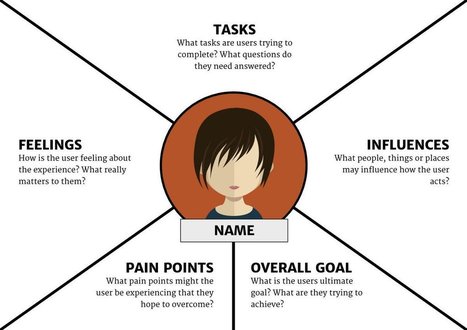
What is an empathy map?
An empathy map is a collaborative tool that teams can use to better understand their customers. It consists of an image of the customer surrounded by six sections. These sections are:
- Think and feel. What matters to the user? What occupies her thinking? What worries and aspirations does she have?
- Hear. What are friends, family and other influencers saying to her that impacts her thinking?
- See. What things in her environment influence her? What competitors is she seeing? What is she seeing friends do?
- Say and do. What is her attitude towards others? What does she do in public? How has her behaviour changed?
- Pain. What fears, frustrations or obstacles is she facing?
- Gain. What is she hoping to get? What does success look like?
|
|
Rescooped by
Edwin Rutsch
from Empathy Movement Magazine
August 31, 2016 6:12 PM
|
Persona is one of the tools that is used to build a better understanding of user behavior either in UX research or in marketing research by building a virtual avatar that represents the target consumer’s characteristics. However, achieving empathic design requires more than just drawing a virtual character that represent the target consumer, it also requires that designers put themselves in the shoes of the consumer to learn more about what they love, hate, think, and feel about the product. This target can be achieved through building a persona empathy map that can bridge the gap between the virtual character’s persona and the real consumer’s experience. Rafiq Elmansy
|
|
Rescooped by
Edwin Rutsch
from Empathy Movement Magazine
August 25, 2016 1:25 PM
|
When building a great product or service, you need to build a user-centric ecosystem of processes and people. It’s not a change you can effect in a couple of days, however some aspects of it can be implemented relatively quickly. The first step is gradual investment in understanding and designing for your customer. Once you start applying user-centered research methods into your product design process, all of the stakeholders will sure see the benefits. They are not just tangible, quantitative results, but can help to build you resonance with your audience, empathy that so many companies are lacking. In this article we highlighted the most popular user research methods and aim to prove the usefulness of using them in teams of any size. Relationships with the customers and in-depth understanding of their needs are becoming the competitive advantage of many successful companies. Michal Mazur
|
|
Rescooped by
Edwin Rutsch
from Empathy Movement Magazine
August 25, 2016 1:25 PM
|
Everybody is talking about empathy. Empathy in everyday life; empathy in work; empathy in design. The latter is fast becoming a buzzword, often encapsulating any activity that makes you think about your users.
As UX specialists, we are all about understanding our clients’ target audience, but it’s so much more than simply developing a UX journey that answers a fundamental need. The key is to be able to connect with a user on a deeper level – how do they think? How do they approach problem-solving? In the context of design, empathy isn’t necessarily feeling how people feel or stepping into their shoes to adopt their lifestyle and everything that comes with it. Empathy in design is taking the time to carry out user research, absorbing it into your thinking to guide your decision-making processes. (Source)
It’s not easy to make sure that you actually empathise – this model by Seung Chan Lim can help you understand how empathy works – it’s not something you have or don’t have, it’s a process.
|
|
Rescooped by
Edwin Rutsch
from Empathy Movement Magazine
August 25, 2016 12:46 PM
|
We talk with author Indi Young about using practical empathy to make better decisions, improve product design strategies, and collaborate more successfully. What can Udacity students do to increase their ability to practice practical empathy? Every chance you get—every day—practice listening. Practice noticing what your reactions are to what people are saying, and giving them a chance to actually describe their perspective. Practice reflecting their perspective so you can encourage them to go deeper. When talking to someone about something that maybe you don’t really believe in, completely suspend that disbelief and launch into the other person’s world. Reflect what they are saying so they feel confident saying back to you the deeper and deeper things…that’s practice. Jane Sheppard
|
|
Rescooped by
Edwin Rutsch
from Empathy Movement Magazine
August 24, 2016 4:39 PM
|
How is empathy manifested physiologically?
In the 90s, scientists conducting an experiment involving primates noticed an interesting phenomenon, later defined as a result of mirror neuron activity.
Quick description: Monkey is wired to a device. Scientists are observing the firing of certain neurons in its brain while the monkey grabs a banana. At lunchtime, a hungry scientist grabs a banana in sight of the monkey. The device shows that same neurons that fired when the monkey was reaching for the banana fire when the monkey observes the experimenter reaching for the banana. Stanka Bozalieva
|
|
Scooped by
Edwin Rutsch
August 22, 2016 7:08 PM
|
|
|
Scooped by
Edwin Rutsch
August 16, 2016 12:47 PM
|
Design professionals from all over the world gather for four days of community, inspiration and skills building. Now in its 14th year, UX Week delivers new tools you can put to use immediately. While all of these activities are incredibly important and valuable, we can go farther. We can feel our users’ pain. We can literally walk miles in their shoes. We can be authentically empathetic. Drawing on lessons from empathy pioneers like Patty Moore and Jane Fulton-Suri, this talk will explore the creative techniques that designers find to develop extreme empathy, and make the case that all of us can and should find ways to feel our users – and why it matters.
|
|
Rescooped by
Edwin Rutsch
from Empathy Movement Magazine
August 13, 2016 1:47 PM
|
Design Thinking 1:
Empathy-Based Prototyping
#DesignThinking
#Empathy
|
|
Scooped by
Edwin Rutsch
August 8, 2016 12:25 PM
|
We’re working toward providing empathy as a service to any voice or messaging platform," says cofounder Fraser Kelton. "We think that’s a critical user experience for a world in which you’re conversing with computers." Companies would license an empathy API from Koko, which could be built into any third-party chatbot, like sticking a heart into a robot.
|
|
Rescooped by
Edwin Rutsch
from Empathy Movement Magazine
July 30, 2016 1:32 AM
|
Design thinking is on the rise. This human-centered approach to solving problems, designing products, and innovating is all about empathizing with users. Design thinking leads with a deeper understanding of how people think and feel when they use your product. Then, you'll be better equipped to improve their experience.
The methodology extends beyond traditional design applications. You can take a design thinking approach to improving your professional and personal relationships, too. Empathy allows you to read people and situations better. Being able to read people's emotions is a valuable skill. Perceiving what those around you are thinking and feeling is key to solving communication challenges and improving your social skills.
|