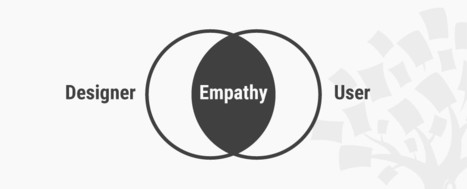
Empathy as a Precursor to Innovation And once again…relationships take centre stage
The role of empathy in innovation is a constant reminder that innovation requires relationships. How can we possibly understand what someone needs if we do not know them?...
We need to find the soul of our data and that soul is always found in the stories of those we serve. We need to understand those we serve — the students, their families, our staff, in order to improve upon what we already do. We need to stop acting from what we think we know and listen to those we serve, to find what is truly needed. The key is empathy.
Developing Empathy towards People The first stage (or mode) of the d.school’s Design Thinking process involves developing a sense of empathy towards the people you are designing for, to gain insights into what they need, what they want, how they behave, feel, and think, and why they demonstrate such behaviours, feelings, and thoughts when interacting with products in a real-world setting.
To gain empathy towards people, design thinkers often observe them in their natural environmentpassively, or engage with them in interviews....
The following are some methods from d.school Bootcamp Bootleg that will allow you to gain empathy towards your users.
Assuming a Beginner’s Mindset....
Ask What? How? Why?...
Photographing or recording target users, like other empathising methods, can help you uncover needs that people have which they may or may not be aware of....
Thank you for joining our Community Conversation featuring Jane McGonigal, New York Times bestselling author, and a world-renowned designer of games that improve real lives and solve real problems.
This event launched Facing History’s first ever virtual Community Conversation, Face The Future, an online game for social change that convened students, educators, and community members from across the globe.
The game fast-forwarded us to 2026 and invited us to think about what empathy might look like—and how that future will impact the choices we make today.
Well, it’s confirmed (again) – the SAP community truly cares about empathy! On Nov 10th in Barcelona, the “Evening of Empathy” event welcomed a packed house of SAP customers, partners and colleagues eager to learn
Fellow SAP Mentor Eng Swee Yeoh described his own experience with one empathy exercise where participants were asked to communicate what they saw in a picture only with their eyes. Other exercises involved listening, non-verbal communication, and personal bias. Needless to say these are all important elements to realizing empathy. Here are my own take-away from the evening:
This video gives an overview about the Empathy Challenges of the Youth Start Entrepreneurial Challenges. All teaching materials and further information can be found at www.youthstart.eu.
When a team directly interacts with their users they can more readily align on user pain points and needs.
1.1 Deepen empathy through intentional practice Developing skills requires practice. It is each team member’s job to develop empathy for the user and this requires direct exposure or observation. Ensure adequate user recruiting budgets, physical space for testing, and funding for excursions to observe your users in the context of your offering.
Keep in mind that empathy is one piece of the puzzle—you can’t conduct research on empathy alone.
How do we get people to experience empathy in software development and promotion. Guest: Seung Chan Lim (Slim), Executive Coach & Meta-Designer Tom Cenens, SAP Mentor and owner of Majestech
Both Forrester and the Temkin Group have begun focusing much more on the emotional elements of an experience, which is spot-on. Emotions are the greatest driver of loyalty – and of disloyalty. And you can’t solve them without empathy.
Here are eight ways to help build empathy in your company. Add your own in the comments!
Show videos of customer interviews. ..
Give them a customer challenge...
Have them directly serve customers...
Have employees from the field share their customer stories...
Could empathy be a key to reconnect us with our ecosystem and ourselves? Pixelache Festival 2016 - 'Interfaces for Empathy' explores the promise of this possible societal shift through macro-level direct experiences and the perspective of interconnectedness of all life.
The purpose of this video is to make our intentions and learning goals clear and transparent. Hopefully you can return to this video as needed. Also, we hope you can use this communication strategy with your students.
At a first glance, an empathy map is very similar to creating customer personas. But they really just overlap on some aspects. An empathy map goes beyond the interests, skills, or lifestyle of your customers, and into what they see, feel and think - allowing you to gain a deeper understanding of what it’s like to be them.
It allows you to empathize with the user or customer, hence the name. And you can use it to empathize with your ideal customer, or with the various segments of your audience. It all depends on the scope.
So here’s a few of the most important situations where using the empathy map will help you reach your goals:
1. Business Model Design
2. Product Development
3. Customer Profiles
4. Staff Training
5. UI And UX Sessions
6. Online Marketing And Sales Campaigns
7. Understand User Behavior
8. Innovating Products And Services Through Extreme User Personas
There are five stages in the design thinking process:
First, empathize. This stage begins with a conversation with stakeholders and constituents impacted by the problem. Design think facilitators should begin with a conversation with constituents, listening to them and digging deep to gain understanding of their experience.
The goal is to connect with the feelings and motivations of the people experiencing this problem before attempting to solve it.
Developing Empathy towards People The first stage (or mode) of the d.school’s Design Thinking process involves developing a sense of empathy towards the people you are designing for, to gain insights into what they need, what they want, how they behave, feel, and think, and why they demonstrate such behaviours, feelings, and thoughts when interacting with products in a real-world setting.
To gain empathy towards people, design thinkers often observe them in their natural environmentpassively, or engage with them in interviews....
The following are some methods from d.school Bootcamp Bootleg that will allow you to gain empathy towards your users.
Assuming a Beginner’s Mindset....
Ask What? How? Why?...
Photographing or recording target users, like other empathising methods, can help you uncover needs that people have which they may or may not be aware of....
The most effective way you can gain empathy comes in the form of immersion: direct experience of the lives, contexts, environments, and activities of the people you would like to understand better.
On top of immersing yourself in the environment to experience first-hand what it feels like to be your user, there are also a couple of methods you can engage in so as to gain a deeper understanding of people’s needs and emotions. Here, we will highlight three methods, and provide a template for each that you can download and use. Remember: the key to developing empathy is to go out there and practice with real people.
Design is, as a management skill, becoming the most relevant collaborative capability to use to navigate organisational challenges across almost every discipline. Companies like IBM, Coca-Cola and many companies in various fields including banking, healthcare and fast-moving consumer goods are adopting this framework to become more human-centric in a digital and technology-led world.
The question some of us are asking is whether to use the terms "design-driven" or "design-led". My mentor a few months ago, who introduced me to design thinking, in 2010 stopped me, abruptly, in my tracks regarding this. He asked:
"How can we say that we are design-led when the very principles we expound are around collaboration, empathy and diversity?"
In researching this topic, most advice about developing empathy was limited to statements like “put aside your viewpoint”, or “engage in active listening”. Easier said than done, right?
In a general sense, to develop your attunement to others you can:
Read literary fiction which stimulates your imagination through connection to characters (Read a study on that here.)
Watch a TV drama with the sound down to get better at observing behaviour
Use your non-dominant hand when accessing your own forms and website because it will encourage you to switch off your auto-pilot
Within the SAPPHIRE audience were SAP Mentors who agreed with Bill McDermott’s message, and also made it a personal goal to learn more about customer empathy and find ways to help our SAP community realize its value. Thanks to the generous support of SAP’s CIO Thomas Saueressig, and SAP’s SVP of Experiential Marketing Sian Smith, our community will have an opportunity to experience and realize empathy.
For fellow community members attending SAP TechEd in Barcelona, I would like to invite you to spend an evening with new and old friends to learn and experience what empathy is, exchange stories, and really commit yourself to this ‘movement’ of applying empathy in your lives.
I’m grateful that SAP Mentor and Empathy coach Seung Chan Lim (Slim) has agreed to conduct and facilitate the event.
Empathy is an important element in Design Thinking and Human-Centred Design. What is empathy exactly?
Why is empathy so important to designing solutions that actually work for people? Here, we’ll not only look at what empathy means, but will also look at how it helps design thinkers create solutions that work and, conversely, how a lack of empathy can result in product failure.
We’ll also come to understand the empowering notion that everyone can master empathy and design truly human-centred solutions.
When a team directly interacts with their users they can more readily align on user pain points and needs.
1.1 Deepen empathy through intentional practice Developing skills requires practice. It is each team member’s job to develop empathy for the user and this requires direct exposure or observation. Ensure adequate user recruiting budgets, physical space for testing, and funding for excursions to observe your users in the context of your offering.
Keep in mind that empathy is one piece of the puzzle—you can’t conduct research on empathy alone.
The Patient Experience: Empathy + Innovation Summit brings together patient experience leaders, healthcare CEOs, innovators, nursing leaders, policy makers, caregivers, industry experts and patients who are committed to not just the patient or caregiver experience, but also the human experience.
The theme of this year's three-day, inter-professional conference is Empathy by Design and features expert speakers, panel discussions and workshops representing multiple healthcare professions and disciplines who design programs, services, structures, spaces, processes and more with empathy in mind.
As drivers of this critical work, we also promise to deliver an experience for attendees that exemplifies empathy and innovation at its best.
Another year, another brilliant Pixelache Festival in Helsinki! This year’s edition took place mostly inside a former psychiatric hospital. The Lapinlahti hospital was designed by neo-classical architect C.L Engel in 1841. It’s a lovely place.
This year the theme of the festival is ‘Interfaces for Empathy’ because if there’s one thing we need more than anything else right now, more than virtual reality, 3D printing and other lasersabers, it’s the capacity and desire to connect with other people and their emotional state.
But understanding other people better is probably not enough. It would just be another form of anthropocentrism. We need to be more empathetic towards the whole ecosystem humans are only a small part of:
While empathy is the first step in the design thinking process, keep your students focused on this necessary element as they move through definition, ideation, prototyping
1. Empathize
Empathy is the first step in design thinking because it is a skill that allows us to understand and share the same feelings that others feel. Through empathy, we are able to put ourselves in other people's shoes and connect with how they might be feeling about their problem, circumstance, or situation. Some questions to consider:
What is the person feeling?
What actions or words indicate this feeling?
Can you identify their feelings through words?
What words would you use to describe their feelings?
These are just some of the guided questions that students can reflect on to identify the problem and how others are feeling about it.
Industry disruption is possible by focusing on providing deep, meaningful engagement to people that use your products or services.
This is achieved by designing products that seem as though they have a personality, or even a soul.
In this talk, you’ll learn how to achieve this, by leveraging design in a product management capacity. You’ll learn an end to end process that uses empathy to create products people lov
To get content containing either thought or leadership enter:
To get content containing both thought and leadership enter:
To get content containing the expression thought leadership enter:
You can enter several keywords and you can refine them whenever you want. Our suggestion engine uses more signals but entering a few keywords here will rapidly give you great content to curate.


 Your new post is loading...