A leather craftsman from Maison Chapal and a Michelin designer — two trades with a common vision: to touch all five senses with what they make.
Episode 1 EMPATHY
A leather craftsman from Maison Chapal and a Michelin tire designer reveal an unexpected secret to their success: they put themselves in the shoes of those who ultimately use what they make.
Did you know?
Charles Lindbergh wore a Chapal A1 aviator jacket, a model composed of 10 different skins, when he made his groundbreaking flight across the Atlantic.
Michelin has 27 patents on the technology that produces the Premium Touch Effect on the side wall of the new Pilot® Sport 4 S tire.
The term “Design Thinking” dates back to the 1987 book by Peter Rowe; “Design Thinking.” In that book he describes the way that architects and urban planners would approach design problems. However, the idea that there was a specific pattern of problem solving in “design thought” came much earlier in Herbert
A Simon’s book, “The Science of the Artificial” which was published in 1969. The concept was popularized in the early 1990s by Richard Buchanan in his article “Wicked Problems in Design Thinking”.
“When creating content, be empathetic above all else. Try to live the lives of your audience.” – Rand Fishkin, Founder at Moz
If you’re in a career that involves designing for people, you’ve probably been lectured on the importance of empathy. You’ve extracted data from tools such as surveys, empathy maps, and scenarios to ensure the design process incorporates empathy and meets the user’s needs. In the midst of all of this, the meaning of empathy becomes increasingly ambiguous.
Empathizing is the process in which we attempt to feel and understand someone else’s joy and pain. It takes a lot of patience, a lot of listening, and a lot of understanding. But when done right, instead of being a doctor asking our patients where it hurts, we can feel the pain ourselves.
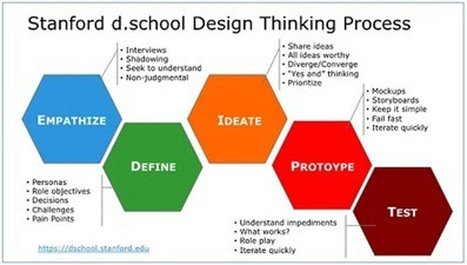
What is Design Thinking? Human-centered design is all about building a deep empathy with the people you’re designing for; generating tons of ideas; building a bunch of prototypes; sharing what you’ve made with the people you’re designing for; and eventually putting your innovative new solution out in the world[1].
Being empathetic to Africa's basic needs could improve the success of community projects, argues Keneilwe Munyai, a Programme Manager at the University of Cape Town.
Empathy in design thinking
There are two types of empathy in design thinking: emotional and cognitive. Emotional empathy centres on instinct, emotions and shared experience. The emotional aspect includes assessing our own thoughts and actions for the purpose of personal learning and development.
Design thinking encourages students to cultivate curiosity and challenge prejudice to discover commonalities with other people who may be different from them. Listening is extremely important, too.
Emotional empathy is a starting point for individual team members in any design thinking programme before they shift focus towards the user for whom they’re designing solutions.
The second dimension of empathy is cognitive. Here, one comes to understand how others may experience the world from their point of view.
Cognitive empathy includes the mental process of acquiring and understanding through thoughts, experience and senses. It includes processes like knowledge, memory, judgement, reasoning and decision making.
Use Customer Journey Mapping to Create a Storytelling and Decision Making Framework The most effective journey maps go beyond simply capturing and representing data in a visual format to tell a story about your customer’s experience from their perspective. They help to create empathy for your customers AND support growth-oriented decision making within your organization.
Empathy is one of the most important skills any leader can have. A huge 2015 research project across 38 countries found that empathy makes leaders more effective and their businesses more successful.
But how do you teach empathy? How can it be cultivated in students who will become leaders in future? And could it be done in a way that foregrounds ancient, indigenous knowledge and practices which might have been sidelined by colonialism?...
It’s these kinds of contextual considerations that have informed my work with Unicef in a design thinking programme that focuses on empathy and respecting indigenous knowledge...
That’s where instilling empathy comes in: organisations need an empathetic mindset that leads to better understanding not just of what the problem is, but also what caused it in the first place.
That’s what informed my ongoing design thinking programme with Unicef. It’s a customised programme that helps train organisations in design thinking. I’m working with Unicef Malawi and some of its partners – and developing empathy forms a big part of the course.
Interviews as a User Research method are great in giving you the big picture. Although you can always just use Surveys or any other quantitative method.
So why is it better to hear instead of read about it?
Some of the aims of Design Thinking's approach are to create:
greater inclusiveness
better team cohesion
higher levels of collaboration and interaction
increased creative confidence
Everyone thinks, feels, and experiences things differently. Differences are what we need. Knowing that certain activities are not natural for everyone means that some preparation, explanation, and trust-building, before the launch, can go a long way towards preventing people from jumping ship.
Some of the obstacles the process aims to overcome:
Why are immersion and empathy critical to the design thinking process?
When you observe users, you see what they actually go through. But when you actually do it, that’s when you can really understand how difficult some things may be, or understand the emotions that some challenges are creating. I may tell you that changing the tire of my car is difficult, but in order for you to understand why it’s difficult, you would probably want to do it yourself. Or, I may tell you that I find a particular task challenging, but you may be able to better appreciate how challenging it is when you try to do it yourself.
To begin, let’s have a quick overview of the fundamental principles behind Design Thinking:
Design Thinking starts with empathy, a deep human focus, in order to gain insights which may reveal new and unexplored ways of seeing, and courses of action to follow in bringing about preferred situations for business and society.
What Is Empathy Exactly? In a general sense, empathy is our ability to see the world through other people's eyes, to see what they see, feel what they feel, and experience things as they do. Of course, none of us can fully experience things the way someone else does, but we can attempt to get as close as possible, and we do this by putting aside our own preconceived ideas and choosing to understand the ideas, thoughts, and needs of others instead.
In Design Thinking, empathy is, as explained in IDEO’s Human-Centred Design Toolkit, a “deep understanding of the problems and realities of the people you are designing for”. It involves learning about the difficulties people face, as well as uncovering their latent needs and desires in order to explain their behaviours. To do so, we need to have an understanding of the people’s environment, as well as their roles in and interactions with their environment.
If you haven’t addressed the needs of those affected by the problem, you haven’t solved it. In order to address those needs, you must be able to comprehensively understand how others are affected by the problem. The Cambridge Dictionary defines empathy as “the ability to share someone else’s feelings or experiences by imagining what it would be like to be in that person’s situation.”
In IDE Corp’s design process, the first step is to “formulate” the problem. What is the ideal situation? What is the reality? What are the consequences of not solving the problem? Answering the latter two questions requires you to understand deeply how others are affected by the problem, that is, to demonstrate empathy.
Empathy is complex. Consider the nuances of three kinds of empathy, described in a blog post by Daniel Goleman, the author of Emotional Intelligence. All are important to develop.
The most effective way you can gain empathy comes in the form of immersion: direct experience of the lives, contexts, environments, and activities of the people you would like to understand better.
On top of immersing yourself in the environment to experience first-hand what it feels like to be your user, there are also a couple of methods you can engage in so as to gain a deeper understanding of people’s needs and emotions. Here, we will highlight three methods, and provide a template for each that you can download and use. Remember: the key to developing empathy is to go out there and practice with real people.
What is Design Thinking? Human-centered design is all about building a deep empathy with the people you’re designing for; generating tons of ideas; building a bunch of prototypes; sharing what you’ve made with the people you’re designing for; and eventually putting your innovative new solution out in the world.
A Customer Empathy Map is an incredible tool that helps organizations to unlock greater power in the customer experience. It can be used by itself or be used in conjunction with other cx tools including customer journey maps, customer personas, service blueprints, motivation matrix, mind maps and more.
This human-centered design tool helps you to obtain great clarity and understanding of how to get into the hearts and minds of your customers. You dramatically increase your individual emotional intelligence about customers when you use a Customer Empathy Map. This enables you with the opportunity to raise organizational emotional intelligence.
Empathy is defined by the metaphors of ‘standing in someone else’s shoes’ or ‘seeing through someone else’s eyes’. Simply put, it is the ability to understand and share the feelings of others.
Empathy is a super-skill that all User Experience designers should possess. ‘Seeing through someone else’s eyes’ is not as easy as it sounds. To understand user’s perspectives, we need to understand the users.
To understand our users well, we have to communicate with them. And guess what, you will be awestruck with the ideas and solutions that they have for various pain areas.
Change doesn’t happen overnight but we certainly have opportunities to inspire and teach new concepts in the classroom, and at all levels. Teaching and problem solving with a human-centered approach means bringing empathy to the forefront of learning,
and that’s just the beginning. We can go one step further and model collaborations and cross functional work by encouraging the uniqueness of students’ skills and their ability to teach each other.
Does UX ability require empathy? originally appeared on Quora: the place to gain and share knowledge, empowering people to learn from others and better understand the world.
Strictly speaking, user experience design does not require empathy, but it’s a huge practical advantage. I like getting definitions on the table first to make sure we’re all talking about the same thing. Both UX and Empathy can be broad words.
Empathy: the ability to understand and share the feelings of another.
User Experience: the overall experience of a person using a product such as a website or computer application, especially in terms of how easy or pleasing it is to use.
Empathy by Design is an experiential online workshop for individuals motivated to lead their team and organization, with or without authority, through the difficult process of change, development, or innovation.
Seung Chan Lim (Slim) believes leaders who have empathic relationships with themselves, their family members, their team, and their customers not only have lives that are more healthy & meaningful but also more creative & effective.
Have a look at some of these headlines (some of the articles are more nuanced than the headlines imply):
Emulating Empathy
Why every tech company needs to integrate empathy
Facebook adds “empathy” reactions
Empathy Machine
When tech people casually reference empathy they’re treating it like just another commodity. This isn’t intentional or malicious. It’s a by-product of living in a world of ultimate convenience and privilege. But you can’t order up empathy the way you can order a ride or dinner.
by Pamela Malinowski, eighth grade science teacher
In a science lesson coordinating with a recent guest speaker and reading in English class, eighth graders used Design Thinking and simple machines to create devices for people with disabilities.
The students in my eighth-grade science class had an introduction to Design Thinking last week. Instead of designing a wallet or some other similar device, my hope was to expose them to some experiences with which they may not be as familiar. Each student, upon entering the room was assigned a certain disability: they either were confined to a wheelchair or they had an arm amputated. At each station was a task they were asked to accomplish. These tasks included pouring cake batter from a bowl into a cake pan with only one arm, cutting carrots into thin strips with one arm, and seeing what was cooking on a stove from the vantage point of a wheelchair.
In total there were 11 different scenarios, and each student had a chance to try his or her task to gain a sense of empathy for living without being fully physically abled.
Lay the four quadrants out on a table, draw them on paper or on a whiteboard.
Review your notes, pictures, audio, and video from your research/fieldwork and fill out each of the four quadrants while defining and synthesising:
What did the user SAY? Write down significant quotes and key words that the user said.
What did the user DO? Describe which actions and behaviours you noticed or insert pictures or drawing.
What did the user THINK? Dig deeper. What do you think that your user might be thinking? What are their motivations, their goals, their needs, their desires? What does this tell you about his or her beliefs?
How did the user FEEL? What emotions might your user be feeling? Take subtle cues like body language and their choice of words and tone of voice into account.
To get content containing either thought or leadership enter:
To get content containing both thought and leadership enter:
To get content containing the expression thought leadership enter:
You can enter several keywords and you can refine them whenever you want. Our suggestion engine uses more signals but entering a few keywords here will rapidly give you great content to curate.


 Your new post is loading...