Your new post is loading...

|
Scooped by
Kim Flintoff
June 20, 2012 3:57 AM
|
With today’s rollout of college collaboration tool “Groups For Schools”, Facebook gets nostalgic for Zuck’s Wirehog and lets students share un-copyrighted files up to 25mb. Soon all U.S. colleges and then those around the world will be able to create groups for dorms, classes, and clubs that can only be joined by people with that school’s “.edu” email address. The idea is that you’ll share more nerdy or racy content if it’ll only reach your classmates. KF: This story is a couple of months old but as the system seems readily accessible now it might be that there are some good uses possible.
great inforgaphic and exmaple how a day in your life as a connected educator may unfold...
Via Vasi Doncheva

|
Scooped by
Peter Mellow
June 19, 2012 8:54 PM
|
Elizabeth Karol used a virtual video tour of a building to enable students to have access to ‘behind the scenes’ services in a building. These services are usually in tight spaces making it difficult for large groups of students to actually see the services as installed whilst listening to a commentary. The recording of interviews in the service areas with the building engineers gave students a valuable insight into the technologies used in the running of a ‘green’ building in Perth.
|
|
Rescooped by
Peter Mellow
from Open Educational Resources
June 19, 2012 1:49 AM
|
What do I like about Scoop.it? First of all, it’s easy to set up a topic and start collecting articles. You simply enter search keywords and Scoop.it searches Twitter, YouTube, Digg, Google Blogs and Google News feeds for matches. You can add any RSS feed, search a Twitter user, list or search stream. You can add a Facebook page or import an OPML file.
|
|
Rescooped by
Peter Mellow
from The Mixing Panel
June 18, 2012 10:22 PM
|
Social media tools can help create a more dynamic community of
practice and provide an ongoing and searchable conversation to
benefit others.
Via catspyjamasnz
|
|
Scooped by
Peter Mellow
June 17, 2012 7:57 PM
|
Digital tools cultivate engagement and encourage mastery by allowing for highly individualized instruction.
|
|
Rescooped by
Peter Mellow
from The 21st Century
June 17, 2012 12:18 AM
|
Many educators are experimenting with the idea of a flipped classroom model. Find out what it is and why everyone's talking about it.
Via Dr. Susan Bainbridge
|
|
Rescooped by
Peter Mellow
from The 21st Century
June 17, 2012 12:17 AM
|
We also realize there is a lot of mis-information about the Flipped Classroom and quite a bit of controversy about whether or not this is a viable instructional methodology.
Via Dr. Susan Bainbridge
|
|
Scooped by
Peter Mellow
June 15, 2012 3:16 AM
|
Educational Twitter hashtags plus a great infographic on Twitter.
|
|
Scooped by
Peter Mellow
June 15, 2012 1:32 AM
|
Are online learners frustrated with collaborative learning experiences? by Capdeferro in "The International Review of Research in Open and Distance Learning".
|
|
Rescooped by
Kim Flintoff
from Tools for Teachers & Learners
June 15, 2012 12:45 AM
|
This is a really easy to use quick tool for transferring a file from one person to another. Just drag the file (up to 2GB) onto the page and it creates a unique URL for the file. Very useful for supporting collaboration.
Via Nik Peachey
|
|
Scooped by
Kim Flintoff
June 14, 2012 11:46 PM
|
On May 17, 2012, Peter Klein, writing for the Christian Science Monitor, wrote that, "Mainline universities loudly proclaim their love of online learning — and pedagogical innovation more generally — while doing everything possible to retard it. The strategy has been to make a few easy, low-cost, conservative moves that preserve the status quo, such as putting some existing courses online, while trying to suppress the innovative outsiders like Phoenix, DeVry, TED, Kahn Academy, etc. It’s a classic example of what Clayton Christensen calls sustaining innovation — incremental changes that keep the existing market structure intact. The last thing the higher-ed establishment wants is disruptive innovation that challenges its dominant incumbent position" (CSMonitor.com).
Accessibility - Free Screen Readers Whether you use a PC or a Mac, or Linux, there is free Screen Reader that will enable you to use your computer, surf the Internet or both/ A summary of Screen Readers that are free include... Read more: http://kb.wisc.edu/helpdesk/page.php?id=13805
Via Gust MEES
|
|
|
Scooped by
Kim Flintoff
June 20, 2012 1:30 AM
|
Findings is a groundbreaking tool for collecting, sharing and discussing clips you find on your Amazon Kindle and from any website on the internet. Just import your Amazon Kindle Highlights with Findings and you can start sharing and discussing them with others instantly. Findings is a Betaworks company. KF: Classroom uses of Findings might include crowdsourced note-taking sessions, collaboratively identifying key passages/content, collaborative summarsing...
|
|
Scooped by
Peter Mellow
June 19, 2012 11:51 PM
|
Peer 2 Peer University, a three-year-old online institution where students learn together, at no charge, using materials found on the Web. The poet, Vanessa Gennarelli, and the programmer, John Britton, taught each other online, discovering unexpected bridges between their disciplines.
|
|
Scooped by
Kim Flintoff
June 19, 2012 11:08 AM
|
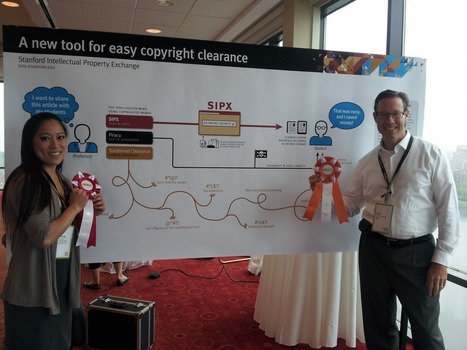
Legal experts fear that drawn-out copyright cases like this could have a nasty effect on the quality of education. Just as iTunes offered a salvation to the music industry, universities are in desperate need of an electronic, yet pragmatic, solution for academic content. At Stanford University, a group of researchers drawn from the fields of computer science, law and higher education, are studying the requirements for a system to automate the copyright clearing process, known as the Stanford Intellectual Property Exchange (SIPX). The Openlibrary service intends to roll out the SIPX technology campus-wide in 2012. KF: This is an exciting solution, and while it seems to focus on the US version of copyright the principles involved could be adopted by Australian institutions in developing a regionally appropriate iteration.
|
|
Scooped by
Kim Flintoff
June 18, 2012 11:54 PM
|
Screen share instantly for free using Screenleap. Screenleap makes it really easy to share your computer screen. You can share your screen with as many people as you like with no downloads, account setup, or cost required. Friends, family, and colleagues can view your computer from their laptops, desktops, or mobile devices without having to install anything.
|
|
Scooped by
Peter Mellow
June 18, 2012 8:22 PM
|
Welcome to the Morning Blend, our occasional blog dedicated to exploring the many facets of blended learning. As time goes on, we hope to use this space to create a forum for ideas related to blended learning from the leading thinkers. University of Central Florida
|
|
Scooped by
Peter Mellow
June 17, 2012 12:19 AM
|
Educators experimented with flipping the classroom long before Khan started shooting video. In 2004, a former hedge fund analyst began recording and posting videos of himself explaining some math techniques. He created the material to help tutor his young cousin. Rather than keeping it private, however, the analyst posted the videos to YouTube. By 2012, Salman Khan had more than 3,000 lessons online, 140 million views, and a reputation as an education guru.
|
|
Rescooped by
Peter Mellow
from The 21st Century
June 17, 2012 12:17 AM
|
If you've read my thoughts about the Flipped Classroom in USA Today this week, you probably are either in agreement with my caution over the excitement around the flipped classroom made popular by Sal Kahn or you are a flipped...
Via Dr. Susan Bainbridge

|
Suggested by
Learning Futures
June 16, 2012 8:22 PM
|
Facebook has been making many inroads into education over the last few years. Many institutions are using Facebook sites to publicize events on campus, as well as to aid in their recruiting.
As well, many students, instructors and administrators are using a number of Facebook applications for a wide variety of academic purposes.
|
|
Rescooped by
Peter Mellow
from Connected Learning
June 15, 2012 3:13 AM
|
EdWeek’s Ian Quillen reviewed a Don McIntosh report on the learning management systems (LMS) market. Adaptive content, social learning, smart engines, lots of open content, and an explosion of mobile apps are expanding aspirations.
Via Stephanie Sandifer
|
|
Scooped by
Kim Flintoff
June 15, 2012 12:48 AM
|
It’s a totally new way of creating an online presence... The easiest and most fun way
to create amazing pages, ever! - Instant pages about anything - Uncanningly versatile, easy and quick. - Stunning results, every time you publish. - Seamless integration of social media eLearning and Design: Terrific if stuents are being asked to create publicly accessible artefacts.
|
|
Scooped by
Kim Flintoff
June 15, 2012 12:27 AM
|
More and more students have Twitter accounts now. Here are five ways I use Twitter in my lecture classes. Curtin Teaching and Learning: Staff at Curtin have access to the Hotseat tool that allows multi-faceted input to lectures including posting via Twitter, but can keep the discussion within the community of the class. Check http://cel.curtin.edu.au/learning_technologies/hotseat.cfm for more information.
|