


Like reading, writing, and arithmetic, web literacy is both content and activity. You don’t just learn “about” reading: you learn to read. You don’t just learn “about” arithmetic: you learn to count and calculate.

 Your new post is loading...
 Scoop.it! Like reading, writing, and arithmetic, web literacy is both content and activity. You don’t just learn “about” reading: you learn to read. You don’t just learn “about” arithmetic: you learn to count and calculate. 
No comment yet.
Sign up to comment
Scoop.it!
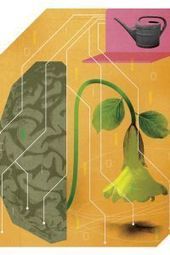
As we think about the future of education, we need to sharpen our understanding of what education is and what educators do. Education is often compared to two other industries upended by the Internet: journalism and publishing. This is a serious error.
Education is not the transmission of information or ideas. Education is the training needed to make use of information and ideas. As information breaks loose from bookstores and libraries and floods onto computers and mobile devices, that training becomes more important, not less.
Scoop.it!
From
vimeo

We recently had the opportunity not only to read a recent release from Diana Oblinger, President and CEO of EDUCAUSE, but also to discuss her new book titled Game Changers. Game Changers, according to Oblinger, discusses the different models that people are developing to do education better. With mounting accountability and affordability pressures, and a wide variety of student needs, Oblinger was interested to learn the innovative ways people are trying to rethink how they shape the system. Game Changers is a higher view of these stories, as well as discussions of the patterns that have emerged as a result of these efforts. We thank Dr. Oblinger for taking the time to discuss Game Changers, and enjoyed learning more about the innovations taking shape in higher education. For more information about Game Changers, or to order your free copy, visit http://www.educause.edu/research-publications/books/game-changers-education-and-information-technologies.
Scoop.it!

ACADEMICS need time and incentives to develop and integrate the wealth of quality online teaching resources that will be crucial in the "dogfight" for students, Monash University economics professor Stephen King has warned.
Scoop.it!

Dropbox is more a mega-utility than a simple tool. It begs you to think up new ways to use it, in & out of the classroom. Great for school. Via Dr. Susan Bainbridge
Scoop.it!

Last month I was at The Schools Network‘s 2011 Annual Conference, and was fortunate to enjoy the keynotes of three particularly interesting educational thinkers – Alan November, Lord Puttnam and Tony Wagner. Their ideas and my discussions with colleagues have helped drive and shape my thinking, and have encouraged me to set down some of my thoughts on the current possibilities for education.
Scoop.it!

Moving a face-to-face credit course to an online environment is far more challenging than one might expect – as numerous experienced and esteemed professors have discovered. In this post lear... Via Dr. Susan Bainbridge, Donna Murdoch
Scoop.it!

The BlendKit Course is a set of subject matter neutral, open educational resources related to blended learning available for self-study or for group use. Periodically, these materials will also be used as the basis for a facilitated open, online course. (See below for information on the most recent facilitated offering: BlendKit2012.)
The goal of the BlendKit Course is to provide assistance in designing and developing your blended learning course via a consideration of key issues related to blended learning and practical step-by-step guidance in helping you produce actual materials for your blended course (i.e., from design documents through creating content pages to peer review feedback at your own institution).
Scoop.it!

THIS ONLINE CONFERENCE IS FREE OF CHARGE
From the website
"The Learning 2.0 Conference is a unique chance to participate in a global conversation on rethinking teaching and learning in the age of the Internet. Subject strands include changes in the classroom (social media, 1:1 computing, "flipped classrooms," digital literacy, maker spaces, gaming, open educational resources, digital textbooks), in student learning (individualized learning, student-directed learning, "hacking" education, personal success plans, ePortfolios, and building a digital presence), in teacher personal and professional growth (lead learning, personal learning networks, peer / open / self-directed PD), in schools (virtual and online schooling, mobile learning, blended learning, MOOCs, immersive environments, learning spaces, entrepreneurship, school leadership, big data, assessment models), and in pedagogy (from teaching to learning, social learning, social / educational networking, passion-based learning, learning how to learn, brain-based learning).
"Keynote Sessions: Julie Evans, Gina Bianchini, Heidi Hayes Jacobs, Lee Rainie, Angela Meiers, Sugata Mitra, Sheryl Nussbaum-Beach, Michelle Pacansky-Brock, Marc Prensky, Audrey Watters, Yong Zhao."
"Keynote Panel on Technology and Librarians: Gwyneth Jones, David Loertscher, Michelle Luhtala, Shannon Miller, and Joyce Valenza."
"Pre- and Post-Conference Special Interviews: David Deubelbeiss, Lee Rainie, Alfie Kohn, Gary Stager, Stephen Downes, Howard Gardner, Rudy Crew, Roger Schank, Paulo Blikstein, Rob Fried, Gordon Dryden, Tony Wagner, and Michael Strong."
Lead organizer of this conference is Steve Hargadon. -JL
Via Jim Lerman
Scoop.it!

This free IPR course introduces intellectual property rights (IPR), Creative Commons and how to create learning objects.
The free online Intellectual Property Rights for Educational Environments course is a HEFCE funded, and Higher Education Academy (HEA)/JISC managed, project created to introduce and build awareness of aspects of intellectual property rights and copyright.
The intended audience is primarily people in higher education designing online learning resources. These course materials are also appropriate for academics working in HE staff development.
The course is divided into three units each comprising a number of sessions. Each element of the course can either be used independently or as a part of a complete learning experience.
While the course primarily addresses IPR in the UK, the course materials can be adapted and re-used to represent IPR issues in non-UK countries.
Scoop.it!

Anyone living even a moderately wired life has heard the complaints: We can't concentrate the way we used to, before the Internet and its temptations came along to distract us. We used to get lost in books; now we get lost in the digital surf.
Alan Jacobs will be either an inspiration or a rebuke to those who feel that technology has ruined them as serious readers. A professor of English at Wheaton College, in Illinois, he spends plenty of time online. He's active on Twitter and blogs regularly for The Atlantic. But he reads more now than he ever has.
Scoop.it!

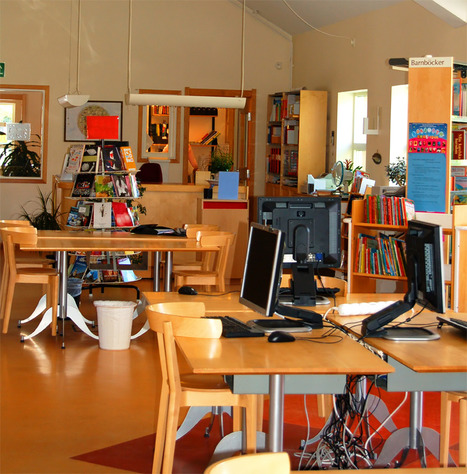
Two threats are impacting rationale for open labs. First, more and more students are bringing their own devices to college and fewer and fewer have no access to computing resources, even if it is a netbook or iPad/smartphone. This trend is even more advanced at institutions that cater to wealthier students. Several years ago the University of Virginia started eliminating its Open Labs because they determined very few of their students lacked computing devices.
Scoop.it!

This module on Interactive Lectures provides strategies and specific examples of techniques and activities designed to involve students in large and small lecture-based classes. The module is designed for the instructor who does not want to replace lecture, but rather to enhance and punctuate lecture to create an interactive classroom experience Via Nik Peachey
|
Scoop.it!
Lately there has been a fair amount of pressure on educators to cultivate “21st century skills” in their students. But what exactly does this mean? Via Dr. Susan Bainbridge, Virginia Pavlovich
Scoop.it!

Boundless - The Free Textbook Replacement via @juandoming
Boundless just launched the public beta version of its brand new site. What is Boundless? It’s a way to easily turn all of the open source information that exists in the world into a simple easy-to-use digital textbook. And it’s free.
This is one of the most exciting announcements that came across my inbox over the past few weeks. Boundless is shaping up to truly disrupt the digital textbook industry and the newly launched tools are robust enough to do just that. But enough hyperbole and hot air, here’s what you should know: Via Cyndi Danner-Kuhn, juandoming, Professor Jill Jameson
Scoop.it!
For as long as I have been involved in education, the focus for finding the key to fixing education has always been about providing professional development for the teachers and administrators. The philosophy is top-down with the intent that knowledge will eventually trickle down to benefit the students.
But, during one of the two ISTE Ignite sessions, I listened to the well respected “education disruptionist,” Will Richardson, sum up 19 of his bold beliefs about education in exactly five minutes. His five minutes were not just inspiring, but I heard it as a call to all educators to stop putting up road blocks and open up the classrooms and allow learning to become powerful and impact the world. There are so many things we are not doing right and, according to Mr. Richardson, we need to start asking “Why wouldn’t we…?” It’s truly five minutes of slides that kindles limitless conversation among those interested in education and definitely worth the few minutes it takes to watch:
Scoop.it!
TED Talks In the fall of 2011 Peter Norvig taught a class with Sebastian Thrun on artificial intelligence at Stanford attended by 175 students in situ -- and over 100,000 via an interactive webcast. Via Dr. Susan Bainbridge, Heiko Idensen
Scoop.it!

Busy schedules are one reason why educators don't collaborate and connect through social networking platforms. But a lack of time isn't the main issue. It's priorities. Via Peter Mellow
Scoop.it!
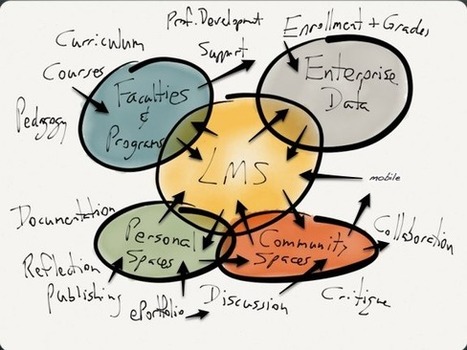
Educational data is stuck in silos, something fostered by educational software – administrative and instructional – that makes it cumbersome at best and impossible at worst to move data in and out of systems. As a result, there’s lots of extra clerical work that educators and administrators have to do – recreating rosters, copying grades, downloading CSVs, copying-and-pasting, and so on. All because educational apps and software do not, as a rule, talk to one another.
Scoop.it!

Literacy and fluency* have to do with our ability to use a technology to achieve a desired outcome in a situation using the technologies that are available to us.
Scoop.it!

Despite the proliferation of technologies on today's college campuses, students say there is still a disconnect between how they envision technology use in the classroom and the current reality.
Educators need better direction and support from their campus IT organizations in order to successfully implement technology in their classrooms, said University of Michigan (UM) student Tyler Hughes in a panel discussion at last month's Campus Technology 2012 conference in Boston. The all-student panel was part of a conference session, "Learn Now, Lecture Later: The New College Experience," which focused on the application of new learning models in the classroom, what students want when it comes to education technology, and what's next for education. Led by Andy Lausch of CDW-G, the discussion highlighted findings from CDW-G's recent education technology report
Scoop.it!

The Hechniger Report sat down with Heather O’Mara, CEO of HOPE Online Learning Academy, a blended-learning school that works with a largely at-risk student population across Colorado.
KF: While the article addresses a K-12 context many of the insights are useful to consider when lookiung at shifts to fully online engagement in a higher ed setting.
Scoop.it!

Internet courses are monologues. True learning is a dialogue.
PM - An opinion piece from the NYT. Use of sexist language ("with his sensitivity..." - "he knows he’s doing something right. From there he folds what he has learned into his teaching, adjusting his course...") and a simple view of what 'is' online education shows how far parts of America are behind the 'real world' and how much further we have to go to get people to see that online education can be so much more. The writer has obviously not had a positive experience with online learning, perhaps they should try some online courses from other institutions as the interaction they describe is certainly possible in an online environment.
Scoop.it!

Higher education’s economics are unsustainable and vulnerable to technologies that could make college campuses the hub of the privileged few, according to a vast collection of opinions from international technologists and educators.
Scoop.it!

There seems to be something pretty big missing from this infographic by Lean Forward. Know what it is? Here’s a hint: it rhymes with ‘eech-err’ and it’s the sixth person needed to implement e-learning.
It’s a teacher! The real person implementing e-learning needs to be a teacher who understands pedagogy and how it all fits together. In any case, this infographic is still quire helpful and useful for anyone considering a more e-learning-centric classroom.
|






