Students understand there are limitations with ChatGPT, but they know it will have a huge impact on their careers.

 Your new post is loading...
 Scoop.it! Students understand there are limitations with ChatGPT, but they know it will have a huge impact on their careers. 
No comment yet.
Sign up to comment
Scoop.it!

No professor or software could ever pick up on it.
Scoop.it!

All instructors, regardless of the field, can promote mental health both by sharing specific resources and by designing accessible and flexible courses.
Scoop.it!

The first article in this series argues that instructors who successfully engaged students during the coronavirus pandemic adapted their thinking, mustered courage, and put heart into their teaching. In this article, an instructor explains how she took an alternative approach to teaching—simulive learning—and discusses the benefits that have extended to her in-person classrooms.

Raúl De La Cruz's curator insight,
June 5, 2023 6:13 PM
Very interesting to learn what simulive learning means and what it entails. Teachers now a days really should give It a try for the benefit of the students.
Scoop.it!

The notion of ‘consistency’ is something that comes up a lot when we talk about online learning, but i’s not always clear what we mean when we talk about consistency or why itR…
Scoop.it!

I suspected a student of AI plagiarism but was in for a surprise.
Scoop.it!

As schools around the country are banning AI tools, Khan Lab School invites one into the classroom.
Scoop.it!

You might have seen teachers on TikTok dancing to the latest viral song with their students. Or dressing up to show how many different jobs they do in a given day.
Raúl De La Cruz's curator insight,
June 5, 2023 6:18 PM
Oh wow. I had really not thought about using tik Tok to connect with students but this articles makes it seem as if this is working for them. It is definitely a social media tools that provides lots of ideas for collaboration and learning communities to occur.
Scoop.it!

A survey of college and university websites gives an early indication about the ways institutions are addressing generative AI and what it might mean
Scoop.it!

These ten principles offer guidance on ways to design and facilitate effective and engaging virtual workshops that leave faculty feeling better equipped to implement new edtech tools.
Raúl De La Cruz's curator insight,
June 5, 2023 6:43 PM
I should share this with my administration to help them create more engaging professional development sessions for teachers. They really need to invest in teaching us how to use and implement new tech tools effectively.
Scoop.it!

Gave a Keynote at City of Glasgow College on 'AI for Learning'. I've rarely seen an audience m ore engaged, the question and answer sessio
Scoop.it!

Zoom's smart recording feature uses AI to help make meetings more actionable and efficient by creating skimmable smart chapters.
Peter Mellow's insight:
Great potential use here if you use ZOOM for lectures/tutorials/webinars. Still early days, but maybe a game changer? Instead of 'take notes for me' to a friend, perhaps AI can do it for us?
Scoop.it!

What is Plan B? Not Plan A!
|
Scoop.it!

As a doctoral student at the University of California at Los Angeles, I was among those who got a recent campus-wide email with an urgent directive
Scoop.it!
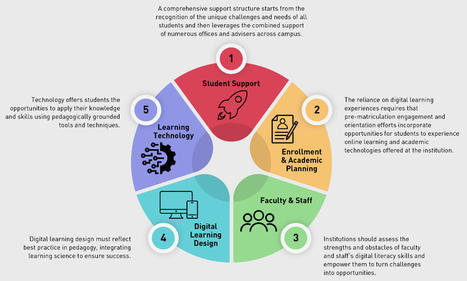
The Digital Learning Strategy Guide can help institutions develop a robust, flexible, and personalized framework for a digital learning strategy infor
Scoop.it!

You may want to use podcasting as an option to deliver short and distinct lessons that students can consume quickly and conveniently.
Scoop.it!

The IDEAS (Inclusion, Design, Engagement, Evaluation, Assessment, and Support) Framework for online teaching and learning highlights best practices fo
Scoop.it!

Current attitudes toward generative AI hearken back to early skepticism about the impact of the internet on education. Both then and now, technology has created challenges but also opportunities that can't be ignored.
Scoop.it!

With the increasing availability of synchronous video-based breakout rooms within online courses, there is a growing need to understand how to best leverage this technology for enhanced online education. To help address this challenge, this paper reports on a case study that explored student activity within online video-based breakout rooms via a Structured Paired Activity (SPA) methodology. SPA, which is adapted from the concept of Paired Programming, defines a general way to structure roles and activities for the participants within the breakout room. Initial qualitative results suggest that the use of SPA in online breakout rooms increases student engagement and process effectiveness. These results are potentially applicable to a broad range of web-based synchronous online courses.
Scoop.it!

Explore the Postgraduate Learning Design Quality Framework and how it can support your own design, evaluation and professional development.
Scoop.it!

In recent years, COVID-19 policy measures massively affected university teaching. Seeking an effective and viable way to transform their lecture material into asynchronous online settings, many lecturers relied on prerecorded video lectures. Whereas researchers in fact recommend implementing prompts to ensure students process those video lectures sufficiently, open questions about the types of prompts and role of students’ engagement remain. We thus conducted an online field experiment with teacher students at a German university (N = 124; 73 female, 49 male). According to the randomly assigned experimental conditions, the online video lecture on topic Cognitive Apprenticeship was supplemented by (A) notes prompts (n = 31), (B) principle-based self-explanation prompts (n = 36), (C) elaboration-based self-explanation prompts (n = 29), and (D) both principle- and elaboration-based self-explanation prompts (n = 28). We found that the lecture fostered learning outcomes about its content regardless of the type of prompt. The type of prompt did induce different types of self-explanations, but had no significant effect on learning outcomes. What indeed positively and significantly affected learning outcomes were the students’ self-explanation quality and their persistence (i.e., actual participation in a delayed posttest). Finally, the self-reported number of perceived interruptions negatively affected learning outcomes. Our findings thus provide ecologically valid empirical support for how fruitful it is for students to engage themselves in self-explaining and to avoid interruptions when learning from asynchronous online video lectures.
Scoop.it!

Students in a medical science subject were asked to use ChatGPT to write their first essay, with markers to judge how well students could edit it.
Scoop.it!
As a result of this workshop and roundtable discussion, ACODE recommends institutions to:
Scoop.it!

How can ranking multiple-choice answers increase cognition and understanding of material?
|