Your new post is loading...

|
Scooped by
Kim Flintoff
May 8, 2017 4:00 PM
|
More than 6 million students took at least one online course in 2015, representing more than a quarter (29.7 percent) of all higher education enrollments that year, according to a new report from Digital Learning Compass. Among that 29.7 percent, it's almost evenly split between students who took some but not all courses online (15.4 percent) and those who took every class online (14.3 percent). In contrast, total online enrollments in 2002 came in just under 10 percent.
|
|
Scooped by
Kim Flintoff
April 29, 2017 3:07 AM
|
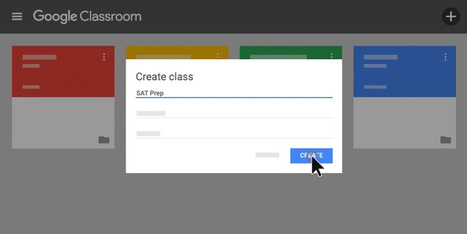
Google is opening up its Classroom educational service to allow anyone to create and teach a class on its platform.
|
|
Scooped by
Kim Flintoff
April 24, 2017 8:40 PM
|
The most popular article on eCampus News is a surprising one to the editors: “6 apps that block social media distractions.” This story, which seemed a bit counter-intuitive for us to write (being a tech-cheerleading publication in nature), has held the top spot by a massive margin for almost three years now; which had the editors considering the question, “Are there technologies that should simply be avoided in the college classroom?”
Movie Clip of One Technology Exasperation:
Of course, the editors then had to ponder what would make a technology easier to avoid than try to implement, and came up with a list of broad technologies and technology trends that either A) caused, rather than eased, more problems and concerns in the classroom, and/or B) were not evolved enough to make an actual difference in teaching or learning.
And, not wanting to simply talk technology trash without offering some useful information, the editors then came up with the technology options that may be better suited for the intended classroom task.
See any technologies you believe should be avoided that didn’t make the list? Be sure to leave your comments in the section below.
|
|
Scooped by
Kim Flintoff
April 19, 2017 7:35 PM
|
Rasmussen College, a regionally accredited private college, Tuesday unveiled a technology-infused learning center in Chicago for high schoolers, college students and community members to access the internet and receive college coaching at no cost. With the new center, Rasmussen seeks to close the digital divide in the area, while increasing the number of high school students taking dual-credit courses at the college, as well as providing a resource for degree-seeking adult students.
Its target audience will be students who lack adequate broadband to complete homework assignments, since the lack of internet access has been cited as a contributing factor to the area’s lower academic achievement statistics in recent years. Notably, a 2012 demographic survey of Chicago found that among individuals living in the area age 25 or older, less than 4 percent hold an associate’s degree and 7 percent hold a bachelor's degree, compared to national averages of 7.76 percent and 18.25 percent respectively.
|
|
Scooped by
Kim Flintoff
April 12, 2017 7:36 PM
|
Key Takeaways
The rise of educational technology is part of a larger shift in political thought, from favoring government oversight to asserting free-market principles, as well as a response to the increasing costs of higher education.
The technocentric view that technology can solve these challenges combines with a vision of education as a product that can be packaged, automated, and delivered to students.
Unless greater collaborative efforts take place between edtech developers and the greater academic community, as well as more informed deep understandings of how learning and teaching actually occur, any efforts to make edtech education's silver bullet are doomed to fail.
|
|
Scooped by
Kim Flintoff
March 30, 2017 7:24 PM
|
Abstract
Gamification of education is a developing approach for increasing learners’ motivation and engagement by incorporating game design elements in educational environments. With the growing popularity of gamification and yet mixed success of its application in educational contexts, the current review is aiming to shed a more realistic light on the research in this field by focusing on empirical evidence rather than on potentialities, beliefs or preferences. Accordingly, it critically examines the advancement in gamifying education. The discussion is structured around the used gamification mechanisms, the gamified subjects, the type of gamified learning activities, and the study goals, with an emphasis on the reliability and validity of the reported outcomes. To improve our understanding and offer a more realistic picture of the progress of gamification in education, consistent with the presented evidence, we examine both the outcomes reported in the papers and how they have been obtained. While the gamification in education is still a growing phenomenon, the review reveals that (i) insufficient evidence exists to support the long-term benefits of gamification in educational contexts; (ii) the practice of gamifying learning has outpaced researchers’ understanding of its mechanisms and methods; (iii) the knowledge of how to gamify an activity in accordance with the specifics of the educational context is still limited. The review highlights the need for systematically designed studies and rigorously tested approaches confirming the educational benefits of gamification, if gamified learning is to become a recognized instructional approach.
|
|
Scooped by
Kim Flintoff
March 29, 2017 8:39 PM
|
After we have seen how to use Google Images to search for and locate free-to-use images, here is another handy visual to help you make the best of your Google search experience. The content of this visual is based on insights provided by Google Search Help. The 12 tips below will help you refine your Google searches and get precise search results using a wide variety of search operators. For instance, you will learn how to search for content published in social media or through hashtags, how to search for a specific site or related sites, how to search for an exact match and many more.
This visual is also available in PDF format from this page.
|
|
Scooped by
Kim Flintoff
March 23, 2017 1:03 AM
|
Every student prepared for every class.
|
|
Scooped by
Kim Flintoff
February 24, 2017 8:59 PM
|
The Teaching Online Preparation Toolkit (TOPkit) website is a comprehensive resource that provides the postsecondary community with the essential elements required to ensure a very high quality online faculty development program, including a sample course that may be imported into any learning management system and then customized. The links below walk you through a three-step process for planning, developing, and evaluating your program along with supporting resources.
While this initiative is Florida funded and Florida focused, it is not Florida exclusive and we invite you, our colleagues around the world, to explore the TOPkit website and actively participate in its accompanying community of practice.
To learn more about this site and its contributors, please read About Us.
|
|
Scooped by
Kim Flintoff
February 23, 2017 5:22 PM
|
New study reveals that collaboration is still not a prevalent online learning habit; mobile phones have yet to be used for serious learning.
|
|
Scooped by
Kim Flintoff
February 3, 2017 11:51 PM
|
Research consistently shows that effective teachers are the most important school-level factor influencing student outcomes. It therefore comes as no surprise that many education reform efforts focus on supporting and improving the teaching profession. At the same time, technology-focused initiatives continue to gain momentum in education—as seen through the White House’s ConnectEd Initiative and the more than 3,100 superintendents who have signed the Department of Education’s Future Ready pledge to increase student access to quality digital learning.
In the competition for scarce education dollars, these two advocacy camps sometimes conflict, especially if technology seems to be a play for cutting teacher jobs. But teachers and technology are only at odds when advocates from the respective camps fail to see technology’s critical role in complementing high-quality teaching.
|
|
Scooped by
Kim Flintoff
January 20, 2017 8:13 PM
|
At the Learning Counsel’s Annual Gathering and National Awards event, twelve leading districts were recognized for their vision and innovation in integrating digital curriculum and technology into their teaching and learning process. Attendees at the event included top education executives from around the U.S., who gathered to acknowledge exemplary progress and discuss how innovation, technology, and school and classroom remodeling is pushing the education envelope—all in the name of better outcomes for our youth.
“The Learning Counsel is helping education leaders chart a course that includes actionable data and current trends,” said Janell McClure, the director of Digital & Multimedia Learning from Cobb County School District. “These awards share incredible examples of innovative thinking. The knowledge we’ve gained at this Gathering event will guide our work as we continue to strive for excellence in teaching and learning through digital platforms, tools, and practices.”
|
|
Scooped by
Kim Flintoff
January 18, 2017 7:03 PM
|
The top 10 IT issues for 2017, reiterated in today's report:
Information security;
Student success and completion;
Data-informed decision-making;
Strategic leadership;
Sustainable funding;
Data management and governance;
Higher education affordability;
Sustainable staffing;
Next-generation enterprise IT; and
Digital transformation of learning.
|
|
|
Scooped by
Kim Flintoff
May 8, 2017 3:59 PM
|
Harvard University is issuing certificates for anybody who passes one or more of the same online courses that are also taken by incoming students prior to starting their Harvard Medical School curriculum and used by the institution's faculty to "flip" their classrooms.
The courses make up the university's new "HMX" program, consisting of online instruction for medical education. The HMX classes each last 10 weeks and cover physiology, immunology, genetics and biochemistry. Rather than using "traditional lectures and PowerPoint slides," these programs introduce real-world scenarios, animation, concept videos, notetaking guides, assessments, interactive components and videos that take participants into clinical settings.
The price of each course is $800, or $1,000 when taken two at a time, or $1,800 when all four are taken simultaneously. To get a taste of the experience, the university is granting free access to lessons from the immunology and physiology courses.
|
|
Scooped by
Kim Flintoff
April 24, 2017 8:42 PM
|
As education becomes more accessible with advanced technology, more and more students are opting to enroll in online schools or take some of their traditional college courses online.
But as this trend grows, institutions are finding it necessary to address faculty concerns and ensure online programs are high-quality and rigorous.
Online and blended learning programs from higher-ed institutions across the nation certainly inspire innovation, but higher-ed administrators must consider faculty point of view amidst these changes, according to Building Trust: How to Address Faculty Concerns about Online Education, a new whitepaper from Wiley Education Services.
Nearly five years ago, 58 percent of professors in a Babson College survey described themselves as having “more fear than excitement” about the growth of online learning; more than 80 percent of academic technology administrators, on the other hand, said they felt more excitement than fear.
The whitepaper aims to help administrators better understand faculty concerns about online learning, and it also offers recommendations to address those concerns.
|
|
Scooped by
Kim Flintoff
April 22, 2017 8:44 PM
|
An Albert Einstein chatbot on Facebook Messenger is a window into how the chat service could be used as an educational tool — at least when it comes to simple facts.
The chatbot is intended to promote National Geographic’s new show Genius, which is about Einstein. And it does that, with a constant stream of gifs and pictures from the show. The conversation was also bookended by references by both the show and a March for Science happening on the National Mall in D.C. this weekend.
|
|
Scooped by
Kim Flintoff
April 17, 2017 6:49 AM
|
These new online learning myths are spreading almost as fast as program creation.
|
|
Scooped by
Kim Flintoff
April 4, 2017 7:48 PM
|
New research by National Centre for Student Equity in Higher Education Equity Fellow Dr Cathy Stone from The University of Newcastle has informed comprehensive new guidelines for improving student outcomes in post-secondary online learning, with a focus on undergraduate retention and course completion.
Qualitative interviews with 151 higher education practitioners from Australia and the United Kingdom consistently illustrated the need for a strategic, tailored approach to online programs, with an emphasis on student engagement and an individualised approach to monitoring, support and outreach.
The full report, Opportunity through Online Learning: Improving student access, participation and success in higher education and the 10 National Guidelines for Improving Student Outcomes in Online Learning are available on the NCSEHE website.
|
|
Scooped by
Kim Flintoff
March 30, 2017 7:23 PM
|
Technology has changed just about every field, including education. Digital learning is reshaping education in unprecedented ways. The ways in which students learn are changing rapidly thanks to technology, and both students and teachers will benefit from it.
There are several specific changes that we can expect to see as digital learning takes over education. For one, the way teachers present information and how students work with that information has changed. Students are asked to be more hands-on and collaborative than ever before. There are also new skills that students must learn, such as digital literacy.
|
|
Scooped by
Kim Flintoff
March 27, 2017 6:44 PM
|
Massive open online course (MOOC) provider edX is introducing 16 new MicroMasters programs this spring that span business analytics, digital product management, cybersecurity and data science fields.
The expansion builds on the success of the MicroMasters program launch last September, when MIT debuted 19 programs that covered topics such as artificial intelligence and supply chain management. For this launch, continuing partners and their MicroMasters courses include:
Columbia University: Business Analytics
Rochester Institute of Technology: Cybersecurity; and
Curtin University: Marketing in a Digital World.
|
|
Scooped by
Kim Flintoff
March 21, 2017 7:27 PM
|
Users without Google’s G Suite for Education accounts can now access Google Classroom from a personal Google account. Classroom also offers more administrator controls that allow G Suite users with domains outside of their own to join.
The company said in a blog post announcement that teachers and students will now be able to use their personal accounts to teach or attend classes and manage assignments. Sometime over the coming weeks, Google will give personal accounts the ability to create their own classes as well. For now, administrators will notice that Classroom has updated settings with new controls that allow them to easily monitor who can join their classes. To add a user from an outside domain, for example, both the administrator and other user need to whitelist the other’s domain in their settings. This feature enables outside guests, like visiting teachers or students, to quickly integrate into their host’s Classroom.
|
|
Scooped by
Kim Flintoff
February 24, 2017 4:34 PM
|
In many cases, there seems to be a tendency to water down expectations when it comes to integrating technology.
During a recent presentation on digital pedagogy for deeper learning I asked attendees to discuss then share out on TodaysMeet how they were effectively integrating technology in their classroom, school, or district. There was an emphasis on describing in detail what effective use of technology meant to them. As the results poured in there were a few consistent responses that stood out. Most attendees flat out stated that they or their schools/districts were not effectively integrating technology. Others confessed that they weren’t sure what effective use constituted. Many of the remaining responses centered on just a listing of tools that were being used as a measure of effectiveness.
|
|
Rescooped by
Kim Flintoff
from Edumorfosis.it
February 4, 2017 6:40 PM
|
The shortage of digital skills in the current marketplace is unprecedented. It is estimated that over 4.4 million IT jobs will be created around Big Data by 2015; however, only a third of these new jobs will be filled. Martha Lane Fox, the UK’s digital inclusion champion, believes over 16 million people in the UK lack the basic digital skills to fully benefit from the Internet. Even Millenials are a matter of concern. In a survey comprising over 800 middle to upper management executives from over 50 industries, nearly one in five Millenials in the modern workplace are perceived to be lacking in analytical skills. The reasons driving this skills shortage are not hard to identify. The usage of mobile, social and analytical tools is permeating the length and breadth of every function across the organization. Unlike the past, the impact of these digital technologies and tools is felt not just in the IT department. This means that the magnitude of training and re-skilling thatis required is enormous. Moreover, each new technology cycle has brought forth new requirements and these cycles are increasingly getting shorter. Employees must now refresh their skills more frequently if they wish to stay relevant in this rapidly changing digital environment. The head of India R&D Labs of software firm SAP succinctly states: “The shelf life of a software engineer today is no more than that of a cricketer – about 15 years. The 20-year-old guys provide me more value than the 35-year-olds do. Organizations are beginning to recognize the magnitude of the problem. Our own research with the MIT Center for Digital Business has revealed that 77% of companies considered missing digital skills as the key hurdle to their digital transformation. Digital leaders or ‘Digirati’ a are already investing in digital skills and reaping significant benefits in comparison to other companies (see Figure 1). On average, ‘Digirati’ are 26% more profitable than their industry competitors. This skills shortage is creating a ‘war for talent’, where companies have to compete for the best talent with new categories of players. Unlike in the past, the hunt for the best talent is no more limited to localized skills in certain departments. In this case, the talent war is manifest across the entire organization. The important questions are: Do organizations include digital skills as a key component in their workforce plans? Are HR departments equipped and skilled to bring innovative solutions to bridge the digital skills gap? How are Digiratis developing digital skills?
Via Edumorfosis
|
|
Scooped by
Kim Flintoff
February 3, 2017 7:19 PM
|
Last week, I spoke with a friend who helps schools launch blended-learning programs about what she sees as the biggest barriers inhibiting program success. Her answers were intriguing. First, she suggested that schools need to ensure that teachers, students, parents, and administrators all have a shared vision for why blended learning would be good for their students before getting into the “what” and “how” of a program. But after developing this shared vision, one of the biggest challenges, she noted, was helping teachers trust their students.
By definition, blended learning gives students more control over the time, place, path, or pace of their learning. But for experienced teachers in a traditional classroom setting, it can be difficult to imagine a class operating successfully when students have a high degree of autonomy. My friend noted that teachers often worry about students surfing the web when they are supposed to be working or not showing up to school at all if their blended-learning program affords them flexible school hours.
|
|
Scooped by
Kim Flintoff
January 18, 2017 7:05 PM
|
Five higher ed leaders analyze the hottest trends in education technology this year.
The education technology forecast for 2017 could perhaps be described in a single word: change. "We're now on an exponential pace of technological change," said Daniel Christian, adjunct faculty member and senior instructional designer at Michigan's Calvin College. "Several technologies continue to converge, new forms of human-computer interaction are gaining visibility and traction, and more. The next few years will be interesting indeed!"
We asked a panel of five higher ed leaders from across the country, including Christian, to assess education's top tech-related trends for the coming year — from artificial intelligence to Generation Z. Here's what they told us.
|