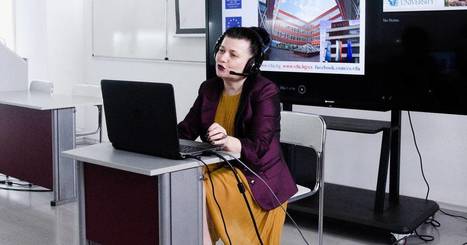
You learned how to Zoom, or Hangout, or Team up. You read all the quick tips about emergency remote teaching. You recorded your lectures or gathered via video call with however many students you could reach each week.
You pivoted, shifted and, let’s be real, maybe stumbled into a makeshift version of online education. At last, final grades—or pass/fail marks—are turned in.
Congratulations, you made it through the virtual semester.
Now what?
No one knows yet what the next semester will bring, but there’s a good chance the spaces where you used to teach, whether cavernous lecture hall or cozy seminar room, won’t be available this fall.
That’s right, more virtual class time may be in your future. So this summer might be the right time to learn a little more about online pedagogy.
Higher education's current move to online learning may be leaving a sour taste in the mouths of students and faculty across the country, but there is a silver lining.
The loss of interstitial encounters is what's most noticeable for me; planned conferences and meetings tend to produce very predictable and uninspired outcomes - over the past 11 years I've found it's the casual chats, the unplanned encounter, the overheard conversations that generate the bulk of the most productive work - the unmanaged human interaction is where it all happens. We lose all of that with having every interaction structured and mediated.
Looking back at findings from a series of eyetracking studies over 13 years, we see that fundamental scanning behaviors remain constant, even as designs change.
Facebook’s new messaging product, Messenger Rooms, is available now on desktop and mobile. Messenger Rooms allows up to 50 people to join someone’s group video chat on Facebook, either through the main app or through the Messenger one.
"While I do not dismiss Lin Martin’s concerns (CMM Wednesday) I can certainly assure her that learning and teaching has risen to the on-line challenge.
On the surface, Dr Martin’s concerns relating to on-line learning and professional registration bodies, and a lack of on-line teaching skills in the sector seem justified. But it is important to acknowledge the huge effort teaching staff are making in coming up-to-speed quickly in this space, largely thanks to the centralised learning and teaching support units that facilitate rapid professional development opportunities."
"While I do not dismiss Lin Martin’s concerns (CMM Wednesday) I can certainly assure her that learning and teaching has risen to the on-line challenge. On the surface, Dr Martin’s concerns relating to on-line learning and professional registration bodies, and a lack of on-line teaching skills in the sector seem justified. But it is important to acknowledge the huge effort teaching staff are making in coming up-to-speed quickly in this space, largely thanks to the centralised learning and teaching support units that facilitate rapid professional development opportunities."
Learn how to teach online in this free teaching course designed to help educators teach and support their students online in response to the COVID-19 pandemic.
We are in the transition period between “Learning at home” and returning to our education settings. It’s messy and we’re managing change across multiple contexts daily. One probable constant is tha…
Feeling tired after endless Zoom meetings? You're not alone. Research suggests video calls increase our cognitive load compared with face-to-face meetings.
As the number of universities (including my own) announce covid-19 plans that include requiring all classes finish out their terms online, I’m imagining an increasing number of college instru…
“Higher education, to do what they’ve been able to do in such a short amount of time, it’s amazing, but it’s still not online education,” Adair argues.
In a joint statement, the council’s members advocate that “online learning involves the careful and deliberate development and implementation of courses and programs that are designed to be offered online. High quality online courses and programs should be guided by instructional design and pedagogical practices specifically created for online education.”
The council aims to help distinguish “this quick pivot to put your stuff up on Zoom” from what carefully designed distance courses can achieve, Adair says, adding, “The fear is that fundamental misunderstanding of what online learning is and what it takes to do it well is going to work against future online efforts, and it will prejudice how student and parents think about online education, and could prejudice how legislatures and folks with other kinds of oversight positions look at online education.”
Following along the lines of Educause's "7 things..." series, a team at Penn State looked at Grassroots Video (low-end amateur video like most on YouTube) and investigated its potential to enrich teaching and learning.
This guest blog has been kindly contributed by Professor Neil Morris, Chair in Educational Technology, School of Education, University of Leeds. He can be found at @NeilMorrisLeeds The Unbundled University research project, funded by the UK’s Economic and Social Research Council (ESRC grant number ES/P002102/1) and the National Research Foundation in South Africa (NRF grant …
To get content containing either thought or leadership enter:
To get content containing both thought and leadership enter:
To get content containing the expression thought leadership enter:
You can enter several keywords and you can refine them whenever you want. Our suggestion engine uses more signals but entering a few keywords here will rapidly give you great content to curate.


 Your new post is loading...
 Scoop.it!