The latest news related to the meaningful and effective implementation of educational technology and e-learning in K-12, higher education, corporate and government sectors.
"The University Professional Continuing Education Association and the Association for Continuing Higher Education recently convened a summit of education leaders to talk about the phenomenon of online learning, described in summit literature as 'the biggest thing to ever hit higher education.'"
"Sometimes students in the online environment just need that extra nudge to feel connected in order to truly excel. As instructors, we can facilitate community-building in an asynchronous environment by utilizing synchronous tools, such as Wimba, Skype, Elluminate, and others available to us via our learning management system or outside of the LMS."
"Building elearning courses is hard enough. Most people are working with limited resources and time. So having to deal with anything that slows down the process is a hassle. Here are three common roadblocks and ways to avoid them."
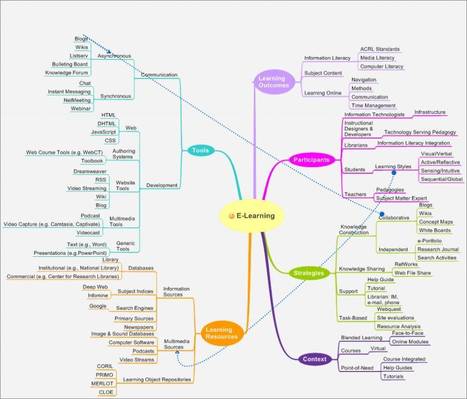
"E-learning can be defined in many ways. In its simplest form it is individual or group use of electronic mediums that provide access to online learning tools and resources. These dynamic mediums offer shared community spaces, support digital communication and collaboration, and link to information sources such as streamed video, podcasts, webcasts, digital libraries, webpages, and videoconferencing."
Because of the proliferation of new technologies, the younger generation today is outgrowing traditional forms of education – remember pencils, chalkboards, textbooks and graphing calculators?
Discussions of “online” vs. traditional learning often go in either/or terms. Which is better? Will online learning wipe out the traditional classroom, or will it fail? This way of thinking risks missing the point in two ways.
"Last week, I told a local superintendent that online learning was a great way to leverage his best teachers, expand options for students, and eliminate high cost courses with small enrollments. He asked what platform was best to use for online courses offered in his district."
"We often tell our employees, customers and ourselves, that e-learning is learning without borders. That you can learn wherever you are, at whatever time you want, and that you can gain knowledge without the previous conditions. I wonder if we have truly achieved this premise, i.e. learning without borders or are we stating something that is not yet accurate?"
When the undefeated Patriots football team of Freedom High School in Bethlehem Township, Pa., played the Emmaus Green Hornets on Friday night, Freedom senior Tyler Alicea had his heart in the game—and his mind and hands on his phone.
At a recent workshop at the University of Wisconsin, Eau Claire, I asked participants to identify the one thing about participation they would most like to change in their classrooms. From a variety of items mentioned, we decided to focus on three.
"As technology progresses, so does its use in education. Despite cuts in educational funding, students who have access to devices like laptops, smartphones and e-readers are teaching themselves to be tech-savvy. And teachers and school administrations are finding innovative and cost effective ways to take advantage of developments in technology."
"YouTube is rolling out some big new ways to engage with the education community. Continuing with our look at how YouTube can aid teachers and students, it’s probably a good idea to actually outline exactly how the video service can help in the classroom."
"Scoffing at Facebook's $82 billion valuation? Think Twitter's done? Take a closer look at the tsunami of social media... take a look below at the steep curve of the user growth rate in all age ranges and demographics, and the continuing pervasiveness of social networking into every facet of work, play and life in general. It’s hard to argue that social media hasn’t changed forever how we interact and connect online."
Instead of examining whether technology is worth schools’ investment, the New York Times should have focused on two other, more relevant questions: Why are so many districts that invest in technology still failing to see success?
To get content containing either thought or leadership enter:
To get content containing both thought and leadership enter:
To get content containing the expression thought leadership enter:
You can enter several keywords and you can refine them whenever you want. Our suggestion engine uses more signals but entering a few keywords here will rapidly give you great content to curate.




 Your new post is loading...