Your new post is loading...
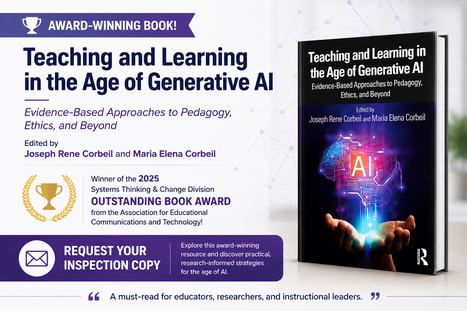
Looking for a Textbook on Generative AI in Education?
Teaching and Learning in the Age of Generative AI: Evidence-Based Approaches to Pedagogy, Ethics, and Beyond Edited by Joseph Rene Corbeil & Maria Elena Corbeil (2025) 🏆 Winner of the 2025 Systems Thinking & Change Division Outstanding Book Award from the Association for Educational Communications and Technology! If you are designing a course that addresses generative AI in education, this award-winning volume provides a research-driven, classroom-ready foundation. Rather than offering hype or fear, this book helps educators:
- Ground AI integration in learning theory and research
- Address academic integrity with thoughtful, practical strategies
- Redesign assessment for an AI-enabled world
- Explore ethics, bias, privacy, and institutional responsibility
- Leverage AI to enhance critical thinking and digital literacy
Bookended by historical and forward-looking analyses of AI in education, the chapters move beyond surface-level discussions to provide evidence-based approaches for real classrooms—K–12, higher education, and professional learning environments.
This text is ideal for:
- Undergraduate and graduate teacher education programs
- Curriculum & Instruction courses
- Educational Technology programs
- Higher education faculty development
- School technology coordinators and talent development professionals
Adopting a GenAI textbook for an upcoming semester? We invite you to request an inspection copy and explore how this resource can support your students in navigating AI with skill, ethics, and informed judgment.
Request your inspection copy today.

|
Scooped by
EDTECH@UTRGV
July 27, 12:22 PM
|
In governance, AI fundamentally changes how decisions are informed, it does not change who remains accountable for them.
|
|
Scooped by
EDTECH@UTRGV
July 27, 12:16 PM
|
The traditional boundary between a traditional degree and active professional development has permanently dissolved, writes Tim Brown. AI skills need to be taught in a similarly joined-up way
|
|
Scooped by
EDTECH@UTRGV
July 27, 12:13 PM
|
"Value no longer lies only in producing an answer, but in how that answer is developed. AI can generate content quickly, but it can’t determine whether a question is well framed, whether reasoning is sound, or whether conclusions are appropriate."
|
|
Scooped by
EDTECH@UTRGV
July 27, 12:06 PM
|
"Every AI problem you chase — hallucinations, wrong answers, poor retrieval — traces back to the IA projects you never funded. Now’s the time to fund them."
|
|
Scooped by
EDTECH@UTRGV
July 27, 12:03 PM
|
Now updated: AIAS 2.1 wording · new AIAS Advisor GPT The AI Assessment Scale (AIAS) A five-level framework that helps educators decide what role AI should play in an assessment task, and redesign the task so that decision holds up in practice. Explore the levels Redesign a task → About the AIAS The AI Assessment…
|
|
Scooped by
EDTECH@UTRGV
July 23, 10:50 AM
|
One of the first randomized controlled trials of AI in teaching found that it can undermine learning. Students felt less motivated to learn.
|
|
Scooped by
EDTECH@UTRGV
July 23, 10:26 AM
|
Writing is one of the most important critical thinking skills to help develop the mind and express creative thought, which AI cannot do
|
|
Scooped by
EDTECH@UTRGV
July 23, 10:22 AM
|
"Designers often say that UX isn’t really about screens. It’s a line I see in portfolios, I hear in interviews; that’s the line we use to signal that we’re thinking beyond just pixels. But honestly, for most of my career, that wasn’t true. In one way or another, the job was screens: building flows in Figma, mapping out states, writing specs, worrying about happy paths and edge cases, and handling handoff. We kept saying UX isn’t about screens, even as we kept making more of them."
|
|
Scooped by
EDTECH@UTRGV
July 23, 10:18 AM
|
Asynchronous course design has to work for the student logging in alone at 11pm, or it doesn’t work at all. Here’s how to design to make your presence felt, even in absence
|
|
Scooped by
EDTECH@UTRGV
July 22, 12:11 PM
|
This Week with EdSurge podcast examines what holds up when artificial intelligence moves fast.
|
|
Scooped by
EDTECH@UTRGV
July 22, 12:06 PM
|
A true digital campus experience requires leaders to think about how every technology decision contributes to the overall online journey.
|
|
Scooped by
EDTECH@UTRGV
July 22, 12:04 PM
|
Gemini’s new learning mode is built on educational science, and that helps set it apart from some of the competition in our tests.
|
|
|
Scooped by
EDTECH@UTRGV
July 27, 12:24 PM
|
Learn when GenAI should support, challenge, or step back in instructional design—and how role switching can improve judgment, quality, and control.
|
|
Scooped by
EDTECH@UTRGV
July 27, 12:20 PM
|
Explore how AI can strengthen teaching by restoring creativity, supporting reflective practice, and helping faculty reconnect with their teaching identity.
|
|
Scooped by
EDTECH@UTRGV
July 27, 12:15 PM
|
"University students now use artificial intelligence (AI) tools in several academic activities, including information retrieval, writing support, and problem-solving. While these technologies may enhance learning efficiency, effective student engagement with AI requires relevant psychological characteristics as well as technology-related competencies."
|
|
Scooped by
EDTECH@UTRGV
July 27, 12:10 PM
|
A study of 31,000 course syllabi by the University of California, Berkeley’s Dr Igor Chirikov has found that in the three years since ChatGPT
|
|
Scooped by
EDTECH@UTRGV
July 27, 12:04 PM
|
"What changes when artificial intelligence moves from answering questions to taking action? The shift from chatbots to agentic AI turns a responsive interface into an operational system that can pursue goals, use tools, and complete multi-step work. ChatGPT, Claude, and Gemini changed how people generate content and interact with software."
|
|
Scooped by
EDTECH@UTRGV
July 23, 11:11 AM
|
I've come to believe that educational AI is a fundamentally different engineering discipline than the consumer AI most people read about.
|
|
Scooped by
EDTECH@UTRGV
July 23, 10:49 AM
|
This article explains why L&D's evaluation capabilities can finally measure behavior transfer and business impact.
|
|
Scooped by
EDTECH@UTRGV
July 23, 10:24 AM
|
Discover how course design as an act of care strengthens faculty support, improves student engagement, and creates more inclusive learning experiences.
|
|
Scooped by
EDTECH@UTRGV
July 23, 10:21 AM
|
Most compliance courses are completed, not learned. See why story is the most powerful tool in learning — and how SHIFT Meteora's SAGA fixes it.
|
|
Scooped by
EDTECH@UTRGV
July 23, 10:16 AM
|
AI literacy, metacognitive frameworks, and reflection apparati have limited efficacy in the absence of systemic change, instructional redesign, disciplinary scaffolding, and ongoing measurement.
|
|
Scooped by
EDTECH@UTRGV
July 22, 12:09 PM
|
How AI deprived my students of the reading struggle they needed to succeed — and five better ways to use it.
|
|
Scooped by
EDTECH@UTRGV
July 22, 12:05 PM
|
Innovation in PD gives teachers autonomy to pursue PD that benefits their students and aligns with district priorities.
|
|
Scooped by
EDTECH@UTRGV
July 22, 12:01 PM
|
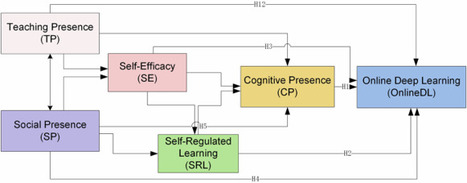
"In the context of global digital transformation in education and post-pandemic reforms, online teaching has evolved from an emergency response into an essential instructional mode in higher education. Enhancing the quality of university students’ online learning and fostering their capacity for online deep learning (OnlineDL) have thus become key concerns in the educational field."
|