

Ebook checkout increased by more than 200% in 2010 according to a recent study from OverDrive, the leading distributor of ebooks and digital audiobooks to libraries.
Get Started for FREE
Sign up with Facebook Sign up with X
I don't have a Facebook or a X account


 Your new post is loading...
 Your new post is loading...
Your new post is loading...
 Scoop.it!
Ebook checkout increased by more than 200% in 2010 according to a recent study from OverDrive, the leading distributor of ebooks and digital audiobooks to libraries. 
No comment yet.
Sign up to comment
Scoop.it!

Games are being used in creative ways in both education and the non-profit sector. Here's a look at some success stories.
Scoop.it!
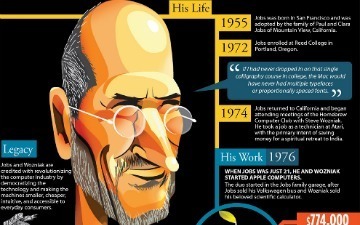
An infographic lays out Steve Jobs's life and considerable accomplishments.
Scoop.it!

FOR more than a decade educators have been expecting the Internet to transform that bastion of tradition and authority, the university. Digital utopians have envisioned a world of virtual campuses and “distributed” learning. They imagine a business model in which online courses are consumer-rated like products on Amazon, tuition is set by auction services like eBay, and students are judged not by grades but by skills they have mastered, like levels of a videogame.
Scoop.it!

“Hybrid education offers promise for engaging students who are demotivated by the lack of meaningful use of technology, and associated opportunities for skill-building and efficiency, in many lessons today.”
Scoop.it!
It is time to look at how some of our outdated teaching practices can be changed to help students learn more effectively. Social Media can help us engage dig...
Scoop.it!

Instead of posting harmful information, use social media networks to showcase your strengths.
Scoop.it!
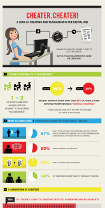
"The consequences of cheating used to instill fear into many a student. But it seems these days, kids just don’t care about academic honesty anymore. Many students can’t even distinguish between what constitutes plagiarism and what doesn’t. According to recent research, 71% do NOT believe copying from the Web is 'serious cheating.' "
Scoop.it!
"For anyone starting a revolution, or a business, Twitter can be a success. For the rest of the world, it can be a waste of time that doesn’t get the message out to people they want to reach. And for some, it’s no more than a bunch of nonsense limited to 140 characters—as this infographic shows."
Scoop.it!
Are tech tools improving your teaching or are they just a distraction? Take this short quiz to find out.
Scoop.it!
Employers dish on what they found on social networking profiles that made them offer a job, or rescind an offer.
Scoop.it!

"Making your material available to mobile learners poses some unique challenges for content developers. It’s one thing when you know your audience. But it’s particularly challenging when you’re working in the extended enterprise space where the end users’ environment is unknown. Either way, several considerations can make the transition to mobile that much easier."
|
Scoop.it!

The latest of several studies to look at Facebook use and low grades says some Facebook behaviors are actually correlated with higher GPAs.
Scoop.it!

"Ten months ago I uploaded Mousetrapped to Smashwords and what was then called Amazon’s Digital Text Platform (DTP) – now Kindle Direct Publishing (KDP) – almost as an afterthought. I was looking for something to do while I waited for my Createspace proof copy to arrive. Turns out it was the best afterthought I’ve ever had."
Scoop.it!

"I’ve been reading entirely with ebooks for about nine months without touching paper. Ebooks are great . . . but there are things I miss from paper books, and things that I still want from ebooks that have yet to come to fruition."
Scoop.it!

While employers continue to use LinkedIn for recruiting -- especially for executive positions -- they prefer interacting with students and graduates via Facebook. Here's why.
Scoop.it!

"Humor is a tricky subject for eLearning. How far do you go? Will it come off as funny or annoying? Also, if this is a course that needs a yearly refresher, how funny will it be the second, third or fourth time around?"
Scoop.it!

"On and off campus, students use their cell phones, wireless personal digital assistants (PDAs), laptops, and iPods and take full advantage of Bluetooth. Each device offers a similar technology medium but also a new way to access course material and communicate with faculty and other students. With the proliferation of technology devices, students have begun exploring new methods of learning, thus paving the way for educators to adopt new instructional strategies. Educators have identified many elements that lead to student success, including frequent communication and participation within a learning community.1 Some of the new technologies can potentially facilitate student involvement in learning. But how?"
Scoop.it!
A quick look at how advancements in technology have impacted teaching and learning over time...

Caitlin Maher's curator insight,
October 9, 2013 8:48 PM
This is a cute cartoon which shows the advancements in technology. Children would like this little cartoon as it visually represents the changes.
Scoop.it!

For universities, deciding to use social media is a no-brainer. It's a great way to market the university to prospective students, make it livelier for current students and keep alumni in the loop. Here are some tips on doing it right.
Scoop.it!

"Steve Jobs, whose creativity and creations such as the Macintosh computers, iPhones, and iPads have influenced more than three decades of students and teachers, died Wednesday after a battle with cancer. He was 56.
The consumer electronics and computer hardware and software company that Jobs co-founded in 1976, Cupertino, Calif.-based Apple, has long held devotees within the world of education. It remained relevant in schools as the early Apple I and II's developed into subsequent lines of desktop computers, laptops, and mobile devices that changed both knowledge sharing and knowledge consumption for students and adults alike."
Scoop.it!

Drs. Rene and Maria Elena Corbeil presented a paper at the 2011 IACIS conference in Mobile Alabama. Maria Elena was awarded the Ben Bauman Award for Excellence in recognition of her outstanding service and teaching.
Scoop.it!
Written by an ex college student, who explains very eloquently how educators must change. If the message in this video resonates with you feel free to send it to any teachers, principals, professors, university presidents, boards of regents, board...
Via Donna Browne
Scoop.it!
"Every day, about 250 million people log in to Facebook. Twitter has 15 million regular users; they send 65 million messages each day. People watch more than 2 billion video clips on YouTube daily. Every hour, users upload an average of 24 hours of video content. Every day, more than 90 percent of college students visit a social networking site. That’s a lot of information bombarding students. Trying to keep up with it all can change the way the brain functions. Is this good or bad?"
|