Your new post is loading...

|
Scooped by
EDTECH@UTRGV
February 11, 5:29 PM
|
Looking for a Textbook on Generative AI in Education?
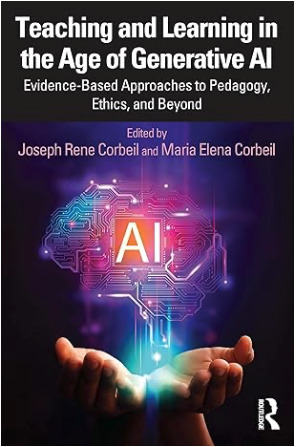
Teaching and Learning in the Age of Generative AI: Evidence-Based Approaches to Pedagogy, Ethics, and Beyond Edited by Joseph Rene Corbeil & Maria Elena Corbeil (2025) 🏆 Winner of the 2025 Systems Thinking & Change Division Outstanding Book Award from the Association for Educational Communications and Technology! If you are designing a course that addresses generative AI in education, this award-winning volume provides a research-driven, classroom-ready foundation. Rather than offering hype or fear, this book helps educators:
- Ground AI integration in learning theory and research
- Address academic integrity with thoughtful, practical strategies
- Redesign assessment for an AI-enabled world
- Explore ethics, bias, privacy, and institutional responsibility
- Leverage AI to enhance critical thinking and digital literacy
Bookended by historical and forward-looking analyses of AI in education, the chapters move beyond surface-level discussions to provide evidence-based approaches for real classrooms—K–12, higher education, and professional learning environments.
This text is ideal for:
- Undergraduate and graduate teacher education programs
- Curriculum & Instruction courses
- Educational Technology programs
- Higher education faculty development
- School technology coordinators and talent development professionals
Adopting a GenAI textbook for an upcoming semester? We invite you to request an inspection copy and explore how this resource can support your students in navigating AI with skill, ethics, and informed judgment.
Request your inspection copy today.
|
|
Scooped by
EDTECH@UTRGV
Today, 12:23 PM
|
Learn why and how teachers can use generative AI to streamline lesson planning, personalize explanations, and automate retrieval practice—without losing instructional control.
|
|
Scooped by
EDTECH@UTRGV
Today, 12:17 PM
|
"Two educators who use artificial intelligence in their classroom combine prompt engineering, in-class assignments and guardrails."
|
|
Scooped by
EDTECH@UTRGV
Today, 12:13 PM
|
Results of two gatherings make case for visionary yet balanced approaches to AI.
|
|
Scooped by
EDTECH@UTRGV
March 3, 10:18 AM
|
More than three years after ChatGPT debuted, AI has become a part of everyday life — and professors and students are still figuring out how or if they should use it.
|
|
Scooped by
EDTECH@UTRGV
March 3, 10:15 AM
|
"From AI study assistants to presentation builders, these free tools can help teachers, students, and parents work smarter."
|
|
Scooped by
EDTECH@UTRGV
March 3, 10:09 AM
|
"Across campuses, conversations about artificial intelligence are sometimes being framed by unease rather than enthusiasm. Leaders, faculty and students are questioning how fast to move, what might break and who bears the risk."
|
|
Scooped by
EDTECH@UTRGV
March 3, 10:05 AM
|
K-12 teachers and higher education faculty across all grade levels and subject areas will have free access to AI literacy training modules designed by Google and aligning with ISTE+ASCD standards.
|
|
Scooped by
EDTECH@UTRGV
March 2, 2:17 PM
|
"Nearly every technological revolution of the past 150 years—from the automobile to televisions, microwave ovens and smartphones—has been marked by both extraordinary promise and deep public fear. Artificial intelligence, or AI, is no exception."
|
|
Scooped by
EDTECH@UTRGV
March 2, 2:14 PM
|
Education needs an analog reboot, says neuroscientist Jared Cooney Horvath in his new book, “The Digital Delusion,” which lays out how technology ha
|
|
Scooped by
EDTECH@UTRGV
March 2, 2:08 PM
|
A recent study of college students using AI to help understand assigned readings found that they would read AI summaries instead of the text. It doesn’t have to be this way.
|
|
Scooped by
EDTECH@UTRGV
March 2, 2:04 PM
|
There are many paths AI evolution could take. On one end of the spectrum, AI is dismissed as a marginal fad, another bubble fueled by notoriety and misallocated capital. On the other end, it’s cast as a dystopian force, destined to eliminate jobs on a large scale and destabilize economies. Markets oscillate between skepticism and…
|
|
Scooped by
EDTECH@UTRGV
February 27, 12:18 PM
|
"Whether you’re an AI advocate or a skeptic, the slow AI movement has something to offer."
|
|
|
Scooped by
EDTECH@UTRGV
Today, 12:27 PM
|
Why are students so comfortable using AI for emotional support?
|
|
Scooped by
EDTECH@UTRGV
Today, 12:19 PM
|
"After the FCC pulled back coverage for school bus Wi-Fi and hotspots, K-12 leaders are scrambling to connect students without home internet."
|
|
Scooped by
EDTECH@UTRGV
Today, 12:15 PM
|
"For years, computer science was marketed as one of the safest degrees in higher education. Strong demand, high wages and a seemingly endless need for technical talent made CS feel like a guaranteed return on investment. Today, that certainty is being questioned."
|
|
Scooped by
EDTECH@UTRGV
Today, 12:10 PM
|
"Momentum appears to be growing against any screen time in schools as states like Tennessee and Kansas propose prohibiting ed tech for grades K-5."
|
|
Scooped by
EDTECH@UTRGV
March 3, 10:16 AM
|
"In graduate school, my experimental archaeology professor told a student to create a door socket—the hole in a door frame that a bolt slides into—in a slab of sandstone by pecking at it with a rounded stone. After a couple of weeks, the student presented his results to the class. “I pecked the sandstone about 10,000 times,” he said, “and then it broke.” This kind of experience is known as individual learning. It works through trial and error, with lots of each."
|
|
Scooped by
EDTECH@UTRGV
March 3, 10:11 AM
|
Teens are turning to AI chatbots for homework help, research, entertainment, and emotional support.
|
|
Scooped by
EDTECH@UTRGV
March 3, 10:08 AM
|
"In the age of AI, the true future of higher education lies not in replacing faculty but in freeing them to do what only humans can—build meaningful relationships, cultivate wisdom, and guide students through the ethical and intellectual challenges machines cannot navigate."
|
|
Scooped by
EDTECH@UTRGV
March 3, 10:01 AM
|
CareerNet builds essential infrastructure for career navigation, using shared data and benchmarks to guarantee users high-quality guidance.
|
|
Scooped by
EDTECH@UTRGV
March 2, 2:15 PM
|
"Organizations are moving fast with AI—often faster than their ability to govern it. Models are being deployed, decisions are being automated and processes are being reshaped at a pace that traditional risk frameworks were never designed to absorb. What’s striking is how quietly risk accumulates."
|
|
Scooped by
EDTECH@UTRGV
March 2, 2:10 PM
|
Learning leaders must shift from AI tool training to designing AI learning architecture with augmentation pathways and embedded governance.
|
|
Scooped by
EDTECH@UTRGV
March 2, 2:06 PM
|
"New Coursera report shows half of U.S. higher education institutions are unprepared to manage AI - 78% of U.S. students and educators say AI is having a positive impact on higher education
- 50% believe the U.S. higher education system is unprepared to manage AI
AI adoption is widespread among U.S. university students and educators, yet half believe higher education is not fully prepared to manage its impact, according to a new survey released today by Coursera (NYSE: COUR), a leading global online learning platform."
|
|
Scooped by
EDTECH@UTRGV
February 27, 12:20 PM
|
Microsoft has released a new research report warning that no single technology can reliably distinguish AI-generated content from authentic media, and that deepening reliance on any one method risks misleading the public.
|
|
Scooped by
EDTECH@UTRGV
February 27, 12:15 PM
|
Increased use of new technologies accompanied by rising fear of being accused of cheating, with many universities’ policies on what is acceptable still unclear, has students on edge. Universities have been urged to reconsider their use of tools that claim to be able to detect artificial intelligence after a survey found three-quarters of U.K. students using AI feel stressed that their work will be wrongly flagged as cheating.
|