The White House will unveil plans Friday for a research center that aims to bring more digital learning into the nation's classrooms.
Via Donna Murdoch


|
Rescooped by
EDTECH@UTRGV
from Educational Technology and New Pedagogies
onto Educational Technology News September 16, 2011 1:49 PM
|
 Scoop.it!
The White House will unveil plans Friday for a research center that aims to bring more digital learning into the nation's classrooms.

 Your new post is loading...
 Your new post is loading...
Your new post is loading...
Scoop.it!
|
|
|
Scooped by
EDTECH@UTRGV
Today, 3:33 PM
|
Scoop.it!

AI voiceovers are reshaping corporate training. Discover how L&D leaders can use AI in eLearning effectively and ethically.
"For instructional text, which is typically clear, structured, and professional — the quality gap between AI and studio talent has narrowed considerably."
|
|
Scooped by
EDTECH@UTRGV
Today, 2:58 PM
|
Scoop.it!

"or years, Learning and Development focused on a single goal: delivering knowledge. Courses were built, content was deployed, and completion rates were tracked. Yet one persistent challenge remained: learning did not reliably translate into on-the-job performance."
"AI coaching agents are emerging as a key part of the answer: moving development from scheduled events into continuous, real-time performance support."
|
|
Scooped by
EDTECH@UTRGV
Today, 2:47 PM
|
Scoop.it!

Lessons learned from a year of building an AI literacy tool.
"My advice to any educator considering building their own edtech tool: build something that extends what teachers do rather than replaces what they do. The technology should handle the matching but let the children’s learning guides handle the moment."
|
|
Scooped by
EDTECH@UTRGV
Today, 2:41 PM
|
Scoop.it!

As technical barriers fall, design, judgment, and imagination matter more for AI's role in learning and instructional technology.
"When students ask weak or incomplete questions, the problem often lies in their thinking rather than in the tool itself."
|
|
Scooped by
EDTECH@UTRGV
June 25, 10:27 AM
|
Scoop.it!

"Discover how educators can use AI to create a month of summer communication in minutes, helping families stay connected, inspired, and engaged while reducing workload before summer break begins."
"With the right prompt, educators can generate family engagement posts, newsletter content, and summer learning ideas in just a few minutes. You bring the educational expertise and knowledge of your community. AI helps turn those ideas into messages that families will actually read."
|
|
Scooped by
EDTECH@UTRGV
June 25, 10:23 AM
|
Scoop.it!

"The AFT’s new 10-point plan, “Devices Down, Eyes Up, Hands-On,” gets some things right. Students do need more active, human, hands-on learning. They need career-connected experiences, civic engagement, collaboration, movement, and opportunities to solve real problems.
But the “devices down” frame points schools in the wrong direction."
"The problem is not the device. The problem is passive learning, poor infrastructure, weak support, and policies that confuse classroom management with meaningful instruction."
|
|
Scooped by
EDTECH@UTRGV
June 25, 10:20 AM
|
Scoop.it!

The conversation around AI in schools is changing almost as rapidly as the technology. Here are some recent trends.
“AI literacy is no longer about, 'Do I know how to prompt? What is prompt engineering?'...It's about understanding the capabilities, being better at assessing the problems, and figuring out what context is needed to solve them.”
|
|
Scooped by
EDTECH@UTRGV
June 24, 12:04 PM
|
Scoop.it!

"Higher education institutions should stop asking which artificial intelligence (AI) tool to buy and instead develop an integrated "AI for operations" architecture to execute end‑to‑end institutional processes effectively."
"The question many colleges and universities are asking about artificial intelligence (AI) is, 'Which tool should we buy?' That is the wrong question."
|
|
Scooped by
EDTECH@UTRGV
June 24, 11:57 AM
|
Scoop.it!

"A recent craze in education that has garnered the attention of students and teachers alike is the ever increasing presence of phone pouches, or more specifically for my school, Yondr pouches, These small, neoprene packs have a firm magnetic seal that can only be released by tapping it against an unlocking base. Their main purpose is quite simple: stop students from accessing their phone during the school day. The rationale is that the less time students spend on their phone, the more time they will spend learning."
"A well-intended policy has unintended consequences."
|
|
Scooped by
EDTECH@UTRGV
June 24, 11:48 AM
|
Scoop.it!

Higher ed leaders and employers believe microcredentials sustain student interest and improve workforce readiness for an economy in flux.
"Microcredentials are expected to play a pivotal role as workforce demands shift...About 60% of the global workforce will require reskilling, while 1.2 billion more people are expected to enter the workforce over the next decade."
|
|
Scooped by
EDTECH@UTRGV
June 23, 9:59 AM
|
Scoop.it!

"As policymakers grapple with how artificial intelligence will reshape work, they face the familiar temptation to double down on training. The logic is that, if AI changes the knowledge workers need, then workforce systems should adapt quickly to teach in-demand skills.
However, this framing assumes the main problem is a shortage of skilled workers, when in many high-paying sectors the bigger problem is a shortage of entry-level opportunities."
"The core problem facing policymakers in the AI age is the same: an incentive mismatch. Expanding entry-level opportunities creates enormous social value in the form of higher earnings, stronger families, and a more capable workforce. But for employers, hiring and training new workers remains risky and expensive."
|
|
Scooped by
EDTECH@UTRGV
June 23, 9:53 AM
|
Scoop.it!

AI agents are already in use or pilot at most organizations, but data visibility, governance and precision recovery capabilities have not kept pace, according to Veeam's new Data & AI Trust Gap report.
"Most organizations don't have an AI adoption problem; they have an AI trust problem"
|
|
Scooped by
EDTECH@UTRGV
Today, 3:39 PM
|
Scoop.it!

Learn how teaching AI literacy helps students use AI as a writing assistant rather than a substitute, improving revision, critical thinking, and ethical AI use.
"[I]f students were taught how to use AI more deliberately and critically, could it strengthen their writing rather than replace it?"
|
|
Scooped by
EDTECH@UTRGV
Today, 3:26 PM
|
Scoop.it!

Reading Anthropic's new reports on the 'AI exponential' and recursive self-improvement alongside recent scholarship on tech oligarchy, this piece asks a simple question: is AI being built to serve people, or to serve its own acceleration?
"Since the dawn of personal computing, a technology's worth has been measured by whether it becomes helpful, intuitive, and meaningful for everyone — across every economy, culture, and belief. As AI begins to build itself, that measure matters more than ever."
|
|
Scooped by
EDTECH@UTRGV
Today, 2:57 PM
|
Scoop.it!
"There’s a screen most people have seen at least once.
You’re trying to cancel a subscription. You’ve made up your mind. You click the button that looks like it starts the process.
And then something strange happens.
The page that loads isn’t a cancellation form. It’s a full-screen gallery of everything you’re about to lose. Videos. Deals. Music. Free delivery. Presented in bright tiles, warm colours, friendly icons. A highlighted countdown showing how many days you have left. And somewhere at the bottom, small, grey, easy to miss, the option to continue cancelling."
“Too often, businesses make people jump through endless hoops just to cancel a subscription. Nobody should be stuck paying for a service they no longer want.”
|
|
Scooped by
EDTECH@UTRGV
Today, 2:44 PM
|
Scoop.it!

"The job market is undergoing a profound shift, one where degrees alone no longer guarantee career success. Skills-based hiring, focusing on what candidates can do rather than where they studied, is gaining more ground across industries. This change creates necessary pressure for colleges and universities to adapt, from new types of credentials and stronger workforce partnerships to career services built for today’s learners."
"Skills-first hiring is no longer the future—it’s happening now, and higher education must evolve to keep pace. Institutions and industry must connect learning with modern workforce demands, and education solution providers play a crucial role in the process."
|
|
Scooped by
EDTECH@UTRGV
June 25, 10:32 AM
|
Scoop.it!

"Academic libraries have long struggled with shrinking budgets, yet some are now making room for a new position: the artificial-intelligence librarian. That’s because at a time when many colleges are grappling with the impacts of generative AI, some are hoping librarians can lead them through the thicket of challenges raised by the new technology."
"At a time when many institutions are grappling with the technology and its implications, some are turning to librarians for leadership."
|
|
Scooped by
EDTECH@UTRGV
June 25, 10:25 AM
|
Scoop.it!
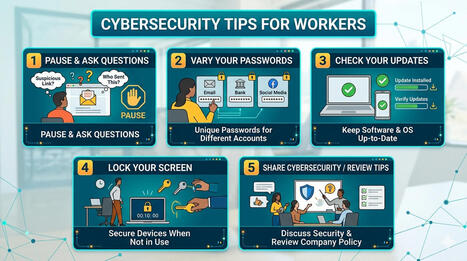
"In a time when one wrong click can freeze an entire institution, cybersecurity becomes not just an IT issue, but an issue for everyone. We think of smart hackers who are ready to take our information, yet most of the time, it is a simple human oversight."
"Sometimes security is a tech issue, but a lot of the time, it is human error. This means the power to protect your school or organization is in your hands."
|
|
Scooped by
EDTECH@UTRGV
June 25, 10:21 AM
|
Scoop.it!
"Across the United States, K-12 schools have spent the past decade building one-to-one device programs. These initiatives have established an essential baseline for digital access, making it easier for students to complete daily schoolwork across grade levels and subjects. By putting a device in the hands of every learner, districts have created a standard foundation for digital literacy, research and everyday classroom engagement.
As STEM programs continue to grow and mature, however, school leaders are beginning to encounter new questions about how well those devices support more advanced coursework. Pathways in fields like robotics, engineering, cybersecurity and data science increasingly rely on specialized professional applications that reach well beyond general-purpose classroom software."
"One-to-one device programs gave students a baseline for digital literacy. Now, specialized pathways like robotics and CAD require a new tier of processing power."
|
|
Scooped by
EDTECH@UTRGV
June 25, 10:11 AM
|
Scoop.it!
In today’s low-fire, low-hire labor market, young Americans are looking for ways to stand out from their peers. Some believe that mastery of artificial-intelligence tools differentiate them within crowded pools of job applicants.
But in reality, it’s soft skills that are critical for navigating the workplace in the age of AI, says Ellevest CEO Sylvia Kwan. The ability to communicate your ideas clearly and engage effectively with clients and co-workers is becoming even more important for young job applicants, she said.
"I don’t think anything will make you AI-proof in this labor market...But if a candidate has good verbal skills and can use AI as a complement, then they will be in a much better position than someone who has only one of those.”
|
|
Scooped by
EDTECH@UTRGV
June 24, 12:01 PM
|
Scoop.it!

"As artificial intelligence (AI) reshapes higher education, educators and technologists must rely on ACTUAL intelligence—agency, connection, trust, uniqueness, adaptability, and lifelong learning—to ensure AI enhances, rather than replaces, human judgment, relationships, and learning."
"ACTUAL intelligence...leverages the key human capacities of agency, connection, trust, uniqueness, adaptability, and lifelong learning to guard against becoming overly reliant on AI."
|
|
Scooped by
EDTECH@UTRGV
June 24, 11:53 AM
|
Scoop.it!
"In today’s evolving higher education landscape, learner demographics are changing, and more learners want flexible course delivery options [1, 2]. The traditional brick-and-mortar classroom, where learners attend in person on specific days and times, is becoming less appealing. As higher education institutions (HEIs) grapple with the enrolment cliff, HEIs are becoming innovative and even partnering with industries to offer alternative credentials (e.g., massive open online courses (MOOCs), micro-credentials), which are available online and are of shorter duration than the typical 16-week college semester. While the flexibility of online delivery options attracts more learners, they need strong self-regulated learning skills to succeed in online courses."
"Educators can support learners' self-regulation by intentionally designing features into courses that aid learners' goal setting, environmental structuring, task strategies, time management, help-seeking behavior, and self-evaluation."
|
|
Scooped by
EDTECH@UTRGV
June 24, 11:45 AM
|
Scoop.it!

"Without clear strategies, AI integration risks widening existing disparities and undermining academic standards. The AI Course Compass: A Seven-Phase Framework for Ethical, Equitable, and Adaptive Course Design (AI Course Compass Framework) addresses the critical gap of higher education’s AI integration through a structured seven-phase model that balances innovation with systemic ethics. While existing frameworks like OLC’s AI Strategy, ETHICAL Principles, and ARCHED offer valuable high-level guidance, they frequently lack phased roadmaps, course-level specificity, model-agnostic adaptability, and integrated ethics assurance."
"A successful AI integration strategy begins with a shared vision and ethical foundation. Leadership, instructional designers, and faculty collaborate to define institutional goals for AI use, align resources, and establish accountability structures."
|
|
Scooped by
EDTECH@UTRGV
June 23, 9:54 AM
|
Scoop.it!

The vast majority of education organizations (98%) expect their AI infrastructure budgets to either increase or hold steady over the next year, according to a recent report from cloud storage provider Wasabi.
"The vast majority of education organizations (98%) expect their AI infrastructure budgets to either increase or hold steady over the next year...Nearly half — 46% — reported planning to increase their AI spending."
|
|
Scooped by
EDTECH@UTRGV
June 23, 9:44 AM
|
Scoop.it!

"A healthy and progressive dialogue about technology, particularly about AI in education, should be based on the best facts available. It isn’t easy to stay current considering how quickly the technology landscape changes. When bad actors come into the mix, it becomes impossible."
"[W]e need to shed the idea that a technology tool flags a student for wrongdoing when its sole purpose is to mark a portion of text for additional attention. Tools do not make decisions. The information they generate should inform a decision, as small bits contributing to the whole."