Your new post is loading...
Looking for a Textbook on Generative AI in Education?
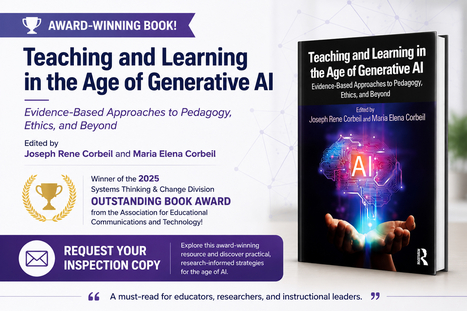
Teaching and Learning in the Age of Generative AI: Evidence-Based Approaches to Pedagogy, Ethics, and Beyond Edited by Joseph Rene Corbeil & Maria Elena Corbeil (2025) 🏆 Winner of the 2025 Systems Thinking & Change Division Outstanding Book Award from the Association for Educational Communications and Technology! If you are designing a course that addresses generative AI in education, this award-winning volume provides a research-driven, classroom-ready foundation. Rather than offering hype or fear, this book helps educators:
- Ground AI integration in learning theory and research
- Address academic integrity with thoughtful, practical strategies
- Redesign assessment for an AI-enabled world
- Explore ethics, bias, privacy, and institutional responsibility
- Leverage AI to enhance critical thinking and digital literacy
Bookended by historical and forward-looking analyses of AI in education, the chapters move beyond surface-level discussions to provide evidence-based approaches for real classrooms—K–12, higher education, and professional learning environments.
This text is ideal for:
- Undergraduate and graduate teacher education programs
- Curriculum & Instruction courses
- Educational Technology programs
- Higher education faculty development
- School technology coordinators and talent development professionals
Adopting a GenAI textbook for an upcoming semester? We invite you to request an inspection copy and explore how this resource can support your students in navigating AI with skill, ethics, and informed judgment.
Request your inspection copy today.

|
Scooped by
EDTECH@UTRGV
Today, 9:23 AM
|
Ban or no ban, students are going to use AI. Let’s make sure they have the skills to navigate it, says Common Sense Media’s chief program officer.
|
|
Scooped by
EDTECH@UTRGV
Today, 9:18 AM
|
A meta-analysis of gamified learning finds real but small effects, and shows which design choices make the difference. What that means for points, badges and leaderboards in your course.
|
|
Scooped by
EDTECH@UTRGV
Today, 9:13 AM
|
"If you’ve been using AI at work this year, you’ve probably noticed something strange. You’re faster than ever, and your days aren’t any shorter."
|
|
Scooped by
EDTECH@UTRGV
October 26, 11:05 AM
|
"Online learning has become increasingly popular in recent years, and students have a lot to say about what they want from their online courses. A recent survey by McKinsey found that students want flexibility, social interaction, high-quality content, support, and value for money from online learning."
|
|
Scooped by
EDTECH@UTRGV
October 26, 11:00 AM
|
Explore how the science of learning can guide AI in teaching and higher education, helping instructors support student learning with evidence-based strategies.
|
|
Scooped by
EDTECH@UTRGV
October 26, 10:54 AM
|
Research finds that when knowledge workers intentionally use AI to challenge their ideas, they can improve their performance.
|
|
Scooped by
EDTECH@UTRGV
October 23, 12:27 PM
|
The implementation of AI should not preclude universities from imparting skills that last a lifetime, including the ability to think critically, defend a conclusion and recognize when it is time to learn something new.
|
|
Scooped by
EDTECH@UTRGV
October 23, 12:21 PM
|
As students increasingly turn to AI for learning, understanding its limitations is critical to ensuring it supports learning.
|
|
Scooped by
EDTECH@UTRGV
October 23, 12:03 PM
|
We examine the purpose of modern schooling and why the traditional model of passive, highly regulated consumption and only base regurgitation is becoming obsolete.
|
|
Scooped by
EDTECH@UTRGV
October 22, 11:56 AM
|
What we’re learning—and still need to discover—about AI for networking.
|
|
Scooped by
EDTECH@UTRGV
October 22, 10:22 AM
|
The edtech world loves a disruption narrative, and it is easy to assume that artificial intelligence in the classroom was born alongside ChatGPT in late 2022.
|
|
Scooped by
EDTECH@UTRGV
October 21, 10:17 AM
|
OpenAI’s AI Skills Jams drew more than 1,600 US educators. Feedback from 802 participants found 92% left with reusable tools, while 29% wanted more hands-on time. ETIH’s edtech news coverage examines classroom examples and the limits of the findings.
|
|
|
Scooped by
EDTECH@UTRGV
Today, 9:25 AM
|
"New AI-powered summaries help teachers identify common questions, learning strengths and areas needing support, while Google also introduces direct publishing of Gemini-built apps to Google Sites"
|
|
Scooped by
EDTECH@UTRGV
Today, 9:20 AM
|
Explore why relevance is the key to meaningful training engagement and how learning leaders can move beyond completion to build capability.
|
|
Scooped by
EDTECH@UTRGV
Today, 9:15 AM
|
Being a student should be about more than completing assignments. Much ink has been spilled over how to respond to artificial intelligence use in education. Harvard College Dean David J. Deming frames cheating with AI as a “temptation”; students know it’s wrong, but we just can’t help ourselves — so assignments have to be restructured to make cheating impossible. We think this framing is mistaken. Instead, we should consider AI misuse to stem from the failure to cultivate curiosity in students."
|
|
Scooped by
EDTECH@UTRGV
Today, 9:10 AM
|
"In schools around the world, AI is increasingly embedded in education technology to facilitate administration, teaching, learning and assessment. Curricula that promote the development of children’s AI knowledge, skills and/or values may be taught in a number of ways: as a required or elective subject; as part of information and communication technology (ICT)/information technology (IT) teaching; or as a cross-curricular or extra-curricular activity (UNESCO, 2022). None of this is inevitable nor universal."
|
|
Scooped by
EDTECH@UTRGV
October 26, 11:02 AM
|
A swing from digital to analogue learning is happening overseas, but student performance is yet to improve on at least one international measure.
|
|
Scooped by
EDTECH@UTRGV
October 26, 10:56 AM
|
"Rapid advancements in artificial intelligence have raised uncertainty about jobs and the value of college. According to the Pew Research Center, young adults increasingly worry about AI taking jobs. No job is entirely AI-proof, creating a need for education and training that emphasizes human skills and adaptability. For college to remain valuable, it must become more affordable and quickly pivot to prepare people for technology-integrated jobs. Higher education must cultivate durable skills, such as critical thinking, problem-solving, and interpersonal communication, alongside specific subject skills to help workers succeed alongside machines."
|
|
Scooped by
EDTECH@UTRGV
October 26, 10:52 AM
|
"Agents at Anthropic now log six hours for every human hour, and reading their output would eat half a week. The job is to create judgement systems for what deserves attention."
|
|
Scooped by
EDTECH@UTRGV
October 23, 12:24 PM
|
Educational AI should be evaluated not only by what it can do, but by what it is designed not to do for the student.
|
|
Scooped by
EDTECH@UTRGV
October 23, 12:06 PM
|
Twelve hundred agents invented a language, a government, and cryptography — and none of it was in the benchmark
|
|
Scooped by
EDTECH@UTRGV
October 22, 12:00 PM
|
AI is quickly changing. These tips from university librarians can help people keep pace with the shifts as they approach their research.
|
|
Scooped by
EDTECH@UTRGV
October 22, 10:34 AM
|
Some of tech's most powerful leaders are treating AI like it's alive. It could have profound consequences for our world and your own personal safety.
|
|
Scooped by
EDTECH@UTRGV
October 22, 10:18 AM
|
"For the past several years, colleges and universities have pondered how artificial intelligence will transform higher education. We're approaching the question backward.
|
|
Scooped by
EDTECH@UTRGV
October 21, 10:16 AM
|
Google is expanding access to AI-generated STEM simulations, Deep Review document checking and Earth AI research tools. ETIH covers the pilots, access arrangements and research findings in this edtech news story.
|