 Your new post is loading...
Looking for a Textbook on Generative AI in Education?
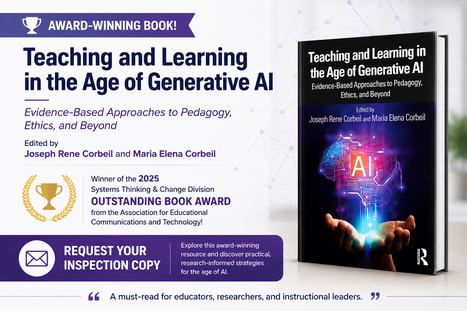
Teaching and Learning in the Age of Generative AI: Evidence-Based Approaches to Pedagogy, Ethics, and Beyond Edited by Joseph Rene Corbeil & Maria Elena Corbeil (2025) 🏆 Winner of the 2025 Systems Thinking & Change Division Outstanding Book Award from the Association for Educational Communications and Technology! If you are designing a course that addresses generative AI in education, this award-winning volume provides a research-driven, classroom-ready foundation. Rather than offering hype or fear, this book helps educators:
- Ground AI integration in learning theory and research
- Address academic integrity with thoughtful, practical strategies
- Redesign assessment for an AI-enabled world
- Explore ethics, bias, privacy, and institutional responsibility
- Leverage AI to enhance critical thinking and digital literacy
Bookended by historical and forward-looking analyses of AI in education, the chapters move beyond surface-level discussions to provide evidence-based approaches for real classrooms—K–12, higher education, and professional learning environments.
This text is ideal for:
- Undergraduate and graduate teacher education programs
- Curriculum & Instruction courses
- Educational Technology programs
- Higher education faculty development
- School technology coordinators and talent development professionals
Adopting a GenAI textbook for an upcoming semester? We invite you to request an inspection copy and explore how this resource can support your students in navigating AI with skill, ethics, and informed judgment.
Request your inspection copy today.

|
Scooped by
EDTECH@UTRGV
Today, 8:40 AM
|
"Artificial intelligence chatbots have become the bane of teachers everywhere, but to prepare for the new school year, a group of educators in Charleston, South Carolina, packed into a high school auditorium and talked about inviting AI into the classroom."
|
|
Scooped by
EDTECH@UTRGV
Today, 8:36 AM
|
Across higher education, conversations among faculty, instructors, and other teaching and learning professionals about generative artificial intelligence (GenAI) often begin with practical questions. How should courses change? What belongs in assessment? How do we as educators discourage inappropriate AI use while preserving academic integrity?
|
|
Scooped by
EDTECH@UTRGV
September 3, 11:05 AM
|
"Just as schools are preparing to open, New York City is putting new limits on technology use. As reported in The New York Times and Chalkbeat, there will be no individual screens before third grade and recommended caps on screen time for grades 3 - 8."
|
|
Scooped by
EDTECH@UTRGV
September 3, 10:59 AM
|
For most colleges and universities, access to AI tools is no longer the barrier. The real work is building the clarity, confidence, and shared responsibility to use them well.
|
|
Scooped by
EDTECH@UTRGV
September 3, 10:56 AM
|
A structured pilot program reduces risk before a districtwide rollout. Here’s how to build one that generates actionable data.
|
|
Scooped by
EDTECH@UTRGV
September 3, 10:53 AM
|
Ghost students are viewed primarily as a financial aid problem. In reality, they are an institutional cybersecurity challenge.
|
|
Scooped by
EDTECH@UTRGV
September 2, 12:19 PM
|
The new offering is promising, but there are some real-world reservations.
|
|
Scooped by
EDTECH@UTRGV
September 2, 12:16 PM
|
Attendance, completion, and click-through data show presence, but they often miss the signals that determine whether learning sticks.
|
|
Scooped by
EDTECH@UTRGV
September 2, 12:13 PM
|
When tech and AI can increasingly handle routine tasks, students need opportunities to build skills that come from not simply following a set of instructions
|
|
Scooped by
EDTECH@UTRGV
September 2, 12:09 PM
|
"Steven Spielberg’s Precogs Are The Sharpest Portrait Of Generative AI Anyone Drew Before It Arrived — Fluent, Confident, Acting On Their Own, Hallucinations Included."
|
|
Scooped by
EDTECH@UTRGV
September 1, 11:42 AM
|
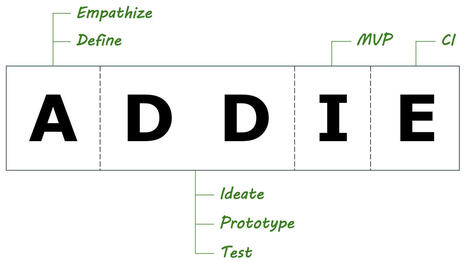
"While listening to the conversation between Purnima Valiathan and Guy Wallace on The LEAD Podcast, I was surprised to hear about the ongoing confusion that's prevalent among instructional designers in relation to Design Thinking."
|
|
Scooped by
EDTECH@UTRGV
September 1, 10:42 AM
|
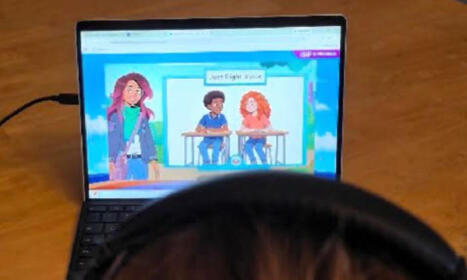
With tools like Amira and Khanmigo, ‘the take-up is very low,’ according to Stanford University’s Susanna Loeb.
|
|
|
Scooped by
EDTECH@UTRGV
Today, 8:41 AM
|
We need a plan to ensure that the good outweighs the bad. The transition to the AI era will be one of the most turbulent times in human history.
|
|
Scooped by
EDTECH@UTRGV
Today, 8:38 AM
|
A new, cautionary APA report wades into the growing debate around screens, classroom technology, and AI.
|
|
Scooped by
EDTECH@UTRGV
Today, 8:33 AM
|
How can education truly prepare students for the unpredictability of the working world? Find three ways to encourage students to develop the skills they’ll need
|
|
Scooped by
EDTECH@UTRGV
September 3, 11:02 AM
|
Colleges should stop treating AI literacy as the finish line and start building clear pathways from learning to workplace application. Every AI literacy program should be designed with employers, tested across institutions and evaluated by what students can actually do afterward.
|
|
Scooped by
EDTECH@UTRGV
September 3, 10:58 AM
|
Schools are gathering tons of data. Here’s how they can use it to support classroom learning.
|
|
Scooped by
EDTECH@UTRGV
September 3, 10:55 AM
|
Ai in schools must move beyond superficial bans and passive policies to everyday practice grounded in scrutiny, judgment, and equity.
|
|
Scooped by
EDTECH@UTRGV
September 2, 4:38 PM
|
When AI helps us think, how much thinking should we still do ourselves?
One of the biggest questions surrounding generative AI in education is no longer simply whether students use it. AI can help someone brainstorm, receive feedback, organize ideas, revise writing, conduct research—or avoid doing the learning altogether. So perhaps the better questions are:
- What intellectual work should the student still perform?
- What evidence would demonstrate that the student actually learned?
This connects to the idea of cognitive offloading—using a tool to reduce the mental effort required to complete a task. We already do this with calculators, calendars, search engines, and navigation systems. Generative AI greatly expands what we can hand over. The challenge is deciding what can be offloaded productively and what thinking remains necessary for developing understanding, judgment, creativity, and expertise. These are among the issues explored in our award-winning book, Teaching and Learning in the Age of Generative AI. We would love to hear your perspective: When does AI become a useful learning support—and when does it begin replacing the learning?
|
|
Scooped by
EDTECH@UTRGV
September 2, 12:17 PM
|
A look at what happens when rules written far from a classroom land on a teacher’s desk.
|
|
Scooped by
EDTECH@UTRGV
September 2, 12:14 PM
|
AI access is only the beginning--institutions need instructional designers to translate new capabilities into responsible teaching practice.
|
|
Scooped by
EDTECH@UTRGV
September 2, 12:12 PM
|
If ever there was a most important era in which we must emphasize discourse with our students, it is today. We are in the midst of major changes in our culture and society as a whole. I have had a long tenure of teaching in higher education, beginning in 1972 at the instructor level at the University of Illinois Urbana, continuing through spring semester 2022 as a full professor and associate vice chancellor at the University of Illinois Springfield. That is one half of a century in the faculty ranks.
|
|
Scooped by
EDTECH@UTRGV
September 1, 11:47 AM
|
What we’re learning—and still need to discover—about AI for networking.
|
|
Scooped by
EDTECH@UTRGV
September 1, 11:04 AM
|
Here are 8.5 things young reporters and editors want you to know about artificial intelligence.
|
|
Scooped by
EDTECH@UTRGV
September 1, 10:39 AM
|
A generation of advocacy, 20,000 papers, and zero experimental control trials. How educational romanticism replaces empirical proof
|




























"When students retreat to chatbots, they risk atrophying the very relational skills they need to thrive"