 Your new post is loading...
Looking for a Textbook on Generative AI in Education?
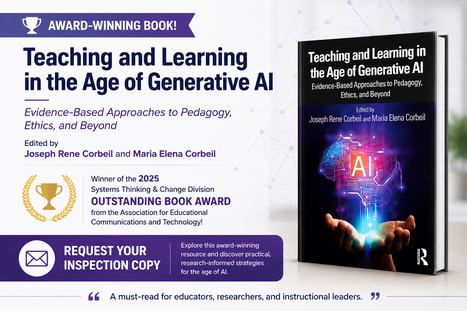
Teaching and Learning in the Age of Generative AI: Evidence-Based Approaches to Pedagogy, Ethics, and Beyond Edited by Joseph Rene Corbeil & Maria Elena Corbeil (2025) 🏆 Winner of the 2025 Systems Thinking & Change Division Outstanding Book Award from the Association for Educational Communications and Technology! If you are designing a course that addresses generative AI in education, this award-winning volume provides a research-driven, classroom-ready foundation. Rather than offering hype or fear, this book helps educators:
- Ground AI integration in learning theory and research
- Address academic integrity with thoughtful, practical strategies
- Redesign assessment for an AI-enabled world
- Explore ethics, bias, privacy, and institutional responsibility
- Leverage AI to enhance critical thinking and digital literacy
Bookended by historical and forward-looking analyses of AI in education, the chapters move beyond surface-level discussions to provide evidence-based approaches for real classrooms—K–12, higher education, and professional learning environments.
This text is ideal for:
- Undergraduate and graduate teacher education programs
- Curriculum & Instruction courses
- Educational Technology programs
- Higher education faculty development
- School technology coordinators and talent development professionals
Adopting a GenAI textbook for an upcoming semester? We invite you to request an inspection copy and explore how this resource can support your students in navigating AI with skill, ethics, and informed judgment.
Request your inspection copy today.

|
Scooped by
EDTECH@UTRGV
Today, 9:59 AM
|
A new report highlights teacher-led adoption, student demand for feedback, and a growing push for tools tailored specifically to the classroom.
|
|
Scooped by
EDTECH@UTRGV
Today, 9:50 AM
|
From grading to lesson creation, these are some of the times when educators are finding it is best for them and their students to do things the old-fashioned way
|
|
Scooped by
EDTECH@UTRGV
Today, 9:46 AM
|
"As online education expands, educators face growing challenges in maintaining emotional connections with students while sustaining their own well-being. Emotional intelligence has long been recognized as a cornerstone of effective teaching, yet in digital spaces, cues are harder to read, and connection requires new strategies. This article explores how AI, when applied ethically, can amplify, not replace, the human touch in online classrooms [1]. Specifically, three practical use cases are discussed: sentiment analysis, nudging tools, and reflective AI journaling."
|
|
Scooped by
EDTECH@UTRGV
Today, 9:38 AM
|
If traditional assessment methods feel limited, Temesgen Kifle shares alternative ways to measure students’ understanding and ability to apply learning to authentic problems
|
|
Scooped by
EDTECH@UTRGV
August 3, 1:15 PM
|
Accreditation in the age of AI must now become the force that pushes higher education beyond simply counting completed work.
|
|
Scooped by
EDTECH@UTRGV
August 3, 1:11 PM
|
A flexible, agile approach to AI skills development allows faculty and students to choose the guidance, resources and learning opportunities that best fit their roles and contexts
|
|
Scooped by
EDTECH@UTRGV
August 3, 1:06 PM
|
New courses, faculty initiatives and bottom-up governance models are helping college students learn when—and when not—to rely on AI.
|
|
Scooped by
EDTECH@UTRGV
August 3, 1:02 PM
|
"I noticed that I’m becoming increasingly annoyed while talking to AI agents. Not because they are not intelligent enough, but quite the opposite. I can spend an hour discussing an idea with a model, while walking with my dogs. We’re moving between design, engineering, psychology, physics, and a real product that appeared somewhere in the middle. The LLM can follow me surprisingly well."
|
|
Scooped by
EDTECH@UTRGV
July 31, 12:06 PM
|
"Accessibility is one of those rare concepts that almost nobody argues against. Making websites easier to navigate for people with disabilities is a fairly uncontested virtue. Semantic HTML, descriptive links, meaningful image descriptions, and keyboard navigation all help create a web that is more inclusive and usable. Yet the AI era has introduced an unexpected, deeply ironic wrinkle into this story. The websites doing the most to make information accessible to humans are often the same websites making it easiest for machines to harvest."
|
|
Scooped by
EDTECH@UTRGV
July 31, 11:57 AM
|
Explore how AI is changing student learning and assessment in higher education and why educators must design assignments that measure thinking, judgment, and understanding.
|
|
Scooped by
EDTECH@UTRGV
July 27, 12:24 PM
|
Learn when GenAI should support, challenge, or step back in instructional design—and how role switching can improve judgment, quality, and control.
|
|
Scooped by
EDTECH@UTRGV
July 27, 12:20 PM
|
Explore how AI can strengthen teaching by restoring creativity, supporting reflective practice, and helping faculty reconnect with their teaching identity.
|
|
|
Scooped by
EDTECH@UTRGV
Today, 10:00 AM
|
This article looks at why an Instructional Design framework should undergird any AI course generation as a foundation.
|
|
Scooped by
EDTECH@UTRGV
Today, 9:52 AM
|
The absence of durable skills from today's graduate pipeline reflects not a skills gap, but a failure of institutional design.
|
|
Scooped by
EDTECH@UTRGV
Today, 9:48 AM
|
Innovative Leader Award - Matt Kuhn of Volusia County Schools shares how his district has implemented AI for use by students, staff, and leaders.
|
|
Scooped by
EDTECH@UTRGV
Today, 9:41 AM
|
"Every educator in higher education is grappling with AI right now. But the challenge lands differently in fully asynchronous online environments. In a face-to-face course, a faculty member develops a running read on each student across the semester. They have heard students speak, watched them work through ideas in discussion, observed the moments where understanding arrived and the moments where it did not. When a submitted paper does not sound like the student who stumbled through an explanation two weeks ago, the discrepancy is recognizable. The faculty member has a reference point outside the artifact itself."
|
|
Scooped by
EDTECH@UTRGV
August 3, 1:17 PM
|
Scott Latham has embraced the new technology and shifted his focus to measuring the AI readiness of colleges and universities. Two years ago, Scott Latham, a business professor at the University of Massachusetts at Lowell, was one of academia’s leading voices of the resistance to artificial intelligence. “AI is not your friend,” he wrote in a June 2024 editorial for Inside Higher Ed, imploring faculty to “pump the brakes on artificial intelligence in higher education,” lest robots take their jobs in the not-so-distant future.
|
|
Scooped by
EDTECH@UTRGV
August 3, 1:14 PM
|
Discover how storytelling in teaching can transform your course syllabus into a guide that engages students, builds context, and creates a more meaningful learning experience.
|
|
Scooped by
EDTECH@UTRGV
August 3, 1:10 PM
|
"A new survey from the ed tech provider also found that two-thirds of instructors and students are concerned about artificial intelligence’s accuracy."
|
|
Scooped by
EDTECH@UTRGV
August 3, 1:04 PM
|
Student interest in non-technical AI skills is exploding as employers hope to integrate the technology into daily operations.
|
|
Scooped by
EDTECH@UTRGV
July 31, 12:08 PM
|
Coursera’s 2026 report shows micro‑credentials driving pay boosts, faster recruitment, and stronger employability in India’s AI‑driven economy.
|
|
Scooped by
EDTECH@UTRGV
July 31, 12:01 PM
|
"Rethinking friction in an AI world Why the best UX often disappears. And when it shouldn’t The paradox of “forgettable” design 'Make the experience forgettable'”
|
|
Scooped by
EDTECH@UTRGV
July 31, 11:55 AM
|
Instead of attempting to predict the future, future-proofing online courses is about making them easier to update, more inclusive and more useful to students, even as context changes
|
|
Scooped by
EDTECH@UTRGV
July 27, 12:22 PM
|
In governance, AI fundamentally changes how decisions are informed, it does not change who remains accountable for them.
|
|
Scooped by
EDTECH@UTRGV
July 27, 12:16 PM
|
The traditional boundary between a traditional degree and active professional development has permanently dissolved, writes Tim Brown. AI skills need to be taught in a similarly joined-up way
|


 Scoop.it!

















"Higher education is approaching a credibility crisis: Colleges may still be awarding degrees, but can they prove that students—not their AI tools—have actually learned?"