Educational Technology News
221.3K views | +1 today
 
Scooped by EDTECH@UTRGV
onto Educational Technology News
May 20, 11:09 AM
Scoop.it!

Most AI tools make users faster. The best AI tools make users better.

"We’ve all lived a version of this story. You start small — asking AI to refine an email. Then something a little harder, like writing a function in a language you barely know. Then a whole feature. Eventually you give it access to your files, your calendar, your codebase. At first it feels like an intern. Then it feels like a colleague. At some point, it even feels like the expert in the room. At first, this feels incredible. A month of work compresses into a few days."

EDTECH@UTRGV's insight:

"We’ve been focusing a lot on how to make AI better. We should also talk about the other side: is there a way to make users better through interactions with AI."

No comment yet.
Educational Technology News
The latest news related to the meaningful and effective implementation of educational technology and e-learning in K-12, higher education, corporate and government sectors.
Curated by EDTECH@UTRGV
Your new post is loading...
Rescooped by EDTECH@UTRGV from Educational Technology News
May 28, 7:46 PM
Scoop.it!

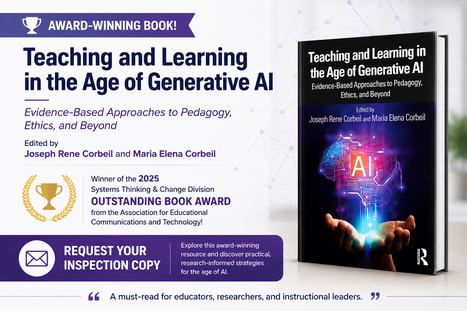
Looking for a Textbook on Generative AI in Education?

Looking for a Textbook on Generative AI in Education? | Educational Technology News | Scoop.it

Teaching and Learning in the Age of Generative AI: Evidence-Based Approaches to Pedagogy, Ethics, and Beyond


Edited by Joseph Rene Corbeil & Maria Elena Corbeil (2025)


🏆 Winner of the 2025 Systems Thinking & Change Division Outstanding Book Award from the Association for Educational Communications and Technology!


If you are designing a course that addresses generative AI in education, this award-winning volume provides a research-driven, classroom-ready foundation. Rather than offering hype or fear, this book helps educators:

  • Ground AI integration in learning theory and research
  • Address academic integrity with thoughtful, practical strategies
  • Redesign assessment for an AI-enabled world
  • Explore ethics, bias, privacy, and institutional responsibility
  • Leverage AI to enhance critical thinking and digital literacy


Bookended by historical and forward-looking analyses of AI in education, the chapters move beyond surface-level discussions to provide evidence-based approaches for real classrooms—K–12, higher education, and professional learning environments.

This text is ideal for:

  • Undergraduate and graduate teacher education programs
  • Curriculum & Instruction courses
  • Educational Technology programs
  • Higher education faculty development
  • School technology coordinators and talent development professionals

Adopting a GenAI textbook for an upcoming semester?

We invite you to request an inspection copy and explore how this resource can support your students in navigating AI with skill, ethics, and informed judgment.

Request your inspection copy today.

EDTECH@UTRGV's insight:

Looking for a Textbook on Generative AI in Education? Teaching and Learning in the Age of Generative AI. Winner of the 2025 Systems Thinking & Change Division Outstanding Book Award. Request your inspection copy today

Request your inspection copy today.

EDTECH@UTRGV's curator insight, February 11, 5:29 PM

Award-winning "Teaching and Learning in the Age of Generative AI" offers research-based, practical guidance for educators seeking to thoughtfully integrate generative AI into their courses—request an inspection copy: https://www.routledge.com/textbooks/evaluation/9781032688602.

Dong Jiayi (Deyiss)'s curator insight, April 30, 3:09 AM
Technology get advanced.
Scooped by EDTECH@UTRGV
June 22, 6:40 PM
Scoop.it!

Stop Trying to Motivate Adult Learners. Start Removing Barriers.

Stop Trying to Motivate Adult Learners. Start Removing Barriers. | Educational Technology News | Scoop.it
Higher education often frames recruitment with motivational rhetoric, but adult learners prefer accessibility, certainty, and community over motivation.
EDTECH@UTRGV's insight:

"For years, higher education has approached adult learners as though they are standing on the sidelines waiting to be inspired. Marketing campaigns focus on aspiration. Recruitment strategies focus on encouragement...The question is rarely, 'Why should I go back to school?' More often, it is, 'Can I realistically do this?'"

No comment yet.
Scooped by EDTECH@UTRGV
June 22, 6:32 PM
Scoop.it!

For schools, cyber resilience starts at the data layer

For schools, cyber resilience starts at the data layer | Educational Technology News | Scoop.it
In cyber resilience, protect the data layer and build recovery plans around the data and services that keep learning and operations moving.
EDTECH@UTRGV's insight:

"[T]he data layer is where schools’ most important information lives and where recovery begins when something goes wrong. It includes the storage, protection, backup, snapshot, and recovery capabilities that keep student records, learning platforms, research data, and administrative systems available and recoverable. If that layer is not protected, schools will struggle to restore operations quickly."

No comment yet.
Scooped by EDTECH@UTRGV
June 19, 11:32 AM
Scoop.it!

Student Cheating Is Becoming Impossible to Detect in an A.I. Era

"The videos are all over social media, making students an irresistible offer: Go ahead and let A.I. do your homework — with the latest technology, you won’t get caught...


These kinds of tutorials are now pervasive on TikTok and YouTube. They show students how to use tools known as humanizers and autotypers, which make it easier than ever to cheat. The videos — sometimes labeled ads, sometimes not — target college and high school students."

EDTECH@UTRGV's insight:

"Big tech companies and small start-ups are using social media to hype new tools that allow students to trick teachers and A.I. detectors."

No comment yet.
Scooped by EDTECH@UTRGV
June 19, 11:26 AM
Scoop.it!

Belonging by design: Practical ways to support adult learners in hybrid and asynchronous courses

Belonging by design: Practical ways to support adult learners in hybrid and asynchronous courses | Educational Technology News | Scoop.it
The most powerful belonging practices are built into the weekly routines of teaching, advising, and communication with learners.
EDTECH@UTRGV's insight:

"[B]elonging is built through small, consistent practices that reduce uncertainty, increase connection, and help students believe they can persist."

No comment yet.
Scooped by EDTECH@UTRGV
June 19, 11:20 AM
Scoop.it!

We used to know that it was a person who wrote it

"Reading used to come with the guarantee that someone was on the other end. We spent it down, and now you check everything."

EDTECH@UTRGV's insight:

"For almost the entire history of written words, you could assume a person was on the other end. You did not have to decide it. The assumption came free, underneath everything, and you spent your attention on what the words said rather than on whether anyone had meant them."


No comment yet.
Scooped by EDTECH@UTRGV
June 17, 12:36 PM
Scoop.it!

Americans' Views on AI Chatbots, Smart Devices and AI's Impact

Americans' Views on AI Chatbots, Smart Devices and AI's Impact | Educational Technology News | Scoop.it
More Americans are using chatbots, and some are adopting AI summaries and smart speakers. But views about AI and how fast it’s advancing tilt negative – even for younger adults.
EDTECH@UTRGV's insight:

"Americans —including younger adults— are deeply skeptical of AI. More adults predict that AI will have a negative rather than positive impact on them and on society. And majorities think AI is advancing too quickly and will put their personal information at risk."

No comment yet.
Scooped by EDTECH@UTRGV
June 17, 12:25 PM
Scoop.it!

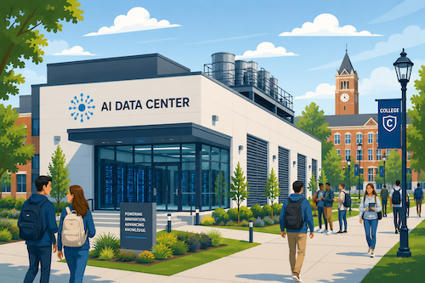
Data centers, AI, and the next big campus debate

Data centers, AI, and the next big campus debate | Educational Technology News | Scoop.it
If AI is becoming part of every discipline, then access to advanced computing power via data centers is becoming part of educational equity.
EDTECH@UTRGV's insight:

"When it comes to AI, the next great debate will focus on if universities are willing to host the engines that powers them"

No comment yet.
Scooped by EDTECH@UTRGV
June 17, 12:18 PM
Scoop.it!

Teachers lack formal AI guidance for learning and instruction, Gallup finds

"Over 60% of teachers said they received no guidance on how to apply artificial intelligence to parts of their jobs, such as for analyzing patterns in student learning, tutoring or one-on-one instruction, according to a survey released Wednesday by Gallup and the Walton Family Foundation."

EDTECH@UTRGV's insight:

"Teachers in higher-needs schools were less likely than those in wealthier schools to have received guidelines, echoing previous research."

No comment yet.
Scooped by EDTECH@UTRGV
June 16, 11:32 AM
Scoop.it!

A Practical Framework to Help Students Use AI (opinion)

A Practical Framework to Help Students Use AI (opinion) | Educational Technology News | Scoop.it
The risk of cognitive outsourcing is real. But there is reason for optimism, if students are taught good AI habits early and often. You have seen it happen: A student opens an AI tool, gets a polished essay outline in minutes, submits the assignment and walks away feeling productive. They do well on the exam. The grade is real. But ask them to explain the same concept three months later, and the room goes quiet.
EDTECH@UTRGV's insight:

"I don’t ban AI tools, nor do I treat them as a shortcut to avoid. Instead, I try to structure AI into the learning process in a way that makes its strengths and limitations visible to students."

No comment yet.
Scooped by EDTECH@UTRGV
June 16, 11:28 AM
Scoop.it!

Bad AI Policy Is Worse Than No Policy at All. How to Build One That Works

Bad AI Policy Is Worse Than No Policy at All. How to Build One That Works | Educational Technology News | Scoop.it
Conversations with Kevin Hogan: SchoolAI policy analyst Sasha Luks-Morgan breaks down the three pillars every district AI policy needs
EDTECH@UTRGV's insight:

"About two-thirds of U.S. districts and states have some form of AI policy in place. The other third is, as Sasha Luks-Morgan puts it, the wild west. And even many of the policies that do exist, she argues, aren't doing what they're supposed to do."

No comment yet.
Scooped by EDTECH@UTRGV
June 16, 11:24 AM
Scoop.it!

AI design isn’t ugly. It’s fluent — and that’s the problem.

"I can usually tell when something was built by AI before I’ve read a word of it. There’s a face it wears: a centered hero with a confident headline and two buttons, rounded cards floating on a soft gradient, a sans-serif working very hard to seem neutral, spacing so even it feels exhaled rather than drawn. I’ve seen that face come out of Claude Design, out of Lovable, out of v0 and Bolt. Different companies. Different models. The same face."

EDTECH@UTRGV's insight:

"I couldn’t stop thinking about wasn’t just why the outputs looked the same — it was what that meant for the designer’s role."

No comment yet.
Scooped by EDTECH@UTRGV
June 16, 11:17 AM
Scoop.it!

Proposed Changes to E-Rate

Proposed Changes to E-Rate | Educational Technology News | Scoop.it

"The FCC announced in April it would be taking a fresh look at all aspects of the Universal Service Fund (USF). The agency recently kicked off this process for the E-Rate program by issuing a combined Notice of Proposed Rulemaking and a Further Notice of Proposed Rulemaking."

EDTECH@UTRGV's insight:

"The FCC asks if E-Rate is still meeting the original intent and asks if the program should be narrowed in scope or even ended."

No comment yet.
Scooped by EDTECH@UTRGV
June 22, 6:44 PM
Scoop.it!

I tested AI glasses in Paris. Here’s what they got wrong

I tested AI glasses in Paris. Here’s what they got wrong | Educational Technology News | Scoop.it
Wearable AI can help travellers navigate cities, translate menus and fundamentally transform travel. But a weekend in Paris showed me the trade-offs behind the convenience.
EDTECH@UTRGV's insight:

"The technology deals with directions, translation, information and recommendations. It reduces issues and increases convenience. But the glasses don't live up to the promise of helping me connect well to the world around me. If anything, they sometimes place another invisible layer between me and the city."

No comment yet.
Scooped by EDTECH@UTRGV
June 22, 6:35 PM
Scoop.it!

Why Hiring Strong Instructional Designers Matters More Than Industry Experience

Why Hiring Strong Instructional Designers Matters More Than Industry Experience | Educational Technology News | Scoop.it
This article explores why strong Instructional Design skills matter more than industry experience when hiring Instructional Designers.
EDTECH@UTRGV's insight:

"Instructional Designers Are Learning Experts First"

No comment yet.
Scooped by EDTECH@UTRGV
June 22, 6:29 PM
Scoop.it!

Leading the Era of AI

"The rise of artificial intelligence (AI) has pushed higher education to a crossroads, and a paradigm shift is required. Universities who expect to lead in this new AI-shaped landscape must reimagine higher education as a hyper-personalized journey for students, enabled by AI, interactive data, predictive analytics, and adaptive technologies from end to end."

EDTECH@UTRGV's insight:

"The essence of leadership in the era of AI is to be proactive, not wait for disruption to come our way."

No comment yet.
Scooped by EDTECH@UTRGV
June 19, 11:30 AM
Scoop.it!

Two Professors, Two Approaches to AI and Assignment Design

Two Professors, Two Approaches to AI and Assignment Design | Educational Technology News | Scoop.it
Explore two professors' approaches to AI and assignment design, from AI-resistant assessments to AI-integrated learning experiences.
EDTECH@UTRGV's insight:

"[A] question has arisen from teachers of every discipline: how do we develop assignments that facilitate learning with AI constantly present? This question does not have a single correct answer. Different instructors have different opinions on the role AI should play in education due to their discipline or personal teaching philosophy."

No comment yet.
Scooped by EDTECH@UTRGV
June 19, 11:24 AM
Scoop.it!

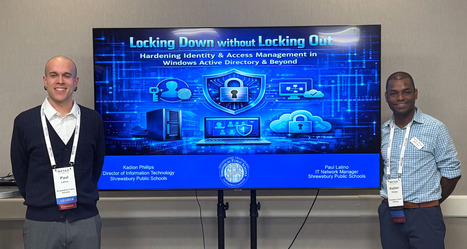
Creating 5 Pillars To Guide AI Use In Your District

Creating 5 Pillars To Guide AI Use In Your District | Educational Technology News | Scoop.it
Innovative Leader Award - Director of Information Technology Kadion Phillips discusses implementing AI in a school district as well as how to bolster cybersecurity.
EDTECH@UTRGV's insight:

"[T]he skills that we want kids to get with AI is going to be similar to what we did with our portrait of a graduate, such as critical thinking, content mastery, innovation, resilience, collaboration, and even the global citizenship piece.”

No comment yet.
Scooped by EDTECH@UTRGV
June 19, 11:17 AM
Scoop.it!

One skill separates the designers who survive 2026 from the ones who don’t

AI is putting the future of UX designers in jeopardy, unless they are willing to become builders, makers, and system thinkers.
EDTECH@UTRGV's insight:

"As AI reshapes product development, design leaders are reassessing what the role of a designer actually means. Responsibilities are converging. The lines between what a designer does and what a PM or a coder owns are blurring. In that blur, the designers who can’t articulate their value beyond their craft will lose strategic relevance."

No comment yet.
Scooped by EDTECH@UTRGV
June 17, 12:28 PM
Scoop.it!

The AI Literacy Gap No One Expected

The AI Literacy Gap No One Expected | Educational Technology News | Scoop.it
While Gen Z may be advanced at generating quick outputs or using free LLMs for surface-level tasks, they need to develop critical thinking, communication, and analysis skills.
EDTECH@UTRGV's insight:

"AI familiarity is not the same as AI literacy: Students may know how to generate quick AI outputs, but still need critical thinking, communication, writing, reading, and analysis skills to evaluate and use those outputs effectively."

No comment yet.
Scooped by EDTECH@UTRGV
June 17, 12:21 PM
Scoop.it!

In an AI-driven world, the most important skills are still human

"Across higher education, artificial intelligence is now embedded in everyday academic work, from early research to final drafts. For many students, it has become a default starting point."

EDTECH@UTRGV's insight:

"The urgent question is not whether students use AI, but how they use it—specifically, whether these tools are reinforcing learning or bypassing the cognitive work that leads to it."

No comment yet.
Scooped by EDTECH@UTRGV
June 17, 12:14 PM
Scoop.it!

Are Ed Tech's Academic Benefits at Odds With Its Social-Emotional Downsides?

Are Ed Tech's Academic Benefits at Odds With Its Social-Emotional Downsides? | Educational Technology News | Scoop.it
An EdWeek Research Center survey asked educators how tech is shaping students' school experiences.
EDTECH@UTRGV's insight:

"[E]ffective use of technology in school that addresses students’ well-being and academic development depends largely on the quality of how the tech is used, not just on the digital tool itself."

No comment yet.
Scooped by EDTECH@UTRGV
June 16, 11:30 AM
Scoop.it!

Four Stages Of Competence: A Guide For Instructional Designers

Four Stages Of Competence: A Guide For Instructional Designers | Educational Technology News | Scoop.it
Understand the four stages of competence and how they help in skill development and learning in today's fast-paced workplace.
EDTECH@UTRGV's insight:

"The model has four levels: unconscious incompetence, conscious incompetence, conscious competence, and unconscious competence."

No comment yet.
Scooped by EDTECH@UTRGV
June 16, 11:27 AM
Scoop.it!

92% of US employers willing to offer higher starting salaries to graduates with micro-credentials

"By 2030, employers expect nearly 4 in 10 key skills required for the job market to change. As technological progress reshapes work, new data from Coursera (NYSE: COUR), a leading global online learning platform, finds that 92% of US employers are willing to offer higher starting salaries to graduates who have earned industry micro-credentials."

EDTECH@UTRGV's insight:
  • 79% of US employers say micro-credential holders demonstrate improved productivity in their first year
  • 85% of US graduates with micro-credentials report securing a role aligned to their field within 12 months
No comment yet.
Scooped by EDTECH@UTRGV
June 16, 11:21 AM
Scoop.it!

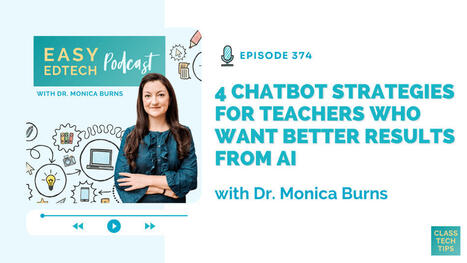
4 Chatbot Strategies for Teachers Who Want Better Results from AI

4 Chatbot Strategies for Teachers Who Want Better Results from AI | Educational Technology News | Scoop.it
Use these chatbot strategies for teachers to move beyond basic prompts and create stronger classroom resources with AI.
EDTECH@UTRGV's insight:

Tips for Chatbot Strategies for Teachers

  • Provide specific context (grade level, goals, format) in your prompt to improve AI output quality.
  • Treat your first prompt as a draft and refine results through follow-up responses.
  • Use the “ask me questions” technique to help the chatbot guide your thinking.
  • Upload existing materials to quickly transform them into new formats or resources.
No comment yet.
Scooped by EDTECH@UTRGV
June 16, 11:16 AM
Scoop.it!

Three levels of AI proficiency for university educators

Three levels of AI proficiency for university educators | Educational Technology News | Scoop.it
To become proficient in GenAI, educators must move beyond one-off interactions to create workflows that increase efficiency and deepen learning. Learn how
EDTECH@UTRGV's insight:

At the first level, "GenAI is used to do what its name so effectively implies: generate answers. At the second level, it becomes a collaborative partner in everyday teaching. Moving to the third level requires an educator to create structured systems and processes that put a GenAI tool to work on their behalf."

No comment yet.