 Your new post is loading...
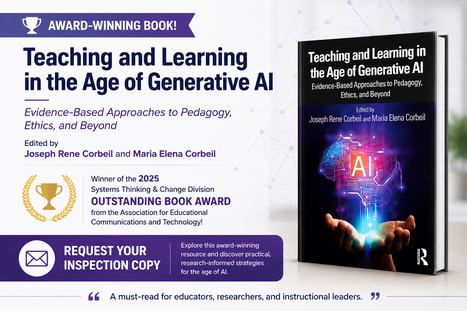
Looking for a Textbook on Generative AI in Education?
Teaching and Learning in the Age of Generative AI: Evidence-Based Approaches to Pedagogy, Ethics, and Beyond Edited by Joseph Rene Corbeil & Maria Elena Corbeil (2025) 🏆 Winner of the 2025 Systems Thinking & Change Division Outstanding Book Award from the Association for Educational Communications and Technology! If you are designing a course that addresses generative AI in education, this award-winning volume provides a research-driven, classroom-ready foundation. Rather than offering hype or fear, this book helps educators:
- Ground AI integration in learning theory and research
- Address academic integrity with thoughtful, practical strategies
- Redesign assessment for an AI-enabled world
- Explore ethics, bias, privacy, and institutional responsibility
- Leverage AI to enhance critical thinking and digital literacy
Bookended by historical and forward-looking analyses of AI in education, the chapters move beyond surface-level discussions to provide evidence-based approaches for real classrooms—K–12, higher education, and professional learning environments.
This text is ideal for:
- Undergraduate and graduate teacher education programs
- Curriculum & Instruction courses
- Educational Technology programs
- Higher education faculty development
- School technology coordinators and talent development professionals
Adopting a GenAI textbook for an upcoming semester? We invite you to request an inspection copy and explore how this resource can support your students in navigating AI with skill, ethics, and informed judgment.
Request your inspection copy today.

|
Scooped by
EDTECH@UTRGV
July 1, 3:40 PM
|
Some tech leaders have a vision for a world where you spend a lot less time looking at your phone. Is it the solution to screen time, or just a new dystopia?
|
|
Scooped by
EDTECH@UTRGV
July 1, 3:04 PM
|
"Every few weeks, another business leader recites the doomsday line: AI will replace all workers. Their confidence is proportional to the capex. A company that just committed tens of billions to data centers has strong incentives to sound sure, and the memo goes out accordingly. They boast about leaner teams and a future where most of the work runs itself. However, the reality looks different."
|
|
Scooped by
EDTECH@UTRGV
June 30, 3:35 PM
|
"Understanding the evolving nature of professional identity is a good lens through which to explore how faculty navigate their roles as academics. Both academic and teacher identities are shaped by various influences, including discipline-related socialization and personal experiences."
|
|
Scooped by
EDTECH@UTRGV
June 30, 3:02 PM
|
Researchers say a lack of reliable information on artificial intelligence use on campus could lead to misguided policies.
|
|
Scooped by
EDTECH@UTRGV
June 29, 3:33 PM
|
Some students with disabilities rely on assistive technology to learn, and they worry it could be swept up in the movement to get screens out of schools.
|
|
Scooped by
EDTECH@UTRGV
June 29, 2:59 PM
|
Why story-driven training sticks — and how to build it fast in SHIFT Meteora AI Studio or deliver it through the LMS you already use.
|
|
Scooped by
EDTECH@UTRGV
June 26, 3:33 PM
|
AI voiceovers are reshaping corporate training. Discover how L&D leaders can use AI in eLearning effectively and ethically.
|
|
Scooped by
EDTECH@UTRGV
June 26, 2:58 PM
|
"or years, Learning and Development focused on a single goal: delivering knowledge. Courses were built, content was deployed, and completion rates were tracked. Yet one persistent challenge remained: learning did not reliably translate into on-the-job performance."
|
|
Scooped by
EDTECH@UTRGV
June 26, 2:47 PM
|
Lessons learned from a year of building an AI literacy tool.
|
|
Scooped by
EDTECH@UTRGV
June 26, 2:41 PM
|
As technical barriers fall, design, judgment, and imagination matter more for AI's role in learning and instructional technology.
|
|
Scooped by
EDTECH@UTRGV
June 25, 10:27 AM
|
"Discover how educators can use AI to create a month of summer communication in minutes, helping families stay connected, inspired, and engaged while reducing workload before summer break begins."
|
|
Scooped by
EDTECH@UTRGV
June 25, 10:23 AM
|
"The AFT’s new 10-point plan, “Devices Down, Eyes Up, Hands-On,” gets some things right. Students do need more active, human, hands-on learning. They need career-connected experiences, civic engagement, collaboration, movement, and opportunities to solve real problems. But the “devices down” frame points schools in the wrong direction."
|
|
|
Scooped by
EDTECH@UTRGV
July 1, 3:58 PM
|
The pace of development and proliferation of artificial intelligence tools — generative, agentic, physical — can be hard to follow, but IT leaders must do their best to stay apprised of potential innovations and risks.
|
|
Scooped by
EDTECH@UTRGV
July 1, 3:19 PM
|
Drawing on experience across higher education in the UK and Malaysia, two academics argue that the real AI divide in universities is not about access to tools but about institutional readiness — and why it is an urgent equity issue policymakers can no longer afford to ignore.
|
|
Scooped by
EDTECH@UTRGV
June 30, 3:55 PM
|
Experienced learning engineers, researchers, and industry leaders shared eight top tips for landing your first ed tech role.
|
|
Scooped by
EDTECH@UTRGV
June 30, 3:16 PM
|
‘It’s not looking good’: The unemployment rate for recent grads is the highest in five years, but AI is not primarily to blame — at least not yet
|
|
Scooped by
EDTECH@UTRGV
June 29, 3:52 PM
|
AI moves into law, mathematics, and the arts as the public turns on the data centers, and Washington moves to claim its share.
|
|
Scooped by
EDTECH@UTRGV
June 29, 3:13 PM
|
Two educators are reckoning with who is really in charge: technology or the teacher.
|
|
Scooped by
EDTECH@UTRGV
June 26, 3:39 PM
|
Learn how teaching AI literacy helps students use AI as a writing assistant rather than a substitute, improving revision, critical thinking, and ethical AI use.
|
|
Scooped by
EDTECH@UTRGV
June 26, 3:26 PM
|
Reading Anthropic's new reports on the 'AI exponential' and recursive self-improvement alongside recent scholarship on tech oligarchy, this piece asks a simple question: is AI being built to serve people, or to serve its own acceleration?
|
|
Scooped by
EDTECH@UTRGV
June 26, 2:57 PM
|
"There’s a screen most people have seen at least once. You’re trying to cancel a subscription. You’ve made up your mind. You click the button that looks like it starts the process. And then something strange happens. The page that loads isn’t a cancellation form. It’s a full-screen gallery of everything you’re about to lose. Videos. Deals. Music. Free delivery. Presented in bright tiles, warm colours, friendly icons. A highlighted countdown showing how many days you have left. And somewhere at the bottom, small, grey, easy to miss, the option to continue cancelling."
|
|
Scooped by
EDTECH@UTRGV
June 26, 2:44 PM
|
"The job market is undergoing a profound shift, one where degrees alone no longer guarantee career success. Skills-based hiring, focusing on what candidates can do rather than where they studied, is gaining more ground across industries. This change creates necessary pressure for colleges and universities to adapt, from new types of credentials and stronger workforce partnerships to career services built for today’s learners."
|
|
Scooped by
EDTECH@UTRGV
June 25, 10:32 AM
|
"Academic libraries have long struggled with shrinking budgets, yet some are now making room for a new position: the artificial-intelligence librarian. That’s because at a time when many colleges are grappling with the impacts of generative AI, some are hoping librarians can lead them through the thicket of challenges raised by the new technology."
|
|
Scooped by
EDTECH@UTRGV
June 25, 10:25 AM
|
"In a time when one wrong click can freeze an entire institution, cybersecurity becomes not just an IT issue, but an issue for everyone. We think of smart hackers who are ready to take our information, yet most of the time, it is a simple human oversight."
|
|
Scooped by
EDTECH@UTRGV
June 25, 10:21 AM
|
"Across the United States, K-12 schools have spent the past decade building one-to-one device programs. These initiatives have established an essential baseline for digital access, making it easier for students to complete daily schoolwork across grade levels and subjects. By putting a device in the hands of every learner, districts have created a standard foundation for digital literacy, research and everyday classroom engagement. As STEM programs continue to grow and mature, however, school leaders are beginning to encounter new questions about how well those devices support more advanced coursework. Pathways in fields like robotics, engineering, cybersecurity and data science increasingly rely on specialized professional applications that reach well beyond general-purpose classroom software."
|

























This looks like an interesting study.