



Theories of Learning. Connectivism: A new type of learning for the digital age
Via Dr. Susan Bainbridge

 Your new post is loading...
 Scoop.it! Theories of Learning. Connectivism: A new type of learning for the digital age Via Dr. Susan Bainbridge 
Scoop.it!

"Among the great ironies of our culture is that science, a fundamentally open-ended and exploratory activity, is frequently taught so much as a body of "facts" that many students become estranged from science, and most are deprived of an opportunity to have experiences which strengthen and reinforce their own inclination to experiment, question, and explore ... both the world outside and themselves. Materials presented here are aimed at finding ways to make science education, and education in general, more exploratory, and more fun."
Scoop.it!
Studies show that sustained and well-integrated social and emotional learning (SEL) programs can help schools engage their students and improve achievement. ...
Scoop.it!

"Educational innovations in youth learning today are bringing to the forefront issues of youth imagination, creation, collaboration, and innovation in a networked world of participatory culture and new media literacies. This forum will showcase design principles and research findings from ongoing partnership projects in Chicago and Oakland in under-resourced public schools and neighborhoods where students work with mentors in designs supporting their creation of video, radio, animations, spoken word poetry, and other media that advance 21st century competencies. Discussions will explore the promise of addressing digital divides and educational inequalities with such designs. The panel will be hosted by Stanford Graduate School of Education faculty member Paulo Blikstein."
Scoop.it!
From
www

Leaving a high-flying job in consulting, Angela Lee Duckworth took a job teaching math to seventh graders in a New York public school. She quickly realized that IQ wasn’t the only thing separating the successful students from those who struggled.
Scoop.it!

By Ainnissa Ramirez (Edutopia)
Scoop.it!

"Could it be that the best way to learn happens in kindergarten? It’s an intriguing proposition, one that’s being explored at M.I.T. by folks like Mitch Resnick, the creator of the famous computer programming site for beginners called Scratch."
Scoop.it!
Scoop.it!

Storyboard That is a cutting edge Web 2.0 tool for rapidly creating amazing storyboards, no art skills needed. Great for business meetings and in the classroom for students to express their creativity. Via Baiba Svenca

Carol Thomson's curator insight,
July 12, 2013 5:51 AM
struggled to use in school (internet issues) but seems a good way to go.
Scoop.it!

"Visual content is a guaranteed winner for eLearning because it’s a people magnet. Visual representations can simplify complex information in a way that attracts attention and is easy-to-consume. As an eLearning developer, seek opportunities where you can include images and graphics to achieve your learning objectives." Via EDTECH@UTRGV
Roxana Marachi, PhD's insight:
Cognitive science supports the use of visualization and mental imagery as powerful encoding strategies for learning and memory. The recommendations in this article for "e-learning" may well be argued to be equally valuable for educators to consider in parallel brick and mortar, person-to-person learning enrvironments as well.

A4Academics's comment,
April 10, 2013 11:24 PM
I feel that Using visual menu is one of the best ways to make people noted about the topic. I am not that sure about the video . If the content is specific and it is well readable people opt for that than a video
Scoop.it!

"The Center was founded in 1997 to improve the treatment of child psychiatric disorders through scientific practice, research, and education, and to eliminate the stigma of being or having a child with a psychiatric disorder. We have made major strides towards fulfilling this mission: our research, clinical, educational, and community services have expanded and grown in new directions." http://www.aboutourkids.org/about_us
Scoop.it!

A list of the top 101 websites for science teachers including general science, astronomy, biology, chemistry, physics, and more. Via Kathleen Cercone
Scoop.it!

Students and teachers alike have been brought up in an educational system that mimics an antiquated job market. The teacher is the boss, managing the work of his student workers who have to produce goods that meet approval, he said. But many people fear that system no longer serves students headed toward a less certain future, one that could necessitate that a student be able to define and create her own job.
Via Nik Peachey, Let's Learn IT

Nik Peachey's curator insight,
February 24, 2013 2:59 AM
Interesting article. I particularly like this - “The real revolution is information and global communication, not technology,” November said. Technology is merely the means to access the information and share it in community. |
Scoop.it!

PLAY ... "is not purely entertainment or a luxury to be given up when things get serious ...
playfulness is ... not only to be enjoyed but to be accorded high value for its fundamental role in the success of all organisms, including humans." from Variability in Brain Function and Behavior.
Scoop.it!
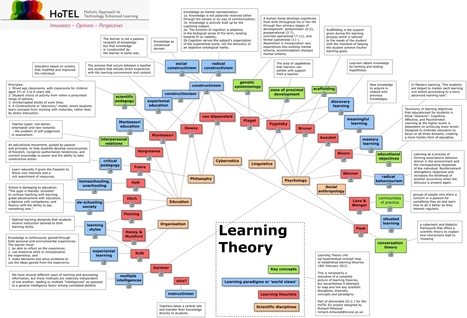
This Concept Map, created with IHMC CmapTools, has information related to: Learning Theory, zone of proximal development The area of capabilities that learners can exhibit with support from a teacher., Montessori constructivism, Lave & Wenger... Via Ana Cristina Pratas, Helen Wybrants

Sonia Thomas's curator insight,
June 1, 2013 1:52 AM
I appreciate being able to see the relationships. As a student of education, I sometimes get bogged down by the divisions between philosophy and science. This will be a nice tool to sort the data in my mind. 
june holley's curator insight,
August 23, 2013 10:42 AM
Maximizing learning is key to an effective network approach.
Scoop.it!

"As California teachers begin to strategize about how to meet the Common Core standards, some educators say that explicit instruction in social and emotional competence – teaching students how to regulate their emotions, problem-solve, and disagree respectfully, among other abilities – should be a key part of the equation. The ability to collaborate, to see others’ perspectives, and to persevere in solving problems is required of students in the Common Core. Social and emotional learning provides the interpersonal skills students need to perform these intellectual tasks, said Nancy Markowitz, an education professor and director of the Collaborative for Reaching and Teaching the Whole Child at San Jose State University."
Scoop.it!

The site promotes the innovative and creative use of film in language learning. All of the lesson plans revolve around the use of video and film to teach English. The site promotes cineliteracy, the ability to analyse moving images, and considers cineliteracy as a 21st century skill which our students need to learn. Via Nik Peachey

Graciela Flores's curator insight,
September 17, 2023 1:25 AM
This film making tool is a good source to teach in a very unique way. It provides innovative digital materials designed around short films and videos, and feature-length films. Its approach focuses in embeds empathy, compassion, diversity, justice, equity, and inclusion as core values of teaching and learning.
Scoop.it!

"Scan your books' ISBNs and view the Guided Reading, Grade Level Equivalent, DRA, and Lexile levels for the book."
Scoop.it!

A study shows how the effects of "stereotype threat" can be overcome by assignments that foster a more supportive environment.
Scoop.it!

We are accustomed to thinking of learning as good in and of itself. But as environmental educator David Orr reminds us, our education up till now has in some ways created a monster. This essay is a...
Scoop.it!

"Socrative is a smart student response system that empowers teachers to engage their classrooms through a series of educational games and exercises via smartphones and tablets."

Roxana Marachi, PhD's comment,
April 24, 2013 5:57 PM
Thanks to my colleague Lara Ervin for this recommendation!
Scoop.it!

A Virginia middle school is partnering with the University of Virginia to use 3-D printing technologies to teach science and engineering concepts.
Scoop.it!
Reading Horizons Reading Specialist, Stacy Hurst, discusses what we do and do not know about the Common Core Assessments.
Scoop.it!

One teacher rushed to embrace the flipped classroom model -- and then realized upon reflection that it wasn't necessary. Via EDTECH@UTRGV

EDTECH@UTRGV's curator insight,
April 10, 2013 5:19 PM
If done properly, the flipped classroom concept can work. And to do it properly requires a lot of time and effort.
Scoop.it!

"Dylan Wiliam outlines 5 formative assessment strategies that work to improve student learning..."
|







¿Epoca de conectivismo?