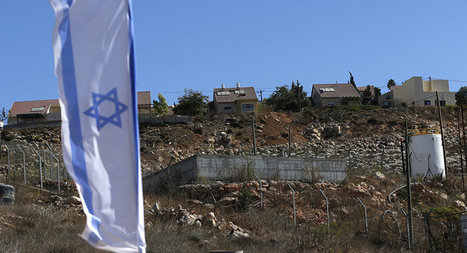
The Israeli-Palestinian conflict is one that powerfully divides the international community. Of those living within the state of Israel, Pew Research data shows that they are often deeply divided based on religious affiliation. Not surprisingly, those divisions extend into how they view the peace process, West Bank settlements and U.S. support. Although the conflict is portrayed as a battle between religious groups, it can be more fairly assessed as two nationalistic groups competing for land. Broadly speaking, the Muslim world has sided with the Palestinians, and the U.S. and its NATO allies have defended Israel. In the United Nation’s Security Council, the United States’ veto power has been use to strike down resolutions that would condemn Israeli settlement in the militarily occupied lands of the West Bank. The 2016 UN resolution that passed 14-0 (with only the U.S. abstaining) says that Israel’s settlements on Palestinian territory occupied since 1967, including East Jerusalem, have “no legal validity” and demands a halt to “all Israeli settlement activities,” saying this “is essential for salvaging the two-state solution.”
These settlements are considered by most of the international community to be illegal, and the UN has condemned them, but since the U.S. has always vetoed this, Israel has never been formally reprimanded. Earlier this week, the U.S. abstained from the vote, and the many see the U.S. position as hypocritical, (Secretary of State John Kerry strongly defended the position).
Some highly partisan supporters of Israel do not see Israel’s actions as the problem, primarily because Israel’s neighbors have traditionally not recognized its right to exist, and attacked it many times. Therefore, they see Israel’s actions as necessary for the security of Israel, and do not see Israel’s settlements in the West Bank as illegal since Palestine isn’t a state that was ever legally accepted.
While religion plays a crucial role in the Israeli-Palestinian conflict, it is important to note that it is not the central issue; disputes over land seem to be the bedrock of the conflict. It is also worth noting that this conflict only began in 1948, and that at several points in history, all three Abrahamic faiths peacefully coexisted and shared Jerusalem. It is essential to understand how sacred Jerusalem (on the border of the West Bank) is to both sides of the conflict and how both parties feel they have a divinely sanctioned right to the territory. Examining the history of this conflict illustrates how things simply spiraled out of control making compromise, specifically the means to share this special land, nearly impossible. The Zionist movement in relation to Holocaust, the Jewish War for Independence in 1949, the Six-Day War, and the First and Second Intifadas have culminated in two sides unwilling to work together in order to reach a lasting, mutually beneficial compromise. This deal would be in the form of an internationally recognized two-state solution, with Jerusalem serving as a shared city. Unfortunately, a large portion of Israelis are tired of the relentless conflict causing them to become apathetic. Having the upper-hand, Israel now lacks the collective willpower to implement change. On the other side are the Palestinians, who possess a sense of national identity but are blocked at every turn from establishing their own country. The rage and frustration in Palestine has pushed organizations like Hamas to employ terror tactics - resulting in Israelis to fight back harder. This process of bloodshed creates a viscous cycle that is already highly complicated due to geography. A salient geopolitical point here is the unhindered spread and development of Israeli settlements on Palestinian land. To me, this is where Israel stepped way over the line of morality and self-defense. They are no longer defenders but are now invaders, conquerors, and perhaps even colonizers. It is no wonder Palestinians are enraged. The physical act of rivals occupying land unjustly has become a humiliating usurpation of sacred rights. Although this would be extremely difficult, the Israeli government needs to pull its people out of the settlements and give all the land back to Palestine. In exchange, Hamas needs to be disowned and disbanded. Palestine should not have a military for 15 years, allowing Israel to manage its security. Jerusalem should be split in half and as a gesture of goodwill, Israel should give up a strip of land to Palestine in order to connect Gaza and the West Bank.
It is a fact that learning to teach is basically a social and practical activity that is supported and informed by theoretical reflections. Field experience and realities should be the core component of any teacher preparation program. That is why,
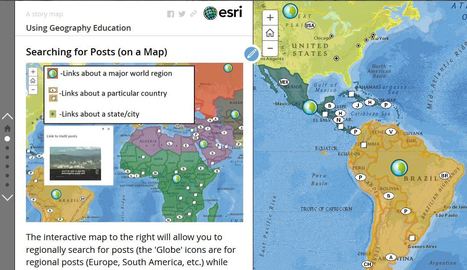
"This story map was created with ArcGIS Online to guide users on how to get the most out of the Geography Education websites on Wordpress and Scoop.it."
This map is a very helpful, useful and fun guide on how to get the most of this website and to learn about geography and different places and facts of the world.
This source allows its viewers to select countries to direct them to a series of topic links. This allows the audience to interact and explore the world through visual representation of the globe. I can see this being implemented for warm up activities, quizzes and practice questions. Great source!
Fewer than half of the world's some six million refugee children are in school, making them five times less likely to get an education than the global average, the UN warned Thursday.A full 3.
Via Mark E. Deschaine, PhD
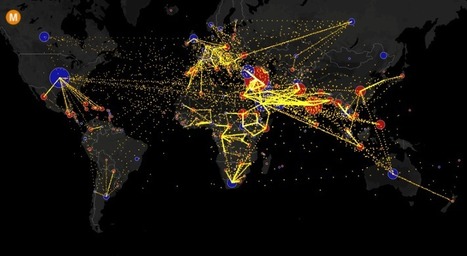
Visualizing the flow of the world's migrants from country to country.
Based on data from the U.N. Population Division, this map shows the estimated net migration (inflows minus outflows) by origin and destination country between 2010 and 2015.
Blue circles = positive net migration (more inflows). Red circles = negative net migration (more outflows). Each yellow dot represents 1,000 people.
Hover over a circle to see that country’s total net migration between 2010 and 2015. Click a circle to view only the migration flows in and out of that country.
For more info about this map, read the article, All the World’s Immigration Visualized in 1 Map.
Tags: migration, USA, mapping, population, unit 2 population.
a. Write the countries with the most and the less people who change their countries. Explain if They are leaving or coming to different countries. b. Could you undestand whiches causes could be the rigin in each country ( Ex : war, poor...)
It took 200,000 years for our human population to reach 1 billion—and only 200 years to reach 7 billion. But growth has begun slowing, as women have fewer babies on average. When will our global population peak? And how can we minimize our impact on Earth’s resources, even as we approach 11 billion?
This relates to our topic by showing that our population is growing rapidly. By the time 2025 there will be more than 11 billion people on the Earth. But we have enough resources to last us.
In my dream I see green, vigorous, high-yielding fields of wheat, rice, maize, sorghums, and millets, which are obtaining, free of expense, 100 kilograms of nitrogen per hectare from nodule-forming, nitrogen-fixing bacteria. These mutant strains of Rhizobium cerealis were developed in 1990 by a massive mutation breeding program with strains of Rhizobium sp. obtained from roots of legumes and other nodule-bearing plants. This scientific discovery has revolutionized agricultural production for the hundreds of millions of humble farmers throughout the world; for they now receive much of the needed fertilizer for their crops directly from these little wondrous microbes that are taking nitrogen from the air and fixing it without cost in the roots of cereals, from which it is transformed into grain...
Enjoy this useful digital citizenship infographic produced by Knowthenet called “Manners Matter.” And they do, especially when it comes to teaching students proper digital citizenship skills. Resources such as this are a terrific way to share what’s important about technology with today’s digital learners!
In this paper, we examine the use of visual metaphor as a tool of reflection for supporting growth towards a multicultural teacher. Tampere University of Applied Sciences’ "Multicultural Authentic eLearning" (MAeL) module is offered as part of the school’s post graduate teacher education program. The shoe metaphor functions as a symbol of continuous authentic learning related to the growth process. This study give voices to three MAeL students through reflections they did in their blogs during the module and in post-course joint reflection/summing up. The main findings of the thre
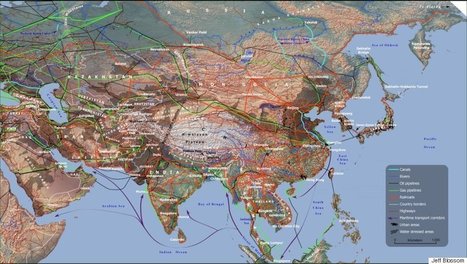
"If you want to understand the world of tomorrow, why not just look at a good map? For my (Parag Khanna) new book, Connectography, I researched every single significant cross-border infrastructure project linking countries together on every continent. I worked with the world’s leading cartography labs to literally map out what the future actually — physically — will look like.
It turns out that what most defines the emerging world is not fragmentation of countries but integration within regions. The same world that appears to be falling apart is actually coming together in much more concrete ways than today’s political maps suggest. Major world regions are forging dense infrastructural connectivity and reorienting their relations around supply chains rather than borders."
The Productivity Commission has said that education spending has substantially increased over the last decade but student achievement has shown little or no improvement. Is that true?
Via Mark E. Deschaine, PhD
"An island, a territory, a self-governing entity, a renegade province, a breakaway part of China, the place formerly known as Formosa—call Taiwan any of those things, but never a country, a state, or a nation. The simple fact that it took a phone call between US president-elect Donald Trump and Taiwanese president Tsai Ing-wen to draw attention to one of Asia’s most vibrant democracies highlights the humiliating plight of Taiwan in the international arena. The irony that the US and other democratic countries cannot openly recognize Taiwan’s achievements for fear of incurring Beijing’s wrath has not been lost on many observers, who nevertheless fear that a cavalier move by Trump to upend diplomatic protocol in such a way could ultimately end badly for little Taiwan."
Tags: Taiwan, political, states, borders, geopolitics, East Asia.
This behaviour towards Taiwan of the so-called “democratic” countries is unfair and their submission to China is unacceptable. But that’s the way things go and Chile is benefiting from this cowardice. Let’s put a stop to the made in China!
(East Asia) The countries of the world cannot identify Taiwan's sovereignty because of China's indignation. Although Taiwan claims to be the true China, most countries recognize the hugely powerful PRC instead. China has prevented Taiwan from entering the United Nations and has pressured countries to perceive Taiwanese citizens as Chinese. However, Taiwan has followed the UN's regulations on issues such as climate change and may soon be the first Asian area to legalize same-sex marriage. While a strong democracy, China strong-arms other nations to exclude Taiwan.
Some simple cultural differences between American and Finns. Now how do these apply to Australians.? Good conversation starter for intercultural understanding.
Much has been written recently about the differences between education systems around the world, but much less has been said about what excellent schools around the world have in common. Over the past year, I’ve visited top-ranked schools across four continents and met an extremely diverse array of school leaders. Amid this diversity, I was surprised when each leader described the same three priorities as fundamental to their schools’ success. From Singapore to Switzerland, South Africa to India, these three practices recurred with remarkable consistency.
Maybe I'm a bit of a science history geek, but I find it really thrilling to leaf through Norman Borlaug's field notebooks, digitized by the University of MInnesota.
His 100th birthday is next month (born 25 March, 1914) - could be a good teaching opportunity.
"Most food, if we trace it back far enough, began as a seed. And the business of supplying those seeds to farmers has been transformed over the past half-century. Small-town companies have given way to global giants. A new round of industry consolidation is now underway. Multibillion-dollar mergers are in progress, or under discussion, that could put more than half of global seed sales in the hands of three companies."
The seed industry, one of the largest industries in modern agribusiness, is quickly being swallowed up by the global giants that lead the seed industry. All over the world small seed businesses are being bought out by larger businesses who seek to mass produce their own genetically modified seeds and strengthen their grip on the global seed market. In American agriculture seed giants rule by providing the highest quality seeds to grow the cereal grains in the U.S. produces. But as a result the consumer benefits, farmers can now run farms that aren’t as capital-intensive because of the biotechnology that goes into these seeds. However it is also important to realize that the number of seed companies is dwindling, and that there are only a few large corporations that control all of the seeds that the world needs to grow enough food to survive. I found this article to be very helpful in shedding some light on how the seeds that go into our food is handled, and the truth on how modern agriculture is run.
To get content containing either thought or leadership enter:
To get content containing both thought and leadership enter:
To get content containing the expression thought leadership enter:
You can enter several keywords and you can refine them whenever you want. Our suggestion engine uses more signals but entering a few keywords here will rapidly give you great content to curate.


 Your new post is loading...