In most cases, seeing a bug on your plate at a restaurant will prompt a return of the plate, a refund and a one-star review of the establishment. Yes, there's nothing wrong with that — your carbonara would be much better without the ants — but there are cultures around the world where eating insects isn't frowned upon. Rather, it's a delicacy.
And there are a lot of options to go through — 1,900 documented insect species are deemed edible. They might not be a staple in most American diets, but there are some nutritional properties that could make at least some bugs enticing enough to try.
In many ways this program asks students to do something that many adults aren’t modeling well — how to be respectful of someone with a different lived experience and opinion. The dialogue skills are particularly important when people disagree strongly.
This is the third post in a series to dig deeper into the relationship between literacy and documenting learning. HOW does documenting learning have an effects on awareness, skills and developing habits around the so called 21st century “Now” literacies.
This article is about the funny names that some of the states that some people visit have or just in general. It shows maps and pictures of some of towns. In my opinion one of the funniest one is in Idaho and it is called beer bottle crossing. This relates to world cultural geography because it is talking about states and that's culture.
"To design a map of the world is no easy task. Because maps represent the spherical Earth in 2D form, they cannot help but be distorted, which is why Greenland and Antarctica usually look far more gigantic than they really are, while Africa appears vastly smaller than its true size. The AuthaGraph World Map tries to correct these issues, showing the world closer to how it actually is in all its spherical glory."
"Across the nation, school districts are investing in one-to-one computing programs and supplying digital devices for their students to use as learning tools. While these tools can be very empowering, giving each child a device isn’t enough to close the digital opportunity gap that exists between students of varying economic means."
"No borders. No landmarks. No context. How many countries will you be able to recognize? Here’s how this works. I give you a the outline of several countries together, without borders or any other context, and you guess which countries you’re looking at."
One key to integrated planning success—understanding and working with many different cultures within your institution. Here are three steps for understanding and working with different cultures in your organization.
According to the American Association of Community Colleges, the portion of all junior college revenues provided by the states has plunged by 16 percent since 2008. Students have been forced to make up most of the difference, through higher tuition. “There’s been a divestment in higher education, and in particular community colleges,” says Martha Parham, the AACC’s senior vice president of public relations. “We can barely afford to do our core classes, so colleges need to find other sources of revenue.”
But educators hoping to strike it rich abroad would do well to heed the lesson of Houston Community College. In 2010, HCC signed a five-year, $45 million deal with Qatar to set up the Gulf monarchy’s first American-style junior college, the Community College of Qatar. Under the agreement, HCC sent dozens of professors and administrators to Doha to teach English-language courses to CCQ’s students, who could then transfer to a four-year college in Qatar or abroad. For its part, HCC looked forward to a financial windfall: With Qatar footing all the bills, plus a 10 percent management fee, it stood to make $4.5 million in profit.
By far the most common research-type question I am asked today is some variation of: What is the impact of (this type of) technology on education? This is a fair question, to be sure. I often find that my reflexive reply to this seemingly simple question ("it depends: what are you trying to accomplish?") is often not viewed as tremendously satisfying by many people. While I increasingly come across academic papers which attempt to identify the 'impact' of the use of a particular educational technology or technology-enabled approach, I remain quite frustrated that there is comparatively little interest in a related but, from the perspective of the people who make huge and often very costly decisions about such stuff, far more important and practical questions related to understanding how or why this 'impact' occurred
LONGMONT, CO--(Marketwired - October 19, 2016) - First Nations Development Institute (First Nations) has partnered with Debbie Reese, Ph.D., (Nambé Pueblo), to create the Native American Children's Literature Recommended Reading List and Discussion Guide. Dr. Reese, known for her expertise in the field of Native children's literature, is a
"Finland’s education system is considered among the finest in the world, as the country produces some of the world’s most intelligent and evolved students. The country has a progressive and successful education system. It is at the top of the international league for literacy and numeracy. Only far eastern countries such as Singapore and China outperform the Nordic nation in the influential Programme for International Student Assessment (PISA) rankings which makes it all the more remarkable that Finland is about to embark on one of the most radical education reform programmes ever undertaken by a nation state – scrapping traditional “teaching by subject” in favour of “teaching by topic”.
"The big reform taking place in Finland is the introduction of a new National Curriculum Framework (NCF), which came into effect in August 2016. The framework sets the overall goals of schooling, describes the principles of teaching and learning, and provides the guidelines for special education, well-being, support services and student assessment in schools.
"The concept of “phenomenon-based” teaching – a move away from “subjects” and towards inter-disciplinary topics – will have a central place in the new NCF. Subject-specific lessons like history and geography are already being phased out for 16-year-olds in the city’s upper schools. They are being replaced by what the Finns call “phenomenon” teaching – or teaching by topic. For instance, a teenager studying a vocational course such as “cafeteria services” lessons, would study elements of maths, languages (to help serve foreign customers), writing skills and communication skills in a holistic manner."
"The White House ConnectED initiative has inspired companies including Apple and Sprint to commit to outfitting classrooms across the country with digital devices, but the devices themselves are only a piece of the puzzle."
When it comes to education, the Finnish know what they’re doing. The Scandinavian country has one of the top education systems in the world, and this year, ranked number one in literacy. So what’s Finland’s secret? It’s simple: more play, less work.
When it comes to education, the Finnish know what they’re doing. The Scandinavian country has one of the top education systems in the world, and this year, ranked number one in literacy. So what’s Finland’s secret? It’s simple: more play, less work.
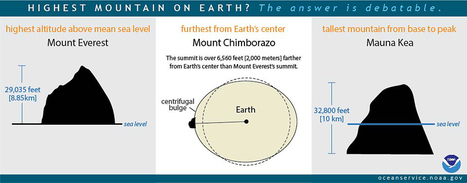
"Mount Everest is usually said to be the highest mountain on Earth. Reaching 29,035 feet at its summit, Everest is indeed the highest point above global mean sea level—the average level for the ocean surface from which elevations are measured. But the summit of Mt. Everest is not the farthest point from Earth’s center.
Earth is not a perfect sphere, but is a bit thicker at the Equator due to the centrifugal force created by the planet’s constant rotation. Because of this, the highest point above Earth’s center is the peak of Ecuador’s Mount Chimborazo, located just one degree south of the Equator where Earth’s bulge is greatest. The summit of Chimborazo is 20,564 feet above sea level. However, due to the Earth’s bulge, the summit of Chimborazo is over 6,560 feet farther from the center of the Earth than Everest’s peak. That makes Chimborazo the closest point on Earth to the stars.
You may be surprised to learn that Everest is not the tallest mountain on Earth, either. That honor belongs to Mauna Kea, a volcano on the Big Island of Hawaii. Mauna Kea originates deep beneath the Pacific Ocean, and rises more than 32,800 feet from base to peak."
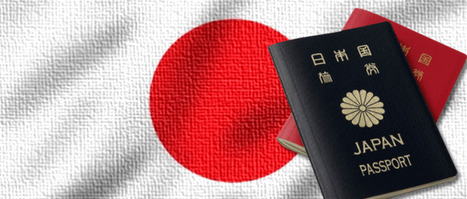
"To become a Japanese citizen, a foreigner must display 'good conduct', among other things. The rules do not specify what that means, and make no mention of living wafu (Japanese-style). But for one candidate, at least, it involved officials looking in his fridge and inspecting his children’s toys to see if he was Japanese enough (he was). Bureaucratic discretion is the main reason why it is hard to get Japanese nationality. The ministry of justice, which handles the process, says officials may visit applicants’ homes and talk to their neighbors."
Interesting to see how the Japanese handle citizenship differently than most of world and America. Japan is mostly a homogeneous culture and from seeing there citizenship laws one can tell why. A foreigner must live there for 10 years and display "good conduct" which no one really knows what it is and also prove to be Japanese enough in culture. It will be interesting to see how this continues today in a world that keeps becoming more and more global. All over the news we see constant backlash about countries that do not want to accept more immigrants or give certain rights to citizens, however you never really hear of the Japanese. The Japanese have many cultures that they can keep alive with mostly a homogeneous population and most likely helps cause less violence and less arguments among its politics. Imagine if here in America they searched your house to see if you were American enough? I think that might be headline news by the night.
If you want to move and live in Japan and attain a citizenship be ready to give up your current citizenship and go on one heck of a rollercoaster. Japan is one of the toughest places to get a citizenship. For one you have to live there for at least 10 years. Then the government can and will come to your home to inspect it from the types of pens you have there to the kid of pictures you hang on your wall. The main thing is the Japanese government wants you to really adapt to their culture. Very few are naturalized, out of 12446 that applied only 9400 were accepted. But the good news is, is it is free compared to 550 in the US and 1200 in the U.k.
In a well-known article entitled “Why The Revolution Will Not Be Tweeted” written for The New Yorker in October, 2010, author Malcolm Gladwell dismissed the vaunted “power of social media” to create social change: “It makes it easier for activists...
To get content containing either thought or leadership enter:
To get content containing both thought and leadership enter:
To get content containing the expression thought leadership enter:
You can enter several keywords and you can refine them whenever you want. Our suggestion engine uses more signals but entering a few keywords here will rapidly give you great content to curate.


 Your new post is loading...