Twenty-five years ago there was a glaring wealth gap in the U.S. between blacks and Hispanics on one hand, and whites on the other. Little has changed, a new report shows.
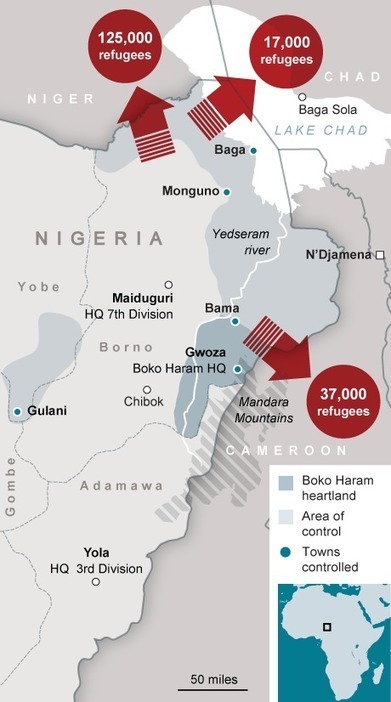
On the shores of Lake Chad, families who have fled the clutches of Nigeria's Islamist fanatics tell David Blair of the methods and madness of the group's massacres
Martijn at CLOSER (Anthropology of Muslims in Europe) looks at the way that anthropological symbols have been appropriated into retail branding. On the one hand, lots to be cynical about; on the other, this is, in fact, how symbols and rituals work. But is it a challenge for anthropologists' attempts to brand themselves?
This education is a vast waste of the resources and potential of the young. It is boring beyond belief and useless–except to the powers and interests that depend on it. When A Ukranian student, a three-week arrival on these shores, writes the best-organized and most profound essay in English of the class, American education has something to answer for–especially to our youth.
Joe Henrich and his colleagues are shaking the foundations of psychology and economics—and hoping to change the way human behavior and culture is understood.
"The battle between the Alamo garrison and Mexican President Santa Anna’s forces reads like a Shakespearian tragedy: greatly outnumbered, all the Texan defenders died. Even the men who surrendered were killed, fueling the outrage and critical mass required to swell the Texan army, become an independent republic, and in time choose to be annexed by the United States."
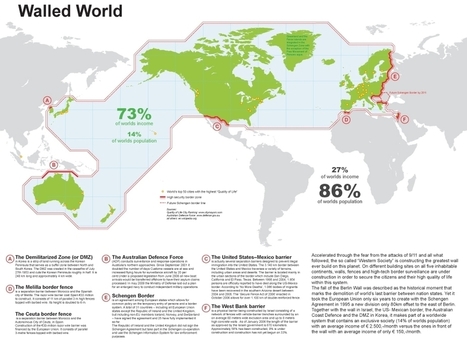
Accelerated through the fear from the attacks of 9/11 and all what followed, the so called ‘Western Society’ is constructing the greatest wall ever build on this planet. On different building sites on all five inhabitable continents, walls, fences and high-tech border surveillance are under construction in order to secure the citizens and their high quality of life within this system. The fall of the Berlin Wall was described as the historical moment that marks the demolition of world’s last barrier between nation states. Yet it took the European Union only six years to create with the Schengen Agreement in 1995 a new division only 80km offset to the east of Berlin.
This article explains how the world is filled with division and segregation. Some of the most notable are the walls are the wall in berlin, the wall/border/river/fence between the u.s. and mexico and the border between north and south Korea is the most notable walls.
This article relates to unit 4 because it shows how people, through borders, have divided them through history creating new politics, culture and borders themselves. The political processes involved can change the policies and shapes of nations in the world.
This map shows that hi-tech political surveillance of borders is highly correlated with the core areas of the global economy and some of the most attractive immigrant destinations.
Questions to Ponder: What else do you see in this map? What does this say about the world order? Are there patterns that this map reveals/conceals?
Restaurants and public places in Ireland are loud. They looked so different from the United States -- full of people laughing and talking to one another -- that it took me several days to figure out just what I was seeing. Actually, it was what I wasn't seeing. As we traveled through Ireland, families and friends met each other for dinner or coffee just like we do here in the States, but without one thing. Their cell phones weren't out. No one was texting. No one was taking selfies. They were with each other. . .
You may know exactly what race you are, but how would you prove it if somebody disagreed with you? Jenée Desmond Harris explains. And for more on how race is...
In my goal to teach myself Mandarin Chinese, I stumbled across this brilliant new app designed for language learning and cultural exchange. Whereas other language learning apps aim to directly teach you a language through a curriculum and exercises, HelloTalk is designed to connect you with other language-learners around the world through translation-based software so that you can teach and help each other.
Emphasising the importance of cultural diversity in the workforce and how important this is to big business when it comes to increasing their bottom line, multiculturalism is such a valuable resource.
But is it that important? Apart from my obvious hyperbole, are more Facebook likes truly going to create massive engagement, viral excitement, and blast revenue to new heights of glory and awesomeness?
According to this article, likes are not synonymous with engagement.
This I see as a possible trend, as people understand Facebook is just a starting point of this social media story. It will not necessarily drive revenue in all cases.
WIRE is Amnesty International's global magazine for people who are passionate about human rights. Read about our campaigns and fresh research, meet the people we work for and with, and - most importantly - take action.
Latest issue of Amnesty International's Wire magazine is out -- available for download here. Stories on arms treaties, human cost of Syria, Romani activism, and more. Free to download.
American scientist and author Jared Diamond was recently in Australia promoting his 5th book The World Until Yesterday: What can we learn from traditional societies?
If you're not over Jared Diamond's account of the differences between Us and Them, and his shtick about fearing the shower, there's more from an interview he did with sociologist Peter Christoff. For example, he has no time for criticisms that he's homogenizing indigenous groups:
'The traditional societies that we see today are not frozen models of the past, on the one hand. On the other hand, they’re not irrelevant to the past because they are still small-scale societies. And when you’ve got 200 people, and whether the 200 people are from today or whether the 200 people are from 30,000 years ago, there are some things that you have to have with 200 people. So in short, I think my book is faithful to the complexities of the problem.'
In other words, I acknowledge what my critics say, but then dismiss it and suggest it's irrelevant because I thought of it.
Shines insight on stereotypes that are commonly used throughout the world. Reading this article really made me think about stereotypes that are so commonly used they are considered acceptable. It's a ridiculous idea to think that all people under a culture act and behave the same way.
This article is written to compare and contrast various ways to teach young school children about global cultures. On one hand, we can relate all cultures to each other, due to their common goals and views. For example, all families around the world aim to do what's best for each other, love and cherish one another, and try their hardest to succeed economically. On the other hand, cultures are extremely different around the world, with different music, clothing, and underlying views on life. We can continue to say that popular culture has diffused so greatly, with advanced technologies and means of transportation, so it has influenced and homogenized our landscape quite a bit. Folk culture is obviously still a powerful force, but popular culture does have some effects around the world. I believe that children need to understand the importance of maintaining diversity thy preserving folk culture but they also need to acknowledge the pros and cons of the global diffusion of popular culture and how it connects us at a global scale.
I think Teaching Cultural Empathy: Stereotypes, World Views and Cultural Difference is a helpful article for teachers to read. This article considers ideas I constantly come back to, whilst collecting resources and ideas for teaching students about cultural diversity and identity. How do I teach students, that ‘people and cultures are different all over the world’ (Dixon, 2015, April 2), but also the same?
Dixon suggests that we need to teach that people and cultures worldwide are the SAME and DIFFERENT simultaneously. In this way, students can appreciate the rich diversity of cultures and societies, whilst at the same time learning values of humanity and empathy, which unite us all.
I believe by recognising and appreciating the rich cultures of students in the classroom, we can explore and learn about cultural diversity in an honest, rich and non-stereotypical way and allow students to feel valued at the same time. In addition, as students know each other, this helps them relate to ‘people from other places, who speak other languages’ and follow different religions to their own (Dixon, 2015, April 2). Furthermore, this should help increase intercultural understanding in the classroom by developing a ‘socially cohesive’ environment that ‘respects, and appreciates cultural, social and religious diversity’ (MYCEETA, p. 7).
Ministerial Council on Education, Employment, Training, and Youth Affairs. (2008, December). Melbourne declaration on educational goals for young Australians. Melbourne: Author.
This experiment brings together the power of Google Translate and the collective knowledge of Wikipedia to put into context the relationship between language and geographical space.
Update (10:21 AM EST): The Chapel Hill Police Department has released a preliminary statement on Wednesday morning regarding the progress of their investigation into the killing of three local residents on Tuesday. The statement confirmed that the suspect in the shooting, identified as Craig Stephen Hicks, remains in police custody and has so far been cooperative with investigators. The police update continues:
To get content containing either thought or leadership enter:
To get content containing both thought and leadership enter:
To get content containing the expression thought leadership enter:
You can enter several keywords and you can refine them whenever you want. Our suggestion engine uses more signals but entering a few keywords here will rapidly give you great content to curate.


 Your new post is loading...