


|
Scooped by
Dennis Swender
from "Testing, Testing, 1, 2, 3..."
May 13, 2016 3:53 AM
|


No comment yet.
Sign up to comment

 Your new post is loading...
 Scoop.it! No comment yet.
Sign up to comment
Scoop.it!

When 3,100 teachers were surveyed by the Gates Foundation in November 2015 about the biggest barriers to using digital resources, the most common response was “My students do not have access to technology outside of the classroom.” Via Nik Peachey
Scoop.it!
When 3,100 teachers were surveyed by the Gates Foundation in November 2015 about the biggest barriers to using digital resources, the most common response was “My students do not have access to technology outside of the classroom.”The lack of access to high-speed internet and its impact on learning Via EDTECH@UTRGV
Scoop.it!
Do you speak African? Well, neither do the 1 billion people on the continent.Africa is home to 54 different nations, more than 2,000 languages and four of the world's 10 fastest growing economies, but is often painted with a sweeping stroke of doom and gloom. In this week's Reality Check, Mehdi Hasan exposes popular misconceptions about the African continent.

Denise Klaves Stewardson's curator insight,
March 21, 2016 3:07 PM
This short video is full of with examples and statistics that show that many of the 'doom and gloom' perspectives and ways of thinking about Africa are outdated (at best). Here are some good facts to update how we talk about Africa.
Tags: Africa, perspective. 
Taylor Doonan's curator insight,
March 24, 2018 5:12 PM
This video combats many misunderstandings about Africa, the biggest one being that many people view Africa as one nation instead of 54 unique nations. It also talks about how some African countries are on the rise and that women have a large role in many governments in Africa. The video aims to take away the stigma of war and poverty that goes along with Africa.

David Stiger's curator insight,
November 10, 2018 4:43 PM
This video mentions that the Western world's negative, doom and gloom perception of Africa are "lazy" and this is important. Westerners may have become so accustomed to the colonial and post-colonial problems in Africa, that there is an outside attitude of "what good could possibly come from Africa - they are doomed and deserve our pity and charity." In reality, as this video points out, Africa is not just one single entity and its different players are on the rise. It is a continent of 54 separate countries containing 1 billion people who speak from a range of 2,000 languages. The video mentions that nearly one third of Africa is part of the middle class. With that said, in our geographic mental maps, it is time to start looking at Africa like the 'Tiger Countries of Asia', like South Korea, who blossomed into economic powerhouses. This is a fair comparison as Africa now has the ten fastest growing economies in the world, outpacing the West. With this line of thinking, Africa is a continent full of opportunity containing a lot of promising potential if given the chance. Interestingly, if white-Americans and white-Europeans improved their attitudes about the 54 countries of Africa (and saw them as capable societies) this would humanize non-white people in general and probably reduce racist, bigoted attitudes.
Scoop.it!
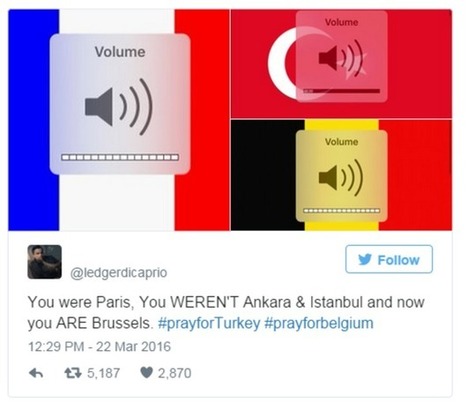
Reports of bombings tend to get huge numbers of mentions on social media, but that doesn't always mean a similar level of news coverage. Via Deanna Dahlsad
Dennis Swender's insight:
The short answer is obviously "Yes." Yet, this question brings up other questions about cultural empathy and how 'connected' we might feel to people of other places than our own global neighborhood. This political cartoon-ish map has more truth in it than we might like to admit; it is subtitled 'How terrible it is the the Western world when a tragedy happens in...?'
Questions to Ponder: Does the 'where' influence if we perceive the event as a true tragedy or not (or maybe just the magnitude or importance of the tradegy)? How come? What does this say about us as inidividuals, society, and the media? How can we teach our students in a way to foster more cultural empathy?
Tags: social media, place, culture, political, terrorism, media.

jorden harris's curator insight,
April 4, 2016 9:52 AM
to me it is mind boggling how we can pay more attention to countries with national threats than others especially with ISIS being so prominent which is a war that is going to take help from not only the united states but the other affected countries - J.H 
Logan scully's curator insight,
April 4, 2016 10:11 AM
It somewhat bothers me how that terrorist attacks outside of Europe and North America is pretty much just ignored by the social media while people are sitting in the hospital for crimes in which terrorists and other religious radicalists have done to their area and country.-L.S.

Brealyn Holley's curator insight,
April 7, 2016 10:20 AM
For the question "Do terror attacks in the Western world get more attention than others?" In my opinion the answer would be yes because a lot of the terror attacks in the Western world are bigger and are expected more than terror attacks near us. ~BH
Scoop.it!

"Chinese investors have splurged on buying big American entertainment companies such as AMC Theaters and Legendary Entertainment. Are edtech companies and universities next on their shopping list? Todd Maurer, founder of 3/1 Global Research, explores the “strategic and financial reasons why China's investment into US education will accelerate.” Via Jim Lerman
Dennis Swender's insight:
Quite an informative bit of news
Scoop.it!

Wondering about the factors that determine the Cognitive Limitations Of Adult Learners in eLearning? Check this article to discover 6 Factors. Via EDTECH@UTRGV
Scoop.it!

Dennis Swender's insight:
It isn't even in the top five.

Fernando de la Cruz Naranjo Grisales's curator insight,
March 16, 2016 7:21 AM
It isn't even in the top five.
Scoop.it!

This lesson is ideal for encouraging critical thinking and developing digital literacies. In the lesson students will learn some amazing facts about hair and the historical significance it has had in different cultures around the world. They will also learn to challenge and question the accuracy of information they find online. Via Nik Peachey
Dennis Swender's insight:
My latest lesson plan.

Nik Peachey's curator insight,
December 19, 2015 1:00 AM
My most recent lesson plan and materials for TES.
Scoop.it!

A Harvard faculty member argues in his new book that averages tell us nothing useful about individuals. That has big implications for schools. Via EDTECH@UTRGV
|
Scoop.it!

The difference between winners and losers how they handle losing. No one can completely avoid troubles and potential pitfalls are everywhere, so the real skill is the resilience to climb out of the hole and bounce back. Via Kenneth Mikkelsen, Paul Thoresen

John Michel's curator insight,
July 19, 2013 8:39 PM
For anyone who wants to get beyond adversity or start over rather than give up, America is the Land of Second Chances. According to Jon Huntsman, former US Ambassador to China, getting back on our feet is an American strength widely admired in China. And everywhere, rapid recovery from natural disasters is increasingly a key to a robust economy. Entrepreneurs and innovators must be willing to fail and try again. The point isn't to learn to fail, it is to learn to bounce back. 
LETP's curator insight,
July 28, 2013 11:34 PM
How can we teach our students to be resilient in this highly digitised world? 
Maureen Orey's curator insight,
August 14, 2013 1:17 AM
A great thought leader really captures the essence of the importance of resilience!
Scoop.it!

But, Robb said, multitasking can be particularly bad for students if they are juggling activities in class or doing schoolwork. Via Mel Riddile, Mark E. Deschaine, PhD
Scoop.it!

Around the world, billions of us use social media every day, and that number just keeps growing. In fact, it’s estimated that by 2018, 2.44 billion people will be using social networks, up from 970,000 in 2010.
Learn more / En savoir plus / Mehr erfahren:
http://www.scoop.it/t/social-media-and-its-influence
Via Gust MEES

Gust MEES's curator insight,
April 27, 2016 4:44 PM
Around the world, billions of us use social media every day, and that number just keeps growing. In fact, it’s estimated that by 2018, 2.44 billion people will be using social networks, up from 970,000 in 2010.
Learn more / En savoir plus / Mehr erfahren:
http://www.scoop.it/t/social-media-and-its-influence

Kimberley Petering's curator insight,
May 10, 2016 11:53 PM
Yet why are we still confiscating mobile devices from our students in schools.
Scoop.it!

The mantra of 'consistent reward' has often been popular amongst educators, but neuroscience suggests we may need to turn that on its head." So says Paul Howard-Jones, a professor of neuroscience and education at the University of Bristol. In one of his studies, participants could choose their reward for answering a question correctly: a guaranteed one point, or a 50/50 chance to win either zero or two points. Via Nik Peachey
Scoop.it!

Is there life after the eLearning course is launched? Yes there is. Here are 5 things you should do. Via EDTECH@UTRGV
Scoop.it!

"The U.S. Geological Survey (USGS) has compiled some of the more stunning examples into a traveling art exhibition called Earth as Art 4, the fourth in a series of shows since 2002. The collection, which can be viewed in full online, debuted at USGS headquarters in Reston, Virginia."
Tags: remote sensing, land use, environment, geospatial, images, art, landscape.
Dennis Swender's insight:
The heights of multicultural art

Maricarmen Husson's curator insight,
April 24, 2016 1:02 AM
Imágenes satelitales que convierten la Tierra en Arte
Scoop.it!

By designing systems for the average person, individuals lose out on potential opportunities to excel. Via EDTECH@UTRGV

Lon Woodbury's curator insight,
March 29, 2016 1:09 AM
I know very few people that like to be considered average. But this concept is great for people to use to hide their weaknesses. -Lon 
Dean J. Fusto's curator insight,
March 29, 2016 8:30 PM
I asked a group of Grade 9 students about averages and average students. They knew there was no such thing, but we persist. Good teachers understand they teach children with real names, real faces, and real stories.
Scoop.it!

Description by The Scout Report
"This blog, written by Mills Kelly of the Center for History and New Media at George Mason University, "considers the intersection of digital technologies and history." As the author would likely admit, what that means changes depending on the week. Recent posts have taken on the narrative hegemony of the U.S. World & News Report's college rankings, questions about how history should be written in the aftermath of Hurricane Katrina, and the tensions between playfulness and rigor in academic scholarship. A simple search feature makes for easy scouting, as well as the option to filter posts by Scholarship, including such topics as Digital Campus, Longform Blog Essays, Making the History of 1989, and others." Via Jim Lerman
Scoop.it!

Etiquette (/ˈɛtɨkɛt/ or /ˈɛtɨkɪt/, French: [e.ti.kɛt]) is a code of behavior that delineates expectations for social behavior according to contemporary conventional norms on how not to be a dufus within a society, social class, or group. — Wikipedia Via Nik Peachey
Dennis Swender's insight:
A really nice illustrated guide to the netiquette of new technology.

Web 2.0 for ELT's curator insight,
March 23, 2016 3:00 AM
A really nice illustrated guide to the netiquette of new technology. 
Stephania Savva, Ph.D's curator insight,
March 26, 2016 10:45 AM
A really nice illustrated guide to the netiquette of new technology.
Scoop.it!
If the population of the world was only 100 people, what would society look like? How many people would have shelter? Clean water? Education?
Dennis Swender's insight:
Reminicent of the picture book, "If the World were a Village" by David Smith, this video attempts to make large statistics more meaningful to to a broader audience. The concept is simple, but the impact is profound.
Tags: statistics, development, perspective.

Ella Price's curator insight,
March 28, 2016 9:19 PM
Reminicent of the picture book, "If the World were a Village" by David Smith, this video attempts to make large statistics more meaningful to to a broader audience. The concept is simple, but the impact is profound.
Tags: statistics, development, perspective. 
MsPerry's curator insight,
March 31, 2016 12:57 PM
Reminicent of the picture book, "If the World were a Village" by David Smith, this video attempts to make large statistics more meaningful to to a broader audience. The concept is simple, but the impact is profound.
Tags: statistics, development, perspective.
Denise Klaves Stewardson's curator insight,
April 1, 2016 4:06 PM
Reminicent of the picture book, "If the World were a Village" by David Smith, this video attempts to make large statistics more meaningful to to a broader audience. The concept is simple, but the impact is profound.
Tags: statistics, development, perspective.
Scoop.it!

Dennis Swender's insight:
U.S. Young Adults Lag Behind International Peers
Gust MEES's curator insight,
March 12, 2016 1:53 PM
U.S. Young Adults Lag Behind International Peers 
CDIMarcChagall's curator insight,
March 13, 2016 7:57 AM
U.S. Young Adults Lag Behind International Peers
Fernando de la Cruz Naranjo Grisales's curator insight,
March 16, 2016 7:21 AM
U.S. Young Adults Lag Behind International Peers
Scoop.it!

What it means to be literate today is significantly different to what is Via Nik Peachey, Ruth Vilmi
Nik Peachey's curator insight,
October 5, 2015 4:42 AM
A good indepth article about an increasingly important area of education. 
Jim Barentine's curator insight,
October 5, 2015 4:52 PM
The Information Age expands exponentially the amount of info out there for students to "weed through" in their searches for understanding and increased knowledge! |






