Imagine. Create. Discover. CoSpaces gives your imagination a place to unfold: Fantasy worlds, immersive birthday cards or virtual museums – with the fre
Scientific American is the essential guide to the most awe-inspiring advances in science and technology, explaining how they change our understanding of the world and shape our lives.
Every day brings a new opportunity to implement a new tool or method into the classroom, and what better way than to have students be able to immerse in a learning experience. Augmented and virtual reality are becoming more commonly used in K-12 classrooms and higher ed for this purpose.
The author states how a vast majority of parents feel positive about the AR/VR benefits to their child's education. It also highlights the ability of students to co-create VR spaces.
It’s hype time again. Spurred on, no doubt, by the current spate of books and articles about AIED (artificial intelligence in education), the IATEFL Learning Technologies SIG is organising an online event on the topic in November of this year. Currently, the most visible online references to AI in language learning are related to Glossika…
This is Where Augmented Reality Is Headed If you think augmented reality is something reserved for Pokemon Go and the like, you might be in for a surprise. Most consumers are exposed to AR every day!
Introducing "HardWIRED: Welcome to the Robotic Future," a new video series in which we explore the many fascinating machines that are transforming society.
Discover how to use VR and AR for education and engage your students to learn by creating. Runs on mobile, tablet, desktop and laptop, including Chromebooks.
As I look down from space on our spinning blue and green planet, I understand why astronauts so often describe the experience of “Earth-gazing” as life-changing. I’m seeing our tiny planet…
Technology is diminishing the role of teachers. But that trend may just be starting - technology innovators have already built and deployed a teacher-bot that can do what teachers do but faster, cheaper and all day long.
Classroom Mode is only available to users running the Minecraft: Education Edition general availability client. Read on for installation for Windows 10 or macOS, getting started, features, and provides a short video from one of our Mentors demonstrating features.
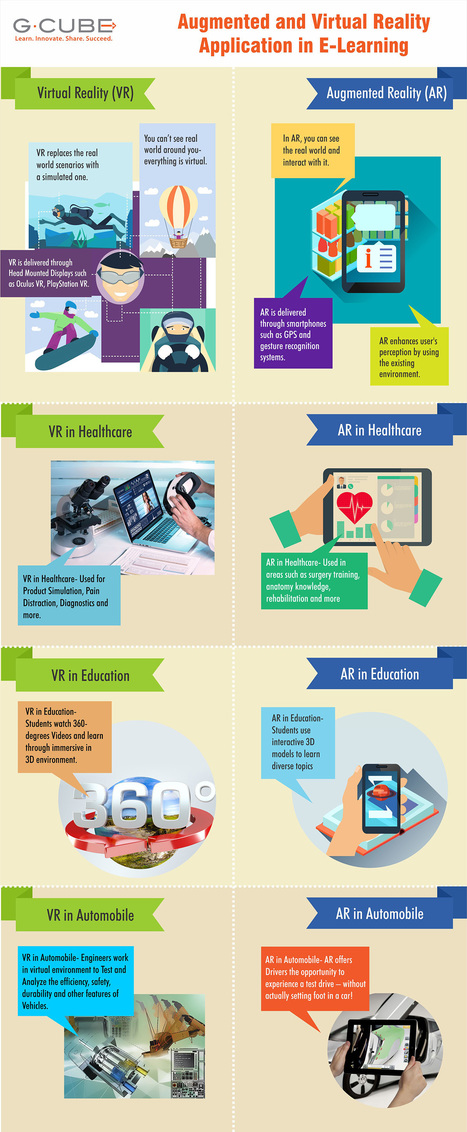
Infographic on AR vs VR: Awareness of VR (Virtual Reality) and AR (Augmented Reality) has reached right threshold level, driving innovative learning solutions.
I live a 10-minute walk from the UK’s first board game café, Thirsty Meeples (a meeple is the name given to any person-shaped figure used as a player’s token in a board game). Until recently, my…
Gamification is grabbing all the L&D headlines. Perhaps that’s because it seems to encapsulate all things to do with games and their application to learning, training and engagement. However, gamification is not game-based learning. They are two very different things and it’s worth putting the record straight. I won’t go into a lengthy history lesson on where gamification as a term emerged from (headlines: advertising and marketing-focused loyalty and reward schemes, the rise of the quantified self, pioneering mobile apps like Foursquare), but the concept of gamification is as old as the hills – think avoiding the cracks in the pavement, or playing 'eye spy' to pass the time on a long journey. Gamification centres on motivating people to complete everyday or mundane tasks, helping them to sustain interest and keep up with activities or goals that they find difficult to complete or lack the motivation to keep on track. If you think of fitness, health and wellbeing apps, badges, stickers, rewards and virtual ‘whoops’ (not dissing this - growth mind-set theories demonstrate the impact of positive strokes), you’ll get the gamification picture. The best approach is where a game and the game mechanics have learning value of themselves, where learning is intrinsic to the gameplay. So, in L&D or training terms, gamification is a great way to reward, motivate and sustain interest in repeat tasks, daily procedures or long-term goals - from following a standard operating procedure to learning a language. It can be applied to anything that might need a boost or extra motivator for people to complete and/or compete. It surrounds a learning intervention (a programme, course, campaign), but – here’s the important bit - it’s not a learning intervention itself. That’s where game-based learning (GBL) comes in. Now don’t get me wrong, GBL is much harder to encapsulate in a few hundred words. It’s like explaining to someone who’s never watched television, what’s on television. Television is so much more than Game of Thrones, right? Click here to take the TJ survey and get three months free digital subscription to TJ plus the chance to win an Amazon Echo GBL is, put simply, the process of learning through play - playing a game to learn rather than to be entertained. The best approach is where a game and the game mechanics have learning value of themselves, where learning is intrinsic to the gameplay, rather than where learning is extrinsic or bolted on after – in my opinion, bad GBL practice. If we take a few genre or game format examples it might help to explain. If you think about role-playing (take on a persona and complete challenges), strategy (gather and utilise resources, testing out strategies to succeed) or simulation games (probe and re-probe simulated circumstances and conditions), you immediately see the similarity between the language of learning and of gaming. As one of the founding fathers of GBL Professor James Paul Gee (2005) says ‘Good game design is good learning design’. Finally a couple of pointers to the heart of game-based learning. First, you can’t compete with the latest console title or the pervasive game that everyone’s playing on Facebook. Don’t start there, don't go there. Second, it’s not ‘fun’ or learning made easy. Good game-based learning should be ‘pleasantly frustrating’ (James Paul Gee again) or as Seymour Papert from MIT called it ‘hard fun’. Good games and good learning games challenge you and put you on the edge of your capabilities. They get you thinking, re-evaluating and playing again. About the author David Squire is creative director of DESQ
To get content containing either thought or leadership enter:
To get content containing both thought and leadership enter:
To get content containing the expression thought leadership enter:
You can enter several keywords and you can refine them whenever you want. Our suggestion engine uses more signals but entering a few keywords here will rapidly give you great content to curate.


 Your new post is loading...
 Scoop.it!