Devops for Growth
121.1K views | +6 today
Devops for Growth
For Product Owners/Product Managers and Scrum Teams: Growth Hacking, Devops, Agile, Lean for IT, Lean Startup, customer centric, software quality...
Curated by Mickael Ruau
Your new post is loading...

Popular Tags

Scooped by Mickael Ruau
December 25, 2021 3:21 AM
Scoop.it!

Growth Hacking, pt 1. Know Your Audience | by Invisible Startuper

Growth Hacking, pt 1. Know Your Audience | by Invisible Startuper | Devops for Growth | Scoop.it
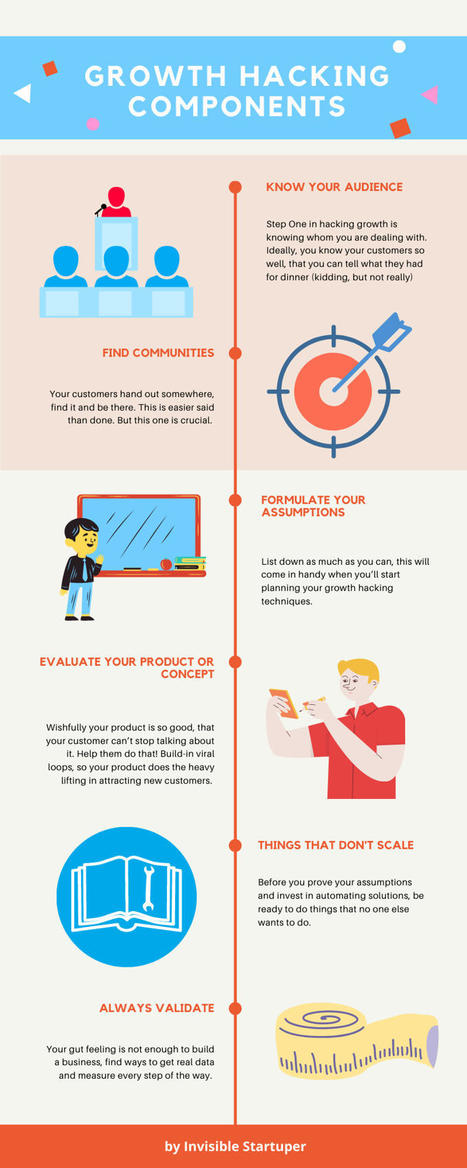
Growth hacking usually refers to a set of strategies focused solely on growth. It normally refers to some creative and low-cost ways to acquire and retain customers. I think of Growth Hacking as a…
No comment yet.
Scooped by Mickael Ruau
December 25, 2021 3:10 AM
Scoop.it!

How to grow sales with early adopters - $10 million in annual sales before you scale

How to grow sales with early adopters - $10 million in annual sales before you scale | Devops for Growth | Scoop.it
If you want to learn why and how to grow sales with early adopters as customers, before you cross the chasm, you’ve come to the right place
No comment yet.
Scooped by Mickael Ruau
December 25, 2021 2:39 AM
Scoop.it!

The Complete Guide To Growth Hacking

The Complete Guide To Growth Hacking | Devops for Growth | Scoop.it
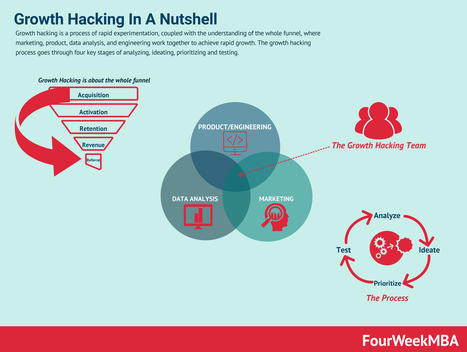
Growth hacking is a method of rapid experimentation, and a process which goes through four key stages of analyzing, ideating, prioritizing and testing. 
No comment yet.
Scooped by Mickael Ruau
December 23, 2021 1:21 AM
Scoop.it!

In Defense of Clean Code - DZone Web Dev

In Defense of Clean Code - DZone Web Dev | Devops for Growth | Scoop.it
100+ pieces of timeless advice from Uncle Bob. Clean Code by Robert C. Martin is the most recommended programming book of all time. There’s a good reason why.
No comment yet.
Scooped by Mickael Ruau
December 23, 2021 12:19 AM
Scoop.it!

TDD’s Impact on Testers

TDD’s Impact on Testers | Devops for Growth | Scoop.it


Testers, and the whole team, are responsible for making sure the product does what they think the customer needs. These are different tests, they cover more code per test as well as checking the interactions between modules. As testers adopt automated testing, they need different skills than the manual tester that is following a script or exploring. Some adopt Acceptance Test Driven Development. For testers in this environment, the world is changing. Changing for the better with the intellectual challenges of automation, keeping the cost of retest low, and reducing the repetitive, error prone and boring manual tests. Not all manual tests go away, but we work to automate what is repetitive. In addition ATDD moves testers upstream from reacting to the code written to specifying system behavior by example.

All that said, most of the world of software development still practices Debug Later Programming and manual test, the same practices I used in my first job as a programmer. Congratulations for using 1979 programming techniques! We’ve learned a lot since then.

For some adopting TDD and ATDD is changing their world. For most it is not. There is so much legacy code out there, as well as people and organizations that do not know how or why to automate their tests, that the status quo of testing will likely have a long life.
No comment yet.
Scooped by Mickael Ruau
December 22, 2021 1:56 AM
Scoop.it!

8 FORCES OF CHANGE - Kanban Change Leadership: Creating a Culture of Continuous Improvement [Book]

8 FORCES OF CHANGE - Kanban Change Leadership: Creating a Culture of Continuous Improvement [Book] | Devops for Growth | Scoop.it
A young boy walks along a beach littered with thousands of starfish. Every couple of meters, he bends down to pick up a starfish and throws it back into the sea. A man watching the boy walks up to him shaking his head and asks him, “What are you doing?” “I’m saving the starfish,” the boy answers. “But that doesn’t make any sense,” replies the man, bewildered. “What difference does it make to the other thousands of starfish lying here on the beach?” “It makes a difference to this one here,” the boy replies, throwing one more starfish into the sea.

“Making a difference” is perhaps the fundamental mantra for change. Similarly, “making lots of small changes” could be Kanban’s mantra. It could be that this causes just as much headshaking as the man in the story about the young boy and the starfish. Why concern yourself with individual starfish when a comprehensive rescue project is really what’s needed? Because many small changes add up to a big change, we might answer, using the beach story as an example. Because every starfish thrown back is equivalent to a small improvement. And because we, just like the boy, have the power to make these improvements.

Something must obviously change if things are to improve. And, as the story about the starfish shows, change is always a little controversial. On the one hand, it seems to come about of its own accord: a powerful gust of wind, an unexpected sea current, and suddenly the beach is covered with starfish.
No comment yet.
Scooped by Mickael Ruau
December 22, 2021 12:55 AM
Scoop.it!

Organizational Behavior

Organizational Behavior | Devops for Growth | Scoop.it
Table of Contents

1. Management and Organizational Behavior
2. Individual and Cultural Differences
3. Perception and Job Attitudes
4. Learning and Reinforcement
5. Diversity in Organizations
6. Perception and Managerial Decision Making
7. Work Motivation for Performance
8. Performance Appraisal and Rewards
9. Group and Intergroup Relations
10. Understanding and Managing Work Teams
11. Communication
12. Leadership
13. Organizational Power and Politics
14. Conflict and Negotiations
15. External and Internal Organizational Environments and Corporate Culture
16. Organizational Structure and Change
17. Human Resource Management
18. Stress and Well Being
19. Entrepreneurship
Mickael Ruau's insight:

The text presents the theory, concepts, and applications with particular emphasis on the impact that individuals and groups can have on organizational performance and culture. An array of recurring features engages students in entrepreneurial thinking, managing change, using tools/technology, and responsible management; furthermore, the unique chapter on Social Media and Communication contextualizes the importance and implications of various platforms and communications methods.

No comment yet.
Scooped by Mickael Ruau
December 21, 2021 1:29 AM
Scoop.it!

How organizations can shed the technical debt of legacy code · Devbridge

How organizations can shed the technical debt of legacy code · Devbridge | Devops for Growth | Scoop.it
Don't let legacy code technical debt slow down your business. Learn agile techniques to help manage and reduce product debt.
Mickael Ruau's insight:


Based on industry-standard and our experience, companies should weigh their options by using the previous questions and their answers as a guide. The following matrix we developed helps visualize the options:


No comment yet.
Scooped by Mickael Ruau
December 21, 2021 12:51 AM
Scoop.it!

A Step By Step Guide On Customer Discovery Process

A Step By Step Guide On Customer Discovery Process | Devops for Growth | Scoop.it
In this article, you will understand the customer discovery process, its four Phases through the Customer development model. Read More..
No comment yet.
Scooped by Mickael Ruau
December 20, 2021 1:52 AM
Scoop.it!

How WIP Limits Can Rescue Troubled Agile Teams

How WIP Limits Can Rescue Troubled Agile Teams | Devops for Growth | Scoop.it
There are several benefits of establishing WIP limits. These include:

Agile teams have an objective, standardized way to decline new requests and explain why tasks are not being fast-tracked through the process. While this still won’t make internal or external customers happy, it is far more agreeable than just saying “no” and being unfairly criticized as inflexible or lazy.
Agile teams do not have to act like goldfish and dart frenetically from one item to another — which is not just inefficient, but it’s also exhaustive. Instead, they can focus on completing high quality work in the fastest possible manner, while minimizing distractions and interruptions.
Agile teams can build slack into processes, which allows for collaboration, collective problem solving, necessary meetings, and other activities that are essential to high-quality work, yet are not captured as formal work items.
Agile teams can more effectively identify actual and potential bottlenecks, and take targeted, practical action to alleviate or avoid them.
Agile teams can make better use of available resources, and deliver persuasive, data-driven business cases to managers and executives if additional resources are required.
Agile teams can cultivate a culture of support and teamwork — instead of “every woman and man for themselves” — which boosts engagement, performance, productivity, and accountability. This is particularly important and valuable given that agile teams must be inherently self-organizing and self-managed. With agile, either everyone reaches the finish line on time and intact, or nobody does.
Agile teams can use the visual language of WIP limits+Kanban boards to significantly reduce the need for status meetings (please keep your cheering and celebrating as quiet as possible, there are likely people in your work environment who are on the phone).
No comment yet.
Scooped by Mickael Ruau
December 20, 2021 12:58 AM
Scoop.it!

Principles of Agile Version Control: From OOD to TBD

Principles of Agile Version Control: From OOD to TBD | Devops for Growth | Scoop.it
The OOD principles of reuse-release equivalence, common closure, and common reuse are all about the appropriate granularity of packages of classes. We wish to investigate the corresponding granularity of packages of evolution within a version control environment. We can consider the scope and granularity of a change, a baseline, a codeline, and beyond. In either case, both (re)use and release imply reuse by some consumer and releasing to some target consumer. Once again, the notion of abstractness in OOD translates to the level of visibility of versioned content that will play a key role.

In version control, the reuse of changes and versions occurs when we view or update (merge/modify) a version of one or more files in our workspace in order to develop, build, test and release our changes. The release of changes and versions occurs when we commit changes to a codeline, transfer changes between codelines, baseline a configuration, or promote a configuration to a new promotion-level. Based on this, we already know a few things about change granularity:

The granule of change is not an individual file/checkout, but is rather a single development task that holds changes we then commit to the codeline.
The granule of baselining and promotion is not an individual change but is, instead, the unit of integration for building and testing the component or product undergoing change on the codeline, which is the configuration.
The granule of progressive collaboration and evolution is the codeline

Not all of the above require principles. Furthermore it’s not apparent that each of these three OOD principles will translate to individual version control principles. Instead, we want to see if we can apply these three principles together as a group for each of changes, baselines, and codelines.

Package Coupling - Change-Flow

The package coupling principles of OOD translate almost directly to version-control, with only slight modification. Sometimes dependency translates into flow, but note that change-flow does not imply dependency. These deal with branching, merging, and the flow and structure of changes across codelines.

What's Next?

Now that we've set the stage and introduced the players, we will exit the stage until next month, when we try to directly apply our translations to each of the different types of version control containers: changes/workspaces, baselines, and codelines. We're very interested in your feedback on these ideas and our initial mapping of them into the version-control domain. So if you have some insights to share, please let us know.
Mickael Ruau's insight:


The principles of object-oriented design [1] address the need to minimize the complexity and impact of change by minimizing dependencies through the use of loosely coupled and highly cohesive classes, interfaces, and packages. These are the logical containers of software functionality and are realized in “physical” containers of version control (configuration elements).  These exist in the form of files, libraries and components, and are as follows:

Principles of Class Design

SRP

The Single Responsibility Principle

A class should have one, and only one, reason to change.

OCP

The Open-Closed Principle

A class should be open for extension (of its behavior) but closed against modification (of its contents).

LSP

The Liskov Substitution Principle

Derived classes must be substitutable for (require no more, and ensure no less than) their base classes.

DIP

The Dependency Inversion Principle

Depend on abstract interfaces, not on concrete details.

ISP

The Interface Segregation Principle

Make fine grained interfaces that are client specific.

LOD

The Law Of Demeter
(Principle of Least Assumed Knowledge)

Objects and their methods should assume as little as possible about the structure or properties of other objects (including its own subcomponents). [3]

DRY

The "Don't Repeat Yourself" Principle

Every piece of knowledge should have one authoritative, unambiguous representation within the system. [4]

Principles of Package Design

REP

The Release Reuse Equivalency Principle

The granule of reuse is the granule of release.

CCP

The Common Closure Principle

Classes that change together are packaged together.

CRP

The Common Reuse Principle

Classes that are used together are packaged together.

Principles of Package Coupling

ADP

The Acyclic Dependencies Principle

The dependency graph of packages shall contain no cycles.

SDP

The Stable Dependencies Principle

Depend in the direction of stability.

SAP

The Stable Abstractions Principle

Abstractness increases with stability.

We wish to derive similar principles for version control using the logical containers of change-based versioning and task-based development:

  • Changes
  • Workspaces (sandboxes)
  • Versions (labels/tags)
  • Configurations (builds & baselines)
  • Streams (codelines)
No comment yet.
Scooped by Mickael Ruau
December 18, 2021 3:53 AM
Scoop.it!

23 Different Types of Business Models Explained with Examples

23 Different Types of Business Models Explained with Examples | Devops for Growth | Scoop.it
This article has 23 different Types of Business models that common organizations work on. Essentially business model is the way how a company makes money.
No comment yet.
Scooped by Mickael Ruau
December 18, 2021 2:14 AM
Scoop.it!

Achieve Product-Market Fit with our Brand-New Value Proposition Canvas

Achieve Product-Market Fit with our Brand-New Value Proposition Canvas | Devops for Growth | Scoop.it
Learn how the Value Proposition Designer Canvas can help a business map, analyze, test, and pivot their company’s value proposition.
Mickael Ruau's insight:


Competing for Customers

Most Value Propositions compete with others for the same Customer Segment. I like thinking of this as an "open slot" that will be filled by the company with the best fit. The visualization for this was an idea by Alan Smith, one of my co-founders, and the designer of Business Model Generation.  

If you sketch out competing value propositions, you can easily compare them by mapping out the same variables (e.g. price, performance, risk, service quality, etc.) on a so-called strategy canvas. 


No comment yet.
Scooped by Mickael Ruau
December 25, 2021 3:10 AM
Scoop.it!

Companies That Succeeded With Bootstrapping

Companies That Succeeded With Bootstrapping | Devops for Growth | Scoop.it
Bootstrapping is likely to be part of the history of nearly every successful company. Here are a few success stories.
Mickael Ruau's insight:

Bootstrapping Methods

By using a collection of methods to minimize the amount of outside debt and equity financing needed from banks and investors, companies that are bootstrapping will look at:

 
  • Owner Financing: The use of personal income and savings.
  • Personal Debt: Usually incurring personal credit card debt.
  • Sweat Equity: A party's contribution to the company in the form of effort.
  • Operating Costs: Keep costs as low as possible.
  • Inventory Minimization: Requires a fast turnaround of inventory.
  • Subsidy Finance: Government cash payments or tax reductions.
  • Selling: Cash to run the business comes from sales.
No comment yet.
Rescooped by Mickael Ruau from LEAP EntrepreneurshiԀPassion - lasting enterprise action practices
December 25, 2021 2:42 AM
Scoop.it!

Scaling from start-up to blue-chip company | McKinsey

Scaling from start-up to blue-chip company | McKinsey | Devops for Growth | Scoop.it
Launching a successful new business concept requires a strong purpose, a focus on research, an innovative business model, and a willingness to adapt.
Via Oliver Durrer swissleap.com
No comment yet.
Scooped by Mickael Ruau
December 24, 2021 1:51 AM
Scoop.it!

Agile to the rescue

Agile to the rescue | Devops for Growth | Scoop.it


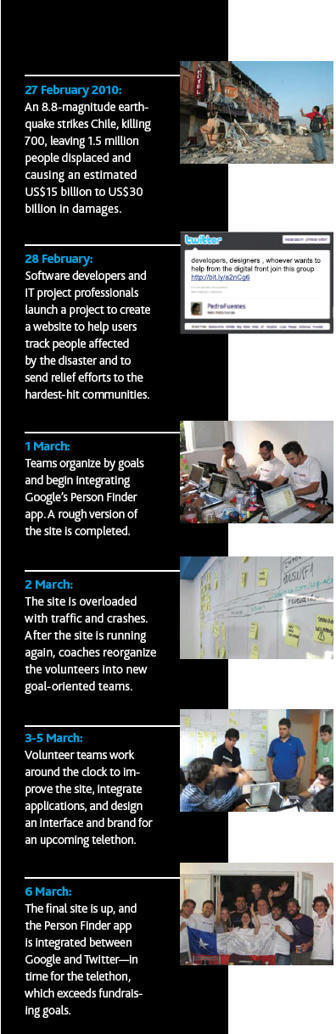
But the growing group of volunteers was unified under a common goal: create a single source of information as quickly as possible.

To make the most of its resources, the team relied on a hybrid recipe that included:

Self-organized multidisciplinary teams focused on specific deliverables
Agile-like small releases to deliver rapid iterative deliverables of the site and applications
Kanban to create workflow boards that allowed some teams to visualize their work and choose tasks without waiting for assignments
Holacracy—an organizational operating system centered on adaptability—to harness self-organizing teams through rapid decision-making techniques

The results were phenomenal: The team launched the first iteration on Day 1, and in less than a week the site was fully functional.
No comment yet.
Scooped by Mickael Ruau
December 23, 2021 12:59 AM
Scoop.it!

Arguing Using Critical Thinking

Arguing Using Critical Thinking | Devops for Growth | Scoop.it


Critical thinking is a series learned skills. In each chapter of this book you will find a variety of skills that will help you improve your thinking and argumentative ability. As you improve, you will grow into a more confident person being more in charge of your world and the decisions you make.
Mickael Ruau's insight:

Table of Contents

  • 1: Standing Up For Your Point Of View
  • 2: Communicating An Argument
  • 3: Clash
  • 4: Claims
  • 5: Building Your Case With Issues, Analysis And Contentions
  • 6: Evidence
  • 7: Reasoning
  • 8: Validity Or Truth
  • 9: Changing Beliefs, Attitudes and Behavior
  • 10: Decision Making - Judging an Argument
  • 11: Discovering, Examining and Improving Our Reality
  • 12: The Foundations of Critical Thinking
No comment yet.
Scooped by Mickael Ruau
December 22, 2021 1:57 AM
Scoop.it!

Pros and Cons of Scaling Agile Frameworks - DZone Agile

Pros and Cons of Scaling Agile Frameworks - DZone Agile | Devops for Growth | Scoop.it
Embracing agility is more of a process than a decision. When a company decides to adopt an Agile framework, whether a scaling one or not, this decision should be followed by change.

Agile methodologies are not quick fixes for problems. Instead, they are glasses with which to look at the way organizations structure themselves and their teams. They are also a brave step: fully implementing an Agile framework implies letting go of anything that is not working in a team and in an organization at large, and not all companies are ready to take this step  —  even if they all like to think so.

Regardless, when Agile is implemented correctly and regularly inspected, it can generate effective benefits that include company success, team empowerment, and quality of the delivered product.
Mickael Ruau's insight:

Scrum and other Agile methodologies don’t address the challenge of scaling. To do it successfully, organizations need to look at scaling frameworks created with this goal in mind.

There are several frameworks, with inherent differences, but all with the common objective of facilitating the application of Agile methodologies to large-scale projects and organizations. Here, we will analyze some of the most common ones.

The distinctions between them are a result of different approaches to the challenges of scaling Agile.


  1. SAFe aims for minimum disruption, adapting itself to the existing organization.
  2. LeSS sees the existing organizational design as a barrier to scaling, so it’s built to address that issue.
  3. And Nexus puts its focus on developing large products with multiple teams working together.
No comment yet.
Scooped by Mickael Ruau
December 22, 2021 1:54 AM
Scoop.it!

Context switching and efficiency -- Kanban to the rescue? | I'd Rather Be Writing Blog

Context switching and efficiency -- Kanban to the rescue? | I'd Rather Be Writing Blog | Devops for Growth | Scoop.it
In Become More Productive and Motivated, Mattias Sander provides a well-written overview of Lean, which is a strategy for eliminating waste and focusing more on customer value. What interests me most with Sander's discussion about Lean is context-switching and the subsequent strategy of Kanban, which uses cards to regulate flow. While these principles were developed in the context of Japanese car manufacturers (namely Toyota), they apply equally to the technical writer's world.
No comment yet.
Scooped by Mickael Ruau
December 21, 2021 7:20 AM
Scoop.it!

Gestion Hors Budgétisation (Fraser, Hope) Centre de Connaissances et Forum - 12manage

Gestion Hors Budgétisation (Fraser, Hope) Centre de Connaissances et Forum - 12manage | Devops for Growth | Scoop.it
Résumé, forum, bonnes pratiques, conseils d'experts, powerpoints et vidéos. Performance de gestion sans budgets et contrats de rendement fixe.
No comment yet.
Scooped by Mickael Ruau
December 21, 2021 1:19 AM
Scoop.it!

You’re Doing it Wrong: It’s Not About Data and Applications – It’s About Processes

You’re Doing it Wrong: It’s Not About Data and Applications – It’s About Processes | Devops for Growth | Scoop.it
For many organizations embracing digital transformation, business process automation represents low hanging fruit, with the potential to quickly deliver substantial cost and efficiency benefits. After all, a process represents the way work gets done. All too often, though, solution builders try to tackle process problems in the worst possible way.

A while back, colleagues of mine expressed some interest in using my company’s digital business process platform to build an application to manage sponsors for a fundraiser they were thinking of doing. As they showed me a preliminary effort over a remote web chat, I was struck by two things:

A really large number of fields.
A really small number of steps in their workflow.

I pointed this out, asking why they had extra fields to record who approved what and when, many extra multi-line text fields, and a lot of fields that were marked “Status.” They replied that they needed to know whether steps had been completed, who did them, what happened at each step, and so on.

Related Sponsored Content
The State of Kubernetes 2021
Production Kubernetes (By O'Reilly) - Download Now
[On Demand Webinar] Get the Most Out of Kubernetes with NGINX
Cloud Caching Techniques for Enterprise Applications
GraphQL at Enterprise Scale

Related Sponsor

Watch the GraphQL conference for developers and leaders, on-demand.

I was both bemused and amused, responding “You realize that each process instance has a built-in audit trail, right? That the workflow’s current state already gives you the status you want to track? That the built-in comments maintain a threaded, date-stamped record of everyone’s free-for comments?”

That wasn’t all. There were extra columns for data that seemed out of scope. When I asked “do you really need that field? It doesn’t seem to have anything to do with sponsoring,” they replied that “I suppose it doesn’t, but I usually collect it for an organization in other applications, and sponsors are organizations.”

Three things had become obvious:

They were working too hard, making the application responsible for things the platform already provided.
They were asking their users to work harder than they needed to as a result.
They probably had data requirements they hadn’t yet thought of, but since they modeled their data before thinking of the process that would be using it, we wouldn’t find that out for a while.

My colleagues weren’t – and aren’t – dumb. Quite the opposite. But they’ve been building applications a certain way for so long that other ways felt unnatural.

It’s the Law of the Instrument in action, akin to a child with a hammer assuming everything is a nail.
No comment yet.
Rescooped by Mickael Ruau from Workplace News
December 20, 2021 3:43 AM
Scoop.it!

Study reveals impact of virtual vs. in-person conference attendance on cost, diversity, carbon footprint, and collaboration

Study reveals impact of virtual vs. in-person conference attendance on cost, diversity, carbon footprint, and collaboration | Devops for Growth | Scoop.it

The study, published in Nature.com, evaluated conference data from three STEM-focused in-person-turned-virtual conferences and three virtual-first offerings. The conference size ranged from 300-4,500 attendees.


Via Kate Lister
Kate Lister's curator insight, December 12, 2021 10:14 AM

The study found that compared to in-person scientific conferences, virtual ones:

  • Increased gender and cultural diversity
  • Increased participation by early-career scientists
  • Reduced travel costs contributed significantly to greater attendance among scientists from emerging economies
  • Async/blended offerings significantly expanded participation among those in distant time zones
  • Those that offered recorded access found their reach increased 74% over the next three months
  • 7k virtual attendees had the same carbon footprint as just one in-person attendee 

The large majority of virtual attendees (75% to 95%) felt the networking substitutes offered by the virtual conference were a poor substitute for the real thing.

Medicals's curator insight, November 14, 2022 9:12 AM

https://pijnpillen.com/product/buprenorphine-online-netherlands09/
https://pijnpillen.com/product/koop-4-aco-dmt-online/
https://pijnpillen.com/product/koop-adderall30mg-online/
https://pijnpillen.com/product/koop-ambien-5mg-online/
https://pijnpillen.com/product/koop-carisoprodol5mg-online/
https://pijnpillen.com/product/koop-desoxyn-online-09/
https://pijnpillen.com/product/koop-dexedrine-online09/
https://pijnpillen.com/product/koop-dmt-online5g/
https://pijnpillen.com/product/koop-etizolam-online1mg/
https://pijnpillen.com/product/koop-fentanyl-citrate-online-09/
https://pijnpillen.com/product/koop-fentanyl-poeder-online1g/
https://pijnpillen.com/product/koop-fentanyl-pleister-online09/
https://pijnpillen.com/product/koop-flakka-a-pvp-online1g/
https://pijnpillen.com/product/koop-gouden-leraar-paddenstoelen-onl...
https://pijnpillen.com/product/koop-hydromorphone-online1mg/
https://pijnpillen.com/product/koop-ketamine-poeder1g-online/
https://pijnpillen.com/product/koop-lsd-sheet-online09/
https://pijnpillen.com/product/koop-methamphentamine1g-online/
https://pijnpillen.com/product/koop-morphine-online15mg/
https://pijnpillen.com/product/koop-natriumcyanide100mg-online/
https://pijnpillen.com/product/koop-nembutal-pentobarbital-online1g/
https://pijnpillen.com/product/koop-nembutal-poeder1g-online/
https://pijnpillen.com/product/koop-nembutal-vloeistof20mg-online/
https://pijnpillen.com/product/koop-nembutal20mg-pillen/
https://pijnpillen.com/product/koop-oxycodon-nachts-online-09/
https://pijnpillen.com/product/koop-oxycodone-hcl-online09/
https://pijnpillen.com/product/koop-oxycontin-online09/
https://pijnpillen.com/product/koop-psilocybe-cubensis-b-online1/
https://pijnpillen.com/product/koop-seconal-sodium-online1/
https://pijnpillen.com/product/koop-suboxone-strips09/
https://pijnpillen.com/product/koop-subutex-online09/
https://pijnpillen.com/product/koop-ultram-online-09/
https://pijnpillen.com/product/koop-vicodin-online5/
https://pijnpillen.com/product/koop-vyvanse50mg-online/
https://pijnpillen.com/product/koop-5-meo-dmt-online/
https://pijnpillen.com/product/koop-mdma-crystal-online09/
https://pijnpillen.com/product/koop-micro-mushrooms-online1/
https://pijnpillen.com/product/koop-oxynorm-20mg-online-09/
https://pijnpillen.com/product/koop-percocet-online1/
https://pijnpillen.com/product/koop-phentermine-adipex-online09/
https://pijnpillen.com/product/koop-hydrocodone1m-online/
https://pijnpillen.com/product/koop-xanax1mg-pillen/

ambien-online
4-aco-dmt-netherland-online
5-meo-dmt-netherlands-online
adderall-online
buprenorphine-online-netherlands
carisoprodol-nederland-online
desoxyn-online
dexedrine-online
dmt-netherland-online
etizolam-netherlands-online
fentanyl-citrate-online
fentanyl-poeder-online
fentanyl-pleister-online
flakka-a-pvp-online
gouden-leraar-paddenstoe-onlinelen
hydromorphone-netherlands-online
ketamine-poeder-online
lsd-sheet-online
mdma-crystal-online
koop-methamphentamine-online
koop-micro-mushrooms-online
koop-morphine-online
koop-natriumcyanide-online
koop-nembutal-pentobarbital-online
koop-nembutal-pillen-online
koop-nembutal-poeder-online
koop-nembutal-vloeistof-online
koop-oxycodon-hcl-online
koop-oxycodon-online
koop-oxycontin-online
koop-percocet-online
koop-phentermine-adipex-online
koop-psilocybe-cubensis-b-online
koop-seconal-sodium-online
koop-suboxone-strips
koop-subutex-online
koop-ultram-online
koop-vicodin-online
koop-vyvanse-online
koop-xanax1mg-pillen
koop-hydrocodone1m-online

Scooped by Mickael Ruau
December 20, 2021 1:51 AM
Scoop.it!

Limiter la complexité du code applicatif grâce au SGBD.

Limiter la complexité du code applicatif grâce au SGBD. | Devops for Growth | Scoop.it
Dans cet article, il sera démontré comment simplifier le code applicatif en exploitant les possibilités du SGBD grâce aux contraintes.
No comment yet.
Scooped by Mickael Ruau
December 20, 2021 12:56 AM
Scoop.it!

Trunk-Based Development - DZone Web Dev

Trunk-Based Development - DZone Web Dev | Devops for Growth | Scoop.it
When coding an application, it is important to remain in sync with the other engineers working on the project. One strategy that helps a team stay in sync with codebase changes is trunk-based development. When employing trunk-based development, the developers working on a project make all their code changes in a common branch known as "trunk". There are numerous benefits to developing with this approach, which we will discuss in this article.
No comment yet.
Scooped by Mickael Ruau
December 18, 2021 2:23 AM
Scoop.it!

Customer Development In A Nutshell

Customer Development In A Nutshell | Devops for Growth | Scoop.it
No comment yet.