


Steve Blank and I worked hard at the Customer Development Manifesto, "rules" for startups and big companies alike when they commit to the customer development process. They're part of chapter two of The Startup Owner's Manual and always worth a read

 Your new post is loading...
 Scoop.it! Steve Blank and I worked hard at the Customer Development Manifesto, "rules" for startups and big companies alike when they commit to the customer development process. They're part of chapter two of The Startup Owner's Manual and always worth a read

No comment yet.
Sign up to comment
Scoop.it!
Jobs to be Done is a customer development framework with great potential. Here you'll learn the JTBD basics, my step-by-step process (together with templates you can copy) of conducting interviews, and ways you can use the insights throughout your organization.
Scoop.it!

It's tempting to get straight to the point: how to remove tech debt, and how to keep it at bay. But that would be missing the journey. The journey without which you can't really appreciate the destination. So let's start with the time when you were not aware of this thing called "tech debt."
Mickael Ruau's insight:
Here's the dirty secret of teams who ship impact and remove tech debt at the same time: they rarely ask for permission to remove tech debt. Instead, they bundle the removal of tech debt to the high-impact project and just do it. Dev: "We'll ship this feature that generates $5M/year additional revenue and we'll also introduce integration testing on the way." Why bother bundling with projects, though? It's to make sure they get done. While projects that only reduce tech debt but deliver no business value will often be de-prioritized, high impact projects almost never are. If you want to see your large tech debt reducing proposals through, couple them with high-impact projects. The pragmatic middle ground: just enough tech debtIs there such a thing as too little tech debt? If you pay off enough of tech debt, at some point, you realize that there is. The name of too little tech debt is premature optimization - and it can slow down teams and companies at critical times. Take an example of a startup. When the company launches, speed and iterating quickly is key to surviving and winning. Do you worry about clean APIs and nice data models or just dump everything in an unstructured JSON that any developer can modify? The startups I've worked at that grew to be successful all went for the tech debt-heavy approach in the early days.
Scoop.it!

Technical debt is complicated to handle and has no specific metrics attached to it. Moreover, quantifying the principal debt amount from the point the shortcut was first taken and estimating the accurate resources needed to pay off the interest and the principal is no easy job. It is equally difficult to predict the expenditure of resources on technical debt over the years.
Scoop.it!

With Git platforms like Bitbucket, GitLab, GitHub, Azure DevOps offered on the cloud, it is now easier than ever to create code repositories on a platform that you prefer. Devbridge can help to choose the right platform in an unbiased way.
Mickael Ruau's insight:
Below, we compare git-flow vs. trunk-based noting key considerations for each. Philosophy Git-flow Trunk-based As far as possible from main branch As close as possible to main branch New features started from develop branch Short-lived feature branches started from main branch New release branch derived from develop branch, after stabilized release branch deployed Main branch always in a state ready to be deployed to production Only hotfixes derived from main branch Hotfixes start from main or release branch, need to be cherry-picked back to main Team composition Git-flow Trunk-based Lack of seniority within the team Well-composed and experienced team Working with other vendors/third-party Team augmentation model Product type Git-flow Trunk-based Complex, mature, monolithic product Microservices Brown-field product Modern single page application (SPA) / Mobile apps Proof-of-concept (POC) / Prototype Distributed system components Authoring process Git-flow Trunk-based Governed Team-driven Deployment Git-flow Trunk-based Various deployment models used Continuous Deployment practices recommended, such as feature toggles, quality gates, canary testing, self-service automation (e.g.. ChatOps), and monitoring Release frequency Git-flow Trunk-based Slower release cadence, pre-determined schedule Teams able to iterate quickly and independently
Scoop.it!
In order not to overload the process you simply need to control how much work is allowed to enter it across the arrival point. Getting a balanced process is the single most important step towards predictability; and how WIP is limited is less important than actually doing it. In Tameflow, the amount of work that is allowed to enter into the process is limited to the amount of work that can be handled by the constraint. All and any prioritization is done only when capacity is available and only to the extent that can be handled by the Constraint. The state of the process must be taken considered when making prioritization and pull decisions. 10 minute read
Mickael Ruau's insight:
This is the fifth post about Dan Vacanti’s book Actionable Agile Metrics for Predictability, An Introduction and how it relates to TameFlow. In the previous installment about Cumulative Flow Diagrams we saw:
We will now continue to see what Dan has to teach in chapter 7, 8 and 9 which are all about Conservation of Flow
Scoop.it!
Despite those who dismissively think their organization is incapable, it’s been my experience that given the right environment and after removing the usual series of tedious bottlenecks, people will create great software. Then, innovation is easy: all you have to do is ask."
Mickael Ruau's insight:
Scoop.it!

Good refinement:
Scoop.it!

L’architecture Microservices est puissante et populaire, et nous verrons dans cet article les bonnes et mauvaises implémentations: “petits services” vs “services découplés” ou “Lettre” vs “Esprit”.
Scoop.it!
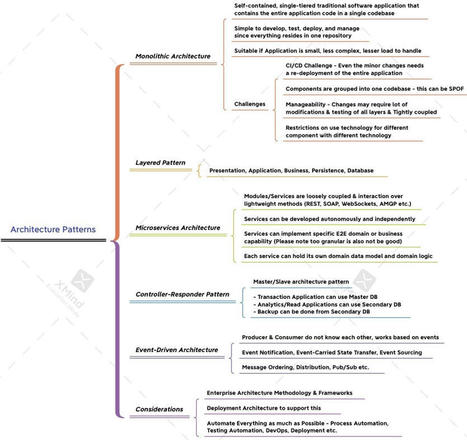
This blog provides various aspects that need to be considered while developing scalable and robust enterprise applications. I will discuss the following areas of enterprise applications development and considerations:
Scoop.it!

Ce cours présente l'Extreme Programming (XP).
Mickael Ruau's insight:
XP est l'un des principaux représentants d'une famille émergente de processus : les processus dits "agiles", qui se démarquent des démarches traditionnelles en mettant l'accent sur le travail d'équipe et la réactivité. L'heure est à l'économie et à l'efficacité : « Quelles activités pouvonsnous abandonner tout en produisant des logiciels de qualité ? ». Ou encore : « Comment mieux travailler avec le client pour nous focaliser sur ses besoins les plus prioritaires et être aussi réactifs que possible ? » XP propose une réponse originale à ces questions, avec un ensemble de pratiques organisées autour des principes suivants :
L'objectif de ce dossier est de donner une vision d'ensemble des principes et des pratiques d'XP, en commençant par ce qui fait son agilité : l'ouverture au changement.
|
Scoop.it!
Download free ebook: Product Management by Intercom - Lapabooks.com
Scoop.it!

Le salaire moyen pour le poste de Agile Coach est de €56 206 à Nantes, 44.
Mickael Ruau's insight:
Entreprise Salaire de base moyen en (EUR) Fourchette 47 k € 52 k € 60 k € 65 k € 45 k € 48 k €
Scoop.it!

Ramanathan: I'm going to talk about my experiences with building Piranha and deploying it at Uber, to reduce stale feature flag debt. I will provide an introduction to feature flags, explain how they can introduce technical debt, and the challenges associated with handling the debt.
Scoop.it!

The panelists discuss how they identify technical debt, how they make room to invest in paying debt down, and how they approach work to minimize future debt.
Scoop.it!

Scoop.it!

Agile Training | Agile Coaching | Agile Transformation...
Scoop.it!

If you're writing product backlog items for parts of a system and stretching to write decent user stories for those items, consider using FDD’s features.
Mickael Ruau's insight:
[action] the [result] [by|for|of|to] a(n) [object] As examples, consider these:
In each case, the feature description starts with the action (a verb) and ends with what would be an object within the system. (FDD is particularly well suited for object-oriented development.)
Scoop.it!

Mickael Ruau's insight:
The best software design is simple and easy to understand. The next time you're starting a new project, instead of thinking, "How will I architect this system, what battle-tested patterns should I use and what formal methodology should I document it with?", think "How can I come up with the simplest possible design, in a way that's easy for anyone to understand?". Software architecture best practices, enterprise architecture patterns, and formalized ways to describe systems are all tools that are useful to know of and might come in handy one day. But when designing systems, start simple and stay as simple as you can. Try to avoid the complexity that more complex architecture and formal tools inherently introduce.
Scoop.it!
Découvrez le modèle C4 et pourquoi utiliser ce modèle pour documenter l'architecture, en plus de ce que nous avons fait dans les produits Open Source de Zup.
Scoop.it!

Windows Sandbox is a utility that enables you to download and run suspicious files in an isolated environment without risking your primary install. It is available on select Windows 10 and 11 configs. Via Frédéric DEBAILLEUL
Scoop.it!
Simply purchasing what you need doesn’t solve your problems because even purchased systems must be cobbled together, requiring unique API’s, unique UI’s, unique portals, and unique mobile applications.
Scoop.it!
SRE advocates addressing problems blamelessly. When something goes wrong, don't try to determine who is at fault. Instead, look for systemic causes.
Mickael Ruau's insight:
SRE advocates addressing problems blamelessly. When something goes wrong, don't try to determine who is at fault. Instead, look for systemic causes. Adopting this approach has many benefits, from the practical to the cultural. Your system will become more resilient as you learn from each failure. Your team will also feel safer when they don't fear blame, leading to more initiative and innovation. Learning everything you can from incidents is a challenge. Understanding the benefits and best practices of analyzing contributing factors can help. In this blog post, we'll look at:
|






Rule No. 7: Agree on Market Type. It Changes Everything
One of the radical insights guiding this book is that not all startups are alike. One of the key ways in which they are different is in the relationship between a startup’s new product and its market. These product/market relationships generally fit one of these descriptions:
What confused entrepreneurs for decades is that the traditional product introduction model works when introducing a product into an existing market with a known business model (i.e., known customers, channels and markets). However, since the majority of startups are not pursuing known markets (those in new or re-segmented categories), they don’t really know who their customers will be. These types of startups are searching for a repeatable and scalable business model.
Market type influences everything a company does. Strategy and tactics that work for one market type seldom work for another. Market type determines the startup’s customer feedback and acquisition activities and spending. It changes customer needs, adoption rates, product features and positioning as well as its launch strategies, channels and activities. In sum, different market types require dramatically different discovery, MVPs, and sales and marketing strategies.
In existing markets, where customers exist, marketing is relatively easy: users can describe the market and the attributes that matter the most to them. The new product or service typically runs faster, does something better or cheaper, or otherwise improves on a customer-defined attribute. Users, the market, and competitors are known, and competition involves comparing the product and its features with others.
In a new market, a company lets customers do something they couldn’t do before by creating something that never existed before. Or it dramatically lowers costs to create a new class of users. By definition, new markets have no customers yet, so there’s nobody to know what the product can do or why they should buy. This makes getting feedback and creating demand particularly challenging, since the product is unknown to users and the market is undefined and unknown, and costly to develop.
The key isn’t competing, but instead understanding whether a large customer base exists and whether customers can be persuaded to buy. A classic founder error in a new market is the “fast-burn” spending of sales and marketing funds, a practice that may be appropriate when selling to existing customers in a known market, but makes no sense in a new market. The new-vs.-existing axis is at the core of the market-type definition.
Re-segmenting an existing market is useful when the incumbent is too difficult to attack head-on (like Amazon, Facebook, or Microsoft). A re-segmentation strategy is based on the startup’s market and customer knowledge, ideally identifying a market opportunity that incumbents are missing, which usually takes one of two forms: a low-cost strategy or a niche strategy. (Unlike differentiation, segmentation forges a distinct spot in customers’ minds that is unique, valuable, and in demand.)
Low-cost re-segmentation is just what it sounds like. Are there customers at the low end of an existing market who will buy “good enough” performance at a substantially lower price?
Niche re-segmentation looks at an existing market and asks whether some segment of this market would buy a new product designed to address more specific needs. Can some sizable portion of the market be convinced that a characteristic of the new product is radical enough to change the rules and shape of an existing market? See Chan Kim and Renee Mauborgne’s work on “Blue Ocean Strategy” for another way to think of re-segmenting a market.
Cloning an existing business model is a powerful technique when an existing business has been proven in one country but has not yet been introduced in another. Startups in Russia, India, Indonesia, Brazil, Japan and China (each with its own large local market and language and cultural barriers) can adopt, borrow, or copy a successful American business model and customize it for local language and buying preferences. (Soon ideas from those countries will be cloned in the U.S.)
For example, Baidu in China and Yandex in Russia are the equivalent of Google in their respective markets. And Qzone, RenRen, PengYou and Kaixin are the Facebooks of China, while Vkontakte and Odnoklassniki play the same role in Russia.
Startup companies generally enter one of these four market types and ultimately must commit to one. The consequences of a wrong market-type choice will prove to be severe in the customer creation stage. While market type is ultimately a “late-binding decision,” a working hypothesis helps frame early customer discovery issues.