Your new post is loading...

|
Scooped by
Mickael Ruau
December 30, 2021 1:22 AM
|
Cette année encore, cet exercice, consommateur de ressources - processus le plus destructeur de valeur de l’entreprise - selon Jack Welch, ancien président de General Electric, a généré frustration, négociations, prises de décisions sur un coin de table, etc…
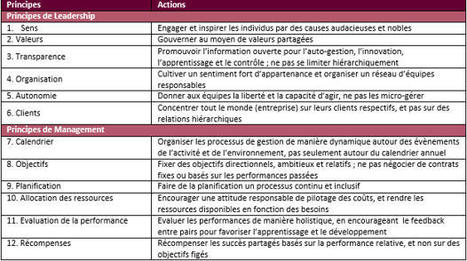
Alors, faut-il supprimer le budget ? La Gestion « Au-Delà du Budget » (ou Beyond Budgeting) propose non seulement de s’affranchir de l’exercice budgétaire, mais également de transformer le modèle de management traditionnel dit « Command & Control », dont le Budget est l’un des processus-cœur, pour un modèle fondé sur des principes comme le partage des valeurs de l’entreprise, l’autonomie, la transparence…
Afin de vous aider à y voir plus clair sur le Beyond Budgeting et savoir si ce modèle est adapté à votre entreprise, nous reviendrons dans un premier temps sur ses principes, ses outils, avant d’en peser ses avantages et limites.
|
|
Scooped by
Mickael Ruau
December 29, 2021 1:26 AM
|
Let's unpack how blue-green deployment works, why it’s important and which best practices to follow for deployment success.
|
|
Scooped by
Mickael Ruau
December 29, 2021 12:22 AM
|
This came up within another “little conversation” that I had with Jim McCarthy at the OSA (Open Space Agility) FB group, the other day. Yes, the the author of the Core Protocols, and a guy that has the uncanny ability to make me more blunt, as if I needed any help.
But now this statement is really getting to me, burning me, really. How did this happen? Wouldn’t you expect that WE, the people that tell the entire world that Agile is the “way to go”, the “way of the future”, the “better way”, be Agile in what we do?
Let’s break it down a bit, before it appears to be just another “complaining” rant:
1. Agile Manifesto
Let’s start here, from the “original source” that defines what Agile is.
As much as I am proud of the merits and accomplishments of the Agile Manifesto, it’s really not a very good explanation of what Agile really is. Mind you, not that there is anything wrong with it, it is just not very well explained. I think Alistair Cockburn has done a good job with his Heart of Agile with a better explanation, but I find myself at odds saying that the official source that defines Agile, needs improvement.
Shouldn’t we be eating our own “dog food” …and iterate and IMPROVE???
|
|
Scooped by
Mickael Ruau
December 28, 2021 1:18 AM
|
|
|
Scooped by
Mickael Ruau
December 27, 2021 9:12 AM
|
Instead of sticking to a lazy term, put some more effort to describe flaws of the code you see, and improvements you could think of.
Be specific on the flaws you see, even at the cost of being more verbose. “I find this function too complicated”. “This class has multiple responsibilities”. “The variable name does not describe its purpose clearly”.
Give a specific suggestion on how to improve the issue, if it not obvious from your description. Thins like “This class has multiple responsibilities. What would you think of breaking it into two parts, one being responsible for serialisation, another for price calculation?” or“I find the name calculate hard to understand. How about calling it getPriceWithoutVAT instead?”
Talk about the future implications of the code you see, if not changed. Things like “I think the class would probably be hard to reuse, because it has many things hardcoded.” or “I’m pretty sure newcomers would find this code hard to comprehend, as it does not follow conventions used across the codebase.”
Ask the person writing the code, what they think about your comments. Say thinks like “what do you think about this?” or “do you think this would make sense?”.
|
|
Scooped by
Mickael Ruau
December 27, 2021 1:51 AM
|
I am sure the concept is not new but it was introduced to me by a very talented Agile mentor (thanks Ben *grin*) a number years ago.
With a view to helping other Scrum practitioners, I thought to outline my structure and experience with a recent "Reset" I conducted with my current team.
My primary reason for doing it with the team was they had successfully implemented the practices for Scrum but didn't really understand the values or principles behind it and suffered from the very common situation of "Doing" Agile not truly "Being" Agile ie compliant not committed.
"Reset" Agenda
Scrum in 10 minutes
The Values of Scrum
High Performance Tree
Our Team Vision
Scrum in 10 minutes
Many may ask "Why would a mature team need to revisit the fundamentals of Scrum?" to which I would reply, purely to see either where their journey began or where they may have gotten lost. Although my team were 12 months into using Scrum it was really interesting to cover off the 4 meetings (Planning, Daily Standup, Sprint Review and Retrospective) and 3 artifacts (Product and Sprint backlogs and the burn down chart) and discuss the usage and value of each.
A really good example of how to deliver this (and the one I used as a reference) is done by my Mentor/Coach Lyssa Adkins (http://www.youtube.com/watch?v=_BWbaZs1M_8).
|
|
Scooped by
Mickael Ruau
December 27, 2021 1:33 AM
|
Culture eats strategy for breakfast, and DevOps, too, needs strong culture to thrive. Here's how to implement and sustain a DevOps culture.
|
|
Scooped by
Mickael Ruau
December 26, 2021 9:56 AM
|
Vous souhaitez internaliser la partie technique dans votre start-up ? Nous vous aidons à dénicher le CTO / développeur le plus approprié à votre projet.
|
|
Scooped by
Mickael Ruau
December 26, 2021 9:50 AM
|
Vous lancez votre projet ? Associez-vous avec un développeur sur cofondateur.fr ! Des milliers de développeur entrepreneurs recherchent actuellement un projet, venez les rencontrer !
|
|
Scooped by
Mickael Ruau
December 26, 2021 9:30 AM
|
Les missions du CTO
Les missions du CTO sont variées.
Elles reposent sur le pilotage de projets technologiques, une recherche d’opportunités stratégiques en lien avec la technologie et des fonctions de direction classiques.
Le CTO réalise des audits pour son entreprise et rédige des rapports et des recommandations pour la direction. Il doit donc savoir identifier risques et opportunités technologiques pour son entreprise. doit identifier les risques et les opportunités de développement technologique de son entreprise. Il doit aussi savoir analyser la concurrence et apporter un éclairage sur les nouvelles technologies au reste du comité exécutif.
Il doit savoir établir une stratégie pour mettre à jour les systèmes d’informations et les process techniques, pour les renouveler quand nécessaire et pour innover en coopérant avec les autres directeurs des autres pans de l’entreprise.
Le CTO gère des projets importants, car ils remettent en question la manière de travailler des équipes. Pour cela, ils doivent apprendre à conduire le changement, c’est-à-dire communiquer sur les actions mises en place auprès des employés et des partenaires.
Ils doivent suivre la faisabilité juridique de leur projet, notamment lorsque les pratiques sont encadrées comme c’est le cas avec la DATA par exemple.
Il doit mener une veille technologique constante pour identifier les possibilités d’évolution de l’entreprise sur le plan technologique et analyser leur potentiel pour son entreprise.
|
|
Scooped by
Mickael Ruau
December 26, 2021 9:27 AM
|
Le CTO a en charge de déterminer les projets techniques digitaux dans l’entreprise. Il définit les méthodes Scrum, Agile, Lean, etc., Il va réaliser un audit concernant l’identification des risques technologiques, mais également les opportunités d’une organisation. Il livre ensuite son rapport à sa direction qui rendra compte de la faisabilité des propositions d’évolutions qu’il préconise.
Le CTO est aussi le manager d’équipes chargées du processus de production de l’entreprise comme les architectes de réseau, les chefs de projets, les développeurs, les responsables de l’infrastructure, etc. Il dépose des brevets d’invention, encadre leur implantation et assure le développement de la roadmap.
|
|
Scooped by
Mickael Ruau
December 25, 2021 4:08 AM
|
Startup founders have many issues to worry about during their journeys. Growth is something they need to be envisioning every day. Sales, team
|
|
Scooped by
Mickael Ruau
December 25, 2021 3:24 AM
|
Summaries Liftoff Ways of working People Teamwork Strategy Strategy analysis - SWOT analysis: strengths, weaknesses, opportunities, threats
- PESTLE analysis: political, economic, social, technological, legal, environmental
- Five forces analysis: entrants, substitutes, customers, suppliers, competitors
Business model canvas Tactics Practices Markets Product/market fit Customer development Product development Modeling Markup Management Practice makes perfect Metrics Meetings Brainstorming Quality assurance Sales Investment Startup advice
|
|
|
Scooped by
Mickael Ruau
December 30, 2021 12:56 AM
|
The project assessment process consists of five distinct phases (ESI, 2005):
Define the assessment charter
Develop the assessment plan
Conduct the assessment
Analyze data gathered; prepare findings
Report findings to stakeholders
Each assessment phase must complete before starting the next phase. There are several key assessment concepts that need to be understood at this point (ESI, 2005):
Assessment: formal examination of a project’s performance, metrics, issues, and forecasted performance
Recovery: save from loss; restore the project to usefulness; prevent total failure
Focus of assessment: determining the current “real” condition of the project
Result of assessment: determine changes needed in people, product, process or all of these (ESI, 2005)
In addition to focusing on determining the current, real status of the project, the assessment needs to thoroughly investigate project variables common to most projects:
Project work breakdown structure (WBS)
Project risks (those in the risk log and risks known but not recorded)
Project deliverable defects
Project resources (human and other)
Project schedule
Project processes (both enterprise related and project-specific)
|
|
Scooped by
Mickael Ruau
December 29, 2021 1:21 AM
|
Présentation du modèle Cynefin de Dave Snowden comme outil de management pour tous les dirigeants.
|
|
Scooped by
Mickael Ruau
December 28, 2021 1:34 AM
|
An annual report on the state of DevOps explains how companies adapt and develop DevOps practices in their IT systems.
Combining development teams with operating teams under a DevOps model, will speed up feature deliveries and also help improve iterative cycles, but it isn’t easy. In order to establish DevOps processes within a company to be successful, it is very often required to remove cultural and operational barriers. The report was issued by the company Puppet, specializing in the implementation of DevOps model in companies. This report presents the axes to help companies, set up DevOps practices in their development processes.
To support this report, here are the 5 steps of DevOps evolution in a company.
Normalize the technological stack
This is the first step of the process. During this stage, the teams started to adopt agile methods. The development teams shall implement inspections and aim to deploy two processes, on computer applications: continuous integration and continuous delivery. It is at this stage that the redundant technologies are eliminated, and the technology stack is normalized.
In order to succeed, one of the keys to success is to keep only standard technologies.
|
|
Scooped by
Mickael Ruau
December 28, 2021 12:52 AM
|
In the last few years, I’ve been using Modern Agile to coach the organization, the management, and the teams. It’s worked so well,that using Modern Agile to do a team reset was a given…the only question was “How?.” (Learn more about Modern Agile at http://modernagile.org)
I came up with a few ideas, perhaps you’ll come up with more. Let me know, and I will add them in — with credit to you, of course.
|
|
Scooped by
Mickael Ruau
December 27, 2021 7:17 AM
|
Is your purpose and strategy unclear?
Are your teams struggling to see where they fit?
Is their hard work wasted?
Wardley Mapping is an open, visual approach to strategic leadership.
Building competence, clarity, and alignment… one sketch at a time.
|
|
Scooped by
Mickael Ruau
December 27, 2021 1:45 AM
|
You can never put a genie back into a bottle. In I Messed Up A Scrum Team Should I Do Kanban? We described a scenario where a well-performing Scrum team had their Scrum Master replaced and troubles ensued. The question that was posed was whether—since scrum was no longer working—perhaps kanban should be adopted. Given the tumult at the team level, putting the genie back in the bottle and pretending nothing has happened is not a good strategy. Assuming the leadership issues have been addressed the question returns to whether to recommit to Scrum, shift to Kanban or combine the two.
|
|
Scooped by
Mickael Ruau
December 27, 2021 12:52 AM
|
ZOMBIES is an acronym.
One of the seemingly odd things I saw back in 1999 when Kent Beck, Ron Jeffries and others demonstrated Test-Driven Development, was how they always started with the simplest cases, working their way deliberately to the more involved cases. For example, they’d first ask how would the object respond right after it is initialized? They would add one behavior at a time. Initially each behavior specified in a test scenario was an opportunity to try interface ideas. The early tests usually had hard-coded return results. The implementations were so simple ZOMBIES could do it.
People new to TDD often struggle with what test to write. It’s hard to know where to start or what test to write next. It’s hard to know when you are done, and it’s scary to think you will leave some incomplete code behind. Scary! How can ZOMBIES help with scary?!
I’ve come to rely on ZOMBIES to help explain how I figure out the next test, and what I am considering as I am writing the test. I find that ZOMBIES help me when I am stuck on a programming problem. ZOMBIES help find a logical next step. ZOMBIES help me keep on the firm footing of continually establishing cause and effect. ZOMBIES help me hone my procrastination skills, by suggesting what to do now and what to put off until later. Procrastination skills!? It is a skill to develop and master. Only use your procrastination skills for good.
Let me spell out ZOMBIES and explain the algorithm:
Z – Zero
O – One
M – Many (or More complex)
B – Boundary Behaviors
I – Interface definition
E – Exercise Exceptional behavior
S – Simple Scenarios, Simple Solutions
|
|
Scooped by
Mickael Ruau
December 26, 2021 9:55 AM
|
Recruter un CTO en étant sûr de son choix ? On en parle dans cet article !
|
|
Scooped by
Mickael Ruau
December 26, 2021 9:32 AM
|
CTO n'est pas un role technique, donc si ca parle de technologie c'est plutot bizarre. Quelles taches ils attendent de toi par exemple?
CTO ca veut dire directeur technique. recrutement, management, architecture, finance et consort ET surtout gerer et embaucher des developpeurs pour faire la realisation.
Normalement en startup, tu fais les premiers développements/prototypes (seul personne technique au debut) et t'arretes completement le developpement au bout d'une dizaine d'employes.
C'est quoi le profil des deux fondateurs?
Qui a developpe l'application? Est-ce qu'ils ont deja fait un seed round?
S'il y a 250k de CA/an, ca veut dire que c'est deja operationnel et plutot bien vendu. B2B or B2C? Combien d'utilisateurs? De pays/langues? Depuis combien d'annees?
Ils comptent lever combien? D'ici quand? Probablement 2-3M en series A. Ca pourrait prendre 6 mois a lever, c'est pas immediat.
Si le business est viable et que t'y crois, il s'agit de rejoindre en négociant un maximum de parts. En tant que salarie et post levee de fonds + CA, tu dois aussi toucher un salaire decent qui couvre tes depenses.
Tu voulais devenir chef de projet, t'as trouve bien mieux en fait =)
P.S. Ce serait plutot difficile d'apprendre un nouveau language, tout en ayant deja un job, tout en devant faire le role de CTO qui est un autre metier. (Sachant que si tu dis a un VC que tu bosses 5h par semaine en tant que CTO tu peux oublier la lever de fonds ).
|
|
Scooped by
Mickael Ruau
December 26, 2021 9:30 AM
|
Devenir CTO d'une startup: éviter les problèmes de débutants Présenté le 21/04/2015 par Adrien Joly à Epitech Innovation Hub
|
|
Scooped by
Mickael Ruau
December 26, 2021 9:25 AM
|
Pour certains développeurs de logiciels, la vision de quitter leurs claviers et de s’impliquer davantage dans les aspects commerciaux semble assez décourageante. Mais Marek Gajda, CTO de The Software House , affirme que le rôle du responsable technologique n’est pas pour les faibles – «La meilleure personne pour ce poste est généralement quelqu’un qui n’a peur d’aucune tâche de n’importe quel domaine. Les responsabilités du CTO couvrent presque tous les aspects du développement logiciel – des finances, du recrutement et du modèle commercial au processus de révision du code, à la sécurité et à la pile technologique. Vous n’avez pas besoin d’être un expert dans aucun de ces sujets, il vous suffit de les connaître suffisamment pour pouvoir parler avec des spécialistes et comprendre leurs suggestions. »
Alors, comment se préparer à ces défis? Gajda a une astuce pour les développeurs de logiciels qui ont du temps libre:
«Si vous avez la possibilité d’offrir vos connaissances et vos conseils – ou du moins d’observer comment d’autres personnes travaillent – allez-y.
«Faites le tour du bureau et voyez si vous pouvez aider quelqu’un, surtout s’il s’agit d’une personne d’un autre service. Après un certain temps, vous remarquerez que vous avez une vision beaucoup plus large sur de nombreux problèmes que vos collègues qui se concentrent uniquement sur l’écriture du meilleur code. Et cela est apprécié des candidats au poste de directeur technique. »
|
|
Scooped by
Mickael Ruau
December 25, 2021 3:32 AM
|
Où le trouver
Vous avez identifié votre profil cible. Pour l'attraper, passer une petite annonce ne sera pas forcément la meilleure solution. Pour David Bernard, CEO et fondateur d’AssessFirst, une plateforme de recrutement prédictif qui prétend évaluer le potentiel réel de chaque candidat en fonction du poste convoité, il faut aller à la rencontre du CTO de ses rêves dans les évènements centrés sur la tech et l’innovation : conférences, TED talks, Meetups, hackathons… “C’est là que l’on trouvera les individus les plus motivés,” explique-t-il.
Faute de résultats concluants, il faudra se résoudre à démarcher les CTO déjà en poste, dans des industries dont les produits impliquent des technologies proches des siennes.
"J'ai lancé ma startup aux USA, sans diplôme"
On peut également se rapprocher des établissements de formation au code, tout en gardant à l’esprit la grande hétérogénéité des profils disponibles sur le marché. S’il existe de nombreux centres d’apprentissage - l’école 42, le Wagon, le Réacteur, etc. - et que de très bons candidats sont autodidactes, “certains entrepreneurs vont préférer recruter des CTO sortant d’écoles d’ingénieur. Non seulement leur niveau en mathématiques sera très solide, mais la startup bénéficiera de l’image de marque “grande école” de leur CTO, rassurant ainsi les investisseurs”, observe Paul Cavan d’Urban Linker.
Les qualités à débusquer
Une fois les candidats sélectionnés et approchés vient le temps des entretiens. Les candidats seront testés sur un ensemble de points. Tout d’abord, un bon CTO doit - évidemment - maîtriser les technologies cruciales pour votre champ d’activité. Pour cela, rien ne vaut des exercices de mise en situation pour vous en assurer. Et mieux vaut faire appel à un tiers de confiance aux compétences techniques avérées - un CTO d’une autre startup, un prestataire en freelance - pour mener avec vous ces entretiens.
10 MOOC pour les (futurs) entrepreneurs à suivre cet été
Mais le recruteur devra également veiller aux “soft skills” : leadership, vision, créativité… Le CTO a un rôle de pilote dans le choix des technos et ne peut pas se contenter d’être un bon technicien. “Le CTO doit être agile d’esprit”, note pour sa part Samia Ghozlane, directrice du label et du fonds d’amorçage La Grande École du Numérique qui regroupe 400 formations au numérique à destination des publics peu qualifiés. “Le CTO doit identifier les besoins de son entreprise et les traduire dans sa langue, le code : s’il ne peut pas penser hors du cadre, son utilité sera très limitée”, insiste-t-elle.
|