Your new post is loading...

|
Rescooped by
Nicolas Weil
from Video Breakthroughs
November 27, 2011 7:50 AM
|
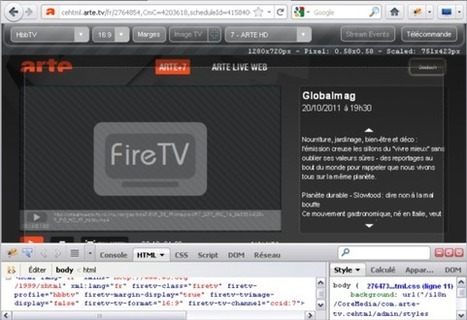
FireHbbTV integrates with Firefox to help you develop HbbTV (http://www.hbbtv.org/) compliant applications. You can then benefit of strong development tools associated with your favourite browser. Most commonly used HbbTV API are injected on-the-fly on the web page once you activate the plugin support for a given site. Moreover, FireHbbTv provides you with usefull tools such as resize, aspect-ratio switch, safe-area margin display and keyboard navigation miming TV remote control capabilities. DSM-CC Stream Event simulation is supported !!! Add-on download : https://addons.mozilla.org/en-US/firefox/addon/firehbbtv/
|
|
Scooped by
Nicolas Weil
November 22, 2011 6:17 PM
|
Developers creating JavaScript applications these days usually use a combination of MVC, modules, widgets and plugins for their architecture. They also use a DOM manipulation library like jQuery. Whilst this works great for apps that are built at a smaller-scale, what happens when your project really starts to grow? Blog post : http://blog.amt.in/large-scale-javascript-application-architectu
|
|
Scooped by
Nicolas Weil
November 20, 2011 3:11 AM
|
I'm a big fan of the WebSockets API for all the real-time goodness it offers, but the iOS platform doesn't (currently) bake the WebSockets API in to mobile Safari. That sucks, particularly because I can enjoy making iOS native apps using awesome frameworks like PhoneGap. However, because I'm using PhoneGap, I can create a PhoneGap plugin that introduces WebSockets to my HTML & JavaScript. So that's what I did.
|
|
Scooped by
Nicolas Weil
November 19, 2011 3:11 AM
|
Compare images pixel by pixel is a slow and heavy work to our computer. IM.js has come to solve this problem, using canvas pixel by pixel in record time.
|
|
Scooped by
Nicolas Weil
November 16, 2011 7:54 PM
|
Wouldn’t it be nice to have an elastically scalable database? NuoDB is a re-think of relational database technology, targeted at an elastic cloud of computers rather than a single computer system. What sets NuoDB apart from other NewSQL and NoSQL solutions is the many distinctive features that underpin its unique architecture. Chief among them is the manner by which multiple nodes cooperate to manage the state of the database.
Unlike traditional database architectures that are centralized with centralized transaction log files and query-processing, NuoDB manages transactions and queries in a de-centralized way, much in the way that peer-to-peer systems such as BitTorrent operate.
Live overview : https://www3.gotomeeting.com/register/686857446
|
|
Scooped by
Nicolas Weil
November 13, 2011 4:53 AM
|
Here is a collection of some useful frameworks to develop easily HTML-based webapp frameworks which will work on all popular smartphone and tablet touch platforms.
|
|
Scooped by
Nicolas Weil
November 12, 2011 3:34 PM
|
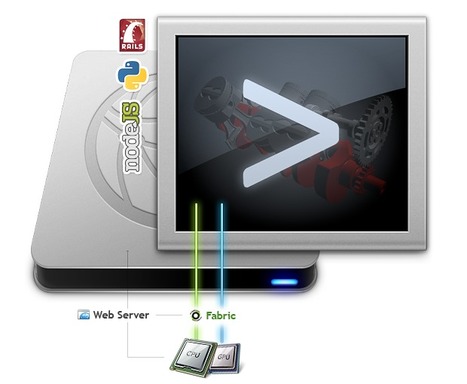
Web developers are constrained by the performance capabilities of scripted languages. Simply put, compiled code is faster than interpreted code. Factor in multi-core CPU architectures and advances in GPU computing, and compiled code can easily be over 100X faster on a single machine. Fabric Engine allows developers to bring this compiled, multi-threaded performance to their web applications.
Fabric Engine brings compiled, multi-threaded performance to scripted languages like JavaScript, Ruby and Python. This means developers can take on bigger, computationally intensive problems and still use web languages to solve them. Fabric can run on the server or in the browser, allowing developers to deliver amazing performance wherever it’s required.
|
|
Scooped by
Nicolas Weil
November 11, 2011 4:40 AM
|
- The document.domain method - The Cross-Origin Resource Sharing method - The window.postMessage method - The Reverse Proxy method - The JSONP method
|
|
Scooped by
Nicolas Weil
November 11, 2011 4:13 AM
|
"Today we’re thrilled to share with you the first developer preview of Sencha Touch 2. Sencha Touch 1.0 launched just one year ago and has become the leading framework to build mobile HTML5 apps. Today, we’re delivering a preview of our biggest update to the framework yet. We’ve focused on three key areas: Performance, Ease of Use, and Native Packaging. We’d like to share with you the details of each of these."
|
|
Scooped by
Nicolas Weil
November 10, 2011 4:01 PM
|
Trying to understand HTML5 compatibility on mobile and tablet browsers...
|
|
Scooped by
Nicolas Weil
November 9, 2011 5:39 PM
|
SOA Software announced today the availability of Atmosphere Cloud, the cloud-based version of its award winning Enterprise API Management solution. Combined with the on-premises ‘behind the firewall’ deployment option that was announced in June, Atmosphere customers can now choose how they want to configure and deploy their API Management environment.
Atmosphere brings together API providers and Application developers in an integrated Enterprise API Management Community. It is a connecting point where APIs can be published, promoted, and managed in a secure, scalable environment. API providers can create and manage their own developer community, or just plug into the existing community. Creative people can discover and harness enterprise APIs blending them with complementary APIs from partner companies. Atmosphere provides a social environment where developers can work together, share ideas, and support each other in new and productive ways.
More info here : http://atmos.phe.re/
|
|
Scooped by
Nicolas Weil
November 9, 2011 4:55 PM
|
This past weekend I had the pleasure of putting on workshop at the Mozilla Festival in London. During the workshop I explained exactly how to take a single player HTML5 game and turn it into a multiplayer one using Node.js and WebSockets.
|
|
Scooped by
Nicolas Weil
November 8, 2011 5:11 PM
|
In this tutorial, you will learn how to setup a complete Node.js development environment, including NPM (the Node Package Manager) and Cloud9 IDE to edit, run, and debug Node programs. The following installation instructions have been sucessfully tested on Debian 6.0 “Squeeze” and on Ubuntu 11.10 “Oneiric Ocelot”, but they should also work properly on previous versions as well.
We will install everything in the user’s home directory : this way, there is no need for any root access to the machine (provided the required packages are, of course, already installed), and each user can manage its own version of Node.
|
|
|
Scooped by
Nicolas Weil
November 23, 2011 2:12 AM
|
HTML5 development tool provider appMobiis putting together a Black Friday deal for programmers as it open-sources many key HTML5 technologies that it hopes should help spur on the building of more mobile web apps. AppMobi is trying to help accelerate the market for HTML5 mobile apps and at the same time position itself to be a sort of Heroku or Red Hat for mobile HTML5. AppMobi will be releasing APIs through GitHub this Friday that will help developers build native-like web apps. They include appMobi’s cross-platform device APIs, which support HTML5 development for both Android and iOS platform; the source code for appMobi’s “mobiUs” browser, which allows HTML5 web apps to perform like native apps; and DirectCanvas, which helps with enhanced graphic rendering for 2D games. There are also APIs for a physics engine, offline and dynamic caching, a media player, authentication and encryption, augmented reality, bar code and QR scanner, and better display support.
|
|
Scooped by
Nicolas Weil
November 20, 2011 3:32 AM
|
Google is enabling developers who use the Adobe Flash Professional developer tool to convert their animations to HTML5 via an extension based on Google's Swiffy conversion technology. The tool, Google said, makes it easier to use Flash to develop HTML5 animations. Available for both Mac and Windows, the extension uses Swiffy as a Web service for accessing the latest conversions.
|
|
Scooped by
Nicolas Weil
November 19, 2011 1:40 PM
|
Much of the excitement we’ve seen so far about HTML5 has been for the new APIs: local storage, application cache, Web workers, 2-D drawing and the like. But let’s not overlook that HTML5 brings us 30 new elements to mark up documents and applications, boosting the total number of elements available to us to over 100. Along the way, we’ll see that HTML5 semantics are carefully designed to extend the current capabilities of HTML, while always enabling users of older browsers to access the content. We’ll also see that semantic markup is not “nice to have,” but is rather a cornerstone of Web development, because it is what enhances accessibility, searchability, internationalization and interoperability.
|
|
Scooped by
Nicolas Weil
November 17, 2011 4:59 PM
|
That’s right, version 1.0 is out! After more than a year of refinements, we now have a rock solid release.
When we first launched this site back in the summer of 2010, we had a few concept sketches and some very ambitions goals: to create an elegant HTML5-based user interface library for the jQuery community designed to work on all popular mobile platforms. We are built on the strengths of jQuery core and jQuery UI and strive to make mobile development efficient, accessible and maybe even a bit fun.
To reach the broadest possible audience, we decided from the start to make the framework work on every popular mobile, tablet, e-reader and even desktop platforms by embracing HTML5 and responsive design techniques. A tall order, but we’re happy to announce that we’ve achieved this goal and now support all our target platforms as of 1.0. By using a progressive enhancement approach, even less capable devices can still access the content and functionality of a jQuery Mobile site. This broad compatibility gives you the ability to reach many billions of people.
|
|
Scooped by
Nicolas Weil
November 16, 2011 4:17 PM
|
Pioneer has announced the availability of Zypr : a new voice-powered, unified Web API (Application Programming Interface) available at no charge to developers. Zypr bridges the disparate worlds of mobile devices, Web apps, consumer electronics and automotive infotainment by bringing normalized Web services mashups to all of these platforms, with the added functionality of unique, conversational voice-control commands.
The Zypr API provides a consistent way for developers to access voice UI, maps and routing, local search, social networking, music and radio, contacts, calendars and weather from multiple content providers. Zypr is a set of RESTful cloud APIs organized by content service category – device makers and app developers can access the API directly via HTTPS calls and potentially implement client applications using common languages and operating system platforms.
|
|
Scooped by
Nicolas Weil
November 12, 2011 4:05 PM
|
Build automated tests for your web and desktop apps. Test HTML5, AJAX, Silverlight and WPF apps, JavaScript calls, Telerik controls, dynamic page synchronization, client-side behaviors, complex UI virtualizations and elaborate XAML animations. Quickly convert them to performance tests to identify performance robbing bottlenecks.
|
|
Scooped by
Nicolas Weil
November 11, 2011 5:37 AM
|
I’m starting to learn how to develop to Android and so far to me the only downside of the whole dev environment is the painfully slow Android Emulator. Don’t get me wrong, it’s such a beautifully made emulator that covers most (if not all) details of a real device, I specially like tricks such as limiting network bandwidth to simulate your app under a slow connection, but let’s face it, the thing is slow.
I have to say I don’t have a top of line computer either, it’s a Core 2 Duo with 4gb of RAM running Ubuntu 11.10 (amd64), so I started searching for tricks to speedup the emulator, until I found that Android-x86 can be used as a emulator. The experience is not as good as Google’s official emulator but with some tweaks you can really speedup turnaround both in boot time and overall execution speed. OK, TL;DR, enough small talk, let’s get down to business...
|
|
Scooped by
Nicolas Weil
November 11, 2011 4:33 AM
|
Here are three dozen JavaScript libraries tuned for mobile devices, Canvas-based animation, HTML5 video, local databases, server interaction, and more...
|
|
Scooped by
Nicolas Weil
November 10, 2011 4:08 PM
|
Jangaroo is an Open Source project building developer tools that adopt the power of ActionScript 3 to create high-quality JavaScript frameworks and applications. Jangaroo is released under the Apache License, Version 2.0.
Why use Jangaroo?
There are two main use cases when you might want to use Jangaroo tools:
* JavaScript programming in the large : Adopt ActionScript 3 language features like packages, classes and inheritance, interfaces, private members, and many more to create even large-scale client-side Web code, where you otherwise would have used JavaScript directly. This approach is extremely helpful when creating frameworks with explicit public APIs, but also for larger applications that use such frameworks.
* Running ActionScript 3 code directly in the browser : You are implementing a Web project that must not rely on plugins and/or requires close integration into an HTML Web site, possibly already using some JavaScript framework. You want to reuse or build upon existing ActionScript 3 code (utility classes, frameworks like FlexUnit, custom code) as well as JavaScript APIs and code.
Jangaroo Flash Application Template
|
|
Scooped by
Nicolas Weil
November 10, 2011 4:00 PM
|
The most appealing software applications developed today are produced by a close collaboration of designers and developers. Unfortunately, the existing development and design tools have been a barrier that keeps everyone from working with a productive workflow. As of late, rich Internet application (RIA) technologies such as Silverlight, WPF, Flex, and client-side HTML5/JavaScript have attempted to destroy this barrier with varying degrees of success.
|
|
Scooped by
Nicolas Weil
November 9, 2011 5:21 PM
|
I’ve started experimenting with the V8 binding for PHP. It’s in the PECL repo, which of course means that there’s no shared libraries – you have to compile it!
Okay, I could just give you the .so or .dll, but that would be really, really boring. And a waste of my ever so precious time. So, if you want to figure out how to install it, just run pecl install v8js-beta – but that’s after installing make, phpize, and the required libraries. Oh, and please don’t forget that you’ll need the latest version of libv8 and libv8-dev, Debian based distros can click the links and download from the Debian package centre.
Now you’ve installed it… …or rather I’ve hoped that you’ve installed it correctly. After editing the config to include the extension, it should be working! Now, the PHP documentation is rather spare at the moment, but routing about the trunk helped me with finding out the abilities (and limits…) of the binding.
Further links : http://pecl.php.net/package/v8js http://code.google.com/p/php-v8/
|
|
Scooped by
Nicolas Weil
November 8, 2011 5:17 PM
|
jPlayer is the completely free and open source (GPL/MIT) media library written in JavaScript. A jQuery plugin, jPlayer allows you to rapidly weave cross platform audio and video into your web pages. jPlayer's comprehensive API allows you to create innovative media solutions while support and encouragement is provided by jPlayer's active and growing community.
Media suport : - HTML5: mp3, mp4 (AAC/H.264), ogg (Vorbis/Theora), webm (Vorbis/VP8), wav - Flash: mp3, mp4 (AAC/H.264), flv
|