Your new post is loading...

|
Scooped by
Nicolas Weil
November 29, 2012 6:30 AM
|
The stage was set with an expected one billion HTML5 phones sold by 2013. Facebook was ready to pave the way. I could repeat many other reasons why HTML5 should have taken off in 2012, but as we’ve seen over the last year, it just didn’t. Mark Zuckerberg said it best, “The biggest mistake we did as a company was bet too much on HTML5.”
Here’s an explanation for why HTML5 did not meet the high expectations set last year.
|
|
Scooped by
Nicolas Weil
November 27, 2012 3:34 PM
|
This year at Full Frontal, offline enabled web site/apps were a recurring theme. Paul Kinlan gave an excellent talk entitled ‘Building Web Apps of the future. Tomorrow, today and yesterday’ (his slides are available here), in which he compared the ‘offline’ user experience provided by the top 50 or so iOS and Android apps with that of popular web sites/apps. Needless to say, the native apps faired better and more gracefully degraded when no internet connection was available. Offline is a feature and it’s crucial we start to consider it from the start of a project as apposed to adding support later in the development lifecycle. At Rareloop we’ve been focussing on adding offline support to our apps from the start. Most notably the FormAgent mobile clients where designed from the outset to support offline access, to allow for use when no connectivity was possible and to transparently sync up data when internet is available. The following are guidelines I’ve found helpful.
|
|
Scooped by
Nicolas Weil
November 17, 2012 5:43 AM
|
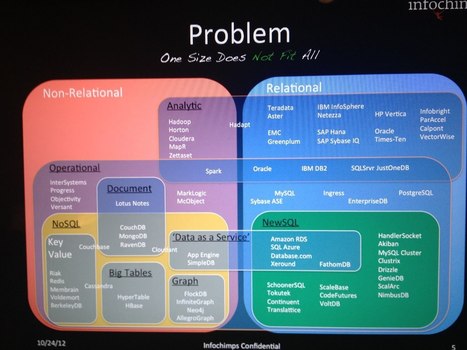
Here’s the NoSQL landscape in 3 slides.
|
|
Scooped by
Nicolas Weil
November 9, 2012 10:43 AM
|
October is full of great news for CUBRID community! We have released a new Node.js driver for CUBRID to allow developers, who love both JavaScript and event-driven programming, to work with CUBRID, the most optimized database for Web applications. We have updated most of our drivers and tools which now provide extended functionality and improved stability. We were invited to speak at HighLoad++ Developers Conference in Moscow, Russia, where we have introduced new features of CUBRID Database for horizontal scalability. And today I am extremely happy to announce a new major CUBRID 9.0 release which provides users with tons of valuable features, significantly increased performance, and native support for database sharding.
|
|
Scooped by
Nicolas Weil
November 8, 2012 9:53 AM
|
Shortly after Microsoft unveiled Windows Phone 8, Urban Airship announced the alliance agreement it signed with Microsoft to provide its push messaging services on Microsoft Azure and Windows Phone 8. Urban Airship’s APIs already enable push messaging on Android, Blackberry, and iOS; accordingly, Windows Phone 8 makes a natural fit.
|
|
Scooped by
Nicolas Weil
October 9, 2012 5:37 AM
|
Presentation by Brendan Eich / Strange Loop 2012
|
|
Scooped by
Nicolas Weil
October 5, 2012 12:02 AM
|
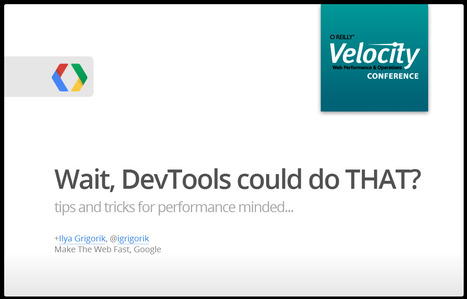
A Velocity 2012 presentation by Ilya Grigorik (Google)
|
|
Scooped by
Nicolas Weil
October 1, 2012 5:21 AM
|
The innodb_memcache daemon plugin is a plugin for the MySQL Server end contains an embedded memcached. This embedded memcached is configured to use MySQL's InnoDB engine as storage backend. By using this data stored inside an InnoDB table can be accessed using memcache's key-value protocol. Back in the times of the previous blog post this was limited to data from a single table, which maps easily to the key-value nature of memcache but is a clear limitation.
|
|
Scooped by
Nicolas Weil
September 26, 2012 12:17 AM
|
Scalability is one of the main drivers of the NoSQL movement. As such, it encompasses distributed system coordination, failover, resource management and many other capabilities. It sounds like a big umbrella, and it is. Although it can hardly be said that NoSQL movement brought fundamentally new techniques into distributed data processing, it triggered an avalanche of practical studies and real-life trials of different combinations of protocols and algorithms. These developments gradually highlight a system of relevant database building blocks with proven practical efficiency. In this article I’m trying to provide more or less systematic description of techniques related to distributed operations in NoSQL databases.
In the rest of this article we study a number of distributed activities like replication of failure detection that could happen in a database. These activities, highlighted in bold below, are grouped into three major sections:
- Data Consistency - Data Placement - System Coordination

|
Suggested by
Jos Dirksen
September 24, 2012 4:14 PM
|
There are many different web api standards that are turning the web browser into a complete application platform. With websockets we get nice asynchronous communication, various standards allow us access to sensors in laptops and mobile devices and we can even determine how full the battery is. One of the standards I'm really interested in is webrtc. With webrtc we can get real-time audio and video communication between browsers without needing plugins or additional tools. A couple of months ago I wrote about how you can use webrtc to access the webcam and use it for face recognition. At that time, none of the browser allowed you to access the microphone. A couple of months later though, and both the developer version of firefox and developer version of chrome, allow you to access the microphone!
|
|
Scooped by
Nicolas Weil
September 18, 2012 3:31 PM
|
Influxis offers the latest Union Platform 2.0 to its cloud network, featuring the new server clustering API and JavaScript framework. Influxis, a premier interactive streaming cloud company, announced its launch of Union Cloud 2.0 today. This next generation of the platform-as-a-service for Union Platform 2.0 is specially designed for scalable real-time collaboration applications. Union Cloud's key new features are Union Server Clustering and a full-featured JavaScript framework, Orbiter. The server clustering API easily connects multiple Union Server instances together, massively increasing the concurrent connection capacity into the millions. With Union Server's clustering, developers can scale an application by simply making a list of servers, sending a remote event, and responding to that event. Orbiter provides a simple set of JavaScript components for connected-application development. It includes connection reliability, user groups, data sharing, user awareness, spectation, user accounts, synchronized user lists, group-and-private messaging, filtering, saving data to a data source, handling server-push data feeds, and security role management. Union 2.0 also provides server-side JavaScript modules for those who prefer to code in JavaScript on the server, offering a comprehensive end-to-end JavaScript solution.
|
|
Scooped by
Nicolas Weil
September 17, 2012 4:58 AM
|
You have a sweet site you are working on, so naturally you want to make sure it is sweet across multiple platforms. The wokflow enhancer, Adobe Shadow is a rad tool built to help you do just that. Let’s take a look at how Shadow can integrate into your flow.
|
|
Scooped by
Nicolas Weil
September 16, 2012 5:23 AM
|
Spanner is Google's scalable, multi-version, globally-distributed, and synchronously-replicated database. It is the first system to distribute data at global scale and support externally-consistent distributed transactions. This paper describes how Spanner is structured, its feature set, the rationale underlying various design decisions, and a novel time API that exposes clock uncertainty. This API and its implementation are critical to supporting external consistency and a variety of powerful features: non-blocking reads in the past, lock-free read-only transactions, and atomic schema changes, across all of Spanner.
|
|
|
Scooped by
Nicolas Weil
November 29, 2012 6:19 AM
|
A couple of weeks ago, I delivered a full day PhoneGap workshop at QCon San Francisco. The workshop went very well, and I thought the materials could be useful to a larger audience. So I turned the workshop instructions into more detailed tutorial instructions. This is a lot more than the usual Getting Started tutorial: In addition to introducing you to key PhoneGap APIs such as LocalStorage, Database, Notification, Geolocation, Contacts, and Camera, the tutorial focuses on how to architect a real-life PhoneGap application using a Single Page Architecture and HTML templates.
|
|
Scooped by
Nicolas Weil
November 24, 2012 7:11 AM
|
What’s the secret to staying fresh, lean and mean when you’re a hot tech company on a fast growth trajectory? A fascinating document brought to our attention today today by Andrew Mager, hacker advocate at Spotify, answers that question in some detail by telling us how the music streaming juggernaut does it: by dividing up its business into small clusters — which it calls ‘squads’ — and running each like a startup in its own right.
|
|
Scooped by
Nicolas Weil
November 16, 2012 5:28 PM
|
3Scale just launched a new open source API proxy build on the NGNIX web server technology--a move, I feel is important for 3Scale, as well as the entire API industry. In addition to the benefits provided by NGNIX, the proxy provides seamless integration with 3Scale’s API management platform that delivers:
- API business modeling using service contracts, API rate limits and pricing rules
- API access control & security with API key generation with user id, app id, oAuth
- API analytics & reporting including alerts, statistics, business intelligence
- API billing & payments supporting pre-paid, post-paid, PCI compliant, six separate payment gateways
- Developer portal for self-service registration and onboarding
- Interactive API Documentation for better adoption using Swagger
|
|
Scooped by
Nicolas Weil
November 8, 2012 10:00 AM
|
SOA Software, a leading enterprise API management and SOA governance solutions provider, has just announced the launch of the SOA Software Open, a solution that combines API management with a unique social platform designed for the developer community. The SOA Software Open is an “API Platform-as-a-service” that was created to benefit both API providers and app developers; App developers can use the platform to find and use APIs, and collaborate with other developers to build third party applications. API providers can use the platform to offer their APIs as products, protect and promote their company brand, and manage the APIs they provide using SOA Software Open tools and services.
|
|
Suggested by
Jos Dirksen
October 12, 2012 8:51 AM
|
Article shows how to use the new pointer lock API. With the pointer lock API you can lock the mouse to a certain element on a page. Perfect from games, 3D views and much more.
|
|
Scooped by
Nicolas Weil
October 9, 2012 5:23 AM
|
LLJS is a typed dialect of JavaScript that offers a C-like type system with manual memory management. It compiles to JavaScript and lets you write memory-efficient and GC pause-free code less painfully, in short, LLJS is the bastard child of JavaScript and C. LLJS is early research prototype work, so don't expect anything rock solid just yet. The research goal here is to explore low-level statically typed features in a high-level dynamically typed language. Think of it as inline assembly in C, or the unsafe keyword in C#. It's not pretty, but it gets the job done.
|
|
Scooped by
Nicolas Weil
October 3, 2012 3:52 PM
|
If you still haven’t found the time to learn how to install, configure, and maintain a database, you might be interested in a cloud solution that promises “zero management.” Xeround sells itself as the “zero-management database.” Managing databases consumes thousands of hours every year, becoming yet another time sink to sys admins and developers alike. Management includes everything from installation through upgrades, checking on server health and disk space, and scaling and managing these things at scale – something that every one of us could learn, given a few books and the time if we could find it. Fully managed databases (DBs) aren’t new, and Xeround isn’t the first, but it has focused on the things that cause plenty of pain. Keeping a DB running and scaling it. After housing, powering, and securing the physical machines, configuring them is the next task that can distract from actually building an app. Although you might have edge case requirements that need specially honed and tweaked database servers, chances are … you don’t really. In most cases, you can do a lot with a good standard config file and focus your efforts on the architecture of the app using these standard configs. Once you’ve given up your grip on the config files and the SSH into the box, you can focus on the app again. It’s okay to make apps and not be a slave to sys admin duties all the time.
|
|
Scooped by
Nicolas Weil
September 28, 2012 5:05 AM
|
As the world shifts to computing on the cloud , or what my non tech friends call, lots of servers connected to the internet, APIs become increasingly the lingua franca or working language to communicate to and fro from these clouds. Storage in the cloud has been of the earliest use cases and one which has increasingly made sense to create secure backups at a much cheaper rate. So here is a collection of Cloud Storage APIs, as far as possible they are RESTful . Please note I am referring only to some of the biggest players in the cloud storage API space- and you may find others. But since the article is aimed at enterprise readers willing to park confidential content on the cloud, this is a list of the biggest cloud storage providers which offer API access.
|
|
Scooped by
Nicolas Weil
September 24, 2012 4:16 PM
|
Adobe and its products have been instrumental in constructing how we view the Web. Flash was, and still is, a major innovator in the Web-based video and gaming arena. The company, however, saw that HTML5 will one day be the future. That’s why Adobe has begun investing heavily in it through various software like Adobe Shadow. This morning, the company announced its new plan to take Web development and HTML5 even further.
|
|
Scooped by
Nicolas Weil
September 21, 2012 6:33 AM
|
Lately I'm trying to build a web application which will be exposed in a RESTfull manner.
There are some general guideline and hints about how to define it, but no explicit standard or accepted schema structure to use. After reading some info on the web, I think I manage to crack the pattern :-)
I would like to share the rules and structure I formed and hopefully to get some feedback about it and improve it, so please don't hesitate to leave notes and point any pain point that structure has. The high level pattern is:
http(s)://server.com/app-name/{version}/{domain}/{rest-convention}
|
|
Scooped by
Nicolas Weil
September 17, 2012 5:12 AM
|
Agile principles to software development are essentially about project and team management, with only sparse recommendations regarding products engineering or processes design. Given this seeming oversight some have even argued that there is no room for models and milestones under the agile roof. Such misconceptions could be unfortunate, especially for project managers having to deal with organizational or architectural dependencies. But omission is not opposition as authors like Robert C. Martin or Dean Leffingwell have demonstrated respectively for products and processes.
|
|
Scooped by
Nicolas Weil
September 17, 2012 4:15 AM
|
|