Your new post is loading...
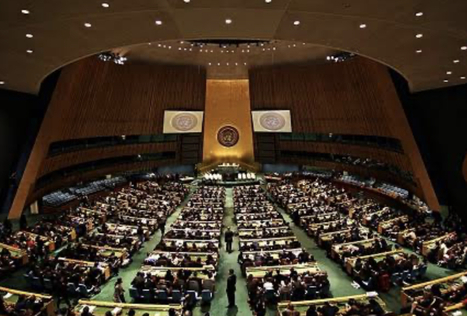
GA/10860 23 September 2009 With Crises in Food, Energy, Recession Hitting All at Once, ‘the World Looks to Us for Answers’, Secretary-General Says, Opening General Debate General Assembly President Hails United Nations as Most legitimate Forum For Concerted Global Action, as 30 World Leaders Address Session’s First Day
Amid signs that countries were slowly pulling back from the brink of recession, United Nations Secretary-General Ban Ki-moon today cautioned world leaders attending the General Assembly’s annual debate that serious challenges remained, and that tackling the fallout from ongoing crises in food, energy and climate would require nothing less than rising to the call of an exceptional moment in history.
“If ever there were a time to act in a spirit of renewed multilateralism –- a moment to create a United Nations of genuine collective action –- it is now,” Mr. Ban said, opening the Assembly’s sixty-fourth general debate with a call for collective action. “Now is our time,” he declared, urging member States to be united in purpose and united in action.
Laying out his vision, he expressed hope that this year would see significant progress on various fronts, including in the creation of a nuclear-free world. Amid new pledges by the United States and the Russian Federation to reduce nuclear arsenals, and optimism that next year’s Review Conference on the Treaty on the Non-Proliferation of Nuclear Weapons (NPT) would offer a fresh start, the Secretary-General said that action on the issue now could helpbring the Comprehensive Nuclear Test Ban Treaty into force.
As for the ongoing fight against poverty, he drew attention to the fact that the “near poor” were becoming the new poor, and that an estimated 100 million people risked falling below the poverty line this year. With that in mind, he was creating the Global Impact Vulnerability Alert System (GIVAS) to provide real-time data on the world’s socio-economic picture. Further, a summit on the Millennium Development Goals would also be convened at Headquarters in 2010 to mount a final push towards the 2015 deadline.
Turning to the Organization’s work in the field, Mr. Ban called for consolidating progress in Darfur and delivering on world body’s mandate, especially as the African Union-United Nations Hybrid Operation in Darfur (UNAMID) –- which still lacked critical assets -– would be 90 per cent deployed by year’s end. Among other situations, he said that, in Myanmar, if next year’s elections were to be accepted as credible, all political prisoners, including Daw Aung San Suu Kyi, must be released.
Regarding the situation in Gaza, he underscored that issues of justice and accountability had to be addressed and negotiations revived towards achieving a two-State solution. Elsewhere, the United Nations was committed to standing with the people of Afghanistan and Pakistan, and solidifying gains in countries like Timor-Leste, Haiti, Sierra Leone and Nepal.
Above all, the United Nations was committed to offering a voice to the voiceless and defending the defenceless. With crises in food, energy, recession and pandemic flu hitting all at once, “the world looks to us for answers”, he said, adding: “If we are to offer genuine hope to the hopeless, if we are to truly turn the corner to economic recovery, then we must do so for all nations and all people.”
Picking up that thread, the President of the General Assembly, Ali Abdussalam Treki, said the biggest challenges –- peace and security, environmental degradation, extreme poverty, simultaneous economic, food and energy crises and disarmament –- could only be tackled through a well-functioning multilateral system.
As the United Nations chief deliberative policy-making organ, the Assembly held legitimacy unmatched by any other body or organization, and he pledged to work with States to forge consensus on a revitalized Assembly and a reformed Security Council. In the area of human rights, racial discrimination, xenophobia and intolerance continued to plague societies across the globe, and the Assembly would need to support the development of the Human Rights Council.
Recalling that peace required global cooperation, United States President Barack Obama said his Government was ready to begin a new chapter of international cooperation -- one that recognized the rights and responsibilities of all nations. Recalling that he had assumed office at a time when many viewed the United States with mistrust, he said it was his deep belief that in 2009 -- more than at any other time -- the interests of nations and peoples were shared.
He said the United States would live up to its values and lead by example. It had re-engaged the United Nations, joined the Human Rights Council and fully embraced the Millennium Development Goals. Challenging all Member States to work together and with more urgency to ensure global peace and security, Mr. Obama laid down four pillars towards a more peaceful word, including eliminating nuclear weapons, curbing global warming, ending intractable conflicts and creating a fair global economic and trade system.
He noted the General Assembly had often become a forum for sowing discord -- but twenty-first century leadership demanded more. No world order that elevated one nation over others would succeed. “The choice is ours,” he said. “We can be remembered as a generation that chose to drag the arguments of the twentieth century into the twenty-first […] or one that chooses to come together to serve the common interest of all human beings.”
Similarly, Ugandan President Yoweri Kaguta Museveni said Africa was entering a phase of growth and transformation. Uganda had faired well during the recession, mainly because of strong regional trade, but it would do much better when roads, electricity and railways were in place. Progress in those infrastructure areas had been slow, due to dependence on foreign funding, which tended to be frivolous and erratic.
How could growth and transformation be expected in such a situation? he asked, and said the whole of Africa needed to “wake up” and cooperate on finding solutions. Indeed, Africa could no longer be held hostage to foreign funding in such vital areas, he said, stressing that African nations faced a double task: to transform from pre-industrial to modern economies and to cope with problems caused by others, including the global financial crisis and environmental deterioration. The need for dialogue among civilizations was long overdue, he added.
On that point, Dmitry Medvedev, President of the Russian Federation, said the international community had felt the need, as never before, for informal collective leadership, and an increased role for forums like the Group of Eight (G-8) and Group of 20 (G-20). Among problems that could not be solved without the United Nations was the imbalance of existing world economic governance mechanisms, the inadequacy of their “rules of the game” and the chasm between financial markets and the real economy.
He said the United Nations had to strengthen its influence and preserve its multinational nature. Reforming the Security Council was essential to those efforts and the time had come to step up the search for a compromise formula for its expansion. In addition, real progress in nuclear disarmament would be impossible without addressing national missile defence and non-nuclear strategic offensive arms potential. He expected work on a new treaty to fully take into account relevant provisions of the joint document endorsed by himself and the United States President at their meeting in Moscow earlier this year.
Hu Jintao, President of China, said that, as the world moved further towards multi-polarity and economic globalization, democracy in international relations had gained greater public support. At the same time, prospects for global economic recovery were unclear and he called on the United Nations to achieve a more balanced global economic system, notably by creating an international environment conducive to developing country growth. Developed countries should open their markets by reducing or exempting tariffs, while developing nations should upgrade South-South cooperation.
For its part, China would continue to open to the rest of the world, he said, pledging support to developing countries hurt by the financial crisis. Such efforts would include assistance for attainment of the Millennium Development Goals, increased assistance to Africa, the reduction -- or cancellation -- of debt for heavily indebted poor countries and promotion of regional monetary and financial cooperation.
Also speaking today were the Heads of State of Brazil, Libya (on behalf of the African Union), Qatar, Turkmenistan, Chile, Uruguay, Algeria, Republic of Korea, France, Argentina, Tajikistan, Monaco, Colombia, South Africa, Czech Republic, El Salvador, Equatorial Guinea, Dominican Republic, Iran, Bolivia, Ukraine and Poland, as well as the Heads of Government of Sweden (on behalf of the European Union), Italy, United Kingdom and Australia.
The General Assembly will reconvene at 9 a.m. Thursday, 24 September, to resume its general debate.
Background
The General Assembly met this morning to begin its annual general debate.
Statement by the Secretary-General
Opening the sixty-fourth session’s general debate, United Nations Secretary-General BAN KI-MOON recalled that the Assembly gathered every September in a solemn rite –- to reaffirm the United Nations’ founding charter and faith in the principles of peace, justice, human rights and equal opportunity for all. Delegates assessed the state of the world and laid out a vision for the way forward.
This year, however, the Assembly had been asked to rise to an exceptional moment: amid the many crises of food, energy, recession and pandemic flu, the world looked to the 192-member body for answers.
“If ever there were a time to act in a spirit of renewed multilateralism –- a moment to create a United Nations of genuine collective action –- it is now,” he said. It was time to put the “united” back into the United Nations.
Laying out his vision, he asked world leaders to make this year one in which the Organization rose to the greatest challenge facing the human family: the threat of catastrophic climate change. Indeed, just yesterday, 100 Heads of State and Government recognized the need for a climate agreement that all nations could embrace, in line with their abilities, consistent with what science required, and grounded in “green growth” –- the lifeline of the twenty-first century.
He urged that this year see a world free of nuclear weapons. It was a cause that had lain dormant for too long, which was why, last October, he had proposed a five-point plan for putting disarmament back on the global agenda. The Russian Federation and the United States had pledged to cut nuclear arsenals and this May, there would be a chance to push for real progress at the United Nations Review Conference on the Nuclear Non-Proliferation Treaty (NPT).
Moreover, tomorrow’s historic Security Council Summit, chaired by the President of the United States, offered a fresh start. “With action now, we can get the ratifications to bring the Comprehensive Nuclear-Test-Ban Treaty (CTBT) into force,” he said.
In the fight against poverty, he hoped this year would bring a focus on those left behind, as a new crisis was at hand. The near-poor were becoming the new poor and an estimated 100 million people risked falling below the poverty line this year.
Markets might be bouncing back, but incomes and jobs were not, he said. People believed the global economy was stacked against them, which was why he had put forward a Global Jobs Pact for balanced and sustainable growth, and was working to create a new Global Impact Vulnerability Alert System, which would provide real-time data on the world’s socio-economic picture.
A special summit on the Millennium Development Goals also would be convened at this time next year. “With only five years to go, we must mount a final push towards 2015,” he stressed. Rightly, women and children had been placed at the forefront.
The prevention of sexual violence against women also must be a priority. “Let us agree: these acts are an abomination,” he stressed. Leaders of every nation were personally accountable when such crimes were committed within their borders. When women died in childbirth or were raped as a weapon of war, the United Nations could not look the other way, and he reminded delegates they had recently agreed to create a single agency to address women’s issues.
Along similar lines, he said the Assembly also had reaffirmed the responsibility to protect. “Where conflicts arise, justice and accountability should follow,” he said, which was why the work of the International Criminal Court was so vital. He looked forward to the Review Conference next May as a chance to strengthen its mandate.
Turning to the United Nations’ work in the field, he said none of those noble goals could be achieved without peace, security and justice. In Darfur, that meant consolidating progress and delivering on the mandate. While the mission would be 90 per cent deployed by year’s end, it lacked critical assets, and in that context, he urged continued work to stabilize the Sudan and to shore up the comprehensive peace with the Southern Sudan.
Noting that Somalia continued to demand attention, he said the United Nations, in Sri Lanka, would continue to press for settlement, reconciliation and respect for the principle of responsibility. He welcomed the Government’s pledge to allow all displaced persons to return by the end of January.
In Myanmar, the release of some political prisoners last week fell short of what was needed, and he called for doing “much more” in the best interests of the country and its people. If next year’s elections were to be accepted as credible, all political prisoners –- including Daw Aung San Suu Kyi –- must be released.
In Gaza, people continued to suffer, he stressed. Issues of justice and accountability had to be addressed and he urged reviving negotiations towards a two-State solution and comprehensive peace in the Middle East. He supported United States President Barack Obama’s efforts for the resumption of peace talks and would work within the Quartet to that end.
While recent elections in Afghanistan had revealed serious defects, the world should not forget that progress had been made, he continued. The United Nations was committed to standing with the Afghan people, as well as with the people of Pakistan. Significant progress also had been made in Timor-Leste, Haiti, Sierra Leone and Nepal. Quiet progress had been made in Iraq and fresh opportunities created in Cyprus. It was time to take stock and move forward.
On a final note, Mr. Ban reminded delegates that their common ambition should be to make the United Nations’ outward renovation work a symbol of the Organization’s inward renewal. The United Nations had made progress in “Delivering as One” and in “getting peacebuilding right” so that societies emerging from war did not slide back into conflict. It had created the Department of Field Support and was developing the “New Horizons” strategy to make peacekeeping more agile and effective.
“We need the strong support of Member States, just as we do to secure the safety of our brave staff serving in dangerous places,” he said.
In his travels from the Arctic ice rim to the steppes of Mongolia, to the Democratic Republic of the Congo, and to summits in Trinidad and Tobago, London and L’Aquila –- he had spoken out on one point above all others: the United Nations was the voice of the voiceless, the defender of the defenceless.
“If we are to offer genuine hope to the hopeless, if we are to truly turn the corner to economic recovery, then we must do so for all nations and all people,” he said. “We are here to take risks, to assume the burden of responsibility, to rise to an exceptional moment, to make history.” This year, of all years, asked no less.
Statement by General Assembly President
ALI TREKI, President of the United Nations General Assembly, said the sixty‑fourth session was taking place as the international community faced multiple crises and enormous challenges in areas from international peace and security, to environmental degradation and climate change, to extreme poverty and deadly infectious diseases. The setbacks to the achievement of the Millennium Development Goals; the economic, financial, food and energy crises; disarmament and non-proliferation were all challenges in the backdrop of this session.
Those challenges could only be addressed through a well-functioning multilateral system that would ensure effective and collective action. As the embodiment of multilateralism, the United Nations was the most legitimate forum for ensuring concerted global action. The Assembly was “the chief deliberative policymaking organ of the United Nations”, and held a global membership and legitimacy unmatched by any other organization. Mr. Treki pledged to work with Member States to forge a consensus on a revitalized Assembly, a more representative and reformed Security Council, and other initiatives to improve the effectiveness and management of the Organization.
Turning to crucial issues facing the world, he said the international community needed to work towards a global climate change agreement in Copenhagen and a more comprehensive and coherent approach towards peace, security and development in Africa. He said the upcoming high-level Assembly meeting, scheduled for the start of the sixth-fifth session in 2010, would be held just five years before the achievement of the Millennium Development Goals and offered an opportunity to identify the impediments to progress towards the Goals.
Supporting post-conflict peacebuilding would continue to be a major concern for Member States, as would the promotion and protection of human rights. He noted that the Assembly would review the follow-up to the outcome of the Durban Review Conference as racial discrimination, xenophobia and intolerance challenged societies across the globe. The Assembly would be required to support the development of the Human Rights Council. The question of Palestine and the Arab-Israeli conflict remain unresolved despite its place on the Assembly’s plenary agenda for many years, and still posed a serious threat to international peace and security. A comprehensive and lasting settlement was needed, he said.
The Organization had a unique responsibility in striving for the rule of law within international affairs and was the universal centre for international standard setting in various fields of international law. Yet the rule of law meant little without the accountability of law, and in the face of violations of international law, there had to be effective means of redress. While the international community was constantly strengthening accountability mechanisms, including dispute resolutions, it had far to travel to fulfil this part of the vision. The law itself had to reinforce the common belief in the fundamental dignity of all human beings, Mr. Treki said.
Statements
LUIZ INáCIO LULA DA SILVA, President of Brazil, said he would focus on three perils haunting the planet: the ongoing economic crisis; the lack of stable world governance; and the threat of climate change. As he had said a year ago, history would never forgive the serious blunder of dealing with the “impacts” rather than the “causes” of the crisis.
For example, he said, the current economic crisis was more than a crisis of “big banks”. It was a crisis of “big dogmas”. An economic, political and social outlook that had been held to be unquestionable had simply fallen apart. A senseless system based on absurd doctrines, such as markets regulating themselves, had proved itself bankrupt. Furthermore, the fact that a total collapse of the system had been avoided had apparently given rise to irresponsible acquiescence in certain sectors. Most of the underlying problems had been ignored. There was enormous resistance to adopting mechanisms to regulate financial markets.
At the G-20 meetings and in other venues with world leaders, he continued, he had insisted on the need to irrigate the world economy with a significant volume of credit. He had defended the regulation of financial markets, the widespread adoption of anti-cyclic policies, the end of protectionism and the fight against tax havens. He had proposed true reform of the multilateral financial agencies.
The world could no longer be run by the same rules and values that had prevailed 65 years before, he stated. Likewise, the United Nations and the Security Council could no longer be run under the structures imposed after the Second World War. The world was growing “multilateral” and also “multi-polar,” based on regional integration, such as South America’s creation of the Union of South American Nations (UNASUR). And rather than being in conflict with the United Nations, such a world would invigorate the Organization.
It would take political will to confront and overcome situations that conspired against peace, development and democracy, he continued. Without political will, throwbacks such as the embargo against Cuba would continue. There would be more coups such as the one that had toppled the constitutional President of Honduras, granted refuge in Brazil’s embassy in Tegucigalpa since Monday. The international community must demand that he be returned to the Presidency of his country and must ensure the inviolability of Brazil’s diplomatic mission in Honduras.
Finally, he said, the threat of climate change would continue to grow unless all countries took action to turn back global warming. His country would arrive in Copenhagen with precise alternatives and commitments based on a National Climate Change Plan that included an 80 per cent cut in deforestation of the Amazon by 2020. Further, despite the fact that Brazil was self-sufficient in oil and major reserves had recently been found, Brazil would not turn into an oil giant but would consolidate its role as a world power in green energy.
Meanwhile, he said the developed countries must set emission-reduction goals far beyond those tabled to date. Plus, the funding for technological innovations to protect the environment in developing countries was totally insufficient.
BARACK OBAMA, President of the United States, said that, while he had been in office for just nine months, he was aware of the expectations that accompanied his Presidency –- they were rooted in a discontent with a status quo that had allowed people to be increasingly defined by their differences and outpaced by their problems. At the same time, such expectations were rooted in hope that real change was possible and that the United States would lead in bringing it about, he said.
He had come to office at a time when many viewed the United States with mistrust, but it was his deep belief that in 2009, more than at any other time, the interests of nations and peoples were shared. Religious beliefs could forge new bonds or tear people apart. Technology harnessed could light the path to peace or darken it. What happened to the hope of a child anywhere could enrich the world –- or impoverish it. “We must embrace a new era of engagement based on mutual interests and mutual respect,” he said. “Our work must begin now.”
“ America will live its values, and we will lead by example,” he said, noting that his Administration would work with all Members States to disrupt, dismantle and defeat Al-Qaida and its extremist allies. In Afghanistan and Pakistan, the United States and others were helping to develop their Governments’ capacity to lead in that effort, and advance their peoples’ security. In Iraq, it had removed American combat brigades from cities and set a deadline of next August to remove all such brigades from Iraqi territory. He pledged to keep his promise to remove all troops by the end of 2011.
He said the United States had outlined a comprehensive agenda to seek a world without nuclear weapons. In Moscow, the United States and the Russian Federation had announced they would pursue reductions in strategic warheads and launchers. At the Conference on Disarmament, they agreed to a plan for negotiating an end to the production of fissile materials for nuclear weapons, and this week, the Secretary of State, Hillary Rodham Clinton, would become the first senior American representative to the annual Members Conference of the Comprehensive Nuclear-Test-Ban Treaty.
The United States also had re-engaged the United Nations, he explained, saying “we have paid our bills”, joined the Human Rights Council, signed the Convention on the Rights of Persons with Disabilities and fully embraced the Millennium Development Goals. Some actions had yielded progress and others had laid the groundwork for it in the future. But such efforts could not fall to America alone; all had to bear their share of responsibility for a global response to global challenges.
Recalling that peace rested on the cooperative effort of the world, Mr. Obama pointed out that the General Assembly had often become a forum for sowing discord. Twenty-first century leadership demanded more, and no world order that elevated one nation over others would succeed. “Old habits and old arguments are irrelevant to the challenges faced by our people,” he said, calling for building new coalitions that bridged old divides. “The choice is ours: we can be remembered as a generation that chose to drag the arguments of the twentieth century into the twenty-first […] or one that chooses to come together to serve the common interest of all human beings.”
With that, he put forward four pillars, fundamental to a future the United States wished to see, calling first on States to stop the spread of nuclear weapons and seek a world without them. Today, the threat of proliferation was growing in scope and complexity. Failing to act invited a nuclear arms race in every region. A fragile consensus stood in the way of that frightening outcome -– the basic bargain that shaped the Nuclear Non-Proliferation Treaty (NPT), which outlined States’ right to peaceful nuclear energy and that those with nuclear weapons had the duty to move towards disarmament.
He said the United States would pursue a new agreement with the Russian Federation to substantially reduce strategic warheads and launchers, and complete a Nuclear Posture Review that opened doors to deeper cuts. It also would host a summit next April reaffirming nations’ duty to secure nuclear material on their territory and help those unable to do so. Such efforts must work to strengthen the NPT.
When International Atomic Energy Agency (IAEA) inspections were avoided and United Nations demands ignored, people were less safe and all nations were less secure, he said, adding that the Governments of North Korea and Iran threatened to take the world down that dangerous slope. He was committed to diplomacy that opened a path to a more secure peace for both nations, but if they ignored international standards, they must be held accountable. “We must insist that the future does not belong to fear.”
Turning to the second pillar –- the pursuit of peace -– he said efforts must begin with an unshakeable determination that the murder of innocent people would never be tolerated. In confronting extremists that promoted conflict by distorting faith, he said the United States would forge partnerships, share intelligence, coordinate law enforcement and protect people. The most powerful weapon in its arsenal was the hope of human beings –- the belief that the future belonged to those who built, not destroyed.
The United States would boost support for peacekeeping and energize efforts to prevent conflicts. In the Sudan, he said, it would pursue lasting peace through support of people in Darfur and implementation of the Comprehensive Peace Agreement. Elsewhere, from Haiti to the Congo to East Timor, it would work with the United Nations to support lasting peace.
In addition, the United States would continue to seek a just and lasting peace between Israel and Palestine, and the Arab world. Just yesterday, he had met with Prime Minister Benjamin Netanyahu and President Mahmoud Abbas. While progress had been made, he continued to call on Palestinians to end incitement against Israel, and reiterate that America did not accept the legitimacy of continued Israeli settlements.
He said the time had come to relaunch negotiations –- without preconditions –- that addressed the permanent status issues: security for Israelis and Palestinians, borders, refugees and Jerusalem, he said. The goal was clear: two States living side by side in peace and security -– a Jewish State with true security for all Israelis, and a viable, independent Palestinian State with contiguous territory, that ended occupation begun in 1967. The United States would also pursue peace between Israel and Lebanon, Israel and Syria, and a broader peace between Israel and its many neighbours.
Turning to the preservation of the planet, he said the danger posed by climate change could not be denied and nations’ responsibility to meet the challenge could not be deferred. Without action, efforts to end conflict would be eclipsed by wars over refugees and resources; development would be devastated by drought. “The days when America dragged its feet on this issue are over,” he said, adding that the country would press ahead with deep cuts in emissions to reach the goals set for 2020, and eventually 2050.
On the final pillar –- creating a global economy that advanced opportunity for all people –- he said the world was still recovering from the worst economic crisis since the Great Depression. Across the globe, there were promising signs, yet little certainty about what lay ahead. At the upcoming G-20 meeting in Pittsburgh, the United States would work with the world’s largest economies to chart a course for balanced growth. That would mean vigilance, to ensure efforts did not let up until people were back to work, rekindling demand, and strengthening regulation for all financial centres.
Indeed, there was a moral and pragmatic interest in the broader questions of development. The United States had set aside $63 billion to carry forward the fight against HIV/AIDS, to end death from tuberculosis and malaria, to eradicate polio, and strengthen public health systems. The United States would join others in contributing H1N1 vaccines to the World Health Organization.
Growth could not be sustained unless all embraced their responsibility. Wealthy nations had to open their markets to more goods, and reform international institutions to give more countries a greater voice. Developing countries had to root out corruption that precluded progress. The United States would support honest police and independent judges, civil society and a vibrant private sector.
“Our goal is simple: a global economy in which growth is sustained and opportunity is available to all,” he said. Such changes would not be easy but he believed the world’s people hoped that for their children. Democracy and human rights were essential to achieving such goals. The test of leadership would not be the degree to which nations fed the fears of their people. As an African American, he would never forget that he would not be here today without the steady pursuit of a more perfect union in the United States. While America had too often been selective in its promotion of democracy, that only reinforced its commitment.
“We have reached a pivotal moment,” he said. “The United States stands ready to begin a new chapter of international cooperation -– one that recognizes the rights and responsibilities of all nations.” With confidence in its cause, and commitment to its values, the United States called on all nations to help it build the future people deserved.
MUAMMAR AL-QADHAFI, Leader of the Revolution of Libya, speaking also on behalf of the African Union, said he hoped this gathering would be a historic one. He also congratulated United States President Barack Obama on his first address to the General Assembly. This year’s debate was being held in the midst of many challenges and the world should unite and defeat these challenges, which included climate change, the economic crisis and the food crisis.
He said many Member States were not present when the United Nations was created by three countries years ago. They created the Charter but the Preamble was different from the provisions and articles. No one objected to the Preamble, but he rejected everything that came after. The Preamble of the United Nations Charter said nations were equal, whether large or small. The veto power bestowed upon the five permanent members of the Security Council was, therefore, against the Charter, and he neither accepted nor recognized it.
Continuing, he said the Charter’s Preamble stated that military force should not be used unless there was a common interest. But 65 wars, with millions of victims, had broken out since the creation of the United Nations. Moreover, the Preamble said if there was aggression against any country, the United Nations together would check such actions. Despite that, countries which held the veto used aggressive force against “the people”, even as the Charter said no nation had the right to intervene in the internal affairs of another.
He went on to express concern that right now, calls for reforming the Organization focused only on increasing the number of Member States. That would only make things worse. For instance, adding more Security Council seats would “give rise to more super-Powers, crush the small people and create more poverty”. Such an impractical move would also generate more competition among countries. In any case, the Council should act according to the rules of the United Nations. The solution was to close the admission of new Member States and provide equality among those already belonging to the Organization, he said.
Currently, the Assembly was like a decor without any substance. “You just make a speech and then you disappear...that’s who you are right now,” he said. Setting that right would mean that the Security Council could serve as a tool for implementing resolutions adopted by the Assembly. The Council should represent the interests of all countries, through individual seats or seats held by unions that represented each region of the world. There were equal votes in the Assembly and there should be equal votes next door in the Security Council, he declared, adding that ultimately, for a united and peaceful world, serious Organizational reform was needed.
Keeping his focus squarely on Security Council dynamics, he said that the 15-member body practised “security feudalism” for those who had a protected seat. “It should be called the terror council”, he said, underscoring that terrorism could exist in many forms. The super-Powers had complicated interests and used the United Nations for their own purposes. Indeed, the Security Council did not provide the world with security, but gave it “terror and sanctions”. He was not committed to adhere to the Council’s resolutions, which were used to commit war crimes and genocides. He reiterated that the Council did not provide security and the world did not have to obey the rules or orders it decreed, especially as it was currently constituted.
Regarding Africa, the African Union deserved a permanent seat in the Security Council for the suffering it had endured for many years. This had nothing to do with reform, he said, declaring that Africa deserved compensation, amounting to some $77.7 trillion for the resources and wealth that had been stolen in the past. Colonization should be criminalized and people should be compensated for the suffering endured during the reign of colonial power.
Africans were proud and happy that a son of Africa was now governing the United States of America and it was a great thing -- it was a glimmer of light in the dark of the past eight years, he said.
However, he noted the money spent by the United States and the city to secure United Nations Headquarters during the annual Assembly. While thanking the United States for its efforts in hosting the Organization for the past 50 years, he said the United Nations should hold its annual debate in another hemisphere for the next 50 years. He complained about the trouble some diplomats and their staff had in securing visas from the United States Government.
YOWERI KAGUTA MUSEVENI, President of Uganda, said Africa had gotten grasp of the development compass in the last 15 to 20 years. Uganda’s economy had grown at the rate of 6.5 per cent a year for the two decades and had grown 7 per cent the last year, despite the global recession. Those reasonable rates of growth had been achieved despite the fact that three vital infrastructural elements remained to be resolved decisively.
In the areas of electricity, roads and railways, he said progress had been slow due to a dependence on foreign funding, which tended to be frivolous and erratic. Rising tax collections have now put Uganda in position to fund projects in those areas and foreign investments were welcome, of course. But Africa could no longer be held hostage to foreign funding in those vital infrastructural areas in which there were shameful global inequities. The United States, for example, had an electrical usage rate of 14,124 kilowatts per capita per year, while Africa had 574, and some African countries had rates as low as 9 kilowatts.
How could growth and transformation be expected in such a situation, he asked, and said the whole of Africa needed to “wake up” and cooperate on finding solutions to that matter and to the poor condition of roads. In China, the cost of transporting a ton of cargo between Beijing and Shanghai by rail, was $12. In East Africa, the cost was $65.
He said another two bottlenecks were related to the export of raw materials and the lack of progress in modernizing subsistence and traditional agriculture. The present process of exporting raw materials was called “modern slavery” by many Africans since it brought in only 10 per cent of the final processed product. The modernization of farming meant the implementation of initiatives to improve products and equipment, irrigation systems, breeding stocks and agro-practices.
Africa was entering a phase of growth and transformation, he said. Uganda had faired well during the recession because of regional trade, but it would do much better when the three infrastructural elements of roads, electricity and railways were in place. Africa had great growth potential that was not yet tapped and multilateral action would unlock the dormant potential. The situation was similar to the current global crisis, which had been caused by lax regulations in managing the world’s economics. Multilateral actions had been required to stop money-laundering and to strengthen regulations.
In conclusion, he said African countries had a double task. One was to transform their economies from pre-industrial to modern ones. The other task was to cope with problems caused by others, such as the global financial crisis and environmental deterioration. The need for dialogue among civilizations was long overdue.
SHEIKH HAMAD BIN KHALIFA AL-THANI, Amir of Qatar, said the current General Assembly coincided with an extremely special international situation; one that took place at “critical junctions of major historical developments”. That had given rise to the opportunity to regulate international interactions and systems. Those opportunities were a “pre-renewal” for a new future, especially after the financial market crisis, 11 September 2001 and other events.
He urged that the United Nations system needed quick renewal and strengthening of its institutions so that it conformed to the new realities of the world. Global events had altered the world map, changed the balance of power, and had also generated a “renewal-seeking movement” in the United States that “we are all following with interest”.
He added that the international community had become “confused”, and it was now clear that peace and prosperity required more than bi-polarity or the hegemony of one country, no matter how advanced that country was. “It is clear that the serious crises of the world were exacerbated when nations and the international order tried to tackle issues not from the United Nations framework but from another setting.” The situation in the Middle East was one of those issues.
Highlighting the contribution that small States could make on issues, he said that although the sizes of States were not equal that “it is time to go back to the United Nations system that accommodates everyone and is a venue recommended by all and a charter accepted by all nations of the earth”. It was necessary to use the United Nations to solve intractable crises with a legitimate international consensus.
Turning to the issue of energy, he highlighted Qatar’s involvement with energy alternatives, its concern with global climate change and the impact of that phenomenon on the environment and life on planet. Moreover, there could not be peace or prosperity when there was an energy crisis. He thanked Secretary General Ban Ki-moon for his United Nations Summit on Climate Change, which was a forum to discuss the issue’s serious threats. He said it was the duty of the international community to respond to these new challenges.
Finally, he noted that Qatar’s North Field has made that country the world’s third largest producer of natural gas; consumption of which was less harmful to the environment. Thus, the Government of Qatar was promoting its use, as well as encouraging efficiency using other forms of alternative energy such as solar power.
GURBANGULY BERDIMUHAMEDOV, President of Turkmenistan, said today’s world demanded closer coordination among States and international organizations. How effective that interaction was would determine how global problems of ecology, energy, food, water distribution and poverty would be solved. It would be impossible to discuss achieving those goals without reaffirming the United Nations’s most important role. For more than 60 years, it had been the main guarantor of universal peace, security and development.
Regarding United Nations reform, he said the Organization had to improve its effectiveness. Reform must be sensible, targeted and related to the global community’s real needs. Supporting efforts to bring more openness to the United Nations, he said the Security Council’s structure had to be improved, notably to create closer interaction with the General Assembly.
He said the permanent neutrality of Turkmenistan, and features of its legal status, provided opportunities for positive influence on the process in the Central Asia and Caspian Sea region. The idea would be to create permanent mechanisms for discussing regional problems and working out mutually acceptable decisions. Security of one country could not be guaranteed in a lack of regional security.
On energy, he said discussion centred not on accepting preventive measures or local agreements on aspects of fuel transport, but on the creation of a new, universal model of relations in the world energy space –- those based on a multilateral balance of interests. In line with a General Assembly resolution on “Reliable and stable transit of energy resources and its role in securing stable growth and international cooperation” (2008), Turkmenistan had held a high-level international conference on that issue. A proposal from it outlined the creation of a legal document on the transit of energy resources, which would take into account proposals of interested countries and organizations. Turkmenistan fully supported that idea and called on interested States to put forward proposals.
Taking up disarmament and reduction of weapons arsenals, he said countering distribution was a main issue on the global agenda. Turkmenistan was convinced that the fewer armaments, the more stable the world’s development. All countries in his region were parties to the 2006 Treaty that established a nuclear-free zone in Central Asia, and he called for holding an international conference in the first half of next year under United Nations auspices. He also welcomed proposals aimed at assisting global disarmament processes.
Among the most serious issues today was effectively countering international terrorism, illegal drug trafficking and trans-border organized crime, he said. Such problems were especially important in his region and only through joint efforts could those threats be resisted. The United Nations should increase its participation in coordinating models of international cooperation that aimed to neutralize those threats.
Turning to the revival of Afghanistan, he said Turkmenistan would continue to provide assistance to that country for reconstruction, and social and humanitarian purposes. The United Nations, with its peacemaking experience, should suggest new political-diplomatic models for solving Afghanistan’s problems and take into account the potential of the United Nations Regional Centre for Preventive Diplomacy for Central Asia.
The serious after-effects of the world financial and economic crisis demonstrated the need to join efforts in shaping a global architecture of security and establishing conditions for equal relations among States, based on recognized international legal norms, he said. Responsibility, morality and humanism were criteria that current and future generations would use to assess the Assembly’s work. As a member of the world community, Turkmenistan would contribute to strengthening the high principles in such international affairs.
MICHELLE BACHELET, President of Chile, said that, while six decades of international collaboration had led to “significant progress”, the current economic crisis had given new urgency to the need for global collaboration on combating climate change and world hunger, among other things. On the issue of poverty, she reminded the Assembly that more than 1 billion people suffered from hunger globally -- 50 million of them in Latin America alone.
She noted the “sad paradox” that at the same time Governments in developed countries spent trillions of dollars to revitalize the economy, the World Food Programme had seen its budget reduced by half. She then observed that less than 0.1 per cent of what had been spent on the financial rescue plans could end the food crisis, and she added that the issue of global hunger should be put on the agenda –- in the Assembly and at the forthcoming meeting of the G-20.
“[It] is not possible that, on the pretext of the economic crisis, the executives of the investment banks, which were at the centre of the current crisis, gambling irresponsibly with financial assets, should today be back to business as usual,” she continued, decrying the excessive bonuses still being paid out by some companies. The world could not continue that way, especially since the collapse of financial institutions in some countries had revealed a “crisis of conception”, where the State and the public sector were now seen as parts of the problem, not the solution. While widespread damage had thus far been averted, it was time for all to recognize the need for constructing realistic, fair and pragmatic models that ensured advancement for all peoples.
Turning to her own country, she said that, having learned the lessons of the past, Chile had developed stricter and more effective financial regulation and more solid macroeconomic foundations, with better capitalized banking systems. “Today, reform cannot wait -– either domestically…or abroad.” On the issue of the United Nations, she said Chile supported the Organization’s recent efforts in the areas of human rights, development and climate change. Her country favoured reform and enlargement of the Security Council and supported the “important work” being done by the Peacebuilding Commission.
Regarding climate change, she warned that, unless the countries coordinate at the highest level, the upcoming Copenhagen Conference would not attain its goal, and she urged the Assembly, “Let us not use the economic crisis as an excuse for not reaching an agreement that our citizens are demanding.”
TABARE VAZQUEZ, President of Uruguay, demanded the immediate restoration of constitutional order in the Republic of Honduras and the restoration of those democratically elected by the Honduran people to their posts. He further called for the integration of the American continent without exclusions, exceptions or embargoes, such as the one on Cuba, without second-class partners. “We are all Americans,” he said, “and equals.”
As one of the main contributors of troops to United Nations Peacekeeping Operations, he noted that the difficulties encountered in the peacekeeping system -– such as their growing demand and complexity –- far from being discouraging, should be a stimulus to better coordination of efforts with other Member States and the Secretary-General to stabilize areas affected by conflicts, protect the civilian population, strengthen institutions and promote economic and social development of affected countries. States must also cooperate in the fight against terrorism, while maintaining absolute respect for international law and human rights.
Uruguay, which had signed a wide range of human rights conventions, would be one of the first signatories to the Optional Protocol of the International Pact on Economic, Social and Cultural Rights, he said. The country was also party to the main international conventions on the environment and sustainable development.
In a time of globalization, it was not only the economy that had to be globalized; “peace, freedom, democracy, justice, dignity and the welfare of the people must be globalized as well”, he said. Among the many policy and actions undertaken by Uruguay to that end, was its firm commitment to tobacco-control policies. Citing the World Health Organization (WHO) statistic that smoking was “the leading avoidable cause of death worldwide”, he noted that Uruguay had become the first smoke-free country in the Americas, which was no small matter when one considered it caused more than 5 million deaths annually. His delegation had sponsored and promoted the resolution to create a smoke-free United Nations. “It is a partial, but auspicious advance in the fight against this epidemic,” he said.
He also spoke of Uruguay’s efforts to become a country providing equal opportunity access to information technologies through the Ceibal Project, providing every student and teacher in the public primary school system with a laptop computer having Internet access. He anticipated that, by the end of 2009, every student and teacher in the elementary school system would have received an XO prototype. The programme developed intelligence and introduced deep changes in teaching and learning, offering equal access to information starting in childhood. The project would provide knowledge that was indispensable for becoming a member of society and ensuring its proper functioning.
In closing, he quoted Michel de Montaigne, who had said: “There is no greater destiny for human beings than taking care of the task of being human.” Five centuries later, it should not be remembered as something solely of the past, but something to be assumed as a task of the present. “I believe there is no other option if we really want to survive as a species and to improve as human beings,” he said.
ABDELAZIZ BOUTEFLIKA, President of Algeria, said the global economic crisis was again at the centre of the Assembly’s debate. It was only through an integrated, concerted approach to international relations that States could collectively surmount today’s problems and deal with the menace that weighed on peace and security. Describing the current state of affairs, he called for ending opaque commercial and financial practices imposed in the name of free trade, and incoherence in the face of the crisis, seen most notably in the unfair treatment of developing nations.
In negotiations to conclude a treaty to replace the Kyoto Protocol, a spirit of compromise and solidarity was needed, particularly because developed countries had been motivated by narrow national interests. He said such behaviour also had been seen on the issue of non-proliferation and disarmament, which had suffered from non-compliance of certain nuclear Powers, and in the fight against impunity. The question of human rights was based on a selective approach, casting suspicion on efforts in that area.
He favoured measures that would strengthen existing structures to counter the financing of terrorism. In that context, the African Union had launched an appeal, and he supported its efforts to make it concrete. He hoped the United Nations would make progress on reform in the General Assembly, Security Council and Economic and Social Council.
Indeed, he continued, a revitalized Assembly would be able to find compromiseon Security Council reform. Equitable representation in the Council was needed, in line with the demands of our time. In addition, the preservation of peace, promotion of development and respect for human rights were necessary for building an Arab-Maghreb region that was stable and integrated. The United Nations had supported Algeria in settlement of disputes in the Western Sahara, in line with the United Nations Charter, he added.
Continuing, he said Algeria was fully committed to Palestinians and their situation. Indeed, the Middle East would not be able to achieve peace without a just and sustainable solution to that question. Pressure must be brought to bear on Israel and its policy of aggression towards Palestinians. Noting that Algeria had joined all African efforts to end obstacles to development, he said the African Union’s collaboration with the United Nations had led to reduced tension on the continent. In closing, he reiterated his hope that international affairs be carried out in a manner that reinforced the multilateral system.
LEE MYUNG-BAK, President of the Republic of Korea, began by underscoring the special historical ties between his country and the United Nations, which had enabled it to carry out unprecedented democratic elections in 1948. The United Nations had come to his country’s rescue only two years into its independence, once the Korean war had broken out in 1950. He acknowledged the Organization’s invaluable support in that regard.
Regarding Republic of Korea’s international contributions, he said the country was striving to become a “Global Korea” by actively ensuring the well‑being of all human beings. Although financial support was crucial, he said it was fundamental to overcome poverty through a development model that was fit for each cou
The Emerging Global Governance (EGG) Project is a collaborative research initiative led by Gregory Chin at York University (Canada) and Eva-Maria Nag at Global Policy journal, Durham University, as the principal partners, and the Johns Hopkins University’s School of Advanced International Studies, Foreign Policy Institute as a legacy partner. The Project brings together leading scholars, early-career scholars, and policy practitioners to profile leading-edge research on key emerging issues and emerging actors in global governance, global collective action, global public goods provision, and global risk management across the range of relevant sectors and issue-areas, including global economy and development; the biosphere, environment, and climate change; global security; global health; digitalization, artificial intelligence, big data; global indigenous rights; international migration. The EGG Project highlights innovative global policy research findings, and international governance solutions that are arising from the emerging world, or at the interface between the emerging powers and the established actors in the system, or new initiatives led by non-state actors. The goal is to bridge the ongoing gap in knowledge-sharing and critical exchange between the scholarly and policy communities. Through its online e-footprint, the EGG Project features cumulative research results, sustained research partnerships and networks, and mobilizes knowledge with broader societal relevancy. The outputs, collaborative research partnerships, and networks emerging from the EGG Project will be used to leverage further and larger sustained, multi-year collaborative research initiatives. Research Outputs The EGG project profiles new evidence-based research and analysis of distinguished thinkers and practitioners. Their work is presented in a range of project outputs including: - Online blog-commentary collections covering “core issues”, “new trends and patterns”, and “emerging hot issues” (briefing memo-length pieces for decision-makers)
- Journal article length pieces and journal special featured sections in Global Policy or other leading journals
- Free to access e-Books on feature themes (Global Policy will e-publish the collections of commentaries in an e-book format)
- Select book reviews of key new books
- Interviews with key thinkers (posted to Youtube)
Global Policy and contributing authors and participating organizations (partner research institutes) will post the outputs on their social media platforms. Related project activities include workshops, and e-workshops, e-presentations, press briefings and media interviews; briefings for policymakers and decisionmakers. Eva-Maria Nag (Co-Director) Gregory Chin (Co-Director)
PUBLISHED ON JANUARY 17, 2025 Bilateral is a series of virtual fireside chats about transforming global governance, hosted by the Coalition for the U.N. We Need. In this second edition, C4UN Senior Advisor Heba Aly sits down with Stephen Heintz, president and CEO of the Rockefeller Brothers Fund and author of the report A Logic for the Future: International Relations in the Age of Turbulence. In this report, published in late 2024, Heintz lays out a vision for a new international logic—one that shifts from national sovereignty to collaborative and human sovereignty; from primacy of the national interest to a focus on the global commons; from zero-sum thinking, blocs, and alignment to positive-sum solutions and variable alignment; and from great power dominance to equitable distribution of power.
World Conference on Constitutional Justice (WCCJ)
- Statute of the WCCJ:
Arabic, English, French, German,
Portuguese, Russian, Spanish
- Composition of the WCCJ Bureau
The five WCCJ Congresses:
*5th Congress, Bali, 2022: - Reports - Bali Commmuniqué:English, French, German,
Portuguese, Russian, Spanish - Programme:
English, French, Arabic, German,
Portuguese, Russian, Spanish *4th Congress,Vilnius, 2017 - Reports - Vilnius Commmuniqué: English, French, German, Portuguese, Russian, Spanish *3rd Congress, Seoul, 2014 *2nd Congress, Rio de Janeiro, 2011 *1st Congress, Cape Town, 2009
WCCJ Team: - Simona Granata-Menghini, Director, Secretary of the Venice Commission
- Emily Walker, Personal Assistant to the Director
- Vahe Demirtshyan, Legal officer, secretariat of the Venice Commission and of the WCCJ
- Isabelle Sudres, Assistant, secretariat of the Venice Commission and of the WCCJ
Contact us:venice@coe.int 5th Congress of the WCCJ (Bali, 4-7 October 2022) On 4-7 October 2022 the World Conference on Constitutional Justice held its 5th Congress on the topic “Constitutional Justice and Peace” that was hosted by the Constitutional Court of Indonesia in Bali. A total of 94 delegations from constitutional courts and equivalent institutions participated in the Congress making a total of 583 participants. The Constitutional Court of Indonesia and the World Conference ensured that members courts from least developed counties could participate. The notion of peace was tackled by the 5th Congress in the broad sense of social peace within the state and the peaceful resolution of conflicts, rather than as a concept of public international law, which relates to inter-state conflicts, as such conflicts are typically outside the remit of constitutional courts.
The President of the Republic of Indonesia, Mr Joko Widodo, the President Emeritus/Special Representative of the Venice Commission, Mr Gianni Buquicchio, and the Chief Justice of the Constitutional Court of Indonesia, Mr Anwar Usman, opened the Congress. The Minister of Foreign Affairs of the Republic of Indonesia, Ms Retno Marsudi, delivered a welcoming speech.
The following sessions took place:
A. "Sources and Jurisdiction"
B. "Application"
C. "Limitation of the Role of Constitutional Courts in Maintaining Peace"
D. "Fundamental Principles: The Protection of Human Rights, Democracy, and the Rule of Law as A Pre-Condition to Peace"
E. "Stocktaking on the Independence of the Member Courts".
The Congress ended with the adoption of the Bali Communiqué.
On 5 October 2022 the Constitutional Court of the Russian Federation terminated its membership in the World Conference on Constitutional Justice.
* * * World Conference on Constitutional Justice The World Conference on Constitutional Justice unites 120 Constitutional Courts and Councils and Supreme Courts in Africa, the Americas, Asia, Australia/Oceania and Europe. It promotes constitutional justice – understood as constitutional review including human rights case-law – as a key element for democracy, the protection of human rights and the rule of law (Article 1.1 of the Statute). According to its Statute, the World Conference has three organs, the General Assembly, the Bureau and the Secretariat. The General Assembly is chaired by the Host Court of the Congress. The Presidency of the Bureau is ensured for one year by rotation between the groups. The Presidency of the Bureau is therefore not that of an individual Court but of a group of Courts. It is up to the groups to designate their representative. The Venice Commission acts as the Secretariat of the World Conference. The World Conference pursues its objectives through the organisation of regular congresses, by participating in regional conferences and seminars, by sharing experiences and case-law and by offering good services to members on their request (Article 1.2 of the Statute). The main purpose of the World Conference is to facilitate judicial dialogue between constitutional judges on a global scale. The exchange of information that takes in the World Conference furthers reflection on arguments that promote the basic goals inherent to national constitutions. Even if these texts often differ substantially, discussion on the underlying constitutional concepts unites constitutional judges from various parts of the world committed to promoting constitutionality in their own country. As these judges sometimes find themselves in situations of conflict with other state powers because of decisions they had to hand down based on the Constitution, being part of the World Conference provides them with a forum that not only allows them to exchange information freely with their peers, but where judges from other countries can also offer moral support. This can be important in upholding constitutional principles, which the judges are called upon to defend in their line of work. The Courts and Councils, members of and committed to the principles of the World Conference may see their membership suspended by the General Assembly of the World Conference in case of flagrant violation of these principles.
Membership of the WCCJ
The following Courts or Councils have given written notification about their accession to the Venice Commission, which acts as the Secretariat of the World Conference (status October2022):
1. Albania, Constitutional Court 2. Algeria, Constitutional Council 3. Andorra, Constitutional Court 4. Angola, Constitutional Court 5. Armenia, Constitutional Court 6. Australia, High Court 7. Austria, Constitutional Court 8. Azerbaijan, Constitutional Court 9. Bahrain, Constitutional Court 10. Belarus, Constitutional Court 11. Belgium, Constitutional Court 12. Benin, Constitutional Court 13. Bosnia and Herzegovina, Constitutional Court 14. Brazil, Federal Supreme Court 15. Bulgaria, Constitutional Court 16. Burkina Faso, Constitutional Council 17. Burundi, Constitutional Court 18. Cambodia, Constitutional Council 19. Cameroon, Constitutional Council 20. Canada, Supreme Court 21. Cape Verde, Constitutional Court 22. Central African Republic, Constitutional Court 23. Chad, Supreme Court 24. Chile, Constitutional Court 25. Colombia, Constitutional Court 26. Comoros, Supreme Court 27. Congo (Brazzaville), Constitutional Court 28. Congo, Democratic Republic, Constitutional Court 29. Costa Rica, Constitutional Chamber of the Supreme Court 30. Côte d'Ivoire, Constitutional Council 31. Croatia, Constitutional Court 32. Cyprus, Supreme Court 33. Czech Republic, Constitutional Court 34. Denmark, Supreme Court 35. Djibouti, Constitutional Council 36. Dominican Republic, Constitutional Court 37. Egypt, Supreme Constitutional Court 38. Equatorial Guinea, Constitutional Court 39. Estonia, Supreme Court 40. Eswatini, Supreme Court 41. Ethiopia, Council of Constitutional Inquiry 42. Finland, Supreme Administrative Court 43. Finland, Supreme Court 44. France, Constitutional Council 45. Gabon, Constitutional Court 46. Georgia, Constitutional Court 47. Germany, Federal Constitutional Court 48. Ghana, Supreme Court 49. Guinea, Constitutional Court 50. Guinea-Bissau, Supreme Court of Justice 51. Hungary, Constitutional Court 52. India, Supreme Court 53. Indonesia, Constitutional Court 54. Iraq, Federal Supreme Court 55. Ireland, Supreme Court 56. Israel, Supreme Court 57. Italy, Constitutional Court 58. Jordan, Constitutional Court 59. Kazakhstan, Constitutional Court 60. Kenya, Supreme Court 61. Korea, Republic, Constitutional Court 62. Kosovo, Constitutional Court 63. Kuwait, Constitutional Court 64. Kyrgyzstan, Constitutional Court 65. Latvia, Constitutional Court 66. Lebanon, Constitutional Council 67. Lithuania, Constitutional Court 68. Luxembourg, Constitutional Court 69. Madagascar, High Constitutional Court 70. Malawi, Supreme Court 71. Malaysia, Federal Court 72. Mali, Constitutional Court 73. Mauritania, Constitutional Council 74. Mauritius, Supreme Court 75. Mexico, Electoral Court of the Federal Judiciary 76. Mexico, Supreme Court 77. Moldova, Constitutional Court 78. Monaco, Supreme Court 79. Mongolia, Constitutional Court 80. Montenegro, Constitutional Court 81. Morocco, Constitutional Court 82. Mozambique, Constitutional Council 83. Namibia, Supreme Court 84. Netherlands, Council of State 85. Netherlands, Supreme Court 86. Nicaragua, Constitutional Chamber of the Supreme Court 87. Niger, Constitutional Court 88. North Macedonia, Constitutional Court 89. Norway, Supreme Court 90. Pakistan, Supreme Court 91. Palestine*, Supreme Constitutional Court 92. Panama, Supreme Court 93. Peru, Constitutional Court 94. Poland, Constitutional Tribunal 95. Portugal, Constitutional Court 96. Romania, Constitutional Court 97. Samoa, Supreme Court 98. São Tomé and Príncipe, Supreme Court / Constitutional Court 99. Senegal, Constitutional Council 100. Serbia, Constitutional Court 101. Seychelles, Supreme Court 102. Slovakia, Constitutional Court 103. Slovenia, Constitutional Court 104. Somalia, Supreme Court 105. South Africa, Constitutional Court 106. Spain, Constitutional Court 107. Sweden, Supreme Administrative Court 108. Sweden, Supreme Court 109. Switzerland, Federal Court 110. Tajikistan, Constitutional Court 111. Tanzania, Court of Appeal 112. Thailand, Constitutional Court 113. The Gambia, Supreme Court 114. Togo, Constitutional Court 115. Türkiye, Constitutional Court 116. Uganda, Supreme Court 117. Ukraine, Constitutional Court 118. Uzbekistan, Constitutional Court 119. Zambia, Supreme Court 120. Zimbabwe, Constitutional Court
___________________________
*This designation shall not be construed as recognition of a State of Palestine and is without prejudice to the individual positions of Council of Europe member States on this issue.
History of the World Conference Since 1996, the Venice Commission has established co-operation with a number of regional or language based groups of constitutional courts, in particular the Conference of European Constitutional Courts, the Association of Constitutional Courts using the French Language, the Southern African Judges Commission, the Conference of Constitutional Control Organs of Countries of New Democracy, the Association of Asian Constitutional Courts and Equivalent Institutions, the Union of Arab Constitutional Courts and Councils, the Ibero-American Conference of Constitutional Justice and the Conference of Constitutional Jurisdictions of Africa.
In pursuit of the goal of uniting these groups and their members, the Venice Commission had organised a Congress of the World Conference on Constitutional Justice for the first time, held in Cape Town, South Africa on 23-24 January 2009 and hosted by the Constitutional Court of South Africa. This event gathered 9 regional or linguistic groups and some 90 courts.
On the basis of a declaration adopted at this occasion, the Venice Commission assisted a Bureau in the establishment of the World Conference as a permanent body. At their first meeting in Mexico, in April 2009, the Bureau prepared a draft statute, which was discussed at other meetings of the Bureau on 12 December 2009 and 5 June 2010 in Venice together with questions of the organisation of a second Congress.
Eighty-eight Constitutional Courts, Constitutional Councils and Supreme Courts as well as the 10 regional and linguistic groups of courts from Africa, the Americas, Asia and Europe gathered for a 2nd Congress of the World Conference on Constitutional Justice on the topic "Separation of Powers and Independence of Constitutional Courts and Equivalent Bodies". This event was hosted by the Federal Supreme Court of Brazil in Rio de Janeiro, Brazil on 16-18 January 2011 in co-operation with the Venice Commission.
The draft statute was amended on this occasion and finally adopted at another meeting of the Bureau on 23 May 2011 on the occasion of the XVth Congress of the Conference of European Constitutional Courts.
With the accession of more than 30 Constitutional Courts, Constitutional Councils and Supreme Courts exercising constitutional justice, the Statute of the World Conference on Constitutional Justice entered into force on 24 September 2011.
The 3rd Congress of the World Conference on Constitutional Justice on the topic ‘Constitutional Justice and Social Integration’ was hosted by the Constitutional Court of the Republic of Korea on 28 September – 1 October 2014. The participants of the 3rd Congress of the World Conference on Constitutional Justice adopted the Seoul Communiqué.
The congress examined how constitutional courts have dealt with social integration and – in its absence – with social conflict. The participating judges were able to draw inspiration from the experience of their peers, whether from positive examples or from cases where the courts were unable to solve these issues. In addition to the 1st General Assembly of the World Conference, a stock-taking exercise took place during the 3rd Congress.
Upon invitation by the Constitutional Court of Lithuania, the 4th Congress of the World Conference on the "Rule of Law and Constitutional Justice in the Modern World" was held in in Vilnius, Republic of Lithuania, on 11-14 September 2017.
The 4th Congress concluded that within the framework of their constitutional competence, Constitutional Courts ensure the respect for and the implementation of national constitutions and exert a strong influence on shaping the content of the principle of the rule of law.
The stocktaking on the independence of Constitutional Courts of the 4th Congress showed that a number of courts had come under pressure from the executive and the legislative powers of their respective countries, but also from the media. The 4th Congress called upon the member Courts of the World Conference to resist pressure and to render their decisions only on the basis of the constitutions of their respective countries and the principles enshrined in them. The World Conference offered its good offices to courts that come under pressure, should they so wish.
The 2nd General Assembly of the World Conference, held on this occassion, amended the Statute of the World Conference and elected the Constitutional Council of Djibouti and the Constitutional Courts of the Dominican Republic, Indonesia and Italy as members of the Bureau.
NEW REPORT CALLS FOR A PARADIGM SHIFT IN INTERNATIONAL RELATIONS PUBLISHED ON JUNE 27, 2024 Today, the Rockefeller Brothers Fund released a new report by its president and CEO,Stephen Heintz, urging swift and holistic reform of global governance institutions to respond to urgent transnational challenges. A Logic for the Future: International Relations in the Age of Turbulence provides an in-depth analysis of the contemporary hurdles to global problem-solving facing the United Nations and other institutions of multilateral diplomacy. Heintz identifies the core logic underlying global affairs—rooted in the earliest international treaties and enshrined in the U.N. Charter—and finds them insufficient to address today’s unprecedented convergence of political, economic, social, technological, and environmental forces. He then offers a reimagined framework for international relations based on the equitable distribution of power and the primacy of global common interests in peace and security, economic prosperity, and environmental sustainability. “From the war in Ukraine to escalating great power tensions, record-breaking climate events to deepening political polarization, the world’s interconnected crises demand fresh thinking and collective action,” said Heintz. “The challenge of designing a better international system may be enormous, but history is replete with examples of hinge moments when human resilience, imagination, and cooperation spurred change once thought impossible.” Acknowledging the barriers to change at the United Nations, Heintz offers a series of practical recommendations to animate his proposed logic for the future, including the establishment of a U.S.-China secretariat, new investment in curriculum and training for future generations of diplomats, and codifying the rights of nature. He highlights the U.N. Summit of the Future, scheduled for September 22-23 in New York, as a critical forum for exploring and advancing these ideas and others proposed by the ecosystem of nongovernmental organizations that support and supplement the United Nations. “Stephen Heintz has written the best explanation I’ve seen of the depth of the crisis the world faces and of why and how the United States must become the ‘indispensable partner’ in the reshaping of a more balanced global order,” said Roger Cohen, Paris bureau chief for the New York Times and author of An Affirming Flame: Meditations on Life and Politics. A veteran of foreign affairs, Heintz has devoted his career to international engagement focused on strengthening institutions to better serve the people. In the 1990s, he worked as executive vice president for the EastWest Institute in Prague during the region‘s democratic transition. After joining the Rockefeller Brothers Fund in 2001, he reorganized the foundation‘s grantmaking to recognize and respond to the interdependent global challenges of peace, democracy, and sustainability. A year later, Heintz led the initiative to open a Track II dialogue that helped lay the groundwork for the Iran nuclear deal. He is a member of the Council on Foreign Relations and board chair of the Quincy Institute. Heintz conducted research for this report as a 2023 Richard von Weizsaecker Fellow at the Robert Bosch Academy in Berlin. “Heintz’s report provides concrete and visionary suggestions on how to make the rules-based global order more suitable for the challenges of the 21st century,” said Henry Alt-Haaker, senior vice president of the Robert Bosch Stiftung and director of the Robert Bosch Academy. “This report is a perfect example of how the Robert Bosch Academy makes a difference by supporting outstanding international leaders, providing them an opportunity and space to work on the most pressing global issues of our times. We hope that the report will further a discussion on how to make international relations more equitable and inclusive.” The full report, A Logic for the Future: International Relations in the Age of Turbulence, is available for download here.
The United Arab Emirates and the New Development Bank: Meeting in the Middle By Andrew F. Cooper and Brendon J. Cannon - 14 April 2022 This is the first in a new collection of commentaries from the Emerging Global Governance (EGG) Project on the New Development Bank's evolution. Read an introduction to the series here. The United Arab Emirates (UAE) joined the New Development Bank (NDB) in September 2021, along with Bangladesh and Uruguay. The UAE, a Middle Eastern country located at the crossroads of Eurasia, is endowed with considerable fiscal resources and maintains close relations with each of the five BRICS members that created the NDB. What are the main drivers of Emirati interest in joining the NDB and, conversely, what considerations led the BRICS members to offer the UAE membership in the first-ever expansion of the NDB? The UAE sees the NDB as creating new opportunity in global finance and world development. Despite being close allies traditionally with the leading Western nations, the UAE also shares some of the sense of dissatisfaction of the BRICS nations with regard to global decision-making and the outcomes of those decisions. The New Development Bank (NDB) stands out from other international financial institutions in terms of its internal governance arrangements.[1] Distinctive from the IMF and World Bank, with respect to organizational structure, the design of the NDB was intended to avoid the dominant role of a single power. Moreover, unlike other multilateral development banks (MDBs),[2] the NDB was self-constrained in terms of its membership as the exclusive institutional preserve of its creators. Agreed in 2014 by the BRICS countries,[3] the goal of the NDB was to become more than a bank for its founding members. But in a more ambitious manner, from the outset, the BRICS members also had the intention to expand the membership, and scope of the Bank, and to reach out beyond the needs and interests of China, India, Brazil, Russia, and South Africa to a wider constituency of emerging economy countries with specific reference to the Global South.[4] According to a former senior NDB official, up to 70 countries were contacted about possibly joining the NDB in 2016 and 2017, because the bank’s expansion was deemed critical for its long-term development, with considerations especially with respect to the assistance this process would provide in boosting the bank's business growth. But a range of very specific barriers prevented membership from being extended to other countries until late 2021.[5]These included the need to operationalize the NDB’s administrative machinery, resistance from Russia on account of potential new members being open to US sanctions, and fears among BRICS members that new members may compromise the NDB’s credit rating and overall reputation. With this context in mind, there seems to have been a strong logic for the United Arab Emirates (UAE) being asked to join the NDB along with Bangladesh and Uruguay in September 2021. BRICS interest in the UAE The UAE has no direct geographic attachment to any of the BRICS countries, which puts its membership at odds with both Bangladesh and Uruguay. Nor has the NDB established a regional office in the Middle East region. Other factors, however, makes the UAE’s membership in the NDB desirable for the BRICS founding members. The UAE’s wealth – generated by the sales of its significant hydrocarbon reserves – are viewed favorably by the BRICS members as an ingredient necessary for boosting the NDB’s credit rating and overall reputation. Concomitantly, the Abu Dhabi Investment Authority (ADIA), owned by the Emirate of Abu Dhabi, is a government-owned investment organization that manages the sovereign wealth fund for Abu Dhabi. It ranks as the fourth-largest sovereign wealth fund in the world in 2021 with just under $650 billion in assets. Moreover, the Mubadala Development Company (known since 2017 as the Mubadala Investment Company) is another sovereign wealth fund. Established in 2002 as a public joint-stock company by the government of Abu Dhabi – which remains its sole shareholder – it has approximately $232.2 billion in assets under management, and a mandate of economic diversification and creating sustainable financial returns for Abu Dhabi But the comparative appeal of the UAE for the NDB members go beyond simple resources. For the NDB, the UAE’s emphasis on and support of an innovative entrepreneurial culture fit well with the bank’s own emphasis on speed of delivery: The NDB aims to establish projects faster than the longer-established MDBs, namely the World Bank and regional development banks. The UAE interest in the NDB There are several factors that motivated the UAE leadership’s decision to join the NDB. First, the geopolitical and geo-economic significance of the BRICS members states to the UAE. Here it is significant that China and India are important to the UAE’s economy as destination markets for Emirati investment and vice-versa. The UAE’s top export partner, for example, is India; China is third. Its top import partners are China and India.[6] The UAE also has deep connections with Russia. In early December 2021, Mubadala Investment Company (MDC) acquired a 1.9 percent stake in Sibur, the largest integrated petrochemicals company in Russia.[7] MDC has reportedly invested over $3 billion in Russia since 2010 to create a portfolio across multiple sectors such as real estate, commodities, banking, logistics and technology. Second, although unlike Bangladesh and Uruguay, the UAE does not directly border any of the BRICS nations, there are regional links. Indeed, the broader importance of the BRICS to the UAE is reflected in Mubadala’s choice of overseas office locations: Rio de Janeiro, Moscow, and Beijing, as well as New York, San Francisco, and London. According to a senior UAE government official, NDB membership thus provides co-financing opportunities for UAE private and sovereign investors such as Mubadala and delivers greater market access to the BRICS countries.[8] The UAE’s leadership places emphasis on the development of infrastructure projects that will enhance connectivity between the UAE and the BRICS countries. It sees membership in the NDB as a critical actualizer of fostering more inter-linkages with BRICS countries. Third, the interest shown by the Emirati leadership in the NDB also had much to do with its objective to fund specific projects and open investment opportunities particularly within the BRICS nations. At the same time, the UAE joining of the NDB should not be viewed in isolation in that this engagement comes alongside its already existing memberships in the World Bank, the Asian Development Bank, and the European Bank of Reconstruction and Development (EBRD). It is interesting to note that the UAE also joined the EBRD in 2021 at around the same time as it joined the NDB. According to a senior UAE government official, the NDB has made significant progress in a short time in establishing itself as a “responsible and pivotal global multilateral development bank” (MDB). He further highlighted the bank’s “nimble and efficient approach” to financing as well as its credit rating; how this combination of advantages has constituted a new outlet for financing of critical infrastructure projects within the BRICS countries. The UAE’s NDB membership, the official stated, will reportedly play a role in furthering regional integration in the Middle East, enhancing the UAE’s political and economic ties with the BRICS nations, and assist the NDB to expand its scope of operations globally. It will also “complement” the UAE’s membership in other key MDBs.[9] The fact that the NDB’s decision-making is far more consensual than more traditional MDBs was also an important motivator for the UAE. At least among the founding members, the NDB substitutes the inequitable representative structure of traditional MDBs such as the IMF and World Bank for the principle of equality. However, the governance arrangement does entail a minority voting share (between 40 per cent and 45 per cent) to other countries that join the bank after the founding members.[10] Crucially, countries with top tier credit ratings such as the UAE could add to the bank’s capital resources – a possibility that the BRICS members likely took into consideration when extending membership to the UAE. The UAE’s potentially major capital contributions to the bank, down the road,would likely have two sustained effects. First, the bank can increase the scale of capital pool by issuing bonds. Bond issuance was initially was a challenge for the NDB when it did not have a rating from the big three credit agencies.[11] Second, as a contributing member, the UAE may be given more weight, albeit unofficially, in terms of privileging its relationships with the more powerful BRICS members such as China, as well as in the consideration of projects. With the established international financial hubs of Dubai and Abu Dhabi now in its membership, the NDB may also be able to assist in the development of the UAE’s own financial markets by issuing bonds in these financial hubs, and by engaging in the development of emerging sectors such as fintech. There is already word that the UAE hopes to host NDB operations and a new Middle East regional office.[12] With NDB membership giving the UAE access to a sizeable pool of funding and increasing voting privileges, it is likely the UAE will push for funding of sustainable and green infrastructure initiatives in the Middle East and North Africa (MENA) region, and equally likely that the NDB membership writ large will be interested to support. The UAE, as a strong proponent of renewable energy to mitigate the negative effects of climate change, fits neatly into the NDB’s intention of advancing sustainable development and green infrastructure. Finally, beyond the economic motivations, and the shared sense of dissatisfaction with what could be called the Western-centric pattern of global decision-making, the UAE’s leadership has sought, over the past decade, to implement a set of distinctive policies that set it apart from its neighbors and provide equidistance with both its security partner, the US, and its now main economic partners in South and East Asia. For the UAE, being a member in this new international financial institution, the NDB, created by the BRICS, along with joining the EBRD, provides a degree of balancing to its global positioning. In geostrategic terms, joining the NDB constitutes another facet of the country’s foreign policy diversification by which the UAE is forging new dialogue partners that are non-West but in a manner that is not necessarily anti-West. In summary, as a UAE government official underscored in an interview (with Cannon): “The UAE has long pursued a balanced, constructive approach to international affairs… In many respects, our broader foreign policy objectives very much informed our decision-making process to join the NDB.”[13] Andrew F. Cooper is University Research Chair, Department of Political Science, and Professor, Balsillie School of International Affairs, University of Waterloo. He holds a DPhil in International Relations from Oxford University. From 2004 to 2010 he was Associate Director and Distinguished Fellow at The Centre for International Governance Innovation (CIGI). He was Visiting Professor, International Relations and Governance Studies Department, Shiv Nadar University, India in 2019. His books include The BRICS – A Very Short Introduction (Oxford: Oxford University Press, 2016), coauthor of the first book on The Group of Twenty (Routledge, 2012), and co-editor of The Oxford Handbook of Modern Diplomacy (Oxford University Press, 2013). His articles have appeared in leading journals such as International Organization, International Affairs, World Development, International Studies Review, and Global Policy Journal. In 2019 he was the first recipient of the Distinguished Studies Award, Diplomatic Studies Section, International Studies Association. Brendon J. Cannon is Assistant Professor of International Security at Khalifa University, Abu Dhabi, UAE. He earned a Ph.D. in Political Science from the University of Utah, USA (2009). His research is at the nexus of international political economy, security studies, and geopolitics. He has published on topics related to regional security and geopolitics, intergovernmental organizations, and shifting distributions of power across the Indo-Pacific. Cannon’s articles appear in International Politics, Small Wars and Insurgencies, and Third World Quarterly. His new book, edited with Kei Hakata, is Indo-Pacific Strategies: Navigating Geopolitics at the Dawn of a New Age (Routledge). Image: Pixabay. Notes [1] Cooper, A.F. (2017) ‘The BRICS’ New Development Bank: Shifting from material leverage to innovative capacity.’ Global Policy, 8(3), pp.275-284; Chin, G. (2014) ‘The BRICS-led Development Bank: Purpose and Politics beyond the G20’, Global Policy 5 (3), pp 366–73. Available on: http://onlinelibrary.wiley.com/doi/10.1111/1758-5899.12167/full [2] Wang, H (2017) ‘New Multilateral Development Banks: Opportunities and Challenges for Global Governance’, Global Policy, 7 February 2017. Available from: http://onlinelibrary.wiley.com/doi/10.1111/1758-5899.12396/full [5] Paulo Nogueira Batista Jr. The BRICS And The Financing Mechanism They Created: Progress and Shortcomings (London: Anthem, 2022): 37-66. [6] Embassy of the United Arab Emirates, Washington, D.C. (n.d.) ‘Open Economy,’ [online]. Available from: https://www.uae-embassy.org/uae-us-relations/business-trade/open-economy [7] Arabian Business. (2021) ‘Abu Dhabi’s Mubadala announces largest investment in Russia,’ 9 December [online]. Available from: https://www.arabianbusiness.com/industries/energy/abu-dhabis-mubadala-announces-largest-investment-in-russia [8] Online interview with senior UAE government official, December 7, 2021. [9] Online interview with senior UAE government official, December 7, 2021. [10] Cooper, A.F. (2017) ‘The BRICS’ New Development Bank: Shifting from material leverage to innovative capacity.’ Global Policy, 8(3), pp.275-284: 277. [12] Online interview with senior UAE government official, December 7, 2021. [13] Online interview with senior UAE government official, December 7, 2021. FacebookTwitterShare
The Failed Dream of a Russian Revolution By C.J. Polychroniou - 30 October 2017 C.J. Polychroniou looks back at the October Revolution and its ramifications. Exactly one hundred years ago today, in the evening of October 25, 1917, the Winter Palace in Petrograd (today's St Petersburg) was stormed. This event marked the beginning of the Great October Revolution, one of the most significant political events of the twentieth century that shaped the course of history for decades ahead. Leading up to the events of October 25 was another revolution in late February 1917, which brought to power a group of leaders from bourgeois political parties that formed a provisional government headed initially by Georgy Lvov, a liberal reformer, and then by Aleksander Kerensky, a socialist. In early March of that year Tsar Nicholas II, who had ruled imperial Russia since 1894, abdicated. Five months later, Russia was pronounced a republic. Although the provisional government did introduce some reforms on the political front, prompting even Bolshevik leader Vladimir Lenin to declare Russia in April 1917 "the freest country in the world", it was the Red October Revolution that turned the old order completely upside down by inaugurating a socialist regime and making Soviet-style communism a global ideological and political force that lasted until the fall of the Berlin Wall in 1989 and the subsequent collapse of the Soviet Union at the end of 1991. Still, one hundred years later, the rise of the Bolsheviks to power continues to divide scholars, the chattering classes and even the educated public. There are several issues that are particularly divisive, such as whether the October Revolution was a popular insurgency or essentially a coup, and whether Stalinism evolved naturally from the basic principles and political strategies of Lenin or was an unexpected development. Likewise, there is still a great deal of ambiguity, disagreement and confusion over the nature of the regime that flourished in the Soviet Union after Lenin's death in 1924. For example, did the Soviet Union represent an "actual socialist society", a "degenerated workers' state", or simply a "totalitarian state economy" in which the communist ideology functioned as a mere instrument of political legitimisation and imperial rule? When it happened, the Great October Revolution produced global hysteria, untamed enthusiasm and hope about the possibility of the creation of heaven on earth (a new utopia) in equal measures. For the bourgeois classes everywhere, the inauguration of the Soviet regime was anathema to core values of the "western civilisation", while for radicals and communists it signified a natural culmination of the inevitable march of history towards human freedom and a social order devoid of exploitation. No room for mourning or celebration On the centenary of the Great October Revolution, an objective evaluation on socialism and the legacy of Soviet communism gives no room for mourning or celebration. It was essentially the epic story of an impossible dream that turned in due time into a political and historical nightmare because of the interplay of a vast array of factors that included "backward" socioeconomic conditions, outside intervention, an absence of democratic traditions, and misconceived notions about socialism and democracy. Hence, while you can easily romanticise about the October Revolution, the cold reality of history smacks you in the face. For starters, the Great October Revolution was unlike the February Revolution which erupted as a result of spontaneous action by hundreds of thousands of hungry and angry men and women workers and militant troops. What happened in October 1917 was the outcome of a well-designed strategy on the part of the leader (Lenin) of a minority party (the Bolsheviks) to wrest control from the provisional government because of a strong ideological aversion to "bourgeois democracy" and desire for power. Unsurprisingly Lenin's call for "all power to the Soviets" ended up being something entirely different: all power went to the party and its politburo. The October Revolution was not a coup in itself, but neither was it a popular uprising that enjoyed the kind of mass support that the February Revolution had. In fact, it was not until the autumn of 1917 that Lenin's "land, peace, bread" slogan had been embraced by some workers in St Petersburg and Moscow. Yet, even this does not mean that the Bolshevik programme and Lenin's ideas of rule were accepted by the majority of the Russian people: In the November 1917 elections, the first truly free election in Russian history, Lenin's party received only one quarter of the vote, while the Social Revolutionaries managed to receive over 60 percent. Lenin had stomach neither for parliamentary democracy nor for sharing power with any other political organisation. His unwavering intent to establish socialism in Russia, regardless of the ripeness of the social and economic conditions, and his firm conviction that only the Bolsheviks represented the true interests of the workers, would compel him to adopt strategies and policies that would soon deprive the Revolution of whatever potential it had originally had for the establishment of a new social order based on workers' control of the means of production and democracy (which Lenin, sadly enough, associated with the "dictatorship of the proletariat"). Indeed, not long after the November elections, Lenin would ban several opposition newspapers and unleash a campaign of "Red Terror" against all class enemies (with the Social Revolutionaries being the first victims following their uprising in Moscow in early July 1918). The orchestration of the "Red Terror," which lasted until the end of the Russian civil war, was assigned to Cheka (a Bolshevik police organisation that reported to Lenin himself on all anti-communist activities), thereby laying the foundations for the emergence of a full-fledged police state under Stalinism. The clearest illustration of how far to the "right" the Bolsheviks had moved following the outbreak of the October Revolution is the brutal repression of the Kronstadt rebellion in 1921 by Red Army troops. Disheartened by the Bolsheviks' dictatorial tendencies, a garrison of the key fortress of Kronstadt revolted in March 1921 against the communist government and the ideas of "war communism" - even though the Kronstadt sailors had been, back in 1917, among the strongest supporters of the October Revolution and the idea of "Soviet power". To be sure, they were, until then, in Lev Trotsky's own words, "the pride and joy of the revolution". With the suppression of the Kronstadt rebellion, it became clear that Lenin's concept of the "vanguard party" and his understanding of the "dictatorship of the proletariat" did not permit dissent of any kind and that a socialist political order was to be based on one-party rule. As for the policy of "war communism", it ended a complete disaster. Lenin himself admitted as much in a speech on October 17, 1921, when he said, "we made the mistake of deciding to go over directly to communist production and distribution". But this did not mean that all Bolsheviks shared Lenin's views on "war communism" or that they embraced the policy that was followed in the 1920s by a partial return to the market system of production and distribution. The soon-to-be "new Tzar" Joseph Visarionovich Stalin, regarded the New Economic Policy as the betrayal of the October Revolution. His "revolution from above", launched in 1928 with the policy of collectivisation and dekulakisation (a campaign of political repressions, including arrests, deportations, and executions of millions of the more "well-to-do" peasants ) reopened the gates of hell and converted Soviet socialism once and for all into a barbarous and murderous regime. Stalinism did not merely formalise the worst aspects of Leninism but became, in reality, an actual stumbling block for the transition into socialism both inside the Soviet Union and throughout the rest of the world where the ideas of social justice and equality continued to move the minds and hearts of millions of decent people. Hence, the end of Stalinism and the collapse of Soviet communism (which in the course of its 74 years did manage to turn a "backward" country into an industrialised nation that was able to defeat Nazism and make undeniable advances on several economic, cultural, and social fronts) mark simply the end of a dream turned into a nightmare. In this context, the legacy of the Russian Revolution obliges, one hundred years later, neither celebration nor mourning. Dreams are surely renewable, and a new world is waiting to be born, but the possibilities available to create an egalitarian, socially just, ecologically friendly, and decent society lie outside the ideas, practices and policies of the October Revolution. The views expressed in this article are the author's own and do not necessarily reflect Al Jazeera's editorial policy. It waa reposted with permission. Image Credit: Pedro Ribeiro Simões Via Flickr (CC BY 2.0) FacebookTwitterShare
Accelerating Digital Repression and Its Existential Threat to Democracy By Chris Ogden and Olivia Hagen - 19 June 2023 Chris Ogden and Olivia Hagen provide the conclusion to Global Policy's e-book on 'Digital Repression: Causes, Consequences and Policy Responses'. The e-book's chapters can all be found here and the full e-book will be available in late summer. This e-book has provided an in-depth analysis of digital repression, which is a growing threat to democratic governance globally. Comprising eleven chapters written by leading scholars and policymakers, it has highlighted how the rapid expansion of new and emerging internet and communication technologies (ICTs) has significantly increased any state’s capacity for repression and social control. This ever-growing technological capacity poses a serious threat to internet freedom and human rights, which can potentially have a devastating – and irrevocable – impact upon our societies worldwide. Although digital repression is often associated with autocracies, many of the contributors have also shown how democracies utilise repressive technologies, albeit less frequently, as they are subject to more significant normative and constitutional constraints (Feldstein 2021). Through the diverse perspectives presented in this book, stakeholders at the local, national and global levels can now better understand the intricate environment of digital repression and develop effective strategies to combat this growing threat. As such, this E-Book serves as a valuable resource for those seeking to safeguard internet freedom and human rights in the face of digital repression. Exploring the various facets of digital repression, this project encompassed four distinct themes, each delving into important aspects of this phenomenon. The first theme, emphasised by Steven Feldstein, Andrea Kendall-Taylor, and Erica Frantz, focused on identifying and understanding digital repression. In Chapter 1, Feldstein shed light on the underlying causes - and dispelled some common misconceptions - surrounding digital repression, noting that ‘policymakers should look at regime incentives, political interests, and resource capacity to better understand why regimes acquire and deploy repressive technologies’. Frantz and Kendall-Taylor’s Chapter 2 then considered the complex and multi-faceted reasons behind states adopting or abstaining from digital repression tactics and specifically considered regime type, digital capacity and levels of wealth. The second theme then looked into the question of responsibility in digital repression, with contributions from Marcus Michaelsen, Xiao Qiang and Adrian Shahbaz. In Chapter 3, Michaelsen illuminated how autocrats employ digital repression tactics beyond their borders, including phishing campaigns, and examined the associated risks of such a strategy. Chapter 4 by Xiao then investigated China’s role in global digital repression through three key dimensions, namely the export of surveillance technology, investment in digital infrastructure and influencing international organisations. Finally, in Chapter 5, Shahbaz investigated private sector companies’ involvement in the digital repression nexus, elucidating their complicity as either unwitting or unscrupulous agents of state repression. The third theme accentuated the perils of digital repression, and featured insights from Jessica Brandt, Anita Gohdes and Jaclyn Kerr. In Chapter 6, Brandt scrutinised the utilisation of digital repression by democracies and the resulting implications for democratic governance. In turn, Gohdes, in Chapter 7, examined whether or not ICTs primarily benefit states or civil society, ultimately identifying three spheres of control relating to criminalising civil society content, weaponising digital infrastructures and manipulating the information space. Finally, Kerr, in Chapter 8, assessed the ‘dictator’s digital dilemma’, exploring how autocracies navigate the delicate balance between complete internet control and fostering economic development, which enhances how to decipher the evolution of digital repression. The concluding theme then underscored effective policy responses to digital repression, featuring contributions from Allie Funk, Richard Crespin, Caroline Logan, Ana Blanco and Jennifer Earl. In Chapter 9, Funk outlined practical strategies for states to counter digital repression at the local, national, and international levels, including having more effective multilateral coordination, bolstering national protections for human rights online and increasing investment in local actors. Subsequently, Chapter 10 by Crespin, Logan and Blanco highlighted eight ways in which multinational corporations can combat digital repression, so as ‘to ensure their platforms promote an open exchange of information and are not used as the weapon of choice by autocrats and their allies’. In the final chapter, Earl discussed how non-governmental organisations (NGOs) and people’s movements can oppose digital repression, specifically by applying existing resistance techniques, making repression risky, and keying mitigation tactics to combat different kinds of digital repression. Generative AI’s Exponential Threat In light of the recent release of generative AI language models such as Open AI’s ‘ChatGTP’ and Google’s ‘Bard’, understanding how governments employ digital repression and how to respond to it has become even more crucial. Disinformation researchers have voiced concerns that these models could be harnessed as potent tools for spreading misinformation at an exponential rate. Whilst disinformation ‘is not a new problem’ (Sanders and Schneier 2023), with Facebook, for example, removing over a billion fake accounts a year that generate ‘fake news’ (Ibid), experts warn that rampant AI technology can make disinformation easier to produce on an industrial scale, and thus more challenging to stop. With personalised chatbots that can mimic language, tone and human logic, disinformation could be spread in ever more credible and persuasive ways (Hsu and Thompson 2023). A 2020 study by the Center on Terrorism, Extremism, and Counterterrorism from the Institute of International Studies at Middlebury found that GPT-3, the technology behind ChatGTP, had an impressive knowledge of extremist communities and could create online content that mimics the content created by such groups (Hsu and Thompson 2023). Although Open AI has policies in place to prevent the creation of harmful or biased content and offers moderation tools to protect against misuse (OpenAI 2023), these measures are unlikely to be entirely effective. As ChatGTP itself has acknowledged, it ‘may occasionally produce harmful instructions or biased content’ and Sam Altman, CEO of ChatGPT’s Open AI, has noted that AI can be used to manipulate voters and target disinformation (Fung 2023). In addition to concerns about the spread of disinformation, ChatGTP and similar AI technologies could also make ‘democracy even more messy’ (Cowen 2022), as they have the potential to intervene in democratic regulatory processes. In the US, for example, there is a comment period before new regulations take effect, which interested parties could potentially flood with the help of ChatGTP, similar to the Russian Internet Research Agency’s attempt to influence the 2016 US elections (Sanders and Scheiner 2023). Experts note that currently, there are no effective mitigation tactics to combat such disinformation, adding to the complexity – and ambiguity – of democratic processes (Hsu and Thompson 2023). As a result, stakeholders must be aware of the potential impact of both known and unknown AI technologies on democratic systems and develop appropriate strategies to mitigate all risks. In autocracies, where digital repression has become a large part of the autocrats’ repressive toolkit, the threat to internet freedom and human rights is further amplified by the advent of AI technologies. For example, in the years leading up to the 2021 military coup in Myanmar, Facebook turned into an ‘echo chamber of anti-Rohingya content’ (Amnesty International 2022), allowing the military junta and radical Buddhist nationalist groups to spread disinformation targeting the Muslim community. The consequences of the disinformation campaign were devastating, resulting in the military junta’s crackdown on the Rohingya in 2017, where the Rohingya were subject to widespread atrocities, including murder, rape, and torture, which forced hundreds of thousands of people to flee to nearby Bangladesh. An Amnesty report from 2022 also revealed that Facebook ‘knew or should have known’ (Amnesty International 2022) that their algorithms were not only spreading but also actively intensifying the dissemination of anti-Rohingya disinformation. This active role played by Facebook’s platform ultimately contributed significantly to the Rohingya genocide (Amnesty International 2022). Facebook later revealed that the key reason disinformation was allowed to flow on their platform was the lack of Burmese-speaking content moderators, with the company having only two such specialists available as of early 2015 (Solon 2018). This example underscores how AI has the capacity to contribute to the rapid spread, intensification and even normalisation of digital repression across different ICT platforms. Furthermore, it highlights the urgent need for stakeholders to proactively recognise the implications of AI technologies and develop robust strategies –regulatory, educational and practical – to counteract their negative impact on internet freedom and human rights. In an authoritarian context, the development of potent AI software can, therefore, potentially turbocharge digital repression and authoritarian tactics. In countries like Myanmar, where the state lacks the incentive to moderate online content, AI could facilitate the mass production of disinformation. Consequently, this could perpetuate hatred and exacerbate the persecution of marginalised groups and activists. In more advanced autocratic states, led by the poster child of China, AI technology could also be used much more systematically by leaders to deeply manipulate information and heighten social control and regime survival. Once developed domestically, such technology could then be exported to other autocracies. - - - AI technology can – and most likely will – be exported in efforts to influence and subvert political processes in established democracies. Such efforts are entirely conceivable vis-à-vis the coming 2024 general elections in the United States and India and those in the United Kingdom in 2025. We can thus expect new AI-powered versions of Cambridge Analytica to personally and collectively target voters on an industrial scale, and in a highly specific, evolving and manipulative manner. Such a tactic will embolden a highly polarised political - and emotionally charged - atmosphere within these countries and elsewhere, significantly disrupting the conduct and outcome of these elections. If unchallenged, this technology will therefore be a destabilising, frightening and destructive force that poses a major existential threat to the world’s oldest, largest and most essential democracies. Such an attack will invigorate authoritarian regimes, and tip humanity into an autocratic future. Dr Chris Ogden is Senior Lecturer / Associate Professor in Asian Security and Asian Affairs in the School of International Relations at the University of St Andrews, Scotland. His research interests concern the global rise of India and China, great power politics, shifting world orders, authoritarianism, the Asian Century, Hindu nationalism, and the interplay between national identity, security and domestic politics in South Asia (primarily India) and East Asia (primarily China). Chris’ latest book concerns The Authoritarian Century: China's Rise and the Demise of the Liberal International Order (Bristol UP) and he was also the Series Consultant for the 2023 BBC Documentary Series, India: The Modi Question. For more information, see http://chris-ogden.org Olivia Mills Hagen is currently in her final year of an MA (Hons.) in International Relations at the University of St Andrews and an intern for Global Policy Online. Before university, she decided to do her National Service and spent a year in Northern Norway in the Norwegian Army's Artillery Battalion. During her time at St Andrews, Olivia has been the director of the Lumsden Leadership Summit, a platform that invites successful and inspiring women to speak to inspire the student body and help them become the next generation of leaders. As the director, she focused the summit on sustainability and invited women whose diverse careers shared sustainability as the common denominator. Her academic research is centered on the intricate and multifaceted phenomenon of digital repression, as well as international development, foreign policy of India and China and force and statecraft. Photo by Brett Sayles References Amnesty International. 2022. “Myanmar: Facebook’s Systems Promoted Violence against Rohingya; Meta Owes Reparations – New Report.” amnesty.org. Amnesty International. https://www.amnesty.org/en/latest/news/2022/09/myanmar-facebooks-systems-promoted-violence-against-rohingya-meta-owes-reparations-new-report/. Cowen, Tyler. 2022. “ChatGPT Could Make Democracy Even More Messy.” Washington Post, December 6, 2022. https://www.washingtonpost.com/business/chatgpt-could-makedemocracy-even-more-messy/2022/12/06/e613edf8-756a-11ed-a199-927b334b939f_story.html. Feldstein, Steven. 2021. The Rise of Digital Repression How Technology Is Reshaping Power, Politics, and Resistance. Oxford: Oxford University Press USA - OSO. Fung, Brian. 2023. “Mr. ChatGPT Goes to Washington: OpenAI CEO Sam Altman Testifies before Congress on AI Risks” CNN Business. May 16, 2023. https://edition.cnn.com/2023/05/16/tech/sam-altman-openai-congress/index.html. Hsu, Tiffany, and Stuart A. Thompson. 2023. “Disinformation Researchers Raise Alarms about A.I. Chatbots.” The New York Times, February 8, 2023, sec. Technology. https://www.nytimes.com/2023/02/08/technology/ai-chatbots-disinformation.html. OpenAI. 2023. “OpenAI API.” Platform.openai.com. OpenAI. 2023. https://platform.openai.com/docs/guides/moderation/overview. Sanders, Nathan E., and Bruce Schneier. 2023. “How ChatGPT Hijacks Democracy.” The New York Times, January 15, 2023, sec. Opinion. https://www.nytimes.com/2023/01/15/opinion/ai-chatgpt-lobbying-democracy.html. Solon, Olivia. 2018. “Facebook’s Failure in Myanmar Is the Work of a Blundering Toddler.” The Guardian, August 16, 2018. https://www.theguardian.com/technology/2018/aug/16/facebook-myanmar-failure-blundering-toddler. FacebookTwitterShare
How Living in an EU Member State Creates Support for the EU By Rosalind Shorrocks and Roosmarijn de Geus - 18 March 2019 Does living in an EU member state give citizens a more positive view of the EU? Rosalind Shorrocks and Roosmarijn de Geus show how extended exposure to European Union membership positively affects pro-EU attitudes. A wave of Euroscepticism has swept through the countries of the European Union with Brexit its ultimate manifestation. Nevertheless, in a recent study we find that living in the EU has a positive impact on people’s attitudes towards their country’s EU membership. Depending on their age and the point in time in which their country joined the EU, citizens have lived for longer or shorter periods of time in EU member states. We use the Eurobarometer for 15 Western European countries in the period 1973-2013 to compare the attitudes of citizens who have lived for longer and shorter time periods in EU member states. We show that citizens who have spent a greater number of years living in an EU member state are more positive about their country’s membership of the EU than citizens who have spent a shorter number of years living in an EU member state. Using a regression model of EU support that accounts for age differences, as well as variation in support over time and between countries, we find that someone who has spent 40 years as an EU citizen is around 15 percentage points more likely to state that EU membership is a good thing compared to a citizen who has only spent 5 years in the EU. This is displayed in the figure below. Figure: The link between time spent living in an EU member state and attitudes toward the EU Source: Author’s own analysis of Eurobarometer data, 1973-2013, in 15 countries: France, the Netherlands, Italy, West Germany, Belgium, Luxembourg, the UK, Ireland, Denmark, Greece, Spain, Portugal, Austria, Sweden, and Finland. We also see that this relationship flattens out after 45 years and decreases after 55 years of living in an EU member state. This could reflect diminishing returns to EU membership, where extra years as an EU citizen no longer have any additional effect on support for the EU. What’s more, only the “founding nations” of the EU – France, Germany, Italy, the Netherlands, Belgium, and Luxembourg – have citizens who have lived for longer than 45 years within an EU country. We argue that such a positive socialisation effect comes from citizens developing a familiarity with the EU. Citizens within the EU are generally not aware of the intricacies of EU legislation and policy-making, and are of course not involved in negotiations or the drafting of treaties. Nevertheless, they do have frequent interactions with the EU and their daily lives are permeated by European influences. In 19 out of the 28 member states, citizens use the euro. Citizens in EU countries can purchase European products in supermarkets, vote in European elections, travel to other EU countries freely, and encounter other EU nationals on a regular basis. We argue these daily interactions with the EU affect attitudes through ‘mere exposure’, a well-established mechanism whereby familiarity breeds affection. In this case extended exposure to the European Union through daily interactions results in a positive disposition towards EU membership. We have also examined whether having EU-related experiences – such as EU membership, referendums, or joining the EU – during one’s “formative years” are relevant for EU attitudes. The formative years are usually thought of as adolescence and young adulthood, when people’s attitudes and opinions are formed by the context around them. We find that such experiences are largely irrelevant for people’s EU support. Even those who spent their formative years within an EU member state are no more supportive of the EU than those who did not once we properly account for over-time and cross-national differences in support for EU membership. What matters for EU support is continued exposure to the EU for a number of years. Our findings might seem contradictory in light of the prominent trend of Euroscepticism. It is important to note however that our findings do not suggest that citizens become Europhiles over time. Instead, they suggest that the experience of living in an EU member state affects attitudes toward the EU and that until now this effect has been positive. It is an open question whether this effect will continue to be positive and whether this positive effect replicates beyond our sample of Western European countries. Most importantly, our research suggests that citizens are not unaffected by living in the European community; on the contrary, their attitudes are shaped by it. For those concerned about the future of the EU in a context of rising Euroscepticism and populist, anti-EU parties, these findings offer some hope. The experience of EU membership for citizens seems to have a broadly positive effect on their attitudes towards membership of the organisation. However, it remains to be seen whether this will continue in light of more recent events within the EU, especially the financial crisis, economic austerity, and Brexit. For more information, see the authors’ accompanying study in West European Politics. Rosalind Shorrocks is a Lecturer in Politics at the University of Manchester. She works on gender and politics in Britain and comparatively, and on electoral politics, political behaviour, and social attitudes more broadly. She has published on the gender gap and generations in Europe and Canada, as well as on British politics and elections. Roosmarijn de Geus is a Postdoctoral Fellow at the University of Toronto. She works on elections and political behaviour in North America and Western Europe as well as the role of women in politics. She has published on democratic accountability and electoral politics in Europe and Canada. This first appeared on the LSE's EUROPP blog. Featured image credit: © European Union 2017 – European Parliament (CC BY-NC-ND 2.0) FacebookTwitterShare
Book Review - The “Third” United Nations: How a Knowledge Ecology Helps the UN By Nina Reiners - 21 September 2021 The “Third” United Nations: How a Knowledge Ecology Helps the UN Think by Tatiana Carayannis and Thomas G. Weiss. Oxford: Oxford University Press 2021. 200 pp., £65 hardcover 9780198855859 Every other year, gatherings of academics, policymakers and civil society happen under a common theme: discussing the future of the United Nations (UN). The arguments exchanged at these events can usually be summarized as follows: one camp sees a future for the UN because it has become larger than life and developed into the world’s conscience. The other camp is more critical but sees a future for the UN because it is unlikely that we would get another organization with global membership and mandate and it will thus continue to exist because, well, at least we have it. To my knowledge, and I attended many of these events over the last decade, no arguments are presented for a future without the UN. Of course, the end of the UN might be predicted in other fora with more distance to the research subject and likely by people whose income and legacy are not intimately linked to the UN’s existence. But despite all criticism and constant calls for reform: the present book for review makes it clear that the UN is and remains the catalyst for innovative ideas about how to practically achieve peace and security, human rights, and sustainable development for all. That the world organization continues to be this catalyst in the future will depend on supportive research networks and communities, in short, the “Third UN”. “The ‘Third’ United Nations” will become a standard source to refer to when discussing how and why actors not belonging to the intergovernmental “First” UN or the civil servant “Second” UN bureaucracy matter. It is accessibly written by two UN scholarship and policy heavyweights whose privileged access to the UN ecology provides for rich insights into how the UN is able to innovate global governance. In particular, the authors focus on the Third UN’s contribution to ideas and, as the subtitle highlights, “how a knowledge ecology helps the UN think”. This ecology is defined as “supportive non‐state actors like intellectuals, scholars, consultants, think tanks, NGOs, the for‐profit private sector, and the media” (p. 2). The authors argue that if the UN system is to remain relevant, or even survive, the thinking to re‐imagine and redesign contemporary global governance will come from the Third UN. The book presents the most comprehensive overview to date of external actors’ contribution to the formulation of ideas for decision‐making in the UN’s policy processes. It provides chapters on the role of NGOs (chapter 2), individuals (chapter 3), academics, think tanks and knowledge brokers (chapter 4) and “alternative voices” (chapter 5), some of which the authors see as challengers of the UN postwar normative order. Empirical illustrations in all chapters draw on a wide array of UN programs, such as the Sustainable Development Goals, the Responsibility to Protect or the Global Compact. The book is suitable for readers from all academic or policy backgrounds, although the authors develop their arguments mainly from a global governance perspective. This perspective is introduced in Chapter 1, which gives the reader an overview of International Relations scholarship on non-state actors and locates the Third UN within the discipline. The authors introduce their contribution as “another step in conceptualizing global governance in terms of free-flowing networks rather than rigid formal structures” (p. 19). The concept of the three UNs is of immense analytical value to scholarship on the world organization and probably beyond the UN as a case. But the main argument about the Third UN provokes more conceptual questions: to argue for a knowledge ecology’s effectiveness, we need tools to theorize about which actors are more likely to bring in their ideas to the First or Second UN, and why some ideas are more likely to become policies than others. These questions are of immediate relevance to the challenges the UN is facing from both within and outside the organization. While the book’s greatest accomplishment is clearly to present a broad overview of the actors and activities that constitute the Third UN, more discussion of the Third UN as a research concept is desirable for future research. Especially since the authors depart from a reading of the literature that sees the Third UN as “poorly understood, often ignored, and normally discounted” (p. 4). Here, the authors have given UN scholars many opportunities to connect the book to scholarship on international organizations and non-state actors and advance research in this area in a more fruitful and systematic manner. One such opportunity lies in studying the dynamics of different ideas within the Third UN. The key role of the Third UN is illustrated mainly with successful interactions of the three UNs for progressive ideas. While the authors occasionally take contestation among Third UN actors into account, for example when discussing the “Save Darfur” advocacy (p. 116), resistance against progressive ideas within the UN does not only come from states and not only from those the authors depict as challengers to the postwar normative system (pp. 120-138). The Third UN is itself divided on key UN issues: for example, we find individuals and organizations committed to women’s rights along with those opposing them. Both camps are building coalitions with individuals from the First and Second UN, which have blocked progressive development in this area for decades. Another example for more contested than progressive idea potential is the UN’s partnership with the for-profit sector. The authors rightly point to crucial knowledge broker functions (p. 107) like that of John Ruggie for the Global Compact and how his network across all three UNs helped the UN established new panels and partnerships with the business sector and foundations for innovative policy ideas (e.g. p. 133). Yet, what does that tell us about how the UN thinks when on the other side, in Geneva, the development of a treaty on business and human rights stagnates? Also, most of the Third UN’s successful partnerships are built in and with Western states. The authors remind such knowledge brokers that they “have a moral and practical obligation to diversify their networks” (p. 117). But how and by whom should they be held accountable? The Third UN might be seen as the “free-flowing network” (p. 19) from afar, but it might resemble elite clubs by closer examination. In the end the question persists: whose ideas matter more to help the UN think – and why? Tatiana Carayannis and Thomas G. Weiss have written a fascinating book of immense value to every student and scholar researching the UN, that will also give UN experts and global policymakers fresh insights, thanks to the original data the authors were able to assemble because of their unique expertise. They raise relevant questions on their findings throughout the book, all of which invite in-depth and comparative analyses of how and why which actors of the Third UN interact with the First and Second UN. Answering these questions supports theory development on which actors in which configurations can most effectively provide ideas for a future UN – one that is more diverse, equal, and effective than the present institution. Dr. Nina Reiners is a researcher in International Relations at the University of Potsdam, member of the interdisciplinary research group ‘International Rule of Law: Rise or Decline?’ at Free University in Berlin and research associate at the Global Governance Centre at the Graduate Institute Geneva. FacebookTwitterShare
It might seem odd to have viewed Darkest Hour and Padmaavat on the same day, and even more odd to then reflect on regional and global politics and international differences. But there is a link. Darkest Hour charts the desperate May 1940 days when British forces retreated to Dunkirk and Neville Chamberlain surrendered the Prime Ministership to Winston Churchill before the recreational armada saved the day (as also reflected in Christopher Nolan’s Dunkirk). Padmaavat recounts how Alauddin Khalji, a fourteenth century Delhi Muslim ruler invaded the Hindu Rajput state of Chittor (Chittorgarh in present day southwest Rajasthan) driven by desire for Hindu King Ratan Singh Rawal’s wife, Padmavati. Unlike Darkest Hour, the fiction here is immediate: Ratan Singh Rawal existed, as Ratnasinha, but Padmavati appeared first in an epic poem written two hundred years later to become part of Rajput folklore. Darkest Hour has six Oscar nominations, including for Best Picture and Best Actor. The first half hour or so verges on caricature. Stuffy old school politicians dither while the eccentric Churchill drinks his way towards brilliant insights when not terrorising a new typist. The last half hour, however, shows why Gary Oldman won the Golden Globe for Best Actor. He channels Churchill’s greatest speeches brilliantly, and the closing shot of him leaving the House of Commons chamber under a shower of approving agenda papers will likely become one of the great art house images. Padmaavat is Viacom’s first Bollywood blockbuster, created in association with Sanjay Leela Bhansali, among contemporary India’s best film makers. It has all the usual singing and dancing, clearly good guys versus even more clearly bad, elaborate costuming, great cinematography and elaborate action. It is also controversial. When Bhansali began shooting at the Jaigarh Fort, up the hill from the Amber Palace near Jaipur that so many people know, news had already spread about his project and the protestors arrived. He shifted to Kolhapur in Maharashtra but sets there were vandalised. Four northern state governments (Haryana, Gujarat, Madhya Pradesh and Rajasthan) petitioned the Indian Supreme Court for the film to be abandoned. The Supreme Court declined, ruling that the Indian censors would exercise their normal and proper work if necessary. The states banned screenings anyway. Like India itself, led by Prime Minister Narendra Modi (a former Chief Minister of Gujarat), all those states have BJP governments. As is well known, the Bharatiya Janata Party has right wing and Hindu nationalist roots, local inflections and differences aside. Even before the film was released, one Haryana BJP leader offered a $US1.5 million reward to anyone beheading Bhansali for making the film and actress Deepika Padukone for disrespecting Padmavati, the Queen who never existed. Hindu-Muslim divide politics inevitably came into play. Long before the film appeared, rumours abounded that it contained either a love scene involving Delhi Muslim Sultan Alauddin and Hindu Queen Padmavati, or a dream scene in which he imagined having sex with her. Bhansali denied that strenuously, as the film’s main writer as well as maker, but the rumours spread and fuelled protests. No scenes like that appear in the film, but one might be construed as Khilji having some imagination like that, while another obviously references an historically-allowed suggestion he and his slave, Malik Kafur, had a gay relationship. Most protests, however, have turned on the idea that Rajputs are portrayed badly. The conservative caste group Shri Rajput Karni Sena, having emerged in 2006 to protect Rajput rights by pressing for reservation of government jobs and challenging perceived slights on Rajput rights, certainly thought so. Now splintered into three factions, the Sena has led the protests. But they are not alone, given India’s complexity. Long time Indian National Congress boss and now General Secretary Digvijay Singh has also criticised the film, and/or any other that damages any community’s sensitivities. This at the same time his new and troubled Congress leader Rahul Gandhi was trying to blame the BJP over the affair. A Rajput himself, Digvijay Singh is the son of a former Gwalior Raja who was also a prominent member of the Jana Sangh that presaged the BJP. As political scientists have long pointed out, caste politics are a mainstay of Indian politics to which all parties must pay attention. If anything, the film lionises Rajputs. Throughout, they act honourably only to be betrayed by amoral, ambitious and grasping Muslims led by Khilji who is assisted by a disgruntled former Brahmin guru to Ratan Singh Rawal. The caste lines are clear here. At the end, Ratan Singh Rawal faces Khilji in honest man-to-man battle and is about to win but killed by the unscrupulous Muslims. To Western eyes, then, Muslims probably have a greater right to grievance here. As Aijaz Zaka Syed writes, we see “marauding, meat-gorging, horny Muslims” in a “deliberate vilification and misrepresentation of a whole community as bloodthirsty, violent savages who live to kill, rape and eat”. Alauddin Khilji, as played by the muscled up and ever-menacing Ranveer Singh, is certainly close to that representation, with nary a word about his many and historically verified administrative and social reforms. Indian Muslim journalist Bobby Naqvi sees the film as the “demonisation of an entire community that is increasingly coming under attack from various quarters”. The film has already been banned in Malaysia on the grounds that it misrepresents Islam. Indian Muslim responses have been slower, and fewer, with Asaduddin Owaisi’s criticism of the Modi government on behalf of the All India Majlis-e-Ittehadul Muslimeen among few public comments. In many respects, that reflects the growing anxiety concerning the present state of communal relations in Modi’s India. That misrepresentation of Alauddin Khilji provides a link to Darkest Hour because, in many ways, its characterisation of Churchill is similarly puzzling or bothering but also carries a political twist. The film was made by Joe Wright whose Atonement, based on the Ian McEwan book, also followed a Dunkirk theme while his Pride and Prejudice was a big hit. New Zealand–born Anthony McCarten wrote the script as a long time obsession. He also wrote The Theory of Everything about Stephen Hawking for which he and actor Eddie Redmayne won Oscars among other awards. McCarten says that he found in the records a different, more self-doubting Churchill than the pugnacious one found in history books. Kyle Smith in The National Interest, however, declares that McCarten “butchers history”. The National Interest, of course, champions “realism” in international relations, invoking Machiavelli and Henry Kissinger among others. Smith argues that McCarten cherry picks the records. Public management academic Sandford Borins elaborates that case, tracing May 1940 War Cabinet records in detail. The most obvious fabrication has Churchill leaping from his car at traffic lights and, having been urged to “listen to the people” by King George V (played spectacularly well here by Australian Ben Mendelsohn), dives into the underground to chat with an astonished group that includes an African-Caribbean man who can quote Macaulay’s Lays of Ancient Rome. There were Afro-Caribbeans in London then, but this is a purely “inclusive” artifice. So is the idea this meeting steeled Churchill to resist the Nazis and stare down his doubters. One of those persistent doubters is Viscount Halifax, painted here as a craven appeaser of a Foreign Secretary who plots with his friend Chamberlain against the unreliable Churchill, the mad mind behind Gallipoli and other national policy disasters. Halifax was more complex than this so, again, history is reshaped to suit the story. Halifax was the great grandson of Earl Grey, the Prime Minister who piloted the 1832 Great Reform Bill. And there is a return to India, too. As Lord Irwin, Halifax was Viceroy in India 1926-1931 and, among other things, helped commit India to at some point receiving Dominion Status. He also negotiated with Gandhi and so enraged Churchill who persistently led those opposing decolonisation. By the time World War II came around Halifax, who saw World War One service on the Western Front, was certainly among those trying to avoid conflict. But by 1939 he was also committed to war if Poland was invaded. And in his own words, though others wanted him to succeed Chamberlain he thought Churchill would be a better wartime leader. So much for the deep plotting portrayed here. That is not the man portrayed by McCarten/Wright presentation so, as with Padmaavat, the facts of history yield to dramatic necessity, and it is from these variations that some contemporary consequences emerge. For example, the film has Churchill meet new Prime Minister Paul Reynaud, predecessor Edouard Daladier and Supreme Commander General Maurice Gamelin at a French airport. (The first of these meetings, at least, occurred at the Quai d’Orsay). Supine, they say France is lost and dismiss suggestions they fight back. As he leaves, they suggest he is delusional. With France gone, Germany and Italy lined up against him and the rest of Europe effectively lost, Churchill returns to lead a resilient Britain. In a BREXIT age it is so easy to read so much into this, as does literary commentator Ian Jack who sees the film’s liberties (and those taken in Dunkirk) as deliberate pandering to a now different United Kingdom, well, England anyway. He point outs both films began production before the referendum, but have emerged into a post-BREXIT environment to reinforce a strident “sovereignty” rhetoric that talks up what is a demonstrably terrible policy failure. That is inevitably reinforced in Darkest Hour by jingoistic descriptions of Hitler and the Germans, disdain for Mussolini and the Italians, a dismissive approach to Oswald Mosley, and that underground scene where one hundred per cent of “the people” pledge to repel the jackbooted vandals from across the Channel. We can, in other words, do without all of them. And there is an inevitable comparison with current leadership. McCarten’s Churchill might be portrayed as prevaricating momentarily, but once decided he is unstoppable. That contrasts starkly with David Cameron who scarpered at the first sign of fire and Theresa May who now seems constantly shell shocked. We need another Churchill. At the meta level, meanwhile, there lurks the question of how now to deal with India when the United Kingdom, like other nations, scrambles to decode its changing signs and accommodate yet another rising Asian economy that often puzzles, like its culture as now demonstrated by responses to Padmaavat. One important result of the now-culminating World War One centenary investigations is wider realisation of the massive role played by Indian troops, including in Churchill’s Gallipoli disaster. Those rediscoveries are in turn further reminder of India’s disappointment when its efforts went unrewarded politically thanks to the cultural deafness of leaders like Churchill, so fuelling the Indian nationalist movement from 1918 onwards. Padmaavat offers a further object lesson around interpretation and change. While the Shree Rajput Karni Sena and male politicians like Digvijay Singh navigate the politics of caste, Indian women sound a note that resonates in a post-Harvey Weinstein environment. Actress Swara Bhasker condemned the film’s depiction of women who are smart but given no agency. Their main role is to commit jauhar or mass suicide by fire to escape the raping Muslims, not so much for their own good but to avoid dishonouring their fallen men. Bhasker allows that history records such events, but suggests that modern depictions should condemn rather than glorify the proceedings. Her view will win favour in the West, but less universally at home. That might be the lesson drawn from both films. History provides powerful stories and myths, but in today’s environment their resonance might take turns that their creators had not imagined and that will have unintended consequences, especially across cultures and polities. Image credit: popturf.com via Flickr (CC BY 2.0) FacebookTwitterShare
The World Bank used to cause untold harm - but 30 years ago it started reforming. What went right By Danny Bradlow - 27 March 2023 Danny Bradlow shows how it became standard practice for multilateral financing institutions like the World Bank to have an independent citizen driven accountability mechanisms. Development projects can have profound impacts on their societies. There are many benefits that flow from building new roads and power plants, and from modernising agricultural practices. But they can also have permanent negative consequences. For example, communities may be involuntarily relocated to make way for roads or power plants. These projects can change the way natural resources are used in a particular area, making it difficult or impossible for communities to continue their traditional agricultural practices. The job opportunities that they create can challenge traditional values and ways of living. Historically, many of these projects have been owned or sponsored by governments, eager to bring the benefits of modernisation to their citizens. They have often been funded by multilateral institutions like the World Bank, which was established in 1944 to fund the reconstruction and development of its member states. These institutions were not unaware of the environmental and social impacts of the projects they funded. However, they maintained that each state had to decide for itself how it wished to manage these impacts. They would argue that they were merely the funders, and so should defer to the government on how to manage them. It would be an affront to the state’s sovereignty for them to interfere with the government’s decisions on these aspects of the project. The World Bank’s confidence in its ability to avoid responsibility for its project related decisions and actions was bolstered by the fact that it was immune from being sued in any national court. The result was that the bank supported some projects that were environmentally and socially damaging. As a result, during the 1980s the World Bank was the target of sustained protests by affected communities and their allies around the world. To its credit, 30 years ago the bank, following an international campaign in which this author participated, recognised that its position was untenable. In 1993 it established the world’s first citizen driven independent accountability mechanism, the World Bank Inspection Panel. This article argues that the panel’s 30th anniversary is a moment to celebrate its accomplishments. The panel has significant limitations. Nevertheless, its impact on development and the international development financing institutions has been profound. Accomplishments The three-member panel is independent of the World Bank’s management. It receives and investigates complaints from communities who allege that they have been harmed or threatened with harm because of the World Bank’s failure to comply with its own policies and procedures in funding a particular project. In other words, the panel’s focus is exclusively on the conduct and decisions of the Bank’s staff and management. It sends its findings to the bank’s board. In cases of noncompliance, the bank’s management is expected to submit an action plan to the board that explains how it will correct the noncompliance and its consequences. Both the report and the action plan are made public. Since it was established, the panel’s investigations have resulted in some relief for affected communities. For example, 70,000 people, previously ignored by the World Bank, received compensation for their losses in a bridge project in Bangladesh. In the Democratic Republic of Congo, a forestry project was revised to provide greater protection to indigenous communities who had not been adequately consulted about the project. The panel has also succeeded in establishing the principle that international financial organisations must be accountable for their own actions to the communities whose lives are affected by the projects and policies they finance. Since its establishment, over 25 multilateral and national development banks and institutions have established their own independent accountability mechanisms. In total, these mechanisms have received 1,634 complaints, of which about 330 have been from 27 countries in Africa. Forty-five of the African cases have resulted in findings on compliance or noncompliance. All findings of noncompliance have led to management action plans intended to correct the noncompliance. The reports of these mechanisms are used both by their own institutions to improve their performance in development projects and to reduce the risk that they repeat old mistakes. They can also help ensure that they are held accountable when they do repeat these mistakes. Many of these mechanisms now offer dispute resolution services in addition to compliance reviews. Many of them now also publish reports documenting the lessons they have learned about specific aspects of development projects. It is important to note that many of the issues that arise in these cases also arise in private sector projects. This means that the reports provide guidance and help develop good practice standards for all development projects. They are also used to develop best practice in regard to the human rights and environmental responsibilities of business. Challenges To be sure, independent accountability mechanisms face significant challenges. The first is that bringing cases to the mechanisms is not simple. Many of the successful cases have required communities to obtain the assistance of technical experts. This means that the cases that are brought come from communities that have access to sophisticated NGOs and advisers rather than because they are the most urgent cases. Second, they cannot make binding decisions or determine that the communities should be given a remedy. There have been cases in which those who have been harmed by the action of the banks have been compensated. But this is not the norm. In fact, there is only one case in Africa in which a panel investigation led to victims receiving monetary compensation. The panel’s report in a case in Uganda resulted in the World Bank developing a new policy on gender-based violence and establishing a trust fund to compensate, and support the girls and women who were the victims of this violence. Designing and funding remedies that can be used in all similarly situated cases is politically and technically complicated. But it is not acceptable that those who have been harmed by the Bank’s own failures do not receive an effective remedy that compensates them for their loss. Third, the bravery required to bring complaints to these mechanisms must be noted. They require the complainants to go to an international forum in opposition to their own governments or powerful interests in their own countries who support the projects the banks are funding. It is therefore inevitable that in some cases, the supporters of the project will retaliate against the complainants. This suggests that the mechanisms and the banks have a responsibility to take action to protect the complainants. To their credit, the banks and the mechanisms have foreseen this problem and do allow for confidential complaints. But the procedures that seek to protect the complainants from reprisals have not always been fully effective. It is now standard practice for multilateral financing institutions like the World Bank to have an independent citizen driven accountability mechanism that focuses exclusively on the responsibilities of the institution. The only exception to this general rule is the International Monetary Fund. The mechanisms have also demonstrated that they can evolve and adapt to new challenges. While their limitations have also become clear, we should celebrate the Inspection Panel’s 30th anniversary. Danny Bradlow, SARCHI Professor of International Development Law and African Economic Relations, University of Pretoria This article is republished from The Conversation under a Creative Commons license. Read the original article. FacebookTwitterShare
By Marion Labouré and Juergen Braunstein - 11 October 2016 Marion Labouré and Juergen Braunstein examine the structural drivers of recent turns towards populist and extremist politics, and offer Sweden as a role model. The recent Brexit vote, as well as high uncertainty around a number of upcoming elections (e.g., the 2016 US and 2017 French presidential elections), are only symptoms of a larger underlying problem. Voting for populist and extremist campaigns is a mean of expressing discontent with the status quo, but with far reaching implications. We believe there is a critical urgency to refocus the debate back to the structural drivers behind this international phenomenon. For a large part of the population in Western countries the current economic situation is characterized by increasing inequality, job-insecurity, and income disparity. This stands in strong contrast to what our parents and grandparents have experienced. Few decades ago, the majorities of citizens’ residents in advanced economies thought that their children will be wealthier and better off than themselves. Until the financial crisis, the majority of households in Western countries had benefited from strong economic growth and sustained employment. Specifically, the baby boomer generation had not only benefited from increasing revenue but also from social benefits. Over the last decade, the income of the middle class, which represents the largest share of the population in developed countries, has stagnated or declined. The financial crisis has been global and the current political environment does not seem to suggest a significant improvement. Other structural factors have put additional pressure on these developments including demographic and labor market pressures, combined with fiscal problems. Global recession Wage stagnation is linked to the global recession that followed the financial crisis of 2008. Economic growth contracted, unemployment significantly increased and median incomes therefore diminished. Since 2008 purchasing power has significantly slowed down. The share of the population in advanced economies with stagnant or declining income has increased significantly over recent years. Detailed McKinsey household surveys data from more than 25 advanced economies show that between 1993 and 2005 98% of household incomes have increased in the 25 countries studied. Between 2005 and 2014, only a third of households have seen their incomes rise, while two thirds saw their incomes stagnate or decline. Moreover, the figures differ significantly across countries. For instance, citizens who have seen the share of their income grow between 2005 and 2014 were “only” 37% in France, 30% in UK, 19% in the United States, and 3% in Italy, contrasting with 80% in Sweden. The study confirms that the (relative) “losers” were the people in the lower and middle parts of rich countries’ income distributions while the “winners” were the global top 1%. Alongside this, long-term structural trends have also played a considerable role. Structural trends and demographics The labor market in advanced economies has evolved with lower demand for low or medium skilled employees. This is partly explained by the rise of technology and by the fact that some mobile units may be relocated abroad with abundant and cheap labour. The few employees or medium-skilled workers have faced stagnant or decreasing wages over the past decade, while highly skilled workers tended to see their wages increase. Together the global recession and structural trends have had a direct impact on the sharp slowdown in revenue growth. Another factor which puts pressure on national accounts and severely limits the ability of governments to continue increasing (if not ensuring the current level) of social benefits and transfers refers to demographics. The demographic structure has changed significantly. The developed economies face a growing aging population, due to increased life expectancy and low fertility. This result in a reduction in the number of people of working age (and therefore less revenue to fund the system) combined with a higher number of benefits to be paid (i.e. an increase in spending). The aging population is also accompanied by an increase in health spending. The paradox Inequalities between countries are narrowing while widening within countries. In his book Capital in the Twenty-First Century, Piketty highlights that 1% of Americans now have 20% of total annual revenue in the United States, and this number has especially increased in forty years. Similar trend can be observed in other OECD countries. At the same time the differences between developed and emerging countries became less nuanced because of outstanding economic progress. A combination of technological advances together with a benevolent international trade and investment environment made economic activity increasingly dispersed globally across production networks. While this has helped to reduce inequalities between countries, it significantly contributed to increase inequality among the population within countries. Reversing the great stagnation: Sweden as role model Reversing this wage stagnation can be done primarily via job creation and supporting workforce at risk. First, reviving economic growth and creating a favorable business environment would enhance job creation. Specifically, removing barriers to competition, encouraging public and private investment, as well as stimulating innovation would support this activity. Also, supporting workforce at risk is crucial. Governmental programs should focus more on categories such as young people, women or workers between 55 and 64. These programs could include, for instance, a professionalization of education in order to have a better match between education and the skills required by companies (for example by encouraging work-linked training, sandwich courses, apprenticeships) or a support of labor mobility. This is what the Swedish government, a country in which 80% of households increased their income between 2005 and 2014, did. The government reformed its system mainly as a consequence of the crisis in the early 1990s. Reforms include the reduction of taxes on capital income and labor to encourage work and investment, the flexibility of the pension system, in particular by modulating pensions by revenue and deregulation, privatization as well as measures to strengthen competition. Marion Labouré is an economist with a passion for macroeconomic policy, public finance, monetary policy and politics. She is currently a Visiting Scholar at Harvard University in the Economics Department. She earned a PhD in Economics from the Ecole Normale Superieure and a MSc in Economics from the London School of Economics.Juergen Braunstein is a Senior Associate with LSE Enterprise and an affiliate with SovereigNet at the Fletcher School (Boston). Currently he is working with LSE and the New Climate Economy on a project on financing green infrastructure in urban spaces. He was awarded his PhD in Public Policy and Administration at the LSE Department of Government in 2016. This post first appeared on the LSE's Euro Crisis in the Press blog. Photo credit: Juæn via Foter.com / CC BY-NC FacebookTwitterShare
|
Artificial Intelligence Artificial intelligence (AI) pushes its way ever more forcefully into society's consciousness every day. Some perceive this as a threat, proposing regulations to limit AI training or use and seeking to create normative guidelines for how AI can be developed and by whom. Others highlight the manifold opportunities AI offers for addressing social challenges both big and small. In this commentary series, we will explore how AI’s development is affecting economic, social and political decision-making around the world. We argue good governance is crucial for minimizing AI’s threats and maximizing its opportunities in order to ensure this groundbreaking technology works to the benefit of the many, rather than the few. ChatGPT agrees.... Laura Mahrenbach explores AI as opportunity and threat, and argues effective governance is the linchpin to close the gap between the two narratives. Eva Erman and Markus Furendal urge researchers and the public to better think through the role of politics in the age of AI. Maximilian Mayer and Gedaliah Afterman ask how middle powers can manage maintain autonomous foreign and technology policies as the rivalry between the United States and China intensifies. Laura Quinteros and Nick Bernards review the landscape of green FinTech and offer some critical discussion of its limits and possibilities. Arthur Gwagwa and Beverley Townsend propose a relational concept of the self-determination and non-dominance that aligns with African aspirations and claims in an era of global governance underpinned by digital interdependencies. Giuseppina (Pina) D’Agostino discusses the AI Inventorship Challenge in patent law. Patrycja Rozbicka, Simon Barber, Nicholas Gebhardt and Craig Hamilton explore the implications and possible responses to the rise of AI in the music industry. Jing Cheng argues that the effective application of AI for governance needs to take local and national contexts into consideration. Laura C. Mahrenbach speaks with Claudia Juech of Bloomberg Philanthropies, Government Innovation on January 18, 2023 regarding how AI is being put to work in the non-profit world. Laura C. Mahrenbach speaks Till Klein of appliedAI, Europe's largest initiative for the application of trustworthy AI technology in companies, on December 16, 2022 regarding how AI is being put to work in the private sector.
PUBLISHED ON FEBRUARY 5, 2025 National leadership changes and resulting regulatory upheavals seek to upend the values-aligned investing industry. But despite the uncertainty ahead and the changes still to come, values-aligned investors intend to remain steadfast in their commitment to Peoples, places, and our planet. A change in strategy is not defeat… “Mission-aligned investors need to focus their attention—and their resources—on measurement,” says Stephen Heintz, RBF President and CEO. “Industry groups have faced challenges in establishing standardized metrics that effectively convey the stories of a broad range of investors. Critics have exploited this gap to create regulatory barriers for investors who want to integrate sensible environmental, social, and governance considerations into their portfolio management.” Read more in Confluence Philanthropy.
The World Constitutional Convention (WCC), also known as the World Constituent Assembly (WCA) or the First World Constituent Assembly, took place in Interlaken, Switzerland and Wolfach, Germany, 1968.[1] The convention aimed to foster global cooperation and world peace through the development of a World constitution and establishment of a democratic federal world government. Democratic governance Sustainable Democratic Societies
A LOGIC FOR THE FUTURE INTERNATIONAL RELATIONS IN THE AGE OF TURBULENCE By Stephen Heintz, President & CEO, Rockefeller Brothers Fund Introduction History is often told as a story of turbulence, and there have been periods, even in recent memory, of wider and more brutal warfare, genocide, violent revolution, and political repression. But what distinguishes this period in human history is the confluence of forces—political, geo-strategic, economic, social, technological, and environmental, as well as interactions among them—that fuel the turbulence that we see today. Many of the causes and consequences of present-day turmoil are transnational or even global in nature. These conflicts have no regard for borders and are not responsive to solutions devised and implemented by individual nation-states or the existing ecosystem of multilateral institutions. "We are free to change the world and start something new in it." Over millions of years, humankind has proven remarkably resilient, capable of innovating its way through periods of grave existential threat while simultaneously developing cultural, societal, and technological means of improving the human condition. Through vision, creativity, and diligence, humankind can—and must—develop an international framework that can guide us toward a more peaceful, more humane, and more equitable global society, as well as a thriving planetary ecosystem; all by the end of this century. The challenge of designing a better international system is a difficult one, but choosing to ignore the necessity of reform is a far greater failure than striving and falling short. Moments of profound challenge offer opportunity to convert today’s idealism into tomorrow’s realism. Writing in 1972, German historian and philosopher Hannah Arendt reminded us that we are not consigned to live with things as they are: “We are free to change the world and start something new in it.” This paper is offered in that spirit. Part I examines the origins and evolution of the logic that underlies today’s system of international relations and offers a revised logic for the future. Part II applies this new logic to the global political landscape and proposes alterations to the institutions and mechanisms of the current international system to better meet the global challenges of this century.
New Trends The First Four Years of Operations at the Asian Infrastructure Investment Bank and New Development Bank Chris Humphrey examines the governance and early operations of the Asian Infrastructure Investment Bank and New Development Bank. The Way Forward for International Trade: Lessons from the TPP reborn Jorge Heine and Nicolás Albertoni expore the rebirth of the TPP, and a rising tide of free trade agreements (FTAs), preferential trade agreements (PTAs) and regional trade agreements (RTAs). Hong Kong, the AIIB, and the Evolving Geography of Finance: A World Financial Center in the Making? Gregory T. Chin explores Hong Kong’s lobbying for a special role in the AIIB and in the Belt & Road strategy, the number of visits by Asian state leaders, and corporate realignments across Asia. Global Climate Action Amid Trump: Challenges…But Also Measured Optimism Despite the worries, Kathryn Hochstetler finds room for transformative climate change action under newly elected President Trump. Chinese Development Finance: A Convergence of Passions and Interests Kevin P. Gallagher explores China's growing passion for green finance, south-south development cooperation, and global leadership. Reshaping World Trade: The Export Finance of the Emerging Economies Kristen Hopewell argues that export credit is proving to be a useful lens on both the challenges of multilateral cooperation amid contemporary power shifts, as well as the diminishing capacity of the US. Emerging Hot Issues Solar Geoengineering at a Standstill? Joshua B. Horton argues that developing countries have the most to gain and to lose from resolving the impasse stalling global governance for geoengineering. The Global Financial Safety Net: Lessons for the COVID-19 Crisis Laurissa Mühlich, Barbara Fritz, William N. Kring, and Kevin P. Gallagher call for a urgent upgrading of global institutions for short-term crisis finance. Responding to COVID 19: TOChina Hub, Private Foundations and Emerging Transnational Support Networks Gregory Chin argues that the TOChina Hub is an example of a virtuous combination of advanced research and the applied translation of knowledge. How Can Global Economic Governance Be Improved? Jim O’Neill from the Emerging Global Governance (EGG) Project outlines his thoughts for 2018. Opening the Shrinking Global Space for Civil Society Claudia Juech examines what is causing the shrinking space for civil society globally and what can be done about it? Foundations 20 (F20): Non-Governmental Actors in Global Governance Keith Porter explores the emergence of new groupings of international multi-stakeholder that are forcing the powers-that-be to acknowledge and act upon the wishes of real people. The Maritime Silk Road Initiative (MSRI): Why India is Worried, What China Can Do Amitendu Palit argues that the China-led Maritime Silk Road Initiative is causing ripples among Indian policymakers. Core Issues The Future of Global Governance: Developing a Global Financial Safety Net? Yunnan Chen and Cinnamon Dornsife explore the prospects for the future of global economic governance. Can China and India Collaborate in Global Governance? Kishore Mahbubani explores the prospects of a joint Chinese-Indian defence of globalisation Emerging Global Governance (EGG): An Economist’s Perspective Justin Lin and Wang Yan are the authors of the first commentary in the Emerging Global Governance (EGG) series. Their piece details the key shifts in the global economic landscape and comments on how the emergence of new institutions reflects the changing global economic reality. The New Global Energy Governance Ann Florini argues that agreements on climate and energy in 2015, and rapidly developing technologies, are creating opportunities that policymakers should seize. Can Africa Truly Benefit from Global Economic Governance? Garth le Pere explores Africa’s ongoing climb out of a peripheral global position and how the international community can work with it.
The New Development Bank and Uruguay: A Win-Win Deal By Alvaro Mendez - 13 June 2022 DEVELOPMENT, INEQUALITY AND POVERTY This is part of in a new collection of commentaries from the Emerging Global Governance (EGG) Project on the New Development Bank's evolution. Browse the series here. Alvaro Mendez argues that Uruguay’s accession to the NDB has numerous benefits for both the country and the Bank. In July 2020, upon arrival the current president of the New Development Bank (NDB), Marcos Troyjo took the decision to recruit new members. Such an expansion was on the cards from the Bank’s founding in 2014 and is prefigured in Article 2 of the Articles of Agreement, which authorizes the admission of new members beyond the five founders (Brazil, China, Russia, India, and South Africa). The NDB’s first President, K.V. Kamath (2015-2020), was not dormant on the issue. Under his leadership, NDB officials had tried to spark expansion by putting out feelers to a range of countries about the possibility of joining the Bank. But success proved more difficult than expected, and the Bank members decided to wait until the founding period of consolidation was finished. After the first five years of operations had passed smoothly, the Board of Governors (BoG) felt the time had come to take the risk of authorizing Senior Management to form a “Task Force” which could identify potential members in all the regions that are represented by the founding members. Leslie Maasdorp, NDB’s Vice President and Chief Financial Officer, disclosed that they had relied on a three-pronged selection criterion where prospective members had to show: (1) a financial need for the Bank’s funds, consistent with its mandate to mobilize resources for sustainable development; (2) a firm commitment to multilateralism along with a sound sovereign credit rating to warrant the credibility of both its economic and political outlook; and (3) a disentangled political alignment in world politics that would cause no tensions with a founding member, particularly one in the same region, whose support is required to advance the membership (e.g. South Africa respecting Egypt; Brazil respecting Uruguay).[1] Following these guidelines, the Bank held talks in early 2021 with Bangladesh, the United Arab Emirates (UAE), Uruguay, and Egypt. Negotiations were successful with each of these four countries, and in late 2021 they became the first cohort of non-founding members to join the Bank, expanding its membership by 80% in one go, in terms of total country-members. This commentary examines the admission of Uruguay to the NDB as a prospective member in September 2021, the first case of NDB organizational expansion and evolution in Latin America and the Caribbean (LAC). The NDB is hoping that new members like Uruguay will expand the Bank’s base level of funding, extend its financial influence, and raise its international profile. Montevideo, for its part, hopes that membership will facilitate cooperation with the NDB’s founding members, particularly Brazil and China, and provide access to funds for interconnectivity projects for deeper regional integration in South America and for optimizing cross-border capital flows and investment within the region and across regions. In the case of Uruguay and the NDB, we see two logics at work behind the expansion of the membership of the NDB as an International Governmental Organization (IGO): first, the logic of attraction, when the organization’s merits attract candidate members without any solicitation, and the impetus to expand is external, located in the candidates; and second, the logic of prescription, when the onus of the decision to admit is internal to the organization’s incumbent members, and the organization decides its own preferences for the non-members seeking admission. The two logics may work simultaneously, as seen in the case of the NDB and Uruguay. The NDB & Uruguay – a Win/Win Deal Uruguay matched the three-pronged criterion of the NDB Task Force on membership expansion. Uruguay fits the bill of the first prong -- a legitimate need to finance sustainable infrastructure projects to meet its development mandate. Montevideo urgently needs to overhaul and further develop its outdated and inadequate infrastructure which is a hindrance to the country’s ambition to become a regional trade/investment hub and the “gateway to Latin America”.[2] Uruguay’s substandard infrastructure stems from low levels of public investment: just 1.8% of GDP per annum. By contrast, the latest Inter-American Development Bank (IDB) recommended annual public investment for LAC is 3.12% of GDP at the very least. For Montevideo, it is not viable to self-finance the increase in public investment in infrastructure when considering the country’s high public indebtedness and fiscal deficit. Successive Administrations have adopted very conservative public debt management policies. As the IMF highlights, the country has relied heavily on public-private partnerships (PPPs) to fund infrastructure. Multilateral development banks (MDBs) such as the NDB aim to foster PPPs by offering concessional loans to incentivize private investors to “crowd-in”, as lower interest rates help to de-risk infrastructure projects. Uruguay also matches the second prong -- countries with a firm commitment to multilateralism and a sound sovereign credit risk rating. Uruguay has a long history of leadership and commitment to MDBs in particular. It joined the World Bank as early as 1946, and was a founding member of the Inter-American Development Bank (IDB) in 1959. It was one of five founding members of FONPLATA-Development Bank in the early 1970s, and, again, in CAF in 2001. In April 2020, Uruguay became a full member of the Asian Infrastructure Investment Bank (AIIB). It should also not go unnoticed that the NDB can also trace some of its own roots to LAC. The NDB constitution was signed in Brazil in 2014, and elements of the Bank’s design, including some of its provisions for membership expansion, were inspired by the Development Bank of Latin America (CAF). To quote former NDB President K.V. Kamath, in a discussion with the author in October 2018: “Without CAF we would not have the NDB”. This link to the history of multilateralism in the LAC region also played favourably into Uruguay joining the NDB. Complementing its commitment to multilateralism, Montevideo has a sovereign credit risk rating of BB, which demonstrates a strong capacity to honour debt obligations.[3] Uruguay is one of the most stable economies in LAC and one of the strongest democracies in the world. These governance traits and relatively low levels of corruption, together with a strong political culture, make Uruguay a country of low political and policy risk, and an ideal candidate for NDB membership. Joining the NDB provides Uruguay with a further multilateral platform to amplify its international voice among developing countries and emerging economies across the global South in matters of international finance. Finally, Uruguay also fits the third prong -- countries with a disentangled political alignment that will not antagonize any NDB founding member. Montevideo has an excellent relationship with all members, especially China and Brazil. The relationship with China matters a great deal of course, and Uruguay could not have a better one: China has been Uruguay’s largest trading partner since 2013, and a “strategic partner” since 2016. Montevideo endorsed the Belt and Road Initiative in 2018.[4] But the geopolitical relationship with Brazil is the one that matters the most in this case, given that Uruguay and Brazil are next-door neighbours. The potential candidates for NDB membership must have the support of the founding member of the region where they are located. It is fortunate that Montevideo has an outstanding relationship with Brasilia. In fact, the formal invitation to Uruguay to join the NDB came from Brazil in summer 2021. Brazil is Uruguay’s second-largest trading partner[5], and it counts Uruguay as its main political ally in Mercosur, the Southern Cone regional economic and political bloc founded in 1991, comprising Argentina, Brazil, Paraguay, and Uruguay. Brazil publicly expressed its support for Uruguay’s long-standing ambition to conclude a Free Trade Agreement (FTA) with China, and despite Argentina’s vehement objection, citing the prohibition on bilateral trade negotiations by members of the Mercosur bloc and raising the spectre of an FTA leading to cheap Chinese products being dumped into the Southern Cone. Negotiating Accession to the NDB: Uruguayan Diplomacy, Brazilian Support Uruguay’s formal courtship of the NDB began during the period of K.V. Kamath’s Presidency. The Brazilian contingentin the Bank was most enthusiastic about adding new members such as Uruguay, believing that they would enhance the Bank’s international prestige and augment its financial capacity. The Brazilians were especially positive about admitting states from LAC, knowing first-hand that the region has a keen interest in international financial institutions that are capable of providing funds for infrastructure development.[6] As other scholars in this EGG collection have reported, the NDB sounded out many countries on the possibility of joining. Uruguay was one of them. The NDB even drew up a formal membership policy in 2017 in anticipation of inaugurating expansion in 2018, though the process was put on hold after internal disagreements arose over the timing. But the pause in the process of NDB expansion did not dampen the enthusiasm of Montevideo for acceding to the newest multilateral lenders, the AIIB and the NDB. Uruguay’s interest in both can be traced to a State Visit to Beijing by Uruguay’s then-President Tabaré Vasquez in October 2016. The two new China-backed MDBs were put on Uruguay’s radar screen by its astute and seasoned Ambassador to China, Fernando Lugris, who had been his country’s ears and eyes on the ground since 2015.[7] With the expansion of the NDB blocked by the BRICS founders’ decision to not expand during the period of consolidation, the Uruguayan government focused on the AIIB, which it joined as a full member in April 2020. However, behind the scenes, Uruguayan diplomats continued to probe for an opening to the NDB. Mario Vergara, then-President of Uruguay’s Central Bank, travelled to Shanghai in April 2018 to pay a courtesy call to the NDB, at which he underscored to Bank officials his country’s continuing interest in membership, notwithstanding the fact that the NDB was not accepting new members at the time.[8] The meeting in Shanghai went well, partly due to the support of NDB officials from Brazil who understood Uruguay's macroeconomic situation and the importance of such new members for the NDB’s future success in the world.[9] The issue of membership expansion would remain dormant for two more years until the arrival of a new NDB President, Marcos Troyjo of Brazil, in July 2020. Soon after taking office, Troyjo announced that membership expansion would be a top priority. Troyjo’s deep knowledge of Uruguay and awareness of its suitability for the NDB further helped the case for Uruguay’s membership. As a high-ranking Brazilian official, he had previously worked closely with Uruguayan negotiators to iron out many details in the EU-Mercosur Trade Agreement. In this capacity, Troyjo had developed a certain respect and appreciation for Montevideo. He was seen as “a good friend of Uruguay” in its policy-making circles.[10] Uruguayan policy-makers wasted no time after Troyjo became the NDB president. Azucena Arbeleche, Uruguayan Minister of Finance and Economics (MEF) personally telephoned Troyjo to congratulate him on the appointment[11], and the conversation led to an impromptu ‘heart-to-heart’ discussion about Uruguay’s interest in joining the NDB. Having been the first-ever Uruguayan Governor of the AIIB and a distinguished academic economist who had also served in the public sector. Arbeleche had a unique standing to convey the country’s continuing interest in the NDB by the new Uruguayan President Lacalle Pou who had been inaugurated only a few months earlier. The support from Troyjo and Arbeleche behind the scenes, and the interest of high-level Uruguayan officials in joining the NDB, meant that Uruguay was quickly identified by the Bank’s Membership Expansion Task Force as a potential and even an ideal member of the NDB in early 2021. Uruguayan policy-makers reacted enthusiastically to this news. Potentially emblematic of new global South norms of Southern multilateral membership accession, the negotiation process between the NDB and Uruguay was not as rigid as the procedural norms in the multilateral institutions of the North. The accession process initially commenced via informal unstructured talks and consultations between NDB, Uruguayan and Brazilian officials during the first quarter of 2021. These informal consultations sometimes took place on the side-lines of major international forums hosted by China, such as the Boao Forum for Asia in April 2021, and at other times via WhatsApp (even at the highest governmental levels). This effective combination of informal and formal discussions reflected the ideal negotiating environment created by the rapport between Troyjo and Arbeleche. In mid-May 2021, the NDB called on Uruguayan Ambassador Fernando Lugris to convey to Montevideo that the Bank would be willing to issue an official invitation to Uruguay to join, if Uruguayan authorities would submit a formal written letter of expression of interest addressed to the BoG of the NDB. Uruguay wasted no time and submitted its official letter to the NDB, signed by Arbeleche, on 31 May 2021. Just days later, on 3 June 2021, the Bank responded with an official invitation stating: “We are confident that both Uruguay and the NDB would benefit from the new partnership”.[12] The official negotiations started with determining the indicative terms and conditions of Uruguay's membership, and how much of the respective subscription (paid-in and callable) of capital stock and member-share that Montevideo would hold in the NDB. This negotiation process ended on 5 August 2021 when the NDB BoG approved the formal admission of Uruguay as a prospective member.[13] The exact amount of Uruguay’s subscription has yet to be publicly announced. But on 2 September 2021, NDB president Troyjo and the Uruguayan government (represented by Arbeleche) issued a joint communique announcing Uruguay's acceptance into the NDB. Future research will track the details of Uruguay’s subscription to the NDB, and its share of votes on the Boards of the NDB. In summary, Uruguay’s accession to the NDB has numerous win-win benefits for both the country and the Bank. It is heartening other countries in LAC, helping them believe that they may also find acceptance. Argentina recently announced its interest in joining the BRICS grouping, and already its bid is being backed by Brazil and China. The comprehensive involvement of Brazil in Uruguay’s candidacy has brought the NDB much nearer to the region, potentially making its Americas Regional Office, which opened in São Paulo in 2020, a bridge to Shanghai for the expansion of South-South multilateralism into LAC. Alvaro Mendez is a Senior Research Fellow at the London School of Economics and Political Science (LSE), as well as the co-director of the Global South Unit at LSE-IDEAS. He is an Adjunct Professor at Sciences Po Paris and Fudan University. Dr. Mendez is also an Associate Fellow of the Geneva Centre for Security Policy (GCSP). He is the author, co-author, or editor of seven books: Colombian Agency and the Making of US Foreign Policy (2017); The China-Latin America Axis (2018); La Conexión China en la Política Exterior del Perú (2019); New Development Assistance (2020); The Political Economy of China–Latin America Relations (2020); Nuevas Relaciones Diplomáticas entre Panamá y China (2021); and China and Latin America: Development, Agency, and Geopolitics (with Chris Alden – in press). He has published articles in such journals as Geopolitics, Journal of Business Research, Sustainability, and Global Policy. His latest work is soon to be published in Foreign Policy Analysis. Credit: Photo by Guilherme Hellwinkel on Unsplash Endnotes [1] Interview by author with Leslie Maasdorp, NDB Vice President and Chief Financial Officer: London-Shanghai (via Zoom), January 2022. [2] Interview by author with a senior ranking Uruguayan diplomat involved in the membership negotiations with the AIIB: Undisclosed location (via Zoom), February 2022. [3] EIU. Country Report: Uruguay (1st Quarter). Economist Intelligence Unit Country Reports 2022, 1-42. [4] Mendez, A.; Forcadell, F. J., China y America Latina. Diplomacia, comercio y geopolítica. In América Latina Hoy, Estrada, G., Ed. Fundación Felipe Gonzales.: Madrid, Spain, 2022. [5] Presidencia-Uruguay, Exportaciones uruguayas de bienes crecieron 43% en 2021 y alcanzaron los 11.549 millones de dólares (April 1, 2022). Source: Uruguay Presidency. [6] Interview by author with German Rios, former Director of CAF in Uruguay, 2017-2019: London & Madrid (via Zoom), February 2022. [7] Interview by author with a senior ranking Uruguayan diplomat involved in the membership negotiations with the AIIB: Undisclosed location (via Zoom), January 2022. [8] Interview by author with Fernando Lugris, Uruguayan Ambassador to the People’s Republic of China since 2015: London & Beijing (via Zoom), May 2022. [9] Interview by author with German Rios, former Director of CAF in Uruguay, 2017-2019: London & Madrid (via Zoom), February 2022 [10] Interview by author with Fernando Lugris, Uruguayan Ambassador to the People’s Republic of China since 2015: London & Beijing (via Zoom), May 2022. [11] Interview by author with Fernando Lugris, Uruguayan Ambassador to the People’s Republic of China since 2015: London & Beijing (via Zoom), May 2022. [12] Interview by author with Fernando Lugris, Uruguayan Ambassador to the People’s Republic of China since 2015: London & Beijing (via Zoom), May 2022. [13] Interview by author with Fernando Lugris, Uruguayan Ambassador to the People’s Republic of China since 2015: London & Beijing (via Zoom), May 2022.
Rebuilding global governance by taking cues from domestic politics Cornelius Adebahr reports on how the next generation of leaders view the the future of global governance in a world where consensus-based, technocratic rulemaking can no longer be considered the norm. Every year in August, the Bucerius Summer School invites young professionals from all over the world to Hamburg to discuss the most urgent global issues of the day. In my intervention this year, I asked the assembled 50+ bright minds to step back and reflect on how one should think about rebuilding global governance. Many worthy papers from governments and think tanks on the reform of multilateral institutions have been published over the past 20 to 30 years, but to little avail. (I happen to be guilty by association, most recently through a co-authored paper on “Making Multilateralism Matter”.) Yet, it is time to question some fundamentals. As I see it today, the issue is not one of finding the right (technocratic) solution, but of starting with the right assumptions. And it appears that global governance isn’t so different from domestic politics as it is often made to be. The “rules-based international order”, as some would call it, isn’t a separate system outside of national politics but very much intertwined with the latter. And it isn’t just under attack from autocratic and nationalist governments but, more fundamentally, the system itself that has proved to be increasingly dysfunctional over the past years. (Where exactly was that order when the pandemic hit societies worldwide?) This means that, when discussing global governance and a possible reform of its institutions, we need to look at the same mechanisms as we do on internal issues: Power, politics, and people. Obviously, the past two decades have seen a major shift in global power relations away from the United States’ unipolar moment after the end of the Cold War. However, which category of power is most decisive? Military or economic? The military appears increasingly ambiguous as a marker, especially when used in ‘faraway places of which we know nothing’ (Vietnam, Afghanistan, Somalia, Iraq – you name it). Economically, a fundamental shift towards Asia is recognizable, reversing a Westward trend that had lasted from around 1600 to the 1950s. Yet, „Asia“ is neither a block, nor all about China, as any closer look reveals. Also, recent systemic shocks – the pandemic, inflation, the climate emergency – have underlined gross economic inequities impacting on this trajectory. More importantly, the politics of global governance means that consensus-based, technocratic rulemaking can no longer be considered the norm. In a geopolitical and ideological confrontation, „global governance“ means different things to different people: For (Western) academics and some policymakers, it may be an intricate web of relations built across institutions; for hard-nosed politicians from any country, it means the ruthless pursuit of national interest. That said, global institutions are not going to go away soon or easily, nor is there (currently) any room for reform. If, in domestic politics, “nothing is more permanent than the temporary”, then it seems that states are equally loth to replace the international system they have with something that is as of yet undefined. Short of a systemic collapse, therefore, the most that politics will allow are tweaks to the machinery, not its replacement. Lastly, what is the role of the people? In a world of great power rivalry, focusing on the people – one’s own, but also those in other countries – can be a tool of smart power. The past three decades have seen a fundamental shift from the state-led Westphalian order to a citizen-driven one. From the notion of human security of the 1990s and the Women, Peace, and Security Agenda of the 2000s to the Sustainable Development Goals of the 2010s and now Feminist Foreign Policy most recently – a string of human-centered policies has come to the fore. Especially when government-to-government relations have turned sour, it is wise to devise policies and programs that tangibly improve the situation of a broad swath of people – and publicize their actual effects. While the world is far from being a democracy, the standing of one country in another’s public opinion does matter for what it can achieve vis-à-vis the respective government. Coming back to the question of reform, governments alone cannot redesign the global system – as much as they cannot, except for very exceptional cases, change a domestic political system. Instead, citizens – via civil society, businesses, unions, academia, and the like – need to be part of the discussion. Because whatever (new or altered) order should emerge from the current period, it needs to have a compelling and inclusive narrative that resonates with a global public to be convincing in a sufficiently high number of countries. Photo by Duc Anh Nguyen
Lisa Nandy on UK’s Future Development Policy Under Labour By Duncan Green - 04 March 2024 Duncan Green on whether the UK will seek to regain its lost legitimacy for thought leadership on aid. So, apologies for the anglo-centrism and all that, but the recent series of crystal ball blogs on the future of UK Aid under (as seems likely) an incoming Labour Government has been getting lots of good comments. Here’s Andy Sumner parts one and two, and Tom Wingfield’s response. This week, Labour’s Shadow Cabinet Minister for International Development, Lisa Nandy (right), spoke at the ODI think tank (her first major speech since she first took on the role). Overall impression? She is very relatable, sensible, smart, listens to questions and then (shock!) largely tries to answer them. The questions were good too, reviving my faith in the UK dev cluster of academics, thinktanks and NGOs, which has taken quite a battering since the destruction of DFID. More on that later. Some headlines and quotes from her initial presentation: Any new government will have to mend the damage to its reputation and antagonism between EU and the South over human rights, Gaza and perceived double standards. She’s been to the Middle East a few times, and is a former Chair of Labour Friends of Palestine, and has been struck by the anger over European inaction on Gaza. That will have to involve the whole of government, not just the aid bit. For that you need a simple overall narrative – aka a ‘clear direction of travel’. ‘This is not 1997’. Her slogan for a future Labour government is ‘a world free from poverty on a liveable planet’, with a focus on poverty, climate and debt. Big emphasis on the how, not just the what – ‘based on one word – respect’. Respect for partners, for the voices of those on the ground, including an ‘asset-based approach’ that focusses on people’s strengths, not what, in outsiders’ views, is missing. ‘People know better than we do.’ The immediate task is spending development money on development, not letting it be raided by other departments for things like refugee and asylum-seeker costs in the UK. Words matter. The abolition of DFID was ‘not a merger, just mindless vandalism’. She was very critical of NGO ‘poverty porn’ fundraising and hates the term ‘development superpower’. ‘The thing people most miss from the UK is not money, but thought leadership. Interesting. Prior to the mindless vandalism, I argued that there was a strong cluster of organizations doing just that in the UK, between universities, thinktanks and NGOs and their partners around the world. We need a strategy for reviving that, which is not just about lobbying on our specific agenda points, but thinking more broadly about how to recreate that network solidity in pursuit of a genuinely progressive agenda. Which brings me to my question to her, which was about institution building. Most of the discussion was understandably on policies and actions, but they can be just as easily overturned when Labour lose power (as they will, eventually). What about creating institutions that could outlive a future Labour government? Thinking back to the 1997 Labour landslide, I identified the creation of DFID, the leading role in agreeing the Millennium Development Goals and subsequently, the legislation on 0.7% (not under Labour) as 3 examples of institutional reforms that made progress ‘sticky’ and harder to reverse. On the future institutional shape of aid under Labour, her response was a guarded ‘watch this space’. But more interestingly, she contrasted those institutional reforms that were largely overturned after Labour lost power in 2010, like the Sure Start early years childcare network, to stickier innovations like the introduction of the minimum wage and civil partnerships, which became part of the fabric of UK society. Her argument was that the difference was ‘winning the argument with the public’ on the latter, although on reflection, I wondered if it was also that Sure Start entailed costs to the Treasury, unlike the others. As for what was missing from the speech (always the hardest part to identify), I was struck that she barely mentioned inequality, except in relation to women and girls. We were back to ending world poverty, a la 1997, but with added climate change. No mention of wealth taxes or other redistributive ideas. And although she had lots of warm words about civil society organizations on the ground, and has clearly met and been inspired by a number of these, she was much more cautious about INGOs, who were largely referenced in relation to their use of stereotyped fundraising imagery. INGOs clearly have some bridges to (re)build there. I’d be very interested in other people’s reflections on the event – please chip in. And here’s the full video and transcript, c/o ODI. This first appeared on From Poverty to Power. FacebookTwitterShare
Is Trump the New Multicultural Internationalist? By Patricia J. Sohn - 07 September 2017 Patricia J. Sohn offers an alternative perspective on Trump's international engagements. I grew up decidedly on the Left. I have been so disgusted by local and national corruption in recent years that I may register Republican for the next major election. I know, I know. How could I think of such a thing? I am the poster-child for multicultural, mixed-race America – that is, what most of us are, really, when we are not faking it. By faking it, of course, I mean, faking that we belong, individually, to only one community – and that community is an important and powerful community in some way. Eschewing the rest. Circling the wagons. And shooting outward if anyone challenges our little communal power center, or our little ideas about our own identity. After all, we all know that Trump is a racist. A xenophobe. A wife-beater – wait, No. No one has said that about him yet. They have just called him a sexist, bigoted meany, bully, jerk, and all other things untoward and inappropriate. Woah. Are we talking about a U.S. President? When I was growing up, the rule was – you salute the flag, say the Pledge of Allegiance, and you stand behind even that President whose policies you do not like. Perhaps I was too much raised by Leave It To Beaver, out in the rural countryside of Alaska, Vermont, and then Florida, mixed, as it was, with a bit of Paris, London, Florence, Granada, Leningrad, and Hispaniola. Perhaps I am just too naïve to understand the necessity of such things as a concerted, Pravda–esque media assault on Trump, his entire family, and his entire entourage. Maybe I just don’t get it. So, as a multi-racial person, how can I consider moving to “the other side”? Here is how I see it. First, I flat out do not believe that Trump is a racist, nor a xenophobe, nor even a sexist. He is married to an immigrant. He happily and wholeheartedly supports his daughter, who converted to Judaism, apparently for her husband. For a lot of people who I know, conversion can be a gut-wrenching thing. I have seen parents respond to it abysmally. Trump appears to have no such quandaries or hesitation in loving and supporting his own flesh and blood. Moreover, Trump has a long history of hiring immigrants and people of color. He is tremendously supportive of his wife and daughters – and even of his ex-wives. And they are all tremendously supportive of him. This is to say nothing of his support of his sons and sons-in-law. All of this is hard to come by in this day and age. I take high note of it. Ex-wives? Get over it. So, he has ex-wives. It is a brand-new era. He has what looks like an extraordinarily well-functioning and supportive blended family. Trump himself is a poster-child for multiculturalism. So, why the scary rhetoric of the election cycle? Because it worked. It horrified the sensibilities of Democrats and took their eyes away from his actual victories. And it brought glee to the hearts of those in the U.S. who are sick of the establishment – I will call it the Aristocracy – of the Eastern Seaboard (e.g., the Left). How does the saying go? Dress an unintelligent person in Chanel, you still have an unintelligent person. Dress an effective, world-renowned businessman in tripe, you still have an effective, world-renowned business man. Something like that. Second, the Left lost great pluralities – if not the majority – of the population with invasive, expansionist policies that put state and national-level bureaucrats in the pockets, bedrooms, families, and otherwise in the personal lives of American citizens. This trend stands fundamentally against the principles that most U.S. citizens believe the country represents. Influenced by European soft-socialism (some of which has gone to the extreme of supporting euthanasia in some medical cases), the U.S. has seen an expansion of the administrative apparatus of state and national-level government agencies, as well as a trend toward the judiciary acting as an administrative agency. The latter is a tell-tale sign of authoritarianism. The Left lost more than it thinks it did in November 2016. Third, meanwhile, the Left within the Media caricatures itself. CNN has accused the standing U.S. President of nothing short of desiring after incest; and, it is apparently a horrific guffaw for the U.S. President to compliment France President Macron’s wife on her athletic physique. However, it is just fine for ABC to wax eloquent about First Lady Melania and First Lady Macron’s high fashion sense. Believe it or not, there are places where women enjoy being complimented on their physique – within limits, of course (and certainly by my age!). It is better to read it as a debonair, genteel and gracious comment, standing as he was next to his statuesque super-model wife. Have some taste. Really. Score one for Trump on multicultural awareness and gender sensitivity. Perhaps the State Department even briefed him on such norms before his arrival. You think?? The media drones on about Russia. Russia?? Really? The only thing with teeth happening in regard to Russia is my old favorite, the New York Times, in its unilateral lifting of Russia back into the arena of world politics. Score one for Putin! He must be one very happy innocent bystander to the current U.S. madness, which verges on – no, well, it is solidly situated in – pathology. Fourth, this drive in the Media-Left appears to come directly from – let us call it “coordination with” the Democratic Party. It really is time for the Democrats to look at themselves in the mirror. Vanity, thy name is corruption. The U.S. works with Russia regularly on a range of issues. It interacts to at least some extent with enemy states such as Iran in coordinating on questions such as Syria, negotiating on nuclear issues, etc. The few meetings or conversations noted in the case of Trump appear to be not significant of anything at all, whereas dealings on the other side drip like compost. Hypocrisy prevails on the Democratic side of the aisle, much to my sadness as a now past devotée. Analytical skills, anybody? Clearly, in this case, ideology is all that matters. Score one for me. I have been saying that ideas supersede rationality in politics for years! (Not necessarily good ideas, I should now add.) And, fifth, Trump emerges a great internationalist. Trump has made three international visits to nine countries, including a striking and unusual representation of non-NATO, non-Anglo, non-Western, and even non-Christian countries by comparison with every other President on record by this time in their presidency. I would bet money that his international visits have been multiculturalin this way more than any other president considerably beyond their first six months in first term in office. And, yet, a perusal of the press shows many stories up through the end of April 2017 on Trump’s lack of international visits, and almost no comparative stories on the striking number and quality of his international visits since then. Go figure. Patricia J. Sohn is Associate Professor of Political Science at the University of Florida, Gainesville. this post first appeared on:
Photo Credit: John LeGear Via Flcikr (CC BY-SA 2.0) FacebookTwitterShare
United Nations to Retire at 70 – Youthful United Actors to take over By Susanne Salz - 28 July 2015 To prepare it to address pressing global challenges, Susanne Salz suggests the United Nations should be turned into the ‘United Actors’, which would include certain non-state actors alongside the current UN Member States. The United Nations (UN) is a picture of the world 70 years ago and is no longer suitable for or representative of current global realities. To deliver on the original vision of its founders and address urgent global challenges, such as climate change, reform of the UN is needed. Such UN reforms need to go deeper than those that have already been discussed, like the inclusion of more Member States in arguably the most powerful UN body – the Security Council. While most people recognize this reform as useful and appropriate, it has been indefinitely postponed because no agreement on it could be reached. In this age of unprecedented global challenges we need better global governance. The United Nations should be turned into the United Actors, which would include certain non-state actors alongside the current UN Member States. If reform continues to elude the UN, innovative actors of global diplomacy should move ahead and create parallel structures which can demonstrate their worth to the world in terms of enhanced global consultation and more coordinated action. It has been over two decades since the Cold War ended, and yet we lack a consensual description of the current global order. There is no simple explanation to make sense of the current complex world. The roles and relative power of nation states have not only shifted between each other – the relative decline of Russia, the rise of China, India and Brazil – but also between state- and non-state actors. Notably, three groups of non-state actors play an important role in today’s globalized world and should be included in global governance in a way that befits their influence. They are: - Civil Society Organizations (CSOs)
- Local Government Organizations (LGOs)
- Private sector
The long list of CSOs which do important global work includes organizations such as the World Wide Fund for Nature (WWF), Amnesty International, Friends of the Earth, Oxfam, Consumers International and a number of foundations worldwide. The eventual role and impact of these organizations were not obvious 70 years ago but are now highly relevant to the UN’s original vision to address urgent global challenges. When one thinks of tackling corruption, the first organization that comes to mind is not any country or UN agency, but rather Transparency International. During the recent Ebola crises, organizations such as Doctors Without Borders worked hand in hand with the World Health Organization to tackle the outbreak. Attention to environmental threats has been increased in part due to Greenpeace activism. Considering how easily such examples come to mind, CSOs should be given a place at the global governance table in line with their important global roles. Take the example of climate change and sustainability. Cities are dealing on a daily basis with issues of water and energy provision, building standards, waste management, transport and much more. The cumulative effect these actions have on global carbon emissions and on climate change is staggering. Cities of varying sizes from around the world have joined together in LGOs such as ICLEI – Local Governments for Sustainability and the C40 Cities Climate Leadership Group. C40 cities represent 21% of world GDP and are undertaking 1056 actions to mitigate and adapt to climate change as of July 2015. 20% of the world's urban population lives in ICLEI member cities, which have been cooperating for 25 years to become more sustainable and advocate for the role of cities at UN conferences. In order to better integrate these efforts and tap the transformative potential of cities, LGOs should be more fully included at the global governance table. Since the private sector drives local and national economies as well as the global economy, companies’ decisions have a significant impact that reach beyond the economy affecting societal and environmental well-being. Going beyond Corporate Social Responsibility (CSR), companies are increasingly attempting – and succeeding – in maximizing not only their shareholder value but also their broader societal and stakeholder value. The choices companies make have a profound impact on us and our environment. Increasingly, companies are realizing this and making choices that serve a broader set of goals. In order to recognize this role, encourage this responsible behavior and increase coordination with other actors, companies, too, deserve to have a real say in global governance. This inclusion of non-state actors would not be built from zero. In current UN settings such as climate change and Sustainable Development Goals (SDG) negotiations, some non-national-governments actors are given a very minor role. Nine so-called “Major Groups” are officially recognized by the UN system: Women, Children and Youth, Indigenous Peoples, Non-Governmental Organizations, Local Authorities, Workers and Trade Unions, Business and Industry, Scientific and Technological Community as well as Farmers (for details see https://sustainabledevelopment.un.org/majorgroups). These groups have their worth, but have you ever heard of these exact nine groupings outside of the “Major Groups” system? Or have you, for that matter, heard the term “Major Groups”? Having been the UN voice for cities for several years (or rather a “Local Authority Major Group Organizing Partner” in UN speak), I learned from experience that while well-intended, the current UN Major Group structure has some major flaws. The mechanism for coordination within each group is not transparent or efficient enough. More importantly, how and when each group is allowed to speak is not sufficient. Each group is allowed one or two minutes to present its case. These meetings are often timed to coincide with coffee breaks or the end of the day when delegates are shuffling out of the room. This type of atmosphere is not conducive to the participation and action needed. A real inclusion and a real say for CSOs, LGOs and the private sector would be much better for the world and for non-state actors. The question is whether we will find a meaningful way to include CSOs, LGOs and the private sector within current UN structures, for example by forming a permanent, high-level Advisory Body to the UN General Assembly. If not, the national governments, CSOs, LGOs and businesses who are willing to jointly innovate global governance solutions should go ahead and create a new, parallel structure. They could start with a large one off-conference, the Founding Meeting of the United Actors and then decide on future mechanisms and meetings. With CSOs, LGOs and the private sector at the table, global issues such as climate change can be tackled much more effectively than by national governments alone. It is high time that we move from the United Nations towards the United Actors by including these three groups in a way that befits both them and the global community. Picture the UN as an exhausted grandmother who is unable to solely handle all of her extended family’s affairs... It’s time for this grandmother to hand the reins over to a younger, more energetic successor. At 70, the time has come for the United Nations to do so with the United Actors. Susanne Salz is presently learning Mandarin in Beijing with a full scholarship. She is a Global Governance Futures 2025 alumni and previously worked as Project Manager at the non-profit ‘Think and Do Tank’ Collaborating Centre on Sustainable Consumption and Production and as Head of the Secretary General’s Office at ICLEI – Local Governments for Sustainability amongst other positions. She holds a master’s degree in International Relations from the London School of Economics and Political Science. Susanne is also a member of the Global Diplomacy Lab. Photo credit: ksyz / Foter / CC BY-SA FacebookTwitterShare
If Education is the Cure for Poverty, then How do we Make the Antidote? By Brad L. Brasseur - 04 January 2016 Brad L. Brasseur explores the current problems in creating good education for the poor in developing nations and looks at some of the solutions. The United Nations recently claimed that the Millennium Development Goal that focused on primary education increased global enrolment from 83% to 91%. Despite these gains, today it is estimated that 124 million children do not attend school and 757 million adults are illiterate. The nearly one billion people without a proper education is distressing as a good education is a proven foundation for alleviating poverty, sustainable economic progress, healthier lifestyle and enhanced social development. Inexplicably, the international community continues to fail the global poor by not creating access to legitimate education programs that allow them to conquer poverty. The UN’s Millennium Development Goal (MDGs) on education may have achieved some progress but overall it was ineffective as it concentrated more on the quantity of children attending classes rather than the quality of education at every age group. Substandard education was highlighted in an UNESCO report that stated over 29 million children dropped out of school in Sub-Sahara Africa each year. The reason can be attributed to the children not receiving a high level of education as in most cases classroom sizes are too big and teachers are unpaid, inexperienced or have no training. As a result, of the poor quality of education, an uneducated parent is more focused on their short-term needs and neglects the long-term benefits of education and thus pulls their children out of school to work. This can be seen as a result of the UN not making great gains in improving adult education. Since the parents have not personally experienced education improving their quality of life, they miss the advantages for their children and thus remain trapped in the cycle of poverty. Other education problems include; ineffective, outdated, or irrelevant curriculum that does not teach students the most essential skills for success where they live. Plus, many children have the impossible task of concentrating without having the correct nutrition to properly think as schools lack funding for food programs. Such food programs can also be an added incentive for parents to enroll their children, as they will receive free food. Fixing Education in the Developing World In September 2015, the UN announced that one of the new Sustainable Development Goals (the new MDGs) would be improving the ‘Quality’ of global education. This time around the new goal is more broadly focused on all levels of education and aims to eliminate gender and wealth inequalities. While this is a step in the right direction, ultimately achieving quality education, will involve increased investment in infrastructure, teacher training, curriculum development, classroom materials, technology, food programs and lowering schools fees. Most importantly the ultimate goal should be ensuring any program is focused on learning and not just attendance. Today no universal education model will work for every country, as each education system must be adapted to the local and cultural dynamics that exist in every unique location. This means that national governments should give local leaders, parents and teachers greater educational autonomy, including increased input in setting the curriculum in their region. More emphasis needs to be put on teaching skills that are applicable for obtaining jobs in each specific region. For example, a place like Palawan Island in the Philippines, which was voted the most beautiful island in the world but is also one of its poorest regions in the country, should focus more on tourism skillsets, such as learning languages. Mineral rich countries like Peru or the Democratic Republic of the Congo should put more value into teaching skills aimed at securing legitimate jobs in industries by developing better math, science or geography programs that can produce engineers or geologists (one of Peru’s highest paid professions). Education Innovations Can Be part of the Solution There is hope for improving global education as successful innovative ideas are being used by many organizations, such as One Laptop per Child, who have developed and distributed millions of durable, economical, low powered laptops that allows rural children to digitally access updated textbooks, classes and information. Also, in isolated rural areas Internet problems have been solved by Alphabet’s Loon project (Google’s holding company) as they have developed technology that can supply Wi-Fi access to isolated rural areas by launching balloons into the sky. In fact, India is attempting such a project to combat their low Internet user rate and fight their weak education level. Plus, Bangladeshi based NGO BRAC, has been successfully providing quality education to the poor with their non-formal primary education program, which has a dropout out rate of less than 5%. In addition they have a thriving adult education program that puts emphasis on women by teaching them to read, write, and share their resources so they can successfully run businesses. Another great innovator is The Economist 2015 innovation award winner Bridge International, who has developed a low cost model for building nurseries and primary schools that delivers high quality education in East Africa. These innovations can advance global education but need to be combined with increased global investment into the education sector. Corruption and the lack of knowledge of the importance of education means that governments are not investing enough money into their education sector and sometimes even spend more on their military. Moving Forward Developed countries can also take some of the blame as Kevin Watkins from Overseas Development Initiative has previously stated that only two percent of yearly international global aid given to developing countries is invested into education. To combat this, countries such as the USA, Canada, Australia and EU countries must put stricter conditions on their aid and make sure that it is invested effectively in the education sectors of developing countries. Obviously, education is not the only solution to achieve sustainable human and economic development, but it is undoubtedly the foundation for true progress. In the next decades, with the help of increased investment and utilizing advances in technology, we have a great opportunity to give the world’s poor a quality education and with it the tools to alleviate poverty. We can use South Korea as an example, as in the 1960s, they were a poor country with a horrendous education system and today they have transformed into an economic powerhouse by having one of the best education systems in the world. Brad L. Brasseur is a Canadian international development specialist who has traveled to over 80 countries in the world, while working in several NGOs, including extended time on education programs in Peru and Ukraine. You can follow him on twitter at: @brbrasseur.
Punishing the Kleptocrats: A New Framework By Karl T. Muth - 17 April 2014 Karl Muth lays out a plan for tackling kleptocracy. The riches of Africa have been plundered, and are being plundered. One can argue about whether the kleptocrats on the continent are simply doing what anyone would do in their positions or whether they started from the beginning as thieves. The question of motive is less and less relevant each year, as proving up the mens rea for embezzlement on this scale (billions of dollars in Mr. Mugabe’s case?) is hardly the issue. But recent restrictions (post-Ukraine) on Mr. Putin’s associates are unlikely to punish anyone. The people named are not the oligarchs who own much of Chelsea and South Kensington in London or much of the Upper East Side in New York City. They are not the ones whose entourages and circles of mistresses require mid-sized private jets. They are not the ones whose yachts can be seen from the beaches of St. Barth’s and Antigua. These restrictions will do little to set back the plutocratic kleptocracy that is Russia. But new restrictions might well deal a blow to the African kleptocrats. And these restrictions, which I envision here, would take the scope of North Korean restrictions and overlay them on top of the strategic targeting of the Russian restrictions. I would focus on three key areas: credit ratings, cash mobility, and accounts availability. First, I would attribute the credit ratings of the home country of these kleptocrats (many of the leaders of heavily-indebted poor countries, so-called HIPC’s, don’t have bad credit ratings and many carry elite credit cards or other trinkets of the global ruling class) to the individuals. Sure, the fact that Uganda is heavily in debt doesn’t mean President Museveni is missing payments on his AMEX Centurion card. But credit ratings are powerful things. By denying good credit to these people – and hence not allowing them to profit from mismanaging their countries’ finances while maintaining their own personal accounts – we disallow everything from credit cards to mortgages to Netjets memberships. This is important, as it vastly raises the cost for these kleptocrats to maintain their lifestyles by raising their cost of capital. It also curtails the gains in their investment accounts by disallowing them anything but ordinary (fully collateralised) margin loans. Second, I would restrict the cash mobility of these people and their henchmen. Make it illegal for any developed-world banking institution (any institution with a branch or presence in an FDIC-regulated jurisdiction) to accept deposits or transactions involving notes, bearer bonds, or negotiable instruments created by these countries. Creating extremely large-denomination bearer bonds, as Zimbabwe did, is a classic tool used by kelptocrats to tax (inflation is a tax) the population for their own gain. By destroying the cash mobility of local currencies, the value of hard currency in these countries is increased. The hard currency premium would be initially slight, but would put increased pressure on African kleptocrats. Some, in the resource-rich countries, have had opportunities to hoard at least millions – if not tens of millions – in hard currency. But these pools of capital are finite, and have low returns over time – especially for men who are planning for dynastic wealth that needs to last generations. Third, I would make accounts vulnerable to seizure with criminal penalties and bounties for straw men. This creates uncertainty around the developed world banking system for developing-world kleptocrats and prevents wives, mistresses, and nephews from opening accounts that are functionally under the control of the kleptocrat. I would give a bounty of 20% to any investment banker, fund manager, or bank employee who identifies kleptocrat accounts; giving two million dollars to a banker handling ten million dollars in stolen funds is more than enough to destroy any loyalty. Bounties work well and quickly dissolve the loyalty between the kleptocrat and service providers, accomplices, and others. Most African kleptocrats, no matter how powerful, still do not have first-tier civilian passports (even the citizenship-for-sale schemes in Austria and proposed in Malta and Gibraltar are not popular among African kleptocrats, oddly) and most banks do not allow accounts to be opened with diplomatic credentials alone. While they may handsomely reward members of their circles (or their countries’ diasporas) with cash or cars or jobs or women, these reward schemes can easily be “outbid” and betrayal can be purchased. Through this three-pronged approach, kleptocracy and macroembezzlement would not be stopped, but the lifestyles of the perpetrators would be somewhat more complex. The most effective way to injure or inconvenience a thief is to harm his trust in others (and the trust others place in him). Whether the relationship is with a fence or a pawn shop or a Swiss bank, trust is fragile and can be sabotaged easily; it’s a shame the developed world has done so little to act in its role as the saboteur. Without trust (which is what credit ratings are, for instance – a quantification of trust), the thief cannot enjoy the spoils of his thievery. And without enjoyment of the spoils, there is less reason to steal in the first instance. FacebookTwitterShare
|