Your new post is loading...
Our vision for the future
By 2020, we hope to be witnessing the emergence of a vibrant “global data ecosystem” to support the monitoring and implementation of the SDGs and in which:
- Governments empower public institutions, including statistical offices, protecting their independence, to take on the needed changes to respond to the data revolution and put in place regulatory frameworks that ensure robust data privacy and data protection, and promote the release of data as open data by all data producers, and build capacity for continuous data innovation.
- Governments, international and regional institutions and donors invest in data, providing resources to countries and regions where statistical or technical capacity is weak; develop infrastructures and implement standards to continuously improve and maintain data quality and usability; keep data open and usable by all. They also finance analytical research in forward-looking and experimental subjects.
- International and regional organisations work with other stakeholders to set and enforce common standards for data collection, production, anonymisation, sharing and use to ensure that new data flows are safely and ethically transformed into global public goods, and maintain a system of quality control and audit for all systems and all data producers and users. They also support countries in their capacity-building efforts.
- Statistical systems are empowered, resourced and independent, to quickly adapt to the new world of data to collect, process, disseminate and use high-quality, open, disaggregated and geo-coded data, both quantitative and qualitative. They may be less about producing data and more about managing and curating data and information created outside of their organisations.
- All public, private and civil society data producers share data and the methods used to process them, according to globally, regionally, or nationally brokered agreements and norms. They publish data, geospatial information and statistics in open formats and with open terms of use, following global common principles and technical standards, to maintain quality and openness and protect privacy.
- Governments, civil society, academia and the philanthropic sector work together to raise awareness of publicly available data, to strengthen the data and statistical literacy (“numeracy”) of citizens, the media, and other “infomediaries”, ensuring that all people have capacity to input into and evaluate the quality of data and use them for their own decisions, as well as to fully participate in initiatives to foster citizenship in the information age.
- The private sector reports on its activities using common global standards for integrating data on its economic, environmental and human rights activities and impacts, building on and strengthening the collaboration already established among institutions that set standards for business reporting. Some companies also cooperate with the public sector, according to agreed and sustainable business models, in the production of statistical data for SDGs monitoring and other public purposes.
- Civil society organisations and individuals hold governments and companies accountable using evidence on the impact of their actions, provide feedback to data producers, develop data literacy and help communities and individuals to generate and use data, to ensure accountability and make better decisions for themselves.
- The media fairly report on the statistical and scientific evidence available on relevant dimensions of sustainable development and foster an evidence-based public discourse using advanced visualisation technologies to better communicate key data to people.
- Academics and scientists carry out analyses based on data coming from multiple sources providing long-term perspectives, knowledge and data resources to guide sustainable development at global, regional, national, and local scales. They make demographic and scientific data as open as possible for public and private use in sustainable development; provide feedback and independent advice and expertise to support accountability and more effective decision-making, and provide leadership in education, outreach, and capacity building efforts.
Principles and standards
One of the key roles of the UN and other international or regional organisations is setting principles and standards to guide collective actions within a global community and according to common norms. We believe that mobilising the data revolution for achieving sustainable development urgently requires such a standard setting, building on existing initiatives in various domains.
WE RECOMMEND …
… that the UN develop a comprehensive strategy and a roadmap towards a new ‘Global Consensus on Data’, building upon existing efforts in other domains, setting principles and agreeing standards to build trust and enable cooperation, including:
- Agree on and promote adoption of specific principles related to the data revolution, drawing from and building upon those described in the next two pages, to be further developed by the appropriate UN bodies and agreed by their Member States;
- Accelerate the development and adoption of legal, technical, geospatial and statistical standards, in a range of areas including, but not limited to:
- Openness and exchange of data and metadata, including interoperability of data and information systems; demographic and geospatial information, including “geographic semantic” management and exchange; global exchange of information on illicit financial flows; open data and digital rights management and licensing;
- Protection of human rights, including: standards for anonymising data that is personally identifiable, and standards and enforcement mechanisms for data security, integrity, documentation, preservation, and access.
Capacity and resources
Strengthening national capacities in all areas from data production to use will be the essential test of any data revolution, in particular in developing countries where the basic infrastructure is often lacking. Monitoring a new and expanded set of Sustainable Development Goals will not be possible in many countries without new and sustained investment, so urgent mobilisation of new funds is needed.
We recommend …
… that a proposal be developed for a new funding stream and innovative financing mechanisms to support the data revolution for sustainable development, for discussion at the “Third International Conference on Financing for Development”, which will take place in Addis Ababa in July 2015. The proposal should be built on the following five pillars:
- Investment needs: An analysis of the scale of investments needed for the establishment of a modern system to monitor progress towards SDGs, especially in developing countries. This analysis, building on various attempts currently ongoing, should highlight the costs as well as opportunities for efficiency gains associated with different production systems. Particular attention should be paid to the need for investment in data to analyse the challenges facing the very poorest people and communities, and to involve them as users of data.
- Managing funds: A proposal on how to manage and monitor new funding for the data revolution for sustainable development, taking stock of existing sources and forms of funding. This should look at how funding from a range of sources could be used most effectively, and managed and disbursed in line with national priorities to incentivise innovation, collaboration and whole systems approaches, while also encouraging creativity and experimentation and accepting that not all initiatives will succeed.
- Private sector participation: A proposal on how to leverage the resources and creativity of the private sector, including an examination of suggestions for creating incentives for the private sector to invest given companies’ expectations of time horizon and returns.
- Capacity development: A proposal to improve existing arrangements for fostering the necessary capacity development and technology transfer. This should include upgrading the “National Strategies for the Development of Statistics” (NSDS) to do better at coordinated and long-term planning, and in identifying sound investments and engaging non-official data producers in a cooperative effort to speed up the production, dissemination and use of data, strengthening civil society’s capacity and resources to produce, use and disseminate data.
- Global data literacy: A proposal for a special investment to increase global data literacy. To close the gap between people able to benefit from data and those who cannot, in 2015 the UN should work with other organisations to develop an education program and promote new learning approaches to improve people’s, infomediaries’ and public servants’ data literacy. Special efforts should be made to reach people living in poverty through dedicated programmes.
Basic Principles for the Data Revolution for Sustainable Development
The data revolution will need to be harnessed for sustainable and inclusive development through proactive measures and guided by the following KEY PRINCIPLES:
DATA QUALITY AND INTEGRITY
Poor quality data can mislead. The entire process of data design, collection, analysis and dissemination needs to be demonstrably of high quality and integrity. Clear standards need to be developed to safeguard quality, drawing on the UN Fundamental Principles of Official Statistics and the work of independent third parties. A robust framework for quality assurance is required, particularly for official data. This includes internal systems as well as periodic audits by professional and independent third parties. Existing tools for improving the quality of statistical data should be used and strengthened, and data should be classified using commonly agreed criteria and quality benchmarks.
DATA DISAGGREGATION
No one should be invisible. To the extent possible and with due safeguards for individual privacy and data quality, data should be disaggregated across many dimensions, such as geography, wealth, disability, sex and age. Disaggregated data should be collected on other dimensions based on their relevance to the program, policy or other matter under consideration, for example, ethnicity, migrant status, marital status, HIV status, sexual orientation and gender identity, with due protections for privacy and human rights. Disaggregated data can provide a better comparative picture of what works, and help inform and promote evidence based policy making at every level.
DATA TIMELINESS
Data delayed is data denied. Standards should be tightened and technology leveraged to reduce the time between the design of data collection and the publication of data. The value of data produced can be enhanced by ensuring there is a steady flow of high-quality and timely data from national, international, private big data sources, and digital data generated by people. The data cycle must match the decision cycle.
DATA TRANSPARENCY AND OPENNESS
Many publicly-funded datasets, as well as data on public spending and budgets, are not available to other ministries or to the general public. All data on public matters and/ or funded by public funds, including those data produced by the private sector, should be made public and “open by default”, with narrow exemptions for genuine security or privacy concerns. It needs to be both technically open (i.e., available in a machine-readable standard format so that it can be retrieved and meaningfully processed by a computer application) and legally open (i.e., explicitly licensed in a way that permits commercial and non-commercial use and re-use without restrictions). The underlying data design and sampling, methods, tools and datasets should be explained and published alongside findings to enable greater scrutiny, understanding and independent analysis.
DATA USABILITY AND CURATION
Too often data is presented in ways that cannot be understood by most people. The data architecture should therefore place great emphasis on user-centred design and user friendly interfaces. Communities of “information intermediaries” should be fostered to develop new tools that can translate raw data into information for a broader constituency of non-technical potential users and enable citizens and other data users to provide feedback.
DATA PROTECTION AND PRIVACY
As more data becomes available in disaggregated forms and data-silos become more integrated, privacy issues are increasingly a concern about what data is collected and how it is used. Further risk arises where collectors of big data do not have sufficient protection from demands from State bodies or interference from hackers. Clear international norms and robust national policy and legal frameworks need to be developed that regulate opt-in and opt-out, data mining, use, re-use for other purpose, transfer and dissemination. They should enable citizens to better understand and control their own data, and protect data producers from demands of governments and attacks by hackers, while still allowing for rich innovation in re-use of data for the public good. Within the agreed privacy constraints, people’s rights to freedom of expression using data should be protected. People who correctly provide, collect, curate and analyse data need freedom to operate and protection from recrimination.
DATA GOVERNANCE AND INDEPENDENCE
Many national statistical offices lack sufficient capacity and funding, and remain vulnerable to political and interest group influence (including by donors). Data quality should be protected and improved by strengthening NSOs, and ensuring they are functionally autonomous, independent of sector ministries and political influence. Their transparency and accountability should be improved, including their direct communication with the public they serve. This can include independent monitoring of the same public services, for example, or monitoring of related indicators such as public satisfaction with services.
DATA RESOURCES AND CAPACITY
There is a global responsibility to ensure that all countries have an effective national statistical system, capable of producing high-quality statistics in line with global standards and expectations. This requires investments in human capital, new technology, infrastructure, geospatial data and management systems in both governmental and independent systems, as well as information intermediaries. At the same time, national capacity for data science must be developed to leverage opportunities in big data, to complement high-quality official statistics. Increased domestic resources and international support for developing countries are needed to have the data revolution contribute to sustainable development. Applications of big data for the public good must be developed and scaled up transparently, demonstrating full compliance with applicable laws.
DATA RIGHTS
Human rights cut across many issues related to the data revolution. These rights include but are not limited to the right to be counted, the right to an identity, the right to privacy and to ownership of personal data, the right to due process (for example when data is used as evidence in proceedings, or in administrative decisions), freedom of expression, the right to participation, the right to non-discrimination and equality, and principles of consent. Any legal or regulatory mechanisms, or networks or partnerships, set up to mobilise the data revolution for sustainable development should have the protection of human rights as a core part of their activities, specify who is responsible for upholding those rights, and should support the protection, respect and fulfilment of human rights.
‘A WORLD THAT COUNTS‘ Presented to Secretary-General The Secretary-General’s Independent Expert Advisory Group on a Data Revolution for Sustainable Development (IEAG) met the Secretary-General today to hand over their culminating report A World That Counts: Mobilising The Data Revolution for Sustainable Development. The IEAG consists of … Read more
‘A WORLD THAT COUNTS‘ Presented to Secretary-General The Secretary-General’s Independent Expert Advisory Group on a Data Revolution for Sustainable Development (IEAG) met the Secretary-General today to hand over their culminating report A World That Counts: Mobilising The Data Revolution for Sustainable Development. The IEAG consists of … Read more
‘A WORLD THAT COUNTS‘ Presented to Secretary-General The Secretary-General’s Independent Expert Advisory Group on a Data Revolution for Sustainable Development (IEAG) met the Secretary-General today to hand over their culminating report A World That Counts: Mobilising The Data Revolution for Sustainable Development. The IEAG consists of … Read more
‘A WORLD THAT COUNTS‘ Presented to Secretary-General The Secretary-General’s Independent Expert Advisory Group on a Data Revolution for Sustainable Development (IEAG) met the Secretary-General today to hand over their culminating report A World That Counts: Mobilising The Data Revolution for Sustainable Development. The IEAG consists of … Read more
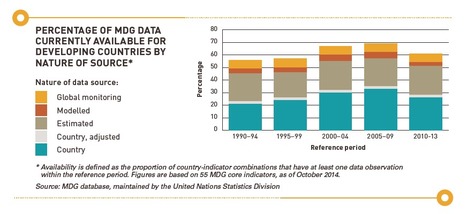
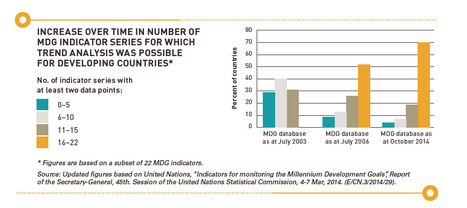
The figure above presents a summary snapshot of current data availability in the MDG database (as of October 2014), covering 55 core indicators for 157 developing countries or areas. There, a country is counted as having data for an indicator if it has at least one observation over the reference period, and availability is broken down by whether the data comes from country or international data sources, and whether it is estimated, adjusted or modelled. vi Overall, the picture is improving though still poor, so there is no five-year period when the availability of data is more than 70% of what is required. The drop in data availability after 2010 demonstrates the extent of the time lags that persist between collection and release of data.
Independent Expert Advisory Group to UN Secretary-General Ban Ki-moon: Data Revolution for Sustainable Development Requires Investment, Innovation and Leadersh…
|
Mobilising the Data Revolution for Sustainable Development: A Call to Action
A revolution is an idea – an inspiring vision of a world of fast-flowing data deployed for the public good, and of citizens and governments excited and empowered by the possibilities this creates. But it is also a practical proposition. Getting from here to there involves deliberate actions and choices.
Decisive action now, taking advantage of the current political opportunities, can set the scene and have a positive impact for years to come. Achieving the SDGs demands embracing the data revolution. We urge the UN Member States and system organisations to dramatically speed up their work in this field to support the global aspiration for sustainable development.
Data will be one of the fundamental elements of the accountability framework for the SDGs. Having high-quality data, and using it to create information that can track progress, monitor the use of resources, and evaluate the impacts of policy and programmes on different groups, is a key ingredient in creating more mutually accountable and participatory structures to monitor the new goals. However, we recognise that data is not the whole story. This report is about how data, and information, can be improved and made more accessible. The decisions on how those data and information will be used in any specific accountability framework for the SDGs belongs to the UN Member States and, as such, remains beyond the scope of this report.
Our recommendations for how to mobilise the data revolution for sustainable development suggest a comprehensive programme of action in four areas, illustrated to the right:
- principles and standards,
- technology, innovation and analysis,
- capacity and resources,
- leadership and governance.
At the heart of the recommendations in every area are people and the planet – our revolution is with them and for them.
Technology, innovation and analysis
Technology has been and will continue to be a fundamental driver of the data revolution. To harness the benefits of new technology, large and continuing investments in innovation are required at all levels, but especially in those institutions which are currently lagging behind. In addition, but beyond the scope of this report, an urgent effort needs to be made to increase access to information technologies by, among other things, increasing access to broadband, increasing literacy, including adult literacy, and increasing the use of ICT in schools worldwide, to ensure that all people, including the poorest, have access to the technologies that can improve their lives.
WE RECOMMEND …
… that the UN foster the establishment of a “Network of Data Innovation Networks” for sustainable development bringing together a range of partners and existing networks to generate knowledge and solve common problems. Some specific areas of activity could be:
- Urgently leverage emerging data sources for SDG monitoring, through an ‘SDG data lab’: The lab should mobilise key public, private and civil society data providers, academics and stakeholders to identify available and missing data and indicators, as well as opportunities for benefitting from new methods, analytical tools and technologies to improve the coverage, timeliness and availability of indicators in each of the SDG areas. Drawing on the existing MDG monitoring architecture, and working with other networks such as the Sustainable Development Solutions Network, it would develop new methodologies for monitoring new goals from January 2016.
- Develop systems for global data sharing: Identify areas where the development of common infrastructures to exploit the data revolution for sustainable development could solve capacity problems, produce efficiencies and encourage collaborations. One such suggestion would be a “world statistics cloud”, to store data and metadata produced by different institutions but according to common standards, rules and specifications.
- Fill research gaps: Identify critical research gaps, such as the relationships between data, incentives and behaviour. Engage research centres, innovators and governments in the development of publicly available data analytics tools and alogrithms to better capture and evaluate long-term trends affecting sustainable development.
- Create incentives: Engage social entrepreneurs, private sector, academia, media, civil society and other individuals and institutions in this global effort through initiatives such as prizes and data challenges.
Governance and leadership
Strong leadership by the UN is vital to make the data revolution serve sustainable development. Such leadership should be made very concrete through various actions and activities, and the continuous engagement of all relevant partners, maintaining a very open and transparent approach with governments, the private sector, NGOs, the media, and academic researchers. The primary aim would be to add value to existing institutional setups, accelerating the delivery of their outputs and building new partnerships. Short- and medium-term results should be clearly spelled out, and periodic reviews should be undertaken to ensure that global cooperation in this area is on the right track.
We recommend …
…the establishment of a “Global Partnership for Sustainable Development Data” (GPSDD)
to mobilise and coordinate as many initiatives and institutions as possible to achieve the vision sketched above. The GPSDD could promote several initiatives, such as:
- World Forum: The establishment of a biennial “World Forum on Sustainable Development Data”, and associated regional and country level events and ongoing engagements. These would maintain momentum on data improvements, foster regular engagement between private, public and community level data collectors and users, showcase ongoing activities and initiatives, create a network of ‘data champions’ around the world, and provide practical spaces for innovation, knowledge sharing, advocacy and technology transfer. The first Forum should be organised by the end of 2015, once the SDGs are agreed.
- Users forum: Establish a “Global Forum of SDG-Data Users”, to ensure feedback loops between data producers, processors and users to improve the usefulness of data and information produced. It would also help the international community to set priorities and assess results achieved, and could encourage replication and experimentation with user forums at country and agency level, increasing demand for and use of data. Particular attention should be paid to how to involve poor and marginalised people and communities in the forum.
- Partnerships and coordination: Work in partnership with international and regional organisations, and with other initiatives looking at best practices related to public data such as the Open Government Partnership (OGP) and the G8 Open Data Charter. The aim would be to enhance coordination of work in various areas, share knowledge on SDG monitoring, and encourage good practice such as open data and harmonisation. Also, to work together on developing common legal frameworks around rights to data and information and redress from abuses of data, to work together to implement new standards once agreed, and to streamline capacity building initiatives and reduce duplicated effort, mobilising new resources.
- Data sharing: Broker some key global public-private partnerships with private companies and civil society organisations for data sharing. Drawing on existing efforts already underway, these would provide models for best practice, useful for national and regional bodies trying to negotiate similar arrangements, would identify incentives and constraints specific to various industries, would allow for economies of scale, and would demonstrate the value and the possibility of sharing data and collaborating between public and private sectors.
We recommend …
… some “quick wins” on SDG data to demonstrate the feasibility of different approaches, experiment and innovate with partnerships and methods as a first step to setting up longer term initiatives. In addition to the proposed “SDG Data Lab”, these could include:
- SDGs analysis and visualisation platform: To be launched in September 2015, using the most advanced tools and features for exploring and analysing and re-using data, and demonstrating best practices in the engagement with data users through the provision of guidance and educational resources for data re-use, building on and coordinating with other platforms in other sectors. The development of the website would also represent a laboratory for fostering private-public partnerships and community-led peer-production efforts for data collection, dissemination and visualisation. It would be continuously updated during the lifetime of the SDGs, remaining a showcase for new ideas and innovations and a source of high quality and up to date information on progress.
- A dashboard on ”the state of the world”: This would harness the richness of traditional and new data, maintain the excitement and openness of the whole SDG process, engage think-tanks, academics and NGOs as well as the whole UN family in analysing, producing, verifying and auditing data, provide a place for experimentation with methods for integrating different data sources, including qualitative data, perceptions data and citizen-generated data, and eventually produce a ‘people’s baseline’ for new goals.
‘A WORLD THAT COUNTS‘ Presented to Secretary-General The Secretary-General’s Independent Expert Advisory Group on a Data Revolution for Sustainable Development (IEAG) met the Secretary-General today to hand over their culminating report A World That Counts: Mobilising The Data Revolution for Sustainable Development. The IEAG consists of … Read more
‘A WORLD THAT COUNTS‘ Presented to Secretary-General The Secretary-General’s Independent Expert Advisory Group on a Data Revolution for Sustainable Development (IEAG) met the Secretary-General today to hand over their culminating report A World That Counts: Mobilising The Data Revolution for Sustainable Development. The IEAG consists of … Read more
‘A WORLD THAT COUNTS‘ Presented to Secretary-General The Secretary-General’s Independent Expert Advisory Group on a Data Revolution for Sustainable Development (IEAG) met the Secretary-General today to hand over their culminating report A World That Counts: Mobilising The Data Revolution for Sustainable Development. The IEAG consists of … Read more
‘A WORLD THAT COUNTS‘ Presented to Secretary-General The Secretary-General’s Independent Expert Advisory Group on a Data Revolution for Sustainable Development (IEAG) met the Secretary-General today to hand over their culminating report A World That Counts: Mobilising The Data Revolution for Sustainable Development. The IEAG consists of … Read more
‘A WORLD THAT COUNTS‘ Presented to Secretary-General The Secretary-General’s Independent Expert Advisory Group on a Data Revolution for Sustainable Development (IEAG) met the Secretary-General today to hand over their culminating report A World That Counts: Mobilising The Data Revolution for Sustainable Development. The IEAG consists of … Read more
‘A WORLD THAT COUNTS‘ Presented to Secretary-General The Secretary-General’s Independent Expert Advisory Group on a Data Revolution for Sustainable Development (IEAG) met the Secretary-General today to hand over their culminating report A World That Counts: Mobilising The Data Revolution for Sustainable Development. The IEAG consists of … Read more
‘A WORLD THAT COUNTS‘ Presented to Secretary-General The Secretary-General’s Independent Expert Advisory Group on a Data Revolution for Sustainable Development (IEAG) met the Secretary-General today to hand over their culminating report A World That Counts: Mobilising The Data Revolution for Sustainable Development. The IEAG consists of … Read more
|