Your new post is loading...

|
Rescooped by
Dennis Swender
from The New Reality of Work
February 25, 2019 10:56 AM
|
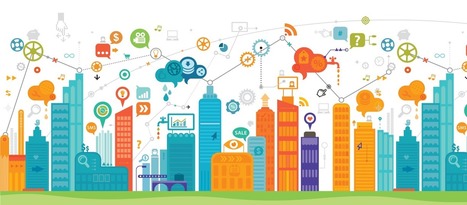
In today’s rapidly changing market, organizations and workforce experts alike are trying to determine what the future of work will look like. However, most professionals involved in the process operate from the perspective of their individual scope of responsibility, which often leads to siloed perspectives that may solve one aspect of the challenge—yet create another problem.
Based on conversations across the market and our in-depth research, KellyOCG has determined that there are four dimensions organizations need to consider when contemplating the “future of work”: the workforce, the workplace, technology, and social norms. By taking these four dimensions into account, organizations can better gain a comprehensive overview of the range of models they may want to utilize to engage and execute within their workforce plan. Further, they can assess which combination of engagement models will drive the business outcomes they want to achieve.
Via Denis Pennel
|
|
Rescooped by
Dennis Swender
from The New Reality of Work
February 25, 2019 10:51 AM
|
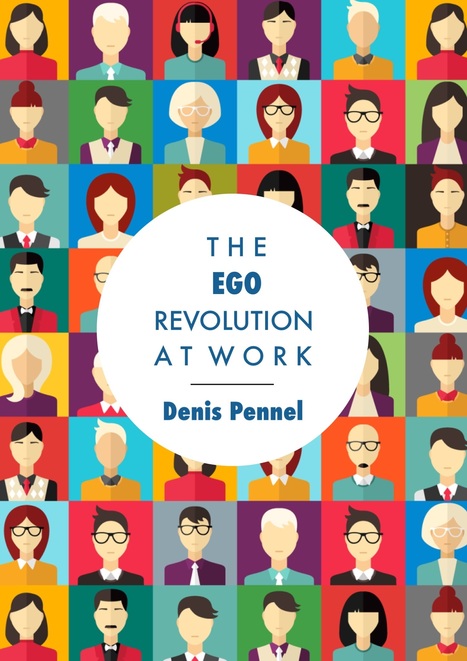
The Ego Revolution at Work: A must-Read!
Entitled “The Ego Revolution at Work”, the new book by Denis Pennel emphases the demise of a dominant work organisation model (Fordism) and the emergence of new forms of work (such as uberisation, human cloud, self-employment,). Today’s labour markets are characterised by the rise of a dispersed workforce and increasing working time flexibility. In this new environment the needs of individuals and business are changing rapidly: companies can no longer offer the security of “a job for life” and individuals want more freedom of choice and expect to work the way they live! The way businesses and individuals think about employment needs to change to accommodate this new working environment. The workplace must be aligned with today’s diverse workforce. Social benefits must become portable to protect individuals’ rights whatever their status, and with these benefits no longer attached to an organisation. Employers must find new ways to attract and retain just-in-time workers and to engage with an extended workforce.
Via Denis Pennel
|
|
Rescooped by
Dennis Swender
from Learning Organizations
February 21, 2019 12:25 PM
|
|
|
Rescooped by
Dennis Swender
from Philosophy everywhere everywhen
February 16, 2019 12:03 PM
|
One of the great paradoxes of human endeavour is why so much time and effort is spent on creating things and indulging in behaviour with no obvious survival value – behaviour otherwise known as art.
Attempting to shed light on this issue is problematic because first we must define precisely what art is. We can start by looking at how art, or the arts, were practised by early humans during the Upper Palaeolithic period, 40,000 to 12,000 years ago, and immediately thereafter.
This period is a far longer stretch of human history than the “modern” age and so how the arts were practised during it should serve as the starting point for any viable explanation. And while art in the modern world is often exploited as a means of expressing individualism, during most of cultural evolution it was utilised by small hunter-gatherer groups as a means of articulating social norms among most, if not all, members of a community.
The arts are special
Why should individuals engage in a preoccupation that requires significant effort, effort that could be better directed towards more immediately gainful activities, such as the search for food or other vital resources? One clue comes from the fact that art objects have special resonance because they come into being through human agency. This involves considerable emotional investment and, consequently, art acts as a crucial node in the complex web of things that make up a culture.
The time and effort committed to making art suggests such behaviour may be a means of signalling to other members of a group. Paradoxically, the very fact that art remains inscrutable and has little obvious practical value is precisely what makes it important for assessing whether a person making art can be regarded as a trustworthy member of a group. In short, art provided a “costly signal” (altruistic behaviour that indirectly benefits the individual by establishing a reputation) for monitoring group allegiance and managing a trust network that weeded out freeloaders.
When combined with ritual, which is often the case, art becomes an even more potent symbol. The notion that it can act as a vehicle for costly signalling is bolstered by the fact that art objects were regularly destroyed or defaced soon after being produced. This suggests that it was the process of making, rather than the final product, that was most significant.
Via Wildcat2030
|
|
Rescooped by
Dennis Swender
from The New Reality of Work
February 3, 2019 2:56 AM
|
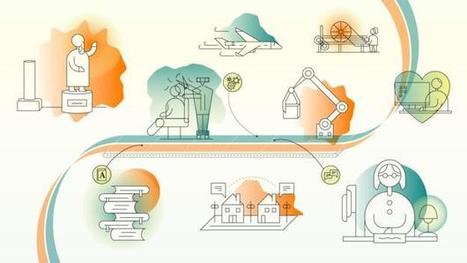
All the times we’ve predicted – wrongly — how technology will change our lives... A very nice infograph from the BBC
Via Denis Pennel
|
|
Rescooped by
Dennis Swender
from The New Reality of Work
February 3, 2019 2:56 AM
|
A new YouGov survey in conjunction with Teneo Blue Rubicon and McDonald’s reveals that almost six in ten (58%) UK workers would choose to start work earlier than 9am if they could leave earlier than 5pm.
Via Denis Pennel
|
|
Scooped by
Dennis Swender
February 1, 2019 6:12 AM
|
If you have a cause you believe in, technology has made it easier than ever to become a part of it.
|
|
Scooped by
Dennis Swender
January 10, 2019 1:47 PM
|
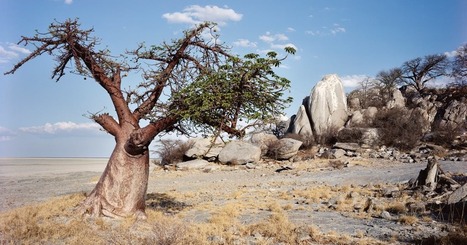
"Learn about one of the world's most iconic tree species, the baobab tree, and discover why these endangered trees might be on their way to extinction—or might outlive us all."
|
|
Scooped by
Dennis Swender
October 20, 2018 2:13 AM
|
The Harvard psychology professor discusses his thoughts on the roles and responsibilities of business today.
There is a tradition of cosmopolitanism, and if we had time we could study this tradition, which comes to us from, on the one hand, Greek thought with the Stoics, who have a concept of the 'citizen of the world'. You also have St.
Cosmopolitanism is the ideology that all human beings belong to a single community, based on a shared morality. A person who adheres to the idea of cosmopolitanism in any of its forms is called a cosmopolitan or cosmopolite.
A cosmopolitan community might be based on an inclusive morality, a shared economic relationship, or a political structure that encompasses different nations. In a cosmopolitan community individuals from different places (e.g. nation-states) form relationships of mutual respect. As an example, Kwame Anthony Appiah suggests the possibility of a cosmopolitan community in which individuals from varying locations (physical, economic, etc.) enter relationships of mutual respect despite their differing beliefs (religious, political, etc.).[1]
Various cities and locales, past or present, have been or are identified as "cosmopolitan"; that does not necessarily mean that all or most of their inhabitants consciously embrace the above philosophy. Rather, locales may be called "cosmopolitan" simply because people of various ethnic, cultural and/or religious background live in proximity and interact with each other.
In origin, cosmopolitanism suggests the establishment of a cosmo polis or ‘world state’ that would embrace all humanity. Cosmopolitanism has come to stand for peace and harmony among nations, founded upon understanding, tolerance and interdependence. Learn more / En savoir plus / Mehr erfahren: https://www.scoop.it/t/21st-century-learning-and-teaching/?&tag=Moral
Via Gust MEES
|
|
Rescooped by
Dennis Swender
from Edumorfosis.Work
August 11, 2018 10:05 PM
|
After a decade of flat productivity, the arrival of the Fourth Industrial Revolution (4IR) is expected to create up to $3.7 trillion in value to global manufacturing. A few years back, experts noted that the changes associated with the 4IR would come at an unprecedented rate yielding incredible results for those who truly embraced them.
The World Economic Forum, in collaboration with McKinsey, has undertaken a global search and assessment for “4IR production lighthouses” – sites representing the most advanced sub-section of the companies who are actively deploying 4IR technologies at scale. Leveraging these lighthouse sites, we will create an inclusive learning platform with aims on becoming the next “go-to” system for advanced manufacturing and bring the world closer to capturing the lion’s share of the benefits.
Via Edumorfosis
|
|
Scooped by
Dennis Swender
July 10, 2018 12:50 AM
|
The question is less whether a dress or an idea is borrowed, than the uses to which it’s then put.
|
|
Rescooped by
Dennis Swender
from Daily Magazine
June 15, 2018 1:20 PM
|
Lions and tigers and bears are increasingly becoming night owls because of us, a new study says.
Via THE OFFICIAL ANDREASCY
|
|
|
Rescooped by
Dennis Swender
from The New Reality of Work
February 25, 2019 10:51 AM
|
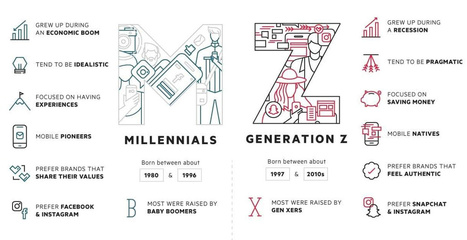
As Millennials enter their early-30s, the focus is now shifting to Generation Z - a group that is just starting to enter the workforce for the first time. Generation Z does not remember a time when the internet did not exist – and as such, it’s not surprising to learn that 50% of Gen Z spends 10 hours a day connected online, and 70% watches YouTube for two hours a day or more. But put aside this ultra-connectivity, and Gen Zers have some unique and possibly unexpected traits. Gen Z prefers face-to-face interactions in the workplace, and also expects to work harder than past groups. Gen Z is also the most diverse generation (49% non-white) and values racial equality as a top issue. Finally, Gen Z is possibly one of the most practical generations, valuing things like saving money and getting stable jobs.
Via Denis Pennel
|
|
Rescooped by
Dennis Swender
from :: The 4th Era ::
February 25, 2019 10:18 AM
|
For the purposes of this site, the history of human interaction with information may be divided into 4 eras. The first (spoken) era ended with the invention of writing around 3000-4000 BC. The second era ended with the invention of the printing press in 1440. The third era ended, and the fourth began, with the invention of the Internet (depending how one defines its operational beginning) somewhere between 1969 and 1982. We now exist early, but decidedly, in the fourth era. All readers may not agree with this interpretation of the history of information, especially with the division and numbering of the eras. That is not the main point. Rather, it is that humankind presently exists in an era distinctly different from the one that preceded it -- that in fact, this new era is accompanied with, and characterized by, a new - and quite different - information landscape. This new Internet information landscape will challenge, disrupt, and overpower the print-oriented one that came before it. It will not completely obliterate that which preceded it, but it will render it to a subsidiary, rather than primary, level of influence. Just as the printing press altered humanity's relationship with information, thereby resulting in massive restructuring of political, religious, economic, social, educational, cultural, scientific, and other realms of life; so too will the advance of digital technology occasion analogous transformations in the corresponding universe of present and future human activity. This site will concern itself primarily with how K-20 education in the US, and the people who comprise its constituencies, may be affected by this transformative movement from one era to the next. All ideas considered here appear, to me at least, to impact the learning enterprise in some way. Accordingly, this work looks at the present and the future through a lens that is predominantly, but far from entirely, a digital one. -JL Opinions expressed, scooped, or copied in this Scoop.it topic are my own, or a result of my own judgment, and should in no way be understood to reflect those of my employer.
Via Jim Lerman
|
|
Rescooped by
Dennis Swender
from Philosophy everywhere everywhen
February 16, 2019 12:05 PM
|
The modern West has placed a high premium on the value of equality. Equal rights are enshrined in law while old hierarchies of nobility and social class have been challenged, if not completely dismantled. Few would doubt that global society is all the better for these changes. But hierarchies have not disappeared. Society is still stratified according to wealth and status in myriad ways.
On the other hand, the idea of a purely egalitarian world in which there are no hierarchies at all would appear to be both unrealistic and unattractive. Nobody, on reflection, would want to eliminate all hierarchies, for we all benefit from the recognition that some people are more qualified than others to perform certain roles in society. We prefer to be treated by senior surgeons not medical students, get financial advice from professionals not interns. Good and permissible hierarchies are everywhere around us.
Yet hierarchy is an unfashionable thing to defend or to praise. British government ministers denounce experts as out of tune with popular feeling; both Donald Trump and Bernie Sanders built platforms on attacking Washington elites; economists are blamed for not predicting the 2008 crash; and even the best established practice of medical experts, such as childhood vaccinations, are treated with resistance and disbelief. We live in a time when no distinction is drawn between justified and useful hierarchies on the one hand, and self-interested, exploitative elites on the other.
Via Wildcat2030
|
|
Scooped by
Dennis Swender
February 14, 2019 12:17 PM
|
We are in a time when continuous learning is becoming the accepted norm in life. We no longer get some schooling, find a job, and then work there until retirement.
|
|
Rescooped by
Dennis Swender
from The New Reality of Work
February 3, 2019 2:56 AM
|
The five-day, 40-hour workweek is stretched to breaking point, and 2019 will be the year that it finally snaps.
Via Denis Pennel
|
|
Rescooped by
Dennis Swender
from The New Reality of Work
February 3, 2019 2:55 AM
|
The Ego Revolution at Work: A must-Read!
Entitled “The Ego Revolution at Work”, the new book by Denis Pennel emphases the demise of a dominant work organisation model (Fordism) and the emergence of new forms of work (such as uberisation, human cloud, self-employment,). Today’s labour markets are characterised by the rise of a dispersed workforce and increasing working time flexibility. In this new environment the needs of individuals and business are changing rapidly: companies can no longer offer the security of “a job for life” and individuals want more freedom of choice and expect to work the way they live! The way businesses and individuals think about employment needs to change to accommodate this new working environment. The workplace must be aligned with today’s diverse workforce. Social benefits must become portable to protect individuals’ rights whatever their status, and with these benefits no longer attached to an organisation. Employers must find new ways to attract and retain just-in-time workers and to engage with an extended workforce.
Via Denis Pennel
|
|
Rescooped by
Dennis Swender
from Talks
December 17, 2018 1:39 AM
|
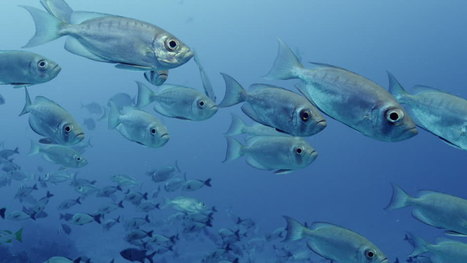
Collective behavior is embodied in swarms of insects, flocks of birds, herds of antelope, and schools of fish. In each of these cases, individuals move through their environment and respond to threats and opportunities almost simultaneously, forming an undulating enclave that seems to operate as a single entity. Such coordinated movement requires the rapid and efficient transfer of information among individuals, but understanding exactly how this information spreads through the group has long eluded scientists. Studying this behavior in schools of fish has been incredibly challenging, because the cues that drive it occur at lightening speed, come from multiple directions and sources, and of course because all of it takes place underwater. Now, Iain Couzin and his colleagues at the Max Planck Institute for Ornithology at the University of Konstanz, Germany are using new observation techniques and technologies—including high-speed video, motion-tracking software, and advanced statistical modeling—to reveal the mysterious mechanics of schooling fish. Their findings may shed light on the evolution and benefits of collective behavior across the animal kingdom.
Via Complexity Digest
|
|
Scooped by
Dennis Swender
October 20, 2018 2:04 AM
|
In Tanzania, it's more than the animals on a safari. It's the people--and make sure you get to meet the Masai.
|
|
Rescooped by
Dennis Swender
from Stage 5 Changing Places
August 25, 2018 12:11 AM
|
�� This map represents the population density of #Australia in 2016 – each colored area contains 1/4 of the Australian population. According to the 2016...
Via GTANSW & ACT
|
|
Rescooped by
Dennis Swender
from Edumorfosis.Work
August 3, 2018 11:11 AM
|
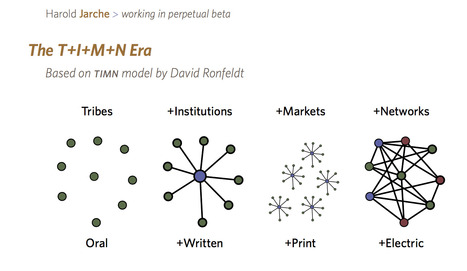
Our institutions and markets are failing us. We need new structures and the return to tribalism currently manifested as populism will not save us. As the advent of the printing press helped usher in an age of inquiry, first in the Christian religion and later in the enlightenment and scientific revolution, so we have to engage in creating new organizational and governance structures for a global network era.
Via Edumorfosis
Us and Them (by -400,000,000) is where we divide the world into those who are like us - the Us, the in-group - and those who are not like us - the Them, the out-group. It seems to go back at least hundreds of millions of years, back to when we were fish. Upon it…
Via Community Village Sites, Dennis Swender
|