Your new post is loading...

|
Scooped by
HAS-veille
January 3, 2023 8:17 AM
|
The XBB.1.5 variant is on a growth spurt in the United States
|
|
Scooped by
HAS-veille
January 3, 2023 5:25 AM
|
Cliquez ici pour éditer le contenu
|
|
Scooped by
HAS-veille
January 3, 2023 3:26 AM
|
|
|
Scooped by
HAS-veille
January 3, 2023 2:01 AM
|
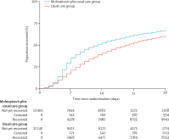
Vaccination against SARS-CoV-2 has been effective in reducing the burden of severe disease and death from COVID-19. Third doses of mRNA-based vaccines have provided a way to address waning immunity and broaden protection against emerging SARS-CoV-2 variants. However, their comparative effectiveness for a range of COVID-19 outcomes across diverse populations is unknown. We emulated a target trial using electronic health records of US veterans who received a third dose of either BNT162b2 or mRNA-1273 vaccines between 20 October 2021 and 8 February 2022, during a period that included Delta- and Omicron-variant waves. Eligible veterans had previously completed an mRNA vaccine primary series. We matched recipients of each vaccine in a 1:1 ratio according to recorded risk factors. Each vaccine group included 65,196 persons. The excess number of events over 16 weeks per 10,000 persons for BNT162b2 compared with mRNA-1273 was 45.4 (95% CI: 19.4, 84.7) for documented infection, 3.7 (2.2, 14.1) for symptomatic COVID-19, 10.6 (5.1, 19.7) for COVID-19 hospitalization, 2.0 (−3.1, 6.3) for COVID-19 intensive care unit admission and 0.2 (−2.2, 4.0) for COVID-19 death. After emulating a second target trial of veterans who received a third dose between 1 January and 1 March 2022, during a period restricted to Omicron-variant predominance, the excess number of events over 9 weeks per 10,000 persons for BNT162b2 compared with mRNA-1273 was 63.2 (95% CI: 15.2, 100.7) for documented infection. The 16-week risks of COVID-19 outcomes were low after a third dose of mRNA-1273 or BNT162b2, although risks were lower with mRNA-1273 than with BNT162b2, particularly for documented infection. Head-to-head comparison of third doses of mRNA COVID-19 vaccines in US Veterans finds that both are effective against documented SARS-CoV-2 infection and severe COVID-19 outcomes.
|
|
Scooped by
HAS-veille
December 22, 2022 4:24 AM
|
Background: Journal impact factor (IF) is the leading method of scholarly assessment in today’s research world, influencing where scholars submit their research and where funders distribute their resources. COVID-19, one of the most serious health crises, resulted in an unprecedented surge of publications across all areas of knowledge. An important question is whether COVID-19 affected the gold standard of scholarly assessment.
Objective: In this paper, we aimed to comprehensively compare the productivity trends of COVID-19 and non–COVID-19 literature as well as track their evolution and scholarly impact across 3 consecutive calendar years.
Results: A significant increase in IF change for manuscripts including COVID-19 published from 2019 to 2020 (P=.002; Annals: 283%; The BMJ: 199%; JAMA: 208%; The Lancet: 392%; NatMed: 111%; and NEJM: 196%) and to 2021 (P=.007; Annals: 41%; The BMJ: 90%; JAMA: 6%; The Lancet: 22%; NatMed: 53%; and NEJM: 72%) was seen, against non–COVID-19 ones. The likelihood of highly cited publications was significantly increased in COVID-19 manuscripts between 2019 and 2021 (Annals: z=3.4, P<.001; The BMJ: z=4.0, P<.001; JAMA: z=3.8, P<.001; The Lancet: z=3.5, P<.001; NatMed: z=5.2, P<.001; and NEJM: z=4.7, P<.001). The publication and citation rates of COVID-19 publications followed a positive trajectory, as opposed to non–COVID-19. The citation rate for COVID-19 publications peaked by the second quarter of 2020 while that of the publication rate approximately a year later.
Conclusions: The rapid surge of COVID-19 publications emphasized the capacity of scientific communities to respond against a global health emergency, yet inflated IFs create ambiguity as benchmark tools for assessing scholarly impact. The immediate implication is a loss in value of and trust in journal IFs as metrics of research and scientific rigor perceived by academia and society. Loss of confidence toward procedures employed by highly reputable publishers may incentivize authors to exploit the publication process by monopolizing their research on COVID-19 and encourage them to publish in journals of predatory behavior.
|
|
Scooped by
HAS-veille
December 21, 2022 3:52 AM
|
Multisystem inflammatory syndrome in children (MIS-C) is a rare and severe condition that follows benign COVID-19. We report autosomal recessive deficiencies of OAS1, OAS2, or RNASEL in five unrelated children with MIS-C. The cytosolic dsRNA-sensing OAS
|
|
Scooped by
HAS-veille
December 20, 2022 2:03 AM
|
La vaccination est souvent associée à une piqure. Elle peut également prendre la forme d’un spray nasal : une approche encore rare, mais qui pourrait être efficace contre le Covid. Voici pourquoi.
|
|
Scooped by
HAS-veille
December 19, 2022 2:04 AM
|
This secondary analysis of an ongoing adaptive platform trial examines the effect of multiple interventions for critically ill adults with COVID-19 on longer-term outcomes.
|
|
Scooped by
HAS-veille
December 19, 2022 1:15 AM
|
This report describes the effectiveness of the updated (bivalent) COVID-19 vaccines for prevention of COVID-19 associated emergency department and urgent care visits and hospitalization among adults ages 18 years or older without a weakened immune system.
|
|
Scooped by
HAS-veille
December 15, 2022 7:35 AM
|
|
|
Scooped by
HAS-veille
December 15, 2022 4:55 AM
|
This cross-sectional study estimates BNT162b2 vaccine effectiveness against SARS-CoV-2 infection among children aged 5 to 11 years during Delta and Omicron variant–predominant periods, by prior SARS-CoV-2 infection status and Omicron sublineage.
|
|
Scooped by
HAS-veille
December 15, 2022 4:50 AM
|
COVID-related mortality rates by country for 2020 and 2021.
|
|
Scooped by
HAS-veille
December 15, 2022 4:48 AM
|
Huge discrepancies in estimates of excess mortality reveal not just how difficult the calculations are, but how far the world has to go in recording how people die.
|
|
|
Scooped by
HAS-veille
January 3, 2023 5:29 AM
|
The safety, effectiveness, and cost-effectiveness of molnupiravir, an oral antiviral medication for SARS-CoV-2, has not been established in vaccinated…
|
|
Scooped by
HAS-veille
January 3, 2023 5:03 AM
|
Abstract Background Nirmatrelvir–ritonavir has been authorized for emergency use by many countries for the treatment of coronavirus disease 2019 (Covid-19). However, the supply falls short of th
|
|
Scooped by
HAS-veille
January 3, 2023 3:23 AM
|
A pragmatic randomized clinical trial demonstrated that angiotensin receptor blockers (ARBs), widely used as an antihypertensive and used to treat individuals with a high risk of heart disease, did not improve clinical outcomes among people hospitalized with COVID-19.
|
|
Scooped by
HAS-veille
December 22, 2022 7:51 AM
|
|
|
Scooped by
HAS-veille
December 22, 2022 3:58 AM
|
Omicron Neutralization after Bivalent Vaccine Boost One or two monovalent vaccine boosters showed a large decrease in neutralization activity against omicron subvariants. The BA.5-containin
|
|
Scooped by
HAS-veille
December 21, 2022 2:50 AM
|
Les vaccins que nous connaissons sont utilisés en prévention des maladies infectieuses. On attend d'eux qu'ils empêchent l'infection par un agent pathogène, ou à défaut qu'ils empêchent le développement d'une maladie ou de ses manifestations les plus graves. Evaluer leur efficacité, particulièrement pendant les phases de développement, peut être difficile et demander beaucoup de temps. On évalue plus facilement leur immunogénicité, c'est dire leur capacité à induire une réponse immunitaire qui se traduit par l'apparition d'anticorps et de cellules spécialisées. Pour montrer que cette réponse est protectrice, lorsqu'il n'est pas envisageable d'infecter expérimentalement des volontaires (on parle de « challenge », réservé à des maladies à coup sûr bénignes), il est nécessaire de comparer les risques d'infection et de maladie entre des groupes de personnes vaccinées et non vaccinées qui vont se trouver naturellement exposées à l'infection. Si celle-ci se transmet peu, si d'autres mesures sont utilisées simultanément pour en limiter la transmission, ou si une partie de la population est déjà protégée ou non exposée, alors que des centaines ou des milliers de cas sont parfois nécessaires pour établir des statistiques fiables, l'évaluation de l'efficacité d'un vaccin peut prendre des mois ou des années. Après sa mise en service, la comparaison avec d'autres vaccins ou entre lots pour un même produit doit également être envisagée et pouvoir être menée rapidement.
|
|
Scooped by
HAS-veille
December 19, 2022 5:43 AM
|
|
|
Scooped by
HAS-veille
December 19, 2022 1:38 AM
|
Except for spontaneous reporting systems, vaccine safety monitoring generally involves pre-specifying health outcomes and post-vaccination risk window…
|
|
Scooped by
HAS-veille
December 19, 2022 1:15 AM
|
This report describes the effectiveness of the updated (bivalent) COVID-19 vaccines for prevention of COVID-19-associated hospitalization among adults ages 65 years or older who did not have a weakened immune system and who were hospitalized with COVID-19-like illness.
|
|
Scooped by
HAS-veille
December 15, 2022 7:30 AM
|
Les réactions inflammatoires au SARS-COV-2 varient fortement en fonction des individus. Des médecins et chercheurs de l’Institut Pasteur, du St. James's Hospital de Dublin et du Trinity College de Dublin ont identifié des facteurs de vulnérabilité supérieure de certaines personnes à la COVID-19, ce qui pourrait orienter l’élaboration de nouvelles stratégies thérapeutiques. Les chercheurs ont notamment découvert un lien entre les formes sévères de la maladie et la difficulté voire l’incapacité des individus à produire une protéine antivirale clé appelée interféron de type 1.
|
|
Scooped by
HAS-veille
December 15, 2022 4:50 AM
|
The World Health Organization has a mandate to compile and disseminate statistics on mortality, and we have been tracking the progression of the COVID-19 pandemic since the beginning of 20201. Reported statistics on COVID-19 mortality are problematic for many countries owing to variations in testing access, differential diagnostic capacity and inconsistent certification of COVID-19 as cause of death. Beyond what is directly attributable to it, the pandemic has caused extensive collateral damage that has led to losses of lives and livelihoods. Here we report a comprehensive and consistent measurement of the impact of the COVID-19 pandemic by estimating excess deaths, by month, for 2020 and 2021. We predict the pandemic period all-cause deaths in locations lacking complete reported data using an overdispersed Poisson count framework that applies Bayesian inference techniques to quantify uncertainty. We estimate 14.83 million excess deaths globally, 2.74 times more deaths than the 5.42 million reported as due to COVID-19 for the period. There are wide variations in the excess death estimates across the six World Health Organization regions. We describe the data and methods used to generate these estimates and highlight the need for better reporting where gaps persist. We discuss various summary measures, and the hazards of ranking countries’ epidemic responses. Msemburi et al. describe how the World Health Organization has estimated the excess mortality associated with the COVID-19 pandemic, by month and for 2020 and 2021, and analyse their estimates across the WHO member states, with 14.83 million global excess deaths estimated.
|
|
Scooped by
HAS-veille
December 15, 2022 4:49 AM
|
Coronavirus disease 2019 (COVID-19) is known to cause multi-organ dysfunction1–3 during acute infection with severe acute respiratory syndrome coronavirus 2 (SARS-CoV-2), with some patients experiencing prolonged symptoms, termed post-acute sequelae of SARS-CoV-2 (refs. 4,5). However, the burden of infection outside the respiratory tract and time to viral clearance are not well characterized, particularly in the brain3,6–14. Here we carried out complete autopsies on 44 patients who died with COVID-19, with extensive sampling of the central nervous system in 11 of these patients, to map and quantify the distribution, replication and cell-type specificity of SARS-CoV-2 across the human body, including the brain, from acute infection to more than seven months following symptom onset. We show that SARS-CoV-2 is widely distributed, predominantly among patients who died with severe COVID-19, and that virus replication is present in multiple respiratory and non-respiratory tissues, including the brain, early in infection. Further, we detected persistent SARS-CoV-2 RNA in multiple anatomic sites, including throughout the brain, as late as 230 days following symptom onset in one case. Despite extensive distribution of SARS-CoV-2 RNA throughout the body, we observed little evidence of inflammation or direct viral cytopathology outside the respiratory tract. Our data indicate that in some patients SARS-CoV-2 can cause systemic infection and persist in the body for months. A study reports the distribution, replication and persistence of SARS-CoV-2 throughout the human body including in the brain at autopsy from acute infection to more than seven months following symptom onset.
|


 Scoop.it!