Your new post is loading...

|
Scooped by
HAS-veille
December 14, 2022 9:24 AM
|
The effectiveness of coronavirus disease 2019 (COVID-19) vaccine in the prevention of post–COVID-19 conditions: A systematic literature review and meta-analysis - Volume 2 Issue 1
|
|
Scooped by
HAS-veille
December 14, 2022 6:21 AM
|
Long Covid has begun appearing on death certificates for a small percentage of people who have died during the pandemic, but that tiny fraction of records only hints at the whole story, experts say.
|
|
Scooped by
HAS-veille
December 14, 2022 4:41 AM
|
|
|
Scooped by
HAS-veille
December 13, 2022 2:37 AM
|
Background: In the EPIC-HR (Evaluation of Protease Inhibition for Covid-19 in High-Risk Patients) trial, nirmatrelvir plus ritonavir led to an 89% reduction in hospitalization or death among unvaccinated outpatients with early COVID-19. The clinical impact of nirmatrelvir plus ritonavir among vaccinated populations is uncertain. Objective: To assess whether nirmatrelvir plus ritonavir reduces risk for hospitalization or death among outpatients with early COVID-19 in the setting of prevalent SARS-CoV-2 immunity and immune-evasive SARS-CoV-2 lineages. Design: Population-based cohort study analyzed to emulate a clinical trial using inverse probability–weighted models to account for anticipated bias in treatment. Setting: A large health care system providing care for 1.5 million patients in Massachusetts and New Hampshire during the Omicron wave (1 January to 17 July 2022). Patients: 44 551 nonhospitalized adults (90.3% with ≥3 vaccine doses) aged 50 years or older with COVID-19 and no contraindications for nirmatrelvir plus ritonavir. Measurements: The primary outcome was a composite of hospitalization within 14 days or death within 28 days of a COVID-19 diagnosis. Results: During the study period, 12 541 (28.1%) patients were prescribed nirmatrelvir plus ritonavir, and 32 010 (71.9%) were not. Patients prescribed nirmatrelvir plus ritonavir were more likely to be older, have more comorbidities, and be vaccinated. The composite outcome of hospitalization or death occurred in 69 (0.55%) patients who were prescribed nirmatrelvir plus ritonavir and 310 (0.97%) who were not (adjusted risk ratio, 0.56 [95% CI, 0.42 to 0.75]). Recipients of nirmatrelvir plus ritonavir had lower risk for hospitalization (adjusted risk ratio, 0.60 [CI, 0.44 to 0.81]) and death (adjusted risk ratio, 0.29 [CI, 0.12 to 0.71]). Limitation: Potential residual confounding due to differential access to COVID-19 vaccines, diagnostic tests, and treatment. Conclusion: The overall risk for hospitalization or death was already low (1%) after an outpatient diagnosis of COVID-19, but nirmatrelvir plus ritonavir reduced this risk further. Primary Funding Source: National Institutes of Health.
|
|
Scooped by
HAS-veille
December 12, 2022 2:03 AM
|
A Covid-19 Milestone Attained The rapid identification of a correlate of protection for Covid-19 vaccines — on the basis of several harmonized randomized phase 3 trials using common validate
|
|
Scooped by
HAS-veille
December 9, 2022 1:22 AM
|
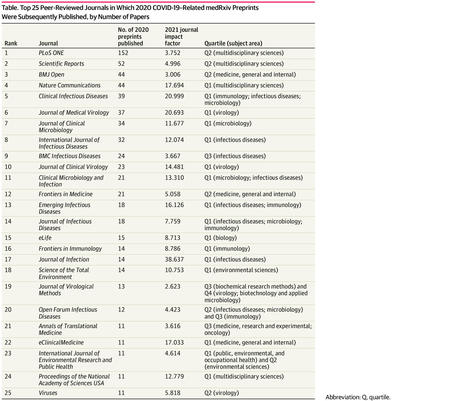
This cross-sectional study evaluates subsequent journal publication of COVID-19–related articles initially posted as medRxiv preprints in 2020.
|
|
Scooped by
HAS-veille
December 8, 2022 10:13 AM
|
It is puzzling that a sizeable percentage of people refuse to get vaccinated against COVID-19. This study aimed to examine social psychological factors influencing their vaccine hesitancy. Thi
|
|
Scooped by
HAS-veille
December 8, 2022 5:15 AM
|
Antiviral Agents and Omicron BQ.1.1 and XBB Neither bebtelovimab nor any mAb combinations tested neutralized the SARS-CoV-2 omicron subvariants BQ.1.1 and XBB, but remdesivir, molnupiravir, an
|
|
Scooped by
HAS-veille
December 7, 2022 7:47 AM
|
|
|
Scooped by
HAS-veille
December 7, 2022 7:05 AM
|
This cohort study of patients with COVID-19 compares the incidence rates of viral rebound in patients with COVID-19 treated with molnupiravir or nirmatrelvir-ritonavir.
|
|
Scooped by
HAS-veille
December 7, 2022 7:00 AM
|
UDCA, a drug commonly used for liver conditions, could protect people who do not have access to vaccines and those with a weak immune system from severe COVID-19.
|
|
Scooped by
HAS-veille
December 7, 2022 6:55 AM
|
|
|
Scooped by
HAS-veille
December 7, 2022 3:53 AM
|
Entre 2020 et août 2022, 34,5 millions de cas de contamination à la Covid 19 ont été identifiés en France (hors résultats des auto-tests). Plus de 150 000 personnes sont décédées, dont près de 126 400 à l’hôpital. Le contact tracing, déployé à partir de mai 2020 à la sortie du premier confinement, est l’un des outils de lutte contre cette épidémie. Il a consisté à joindre par téléphone, par SMS ou par courriel, les personnes dépistées positives afin qu’elles recensent les personnes avec lesquelles elles ont été en contact, puis à prendre l’attache de ces dernières pour les informer - tout en préservant l’anonymat des individus positifs -, et leur communiquer des consignes de prévention. Depuis sa mise en place, l’assurance maladie a joint plus de 32 millions de personnes dépistées positives à la Covid 19 et près de 22,7 millions de personnes contact. L’implication de l’assurance maladie dans une mission de santé publique inédite, de grande ampleur et évolutive Dans l’urgence, l’assurance maladie a créé ce système d’information, mis en place des plateformes départementales d’enquêteurs, recruté des milliers de contractuels à durée déterminée puis indéterminée, et adapté continûment son dispositif. Depuis mai 2020, l’organisme a joint plus de 32 millions de personnes dépistées positives et près de 22,7 millions de personnes contact, d’abord par téléphone puis essentiellement par SMS ou par courriel. Au total, les dépenses liées au contact tracing, notamment de personnel, pourraient dépasser 600 M€ au titre des années 2020 à 2022. Une efficacité globale incertaine Sans le contact tracing, il est vraisemblable que les contaminations auraient été plus nombreuses ou rapides et leur incidence plus forte sur les hôpitaux, mais ces impacts ne peuvent être quantifiés en l’absence d’évaluation scientifique. L’assurance maladie est parvenue à joindre plus de neuf personnes sur dix dépistées positives, ou qui lui ont été déclarées comme cas contact, et plus de 90% des personnes positives jointes l’ont été dans les 24 heures suivant l’annonce du résultat du test. En revanche, seules 70 à 80% des personnes contact ont été jointes dans les 24 heures suivant leur recensement. Seule une partie des personnes cas contact a pu être recensée - en moyenne, une personne dépistée positive sur deux ne lui a déclaré aucune personne contact en 2020 et en 2021. Les vagues épidémiques successives ont augmenté la charge de travail de l’assurance maladie et l’ont donc conduit à alléger les procédures de recherche des cas contact, ce qui a sensiblement atténué leur impact. En effet, l’envoi aux personnes positives de SMS les invitant à télédéclarer leurs contacts sur un site internet a entraîné moins de déclarations de cas contact que les appels téléphoniques. Ainsi, au premier semestre 2022, près de 90% des personnes positives n’ont déclaré aucun contact. Un dispositif en voie d’extinction, des enseignements à tirer La vaccination est devenue le principal instrument de lutte contre l’épidémie, alors que le contact tracing ne recense plus qu’une part réduite des personnes contact (moins de 0,5 en moyenne par personne positive en juillet 2022, contre près de 2,5 en novembre 2021). La loi du 30 juillet 2022 mettant fin aux régimes d’exception créés pour lutter contre l’épidémie liée à la covid 19 conduit à interrompre ce dispositif au 31 janvier 2023. Les effectifs consacrés par l’assurance maladie au contact tracing ont été fortement réduits (350 ETP de CDD-CDI en septembre 2022, contre 6 500 en moyenne en 2021). Il apparaît cependant essentiel que les outils, procédures et effets d’apprentissage du contact tracing soient valorisés pour l’avenir. Dans l’éventualité de la survenance de nouvelles épidémies de grande ampleur, il conviendrait de permettre aux pouvoirs publics d’activer rapidement un dispositif opérationnel et plus performant dans l’attente d’une couverture vaccinale efficace. Ainsi, la Cour recommande qu’à partir d’une évaluation scientifique de l’impact du contact tracing sur les chaînes de contamination de la Covid 19, un dispositif de crise puisse être activé puis désactivé dans des délais rapides afin de rompre ces chaînes.
|
|
|
Scooped by
HAS-veille
December 14, 2022 9:22 AM
|
|
|
Scooped by
HAS-veille
December 14, 2022 5:25 AM
|
|
|
Scooped by
HAS-veille
December 13, 2022 3:40 AM
|
Several studies have shown that SARS-CoV-2 BA.1 omicron is an immune escape variant. Meanwhile, however, omicron BA.2 and BA.5 became dominant in many countries and replaced BA.1. As both have several mutations compared to BA.1, we analyzed whether BA.2 and BA.5 show further immune escape relative to BA.1. Here, we characterized neutralization profiles against the BA.2 and BA.5 omicron sub-variants in plasma samples from individuals with different history of exposures to infection/vaccination and found that unvaccinated individuals after a single exposure to BA.2 had limited cross-neutralizing antibodies to pre-omicron variants and to BA.1. Consequently, our antigenic map including all Variants of Concern and BA.1, BA.2 and BA.5 omicron sub-variants, showed that all omicron sub-variants are distinct to pre-omicron variants, but that the three omicron variants are also antigenically distinct from each other. The antibody landscapes illustrate that cross-neutralizing antibodies against the current antigenic space, as described in our maps, are generated only after three or more exposures to antigenically close variants but also after two exposures to antigenically distant variants. Here, we describe the antigenic space inhabited by the relevant SARS-CoV-2 variants, the understanding of which will have important implications for further vaccine strain adaptations. SARS-CoV-2 omicron variant BA.1 has shown increased transmissibility and immune escape, relative to previous SARS-CoV-2 variants. In this study, authors utilise antigenic cartography to characterise the neutralisation profiles of omicron sub-lineages, BA.2 and BA.5, in comparison to BA.1 and pre-omicron variants.
|
|
Scooped by
HAS-veille
December 13, 2022 2:27 AM
|
Despite the availability of the ChAdOx1-S booster vaccine, little is known about the real-world effectiveness although clinical trials have demonstrated enhanced immunity following a ChAdOx1-S booster. In England 43,171 individuals received a ChAdOx1-S booster whilst 13,038,908 individuals received BNT162b2 in the same period. ChAdOx1-S booster recipients were more likely to be female (adjusted odds ratio (OR) 1.67 (1.64-1.71)), in a clinical risk group (adjusted OR 1.58 (1.54-1.63)), in the clinically extremely vulnerable group (adjusted OR 1.84 (1.79-1.89)) or severely immunosuppressed (adjusted OR 2.05 (1.96-2.13)). The effectiveness of the ChAdOx1-S and BNT162b2 boosters is estimated here using a test-negative case-control study. Protection against symptomatic disease with the Omicron variant peaks at 66.1% (16.6 to 86.3%) and 68.5% (65.7 to 71.2%) for the ChAdOx1-S and BNT162b2 boosters in older adults. Protection against hospitalisation peaks at 82.3% (64.2 to 91.3%) and 90.9% (88.7 to 92.7%). For Delta, effectiveness against hospitalisation is 80.9% (15.6% to 95.7%) and 93.9% (92.8% to 94.9%) after ChAdOx1-S and BNT162b2 booster vaccination. This study supports the consideration of ChAdOx1-S booster vaccination for protection against severe COVID-19 in settings yet to offer boosters and suggests that individuals who received a ChAdOx1-S booster do not require re-vaccination ahead of others. Vaccine effectiveness of a ChAdOx1-S booster was estimated in a test-negative case-control study in England. Protection was found to be moderate against mild disease but remained high and comparable to that of an mRNA booster against hospitalisation with Omicron.
|
|
Scooped by
HAS-veille
December 9, 2022 1:25 AM
|
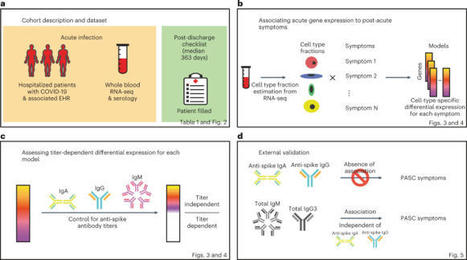
Post-acute sequelae of severe acute respiratory syndrome coronavirus 2 (SARS-CoV-2) infection are debilitating, clinically heterogeneous and of unknown molecular etiology. A transcriptome-wide investigation was performed in 165 acutely infected hospitalized individuals who were followed clinically into the post-acute period. Distinct gene expression signatures of post-acute sequelae were already present in whole blood during acute infection, with innate and adaptive immune cells implicated in different symptoms. Two clusters of sequelae exhibited divergent plasma-cell-associated gene expression patterns. In one cluster, sequelae associated with higher expression of immunoglobulin-related genes in an anti-spike antibody titer-dependent manner. In the other, sequelae associated independently of these titers with lower expression of immunoglobulin-related genes, indicating lower non-specific antibody production in individuals with these sequelae. This relationship between lower total immunoglobulins and sequelae was validated in an external cohort. Altogether, multiple etiologies of post-acute sequelae were already detectable during SARS-CoV-2 infection, directly linking these sequelae with the acute host response to the virus and providing early insights into their development. Transcriptomic analyses of acute phase whole blood from a large cohort of patients with COVID-19 identify molecular determinants of post-infection long-term sequelae.
|
|
Scooped by
HAS-veille
December 8, 2022 10:20 AM
|
The FDA amended the emergency use authorizations (EUAs) of the updated (bivalent) Moderna and Pfizer-BioNTech COVID-19 vaccines to include use in children down to 6 months of age.
|
|
Scooped by
HAS-veille
December 8, 2022 8:34 AM
|
|
|
Scooped by
HAS-veille
December 7, 2022 7:50 AM
|
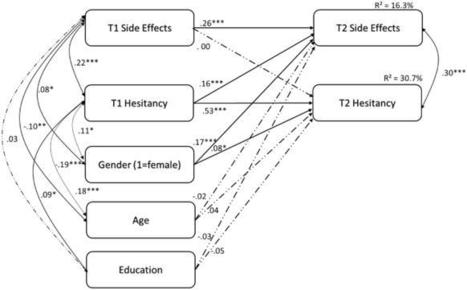
The directionality between vaccine hesitancy and COVID-19 vaccine side-effects has not been hitherto examined. We hypothesized a nocebo effect, whereby vaccine hesitancy towards the second Pfizer vaccination dose predicts subsequent side-effects for a booster dose, beyond other effects. We expected these nocebo effects to be driven by (mis)information in males and prior experience in females. A representative sample of older adults (n = 756, mean age = 68.9 ± 3.43) were questioned in a typical cross-lagged design (wave 1 following a second Pfizer dose, wave 2 after their booster). As hypothesized, earlier vaccine hesitancy predicted subsequent booster side-effects for females (β = 0.10 p = 0.025, f 2 = 0.02) and males (β = 0.34, p < 0.001, f 2 = 0.16); effects were stronger in males (χ2Δ (1) = 4.34, p = 0.03). The (W1-to-W2) side-effect autoregression was stronger in females (β = .34, p < 0.001; males β = 0.18, p < 0.001), χ2Δ (1) = 26.86, p < 0.001. Results show that a quantifiable and meaningful portion of COVID-19 vaccine side-effects is predicted by vaccine hesitancy, demonstrating that side-effects comprise a psychosomatic nocebo component in vaccinated individuals. The data reveal distinct risk levels for future side-effects, suggesting the need to tailor public health messaging.
|
|
Scooped by
HAS-veille
December 7, 2022 7:06 AM
|
|
|
Scooped by
HAS-veille
December 7, 2022 7:00 AM
|
Prevention of SARS-CoV-2 infection through the modulation of viral host receptors, such as ACE21, could represent a new chemoprophylactic approach for COVID-19 complementing vaccination2,3. However, the mechanisms controlling ACE2 expression remain elusive. Here, we identify the farnesoid X receptor (FXR) as a direct regulator of ACE2 transcription in multiple COVID19-affected tissues, including the gastrointestinal and respiratory systems. We then use the over-the-counter compound z-guggulsterone (ZGG) and the off-patent drug ursodeoxycholic acid (UDCA) to reduce FXR signalling and downregulate ACE2 in human lung, cholangiocyte and intestinal organoids and in the corresponding tissues in mice and hamsters. We demonstrate that UDCA-mediated ACE2 downregulation reduces susceptibility to SARS-CoV-2 infection in vitro, in vivo and in human lungs and livers perfused ex situ. Furthermore, we illustrate that UDCA reduces ACE2 expression in the nasal epithelium in humans. Finally, we identify a correlation between UDCA treatment and positive clinical outcomes following SARS-CoV-2 infection using retrospective registry data, and confirm these findings in an independent validation cohort of liver transplant recipients. In conclusion, we identify a novel function of FXR in controlling ACE2 expression and provide evidence that modulation of this pathway could be beneficial for reducing SARS-CoV-2 infection, paving the road for future clinical trials.
|
|
Scooped by
HAS-veille
December 7, 2022 6:59 AM
|
Key genes that are active in the brains of older people are also active in the brains of people who developed serious COVID-19.
|
|
Scooped by
HAS-veille
December 7, 2022 5:45 AM
|
|


 Scoop.it!