Your new post is loading...

|
Scooped by
HAS-veille
January 13, 2023 9:17 AM
|
According to the current ECDC assessment, there is moderate probability of XBB.1.5 becoming dominant in the EU/EEA and causing a substantial increase in the number of COVID-19 cases within the next one to two months.
|
|
Scooped by
HAS-veille
January 13, 2023 1:24 AM
|
This report describes similar early safety findings from the Vaccine Adverse Event Reporting System for bivalent booster vaccination in children aged 5–11 years as the monovalent booster vaccination.
|
|
Scooped by
HAS-veille
January 12, 2023 4:20 AM
|
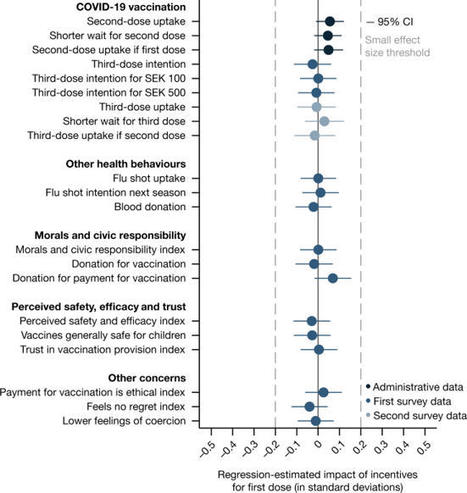
Rigorously designed studies can dispel suspicions that offering cash for vaccines erodes trust, and help health-care providers to design effective immunization campaigns.
|
|
Scooped by
HAS-veille
January 12, 2023 4:18 AM
|
|
|
Scooped by
HAS-veille
January 12, 2023 1:15 AM
|
Response to BA.5 Bivalent Booster In a small study, neutralizing antibody titers against the ancestral strain of SARS-CoV-2 were higher than titers against omicron BA.5 after both monovalent an
|
|
Scooped by
HAS-veille
January 12, 2023 12:48 AM
|
A review of the cumulative body of evidence
|
|
Scooped by
HAS-veille
January 10, 2023 2:05 AM
|
Despite the availability of multiple safe vaccines, vaccine hesitancy may present a challenge to successful control of the COVID-19 pandemic. As with many human behaviors, people’s vaccine acceptance may be affected by their beliefs about whether others will accept a vaccine (i.e., descriptive norms). However, information about these descriptive norms may have different effects depending on the actual descriptive norm, people’s baseline beliefs, and the relative importance of conformity, social learning, and free-riding. Here, using a pre-registered, randomized experiment (N = 484,239) embedded in an international survey (23 countries), we show that accurate information about descriptive norms can increase intentions to accept a vaccine for COVID-19. We find mixed evidence that information on descriptive norms impacts mask wearing intentions and no statistically significant evidence that it impacts intentions to physically distance. The effects on vaccination intentions are largely consistent across the 23 included countries, but are concentrated among people who were otherwise uncertain about accepting a vaccine. Providing normative information in vaccine communications partially corrects individuals’ underestimation of how many other people will accept a vaccine. These results suggest that presenting people with information about the widespread and growing acceptance of COVID-19 vaccines helps to increase vaccination intentions. The authors show that accurate information about descriptive norms can increase intentions to accept a vaccine for COVID-19. They show that these effects are largely consistent in the 23 included countries and are concentrated among people who were otherwise uncertain about accepting a vaccine.
|
|
Scooped by
HAS-veille
January 10, 2023 1:50 AM
|
Prevalence of a new subvariant of Omicron is increasing, but whether it will cause a big surge in infections or hospitalizations isn’t clear.
|
|
Scooped by
HAS-veille
January 9, 2023 1:21 AM
|
|
|
Scooped by
HAS-veille
January 6, 2023 2:46 AM
|
Le contexte épidémique de la Covid-19 en France est actuellement marqué par une prédominance du sous-variant BA.5 d'Omicron et de son sous-lignage BQ1.
|
|
Scooped by
HAS-veille
January 6, 2023 1:53 AM
|
We now have adequate data to describe the core symptoms, course, and prevalence of
long COVID. Core symptoms include breathing difficulties, muscle pain, anosmia, tingling
extremities, and general tiredness. Many of these symptoms are non-specific, but are
seen at higher rates in people with long COVID than would be expected in the general
population.1
|
|
Scooped by
HAS-veille
January 4, 2023 3:58 AM
|
|
|
Scooped by
HAS-veille
January 3, 2023 10:50 AM
|
Accurate determination of mortality attributable to SARS-CoV-2 vaccination is critical in allaying concerns about their safety. We reviewed every death in Qatar that occurred within 30 days of any SARS-CoV-2 vaccine administration between January 1, 2021 and June 12, 2022. Probability of association with SARS-CoV-2 vaccination was determined by four independent trained reviewers using a modified WHO algorithm. Among 6,928,359 doses administered, 138 deaths occurred within 30 days of vaccination; eight had a high probability (1.15/1,000,000 doses), 15 had intermediate probability (2.38/1,000,000 doses), and 112 had low probability or no association with vaccination. The death rate among those with high probability of relationship to SARS-CoV-2 vaccination was 0.34/100,000 unique vaccine recipients, while death rate among those with either high or intermediate probability of relationship to SARS-CoV-2 vaccination was 0.98/100,000 unique vaccine recipients. In conclusion, deaths attributable to SARS-CoV-2 vaccination are extremely rare and lower than the overall crude mortality rate in Qatar. This study assesses the probability that deaths following a COVID-19 vaccination are attributable to the vaccine. The authors review all deaths that occurred within 30 days of vaccine receipt in Qatar until June 2022 and find that deaths attributable to vaccination are extremely rare.
|
|
|
Scooped by
HAS-veille
January 13, 2023 1:31 AM
|
|
|
Scooped by
HAS-veille
January 12, 2023 6:16 AM
|
|
|
Scooped by
HAS-veille
January 12, 2023 4:19 AM
|
Financial incentives to encourage healthy and prosocial behaviours often trigger initial behavioural change1–11, but a large academic literature warns against using them12–16. Critics warn that financial incentives can crowd out prosocial motivations and reduce perceived safety and trust, thereby reducing healthy behaviours when no payments are offered and eroding morals more generally17–24. Here we report findings from a large-scale, pre-registered study in Sweden that causally measures the unintended consequences of offering financial incentives for taking the first dose of a COVID-19 vaccine. We use a unique combination of random exposure to financial incentives, population-wide administrative vaccination records and rich survey data. We find no negative consequences of financial incentives; we can reject even small negative impacts of offering financial incentives on future vaccination uptake, morals, trust and perceived safety. In a complementary study, we find that informing US residents about the existence of state incentive programmes also has no negative consequences. Our findings inform not only the academic debate on financial incentives for behaviour change but also policy-makers who consider using financial incentives to change behaviour. Findings from large-scale studies in Sweden and the USA indicate that providing financial incentives for vaccination and informing about state incentive programmes do not have any negative unintended consequences.
|
|
Scooped by
HAS-veille
January 12, 2023 1:16 AM
|
Bivalent Covid-19 Vaccines Since the rollout of bivalent vaccine boosters targeting omicron subvariants, research has suggested they don’t elicit superior immune responses as compared wit
|
|
Scooped by
HAS-veille
January 12, 2023 1:15 AM
|
Boosting Vaccination with BA.4–BA.5 Sequences In a small study, a bivalent mRNA vaccine targeting omicron BA.4–BA.5 sublineages resulted in similar neutralization of other SARS-CoV-2 variants as
|
|
Scooped by
HAS-veille
January 11, 2023 5:44 AM
|
|
|
Scooped by
HAS-veille
January 10, 2023 2:03 AM
|
Severe acute respiratory syndrome coronavirus 2 (SARS-CoV-2) continued to mutate and spread in 2022 despite the introduction of safe, effective vaccines and medications. Vaccine hesitancy remains substantial, fueled in part by misinformation. Our third study of Coronavirus Disease 2019 (COVID-19) vaccine hesitancy among 23,000 respondents in 23 countries (Brazil, Canada, China, Ecuador, France, Germany, Ghana, India, Italy, Kenya, Mexico, Nigeria, Peru, Poland, Russia, Singapore, South Africa, South Korea, Spain, Sweden, Turkey, the United Kingdom and the United States), surveyed from 29 June to 10 July 2022, found willingness to accept vaccination at 79.1%, up 5.2% from June 2021. Hesitancy increased in eight countries, however, ranging from 1.0% (United Kingdom) to 21.1% (South Africa). Almost one in eight (12.1%) vaccinated respondents are hesitant about booster doses. Overall support for vaccinating children under 18 years of age increased slightly but declined among parents who were personally hesitant. Almost two in five (38.6%) respondents reported paying less attention to new COVID-19 information than previously, and support for vaccination mandates decreased. Almost a quarter (24%) of those who became ill reported taking medications to combat COVID-19 symptoms. Vaccination remains a cornerstone of the COVID-19 pandemic response, but broad public support remains elusive. These data can be used by health system decisionmakers, practitioners, advocates and researchers to address COVID-19 vaccine hesitancy more effectively. In the third annual iteration of a survey assessing vaccine confidence in 23 high-income, middle-income and low-income countries, although results were heteregeous across countries, overall willingness to accept a COVID-19 vaccine was found to have increased.
|
|
Scooped by
HAS-veille
January 9, 2023 1:26 AM
|
|
|
Scooped by
HAS-veille
January 9, 2023 1:16 AM
|
ptoms over time. Chronic conditions and obesity were risk factors, and adolescents were at a greater risk for lon
|
|
Scooped by
HAS-veille
January 6, 2023 1:56 AM
|
XBB.1.5 is a sub-lineage of the SARS-CoV-2 lineage XBB, and is currently estimated to have a large growth advantage over previously circulating lineages in North America (139%) and Europe (137%), although these estimates are associated with significant uncertainty. There is a possibility that this variant could have an increasing effect on the number of COVID-19 cases in the EU/EEA, but not within the coming month as the variant is currently only present in the EU/EEA at very low levels.
|
|
Scooped by
HAS-veille
January 5, 2023 6:09 AM
|
This randomized clinical trial assesses the efficacy of bimodal visual-olfactory training and patient-preferred scents vs unimodal olfactory training and physician-assigned scents in treatment of COVID-19 olfactory loss.
|
|
Scooped by
HAS-veille
January 4, 2023 3:03 AM
|
Insufficient investment and fears about rebound and side effects are driving down use of a lifesaving antiviral.
|


 Scoop.it!