ALKEBULAN INDIGENOUS is a division of KROTOASA RESEARCH INTENSIVE INSTITUTE (KRII), which refers to all Alkebulan communities and Diaspora Slave Descendants who lost their claims to land through colonialism and slavery, also communities with deep historical indigenous ties to the lands, natural resourses and environment, who maintain unique cultures, traditional practices and self-governance,. Alkebulan is considered the oldest and indigenous name for the continent of Africa, translating to "Mother of Mankind" or "Garden of Eden". Used by ancient Moors, Nubians, and Ethiopians, it predates the European-imposed name "Africa" and represents a push to reclaim pre-colonial African identity and history.
Alkebulan Indigeon also points to the rich diversity of Africa's original inhabitants, whose traditional lives and rights are central to understanding the continent's complex history and ongoing social dynamics. These are groups of people native to a specific region, people who lived here before colonist arrived.
Indigenous People like the San and Khoekhoe population both carrying mtDNA +100 000 years in Southern Africa are recognised indigenous peoples by the United Nations and UNDRIP., These two groups chose different lifestyles as hunters and herders but after colonialsm many Khoekhoe populations became hunters due to dispossesion and Genoicide by European and Bantu Settlers. Bantu Settlers was named by the Khoekhoe people as "Xhosas" and adopting the cultures and rituals of the KhoeKhoe population, Bantu's are distinct from the majority African populations who migrated and lost their historic continuity of their culture, tribes, indigenous livestyles, territories and surrounding natural resources.
Political Participation: Indigenous People lack political representation and participation, economic marginlization and poverty, lack of access to social services, discrimination, and protection of rights.
Alkebulan's marginalization in global politics and economics stems from a mix of historical legacies of colonialism, global politics and global economic structures that favor commodity exports, leading to asymmetrical trade, capital flight, and limited industrialization. Key factors include dependence on external powers, poor infrastructure, illicit financial flows, and structural disadvantages within global trade rules, despite rich resources.
Alkebulan's revolution of sweeping transformation, primarily the anti-colonial independence movements (Decolonisation of Africa 1950 -1970s), the anti-colonial restistance, the political revolution, the economic and social revolutions, the labour revolutions with key drivers and goals of self-determination by ending foreign control and achieving political independence and economic independence by moving from exporting raw materials to manufacturing in areas where extraction taking place.
Specific cognitive skills like reading, math, and processing speed are strongly influenced by genetics, even when separated from a person’s overall intelligence. A massive new meta-analysis reveals that specific cognitive abilities rely on inherited DNA just as much as general intelligence does. This distinction opens the door for future genetic profiles to help guide individualized education. The study was published in Intelligence.
Historically, psychology and behavioral genetics have focused heavily on general cognitive ability, often referred to as general intelligence. This concept sits at the very top of a widely used psychological framework called the Cattell-Horn-Carroll model of intelligence. General intelligence represents the overlapping mental energy or broad processing power that helps individuals perform well across a wide variety of mental tasks. It acts as an underlying engine that drives performance across diverse mental challenges.
Underneath this broad umbrella, the model features a middle tier of 16 specific cognitive abilities. These specialized domains include skills like quantitative knowledge, reading and writing, short-term memory, visual processing, and processing speed. The lowest tier of the model contains hundreds of individual cognitive tests used in schools and clinical settings. Researchers group these individual tests into the middle tier to better understand how specific domains function.
Past behavioral research has established that general intelligence is roughly 50 percent heritable. Heritability is a statistical measure that describes how much of the variation in a specific trait within a population can be attributed to inherited genetic differences. It does not mean a single individual’s intelligence is strictly half genetic and half environmental. Instead, it explains the differences connecting people within a given group.
Family and adoption studies have shown a surprising developmental trend regarding general intelligence. The heritability of general intelligence actually increases as people grow older. It climbs from about 20 percent in infancy to 40 percent in childhood, eventually reaching 60 percent in adulthood. People seem to grow into their genetic predispositions as they gain the independence to select environments that match their innate abilities.
Far less data has been available regarding the genetics of the middle tier of specific cognitive abilities. King’s College London researcher Francesca Procopio and her colleagues wanted to understand if these specific abilities were as heritable as general intelligence. They also wanted to know if certain specific abilities were more heavily influenced by genetics than others. Early reviews from the 1970s and 1980s hinted at similar genetic roots, but those early studies relied on very small sample sizes.
A major focus of their modern inquiry was whether the genetic influence on specific cognitive abilities is simply a byproduct of general intelligence. People with high general intelligence tend to perform well on specific tests, creating an overlapping statistical effect. The researchers wanted to isolate specific abilities to see if they possessed their own distinct genetic foundations. If they could separate specific skills from general intelligence, they could map out unique cognitive profiles.
To answer these questions, Procopio and her team conducted a meta-analysis combining data from 77 previous publications. They focused on twin studies, a classic and highly reliable method in behavioral genetics. By comparing identical twins, who share 100 percent of their genes, to fraternal twins, who share about half of their genes, researchers can estimate the genetic contribution to a given trait. Any extra similarity observed in identical twins is attributed to their shared DNA.
The authors compiled 747,567 twin comparisons spanning 11 of the 16 specific cognitive domains within the broader theoretical model. They mapped the numerous different tests used in the original studies into these broad categories to create a unified framework. This aggregation allowed them to calculate average heritability estimates for the specific abilities and compare them across different age groups. The final data set provided enough statistical power to detect small differences between cognitive domains.
The combined results showed that the average heritability across all specific cognitive abilities is 56 percent. This number is slightly higher than the average heritability of overall general intelligence. However, the exact level of genetic influence varied widely among the different specific domains. Some areas of cognition appear far more dependent on inherited differences than others.
Quantitative knowledge, reading and writing, and processing speed were the most heritable traits, with estimates sitting above 60 percent. In contrast, fluid reasoning and short-term memory fell closer to 40 percent. Fluid reasoning involves the capacity to solve novel problems and is often thought to be a core component of general intelligence. This specific contrast presented an unexpected puzzle for the research team.
Many psychologists assume that acquired knowledge domains depend primarily on school instruction and shared childhood experiences. The data showed that these learned subjects were more strongly linked to genetics than innate fluid reasoning. This finding challenges the assumption that subjects taught in school represent pure environmental achievement rather than innate biological ability. It suggests that individuals have strong genetic predispositions toward acquiring specific types of academic knowledge.
The team also noticed surprising differences within functionally similar categories. Processing speed, which involves automatically performing easy cognitive tasks under focused attention, was highly heritable at 64 percent. Meanwhile, reaction and decision speed, which involves making basic responses to simple stimuli, possessed one of the lowest heritability estimates at 42 percent. The authors propose that tasks requiring higher levels of mental complexity might simply capture more genetic influence.
The meta-analysis then evaluated developmental patterns, revealing different aging trajectories for specific abilities compared to general intelligence. The genetic influence on general intelligence predictably increases from childhood through adulthood as individuals select their own intellectual environments. Specific cognitive abilities do not display this same climbing trend over the lifespan. Instead, they follow a much flatter trajectory after an initial childhood bump.
The heritability of specific abilities rises from early to middle childhood and then slightly declines or plateaus. For example, reading and writing heritability showed a general trend of decreasing influence from middle childhood onward. The researchers suggest that difficulties in reliably testing young children might artificially inflate the apparent jump in childhood heritability. Some researchers suspect that universal education reduces environmental disparities, which allows genetic predispositions for these subjects to stabilize during the school years.
When the researchers mathematically adjusted the data to remove the influence of general intelligence, they uncovered another unexpected result. The isolated specific cognitive abilities remained highly heritable, averaging 53 percent. This means that a large portion of the genetic foundation for skills like math or spatial reasoning is entirely independent. It is distinct from the genes that drive a person’s overall intellectual horsepower.
The study does include some limitations based on the available historical data. Five of the 16 specific cognitive categories completely lacked twin comparisons, meaning certain domains like motor or olfactory abilities could not be analyzed. Additionally, only two cognitive categories had enough available data to track across the entire human lifespan. This lack of continuous data makes it difficult to draw absolute conclusions about cognitive aging.
Splitting the data into different age groups naturally reduced the statistical power of the developmental analysis. The researchers also note that studies from different decades and countries often use different exact testing methods, adding noise to the combined data. Organizing diverse cognitive tests into broad categories inevitably requires some subjective categorization. The mathematical methods used to separate general intelligence from specific abilities are also approximations because no paper-and-pencil test is perfectly reliable.
Going forward, the team hopes these findings will encourage more detailed genetic research using modern DNA sampling. They want to identify the exact genetic variants associated with specific abilities to build customized cognitive profiles. Identifying these sequences could eventually allow scientists to predict individual cognitive strengths and weaknesses from a young age. This knowledge would act as an additional tool for educators and parents.
By understanding these profiles independently of general intelligence, educators might one day tailor early interventions. Instead of waiting for a student to struggle in a specific subject, teachers could anticipate learning hurdles and adjust their teaching methods. Fostering a child’s innate strengths while minimizing their weaknesses could help them reach their full educational potential. Ultimately, this research shifts the focus from a single intelligence score to a diverse landscape of individual abilities.
The study, “The genetics of specific cognitive abilities,” was authored by Francesca Procopio, Quan Zhou, Ziye Wang, Agnieska Gidziela, Kaili Rimfeld, Margherita Malanchini, and Robert Plomin.
2,300 years ago, the rulers of Alexandria set out to fulfill a very audacious goal: to collect all the knowledge in the world under one roof. In its prime, the Library of Alexandria housed an unprecedented number of scrolls and attracted some of the Greek world’s greatest minds. But by the end of the 5th century CE, it had vanished. Elizabeth Cox details the rise and fall of this great building.
Lesson by Elizabeth Cox, directed by Inna Phillimore.
Thank you so much to our patrons for your support! Without you this video would not be possible! Bev Millar, Rishi Pasham, Jhuval, SookKwan Loong, Daniel Day, Nick Johnson, Bruno Pinho, Javier Aldavaz, Rodrigo Carballo, Marc Veale, Boytsov Ilya, maxi kobi einy, Misaki Sato, Craig Sheldon, Andrew Bosco, Catherine Sverko, Nik Maier, Mark Morris, Tamás Drávai, Adi V, Peter Liu, Leora Allen, Hiroshi Uchiyama, Michal Salman, Julie Cummings-Debrot, Gilly, Ka-Hei Law, Maya Toll, Aleksandar Srbinovski, Ricardo Rendon Cepeda, Renhe Ji, Andrés Melo Gámez, Tim Leistikow, Moonlight, Shawar Khan, Chris , Megan Douglas, Barbara Smalley, Filip Dabrowski, Joe Giamartino, Clair Chen, Vik Nagjee, Karen Goepen-Wee, Della Palacios, and Bah Becerra.
Georgios Chalkiadakis ranks in the top 0.27% of scientists worldwide in the field of AI. Credit: Technical University of Crete
Georgios Chalkiadakis, a professor at the Technical University of Crete (TUC), has been recognized as one of the world’s top scientists in the field of artificial intelligence (AI) based on international academic evaluations. This distinction recognizes his work and significant contribution to the global scientific community.
With years of extensive research and a strong international presence, Chalkiadakis has excelled in his field while elevating the profile of Greek academia abroad. He has now joined the global elite in artificial intelligence, earning a prestigious distinction that highlights his academic excellence.
Georgios Chalkiadakis, the global elite of artificial intelligence
A professor at TUC’s School of Electrical and Computer Engineering, Chalkiadakis ranks in the top 0.27% of scientists worldwide in the field of artificial intelligence, according to annual evaluations by the highly regarded ScholarGPS analytics platform. The list evaluates 268,084 researchers globally in an apparently competitive analysis and underscores the magnitude of the Greek professor’s achievement.
Originally from Agios Nikolaos, Lasithi, Chalkiadakis has distinguished himself through consistently high-impact research, scientific influence, and the global reach of his work. His research footprint is backed by numerous publications, international collaborations, and academic awards.
ScholarGPS is one of the world’s most authoritative tools for analyzing the research output of scientists and academics. Each year, it identifies top contributors to the scientific community based on objective data and international quality benchmarks.
The Technical University of Crete continues to excel
This achievement is not only a personal milestone for Chalkiadakis but also a major boost for the prestige of the Technical University of Crete. In recent years, TUC has maintained a steady upward trajectory in international rankings, driven by notable faculty achievements.
Such success demonstrates the dynamic presence of the Greek scientific community on the world stage and reflects the dedication and quality of research conducted at Greek universities. Chalkiadakis is a powerful, inspiring example of what future scholars can aspire to.
The largest libraries of the ancient world weren’t mere book collections. They were centers of power, education, and survival across empires. Credit: Greek Reporter archive
Clay tablets, papyrus scrolls and organized archives gave rise to the largest libraries the ancient world had ever seen. From Mesopotamia to the Mediterranean, early civilizations built and guarded repositories that preserved knowledge, solidified power and shaped future generations.
These libraries were more than buildings. They were strategic tools for governance, scholarship, and cultural influence.
From clay tablets to papyrus, Mesopotamia built the first libraries of the ancient world
The earliest libraries were established in Mesopotamia over five thousand years ago. Sumerians developed cuneiform writing by pressing marks into wet clay. These tablets contained records on trade, law, rituals and literature. Stored in temple rooms and palaces, they were grouped by subject and carefully archived.
The Assyrians advanced this system, and King Ashurbanipal of Nineveh built a vast royal library with thousands of tablets in the 7th century BC. These included manuscripts on religion, medicine, and science. His collection, organized by topic, is one of the oldest discovered in archaeological history.
The cuneiform inscriptions on this clay tablet narrate the chronicle of the years 608-605 BC. Credit: Wikimedia Commons / Osama Shukir Muhammed Amin FRCP(Glasg) / CC BY 4.0
A major turning point came with the use of papyrus scrolls in Egypt. Lighter and more portable than clay, papyrus allowed collections to grow in size. The new format enabled broader distribution of texts and helped libraries expand across the ancient world.
Libraries of Persia and Assyria as guardians of culture, law, and empire
In the ancient Near East, libraries held both spiritual and administrative importance. Persian rulers integrated libraries into royal courts. The Achaemenid Empire preserved legal codes, religious texts, and historical records. These archives helped maintain order across a diverse and multilingual empire.
Assyria’s greatest legacy was Ashurbanipal’s library at Nineveh, a vast collection of thousands of clay tablets covering medicine, astronomy, literature, and more.
Library of Ashurbanipal Mesopotamia 1500-539 BC Gallery. Credit: Gary Todd / Wikimedia Commons / CC0
Ashurbanipal viewed knowledge as a tool of control and culture. His efforts helped preserve Mesopotamian heritage for future generations. Cultural exchange carried these texts far beyond their regions of origin. Greek scholars translated many works, merging Near Eastern traditions with Hellenistic thought. In this way, the great libraries preserved and transmitted intellectual life through centuries of conflict and empire.
The Great Library of Alexandria and the ambition to collect all human knowledge
The Library of Alexandria, founded around 283 BC by Ptolemy I in Egypt, aimed to gather every written work known at the time. Located within the Musaeum, a research center devoted to the arts and sciences, the library was supported by powerful rulers who dispatched agents across the world to acquire texts.
Scrolls were taken from ships arriving at the port. Originals were copied and the duplicates returned. The collection spanned literature, philosophy, astronomy, and medicine.
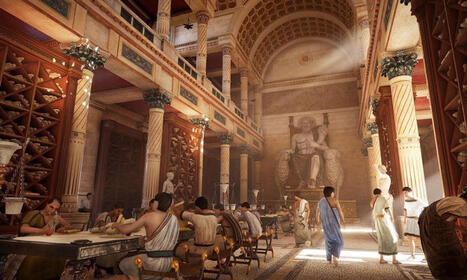
Artistic impression of the an ancient library. Credit: Greek Reporter Archive
Scholars such as Euclid and Archimedes studied there. Librarians developed early cataloging systems and edited standardized versions of key texts.
The library suffered damage during Julius Caesar’s campaign in 48 BC, and its decline continued through later invasions and internal unrest. Despite its fall, the model it established influenced libraries in Pergamum, Rome, and beyond.
Ancient Greek libraries as public learning hubs and private intellectual sanctuaries
Ancient Greek libraries shifted knowledge from private temples to public life. Athens and other city-states built libraries open to scholars and citizens. One early example is Aristotle’s personal collection, which became a foundation for later public institutions.
Private libraries also flourished. Wealthy individuals and philosophers curated collections for study and teaching. Plato, for instance, used their libraries to support schools such as the Academy. These libraries helped preserve philosophy, science, and literature and played a central role in Greek intellectual life.
View of the Acropolis of the ancient Greek Library of Pergamon. Credit: CalicoJackRackham / Wikimedia Commons / Public Domain
Public libraries enabled wider access to knowledge in the ancient world, while private collections fostered personal study and debate. Together, they formed a system that allowed Greek thought to spread across the Mediterranean.
Roman libraries as instruments of power, education, and governance
Rome expanded the library model throughout its empire. In 39 BC, Gaius Asinius Pollio opened the first public library in the capital. Emperors like Augustus followed, building libraries in temples and forums. These became cultural landmarks and centers for learning.
Roman libraries preserved works in both Latin and Greek, encompassing law, science, literature, and official records. They served not only administrative needs but also public education, fostering literacy and stimulating scholarly debate throughout the empire as access expanded.
Timgad Library, a gift to the Roman people by Julius Quintianus Flavius Rogatianus. Credit: Dan Sloan / Wikimedia Commons / CC BY-SA 2.0
Wealthy Romans maintained private collections. These libraries, often run by scribes and servants, became symbols of status. Imperial libraries, meanwhile, preserved state records and reinforced the authority of the emperor.
By preserving Greek and earlier texts, Roman libraries established a bridge between ancient and medieval scholarship, leaving behind a lasting legacy for Europe.
Collapse of ancient libraries and the long survival of their knowledge
Ancient libraries faced repeated threats. Fires, wars, and natural disasters wiped out entire collections. The Library of Alexandria was damaged during civil war, then weakened by centuries of neglect. With the fall of the Roman Empire, invasions, political turmoil, and shifting religious forces accelerated the decline of these repositories of knowledge.
In the Near East, the Library of Ctesiphon was destroyed during the Arab conquests. At Herculaneum, the eruption of Mount Vesuvius buried the Villa of the Papyri beneath volcanic ash, both preserving and damaging hundreds of scrolls.
However, fragments survived. In medieval Europe, monasteries preserved knowledge by copying ancient texts by hand. Across the Islamic world, scholars translated Greek, Roman, and Persian works into Arabic, safeguarding ideas that had vanished elsewhere. These efforts carried the legacy of antiquity into the Renaissance and, ultimately, the modern era.
The fall of ancient libraries marked the end of an era but not the end of their influence. Their legacy endures in today’s institutions, which continue the timeless mission of collecting, preserving, and sharing human knowledge.
A UK-based responsible gold sourcing company has signed a long-term supply and financing agreement aimed at expanding traceable artisanal gold exports from eastern Democratic Republic of Congo (DRC), marking a significant step forward for efforts to formalise the region's mining sector.
A new UK-backed gold deal could help formalise one of Africa's largest artisanal mining sectors
SigraFi Ltd has signed a long-term supply and financing agreement with PeaceGold Trading Company to boost traceable artisanal gold exports from eastern DRC.
The partnership will provide working capital and support to mining cooperatives, improving access to compliant export channels and international refineries.
PeaceGold has worked over a decade to legalise mining operations, reduce mercury usage, and create responsible export pathways in the region.
The agreement aims to formalise more of the artisanal gold sector, which currently supports about two million miners in DRC.
SigraFi Ltd announced it has entered into a partnership with PeaceGold Trading Company Ltd, establishing a framework for the supply of fully traceable gold doré sourced from cooperative-based artisanal miners in Ituri Province.
The agreement builds on PeaceGold's long-running efforts to formalise artisanal gold production in eastern Congo, where much of the sector has historically operated outside regulated international markets.
Under the arrangement, SigraFi will provide structured working capital and refinery-delivery support in exchange for contracted future gold deliveries.
The company said the financing model is designed to help mining cooperatives access compliant export channels, improve pricing transparency, and connect with accredited international refineries.
New financing model targets eastern Congo's artisanal gold sector
The partnership will provide working capital and support to mining cooperatives, improving access to compliant export channels and international refineries.
Founded by Greg Valerio MBE in collaboration with peacebuilding organisations including Peace Direct and Centre Résolution Conflits, PeaceGold has spent more than a decade working with mining communities to legalise operations, reduce mercury use in gold processing, and establish responsible export pathways.
ADVERTISEMENT
The latest agreement represents a commercial milestone for the initiative, which earlier outlined plans to begin formal gold exports despite persistent insecurity in eastern Congo.
"Everyone knows the potential within the artisanal and small-scale gold sector, but producers are often constrained by limited access to compliant export channels, refinery relationships, and appropriately structured financing," said Zara Shirwan, co-founder and director of strategy at SigraFi.
According to industry estimates, artisanal and small-scale mining accounts for around 20% of global gold production and supports more than 15 million livelihoods worldwide.
In the DRC alone, an estimated two million artisanal miners participate in gold production.
SigraFi said the PeaceGold partnership forms part of a broader strategy to develop responsible sourcing and growth-capital partnerships with artisanal mining operations across Africa and Latin America, as demand grows for traceable and ethically sourced minerals in global supply chains.
From the very beginning of Arab civilisation, gold has never been a casual metal. Dug from deserts, traded along caravan routes, stacked in souks and stitched into bridal sets, it has followed the region’s story like a second currency: one for the public world of men, stamped on coins and contracts, and one for the private world of women, resting quietly on wrists and hidden in velvet boxes. To call it just jewellery is to ignore centuries of strategy, survival and inheritance.
In the pre-modern Arab world, gold and silver were literal money. Men kept ledgers; women wore their wealth. In nomadic and trading societies where homes, borders and rulers could change in a season, jewellery was the most portable form of security. A family might lose land or goods, but the bangles on a woman’s arms and the coins around her neck could cross any frontier. Over time, this hard practicality settled into custom: gold became the stable element in an unstable world.
Photo: Getty Images
That logic lives on inside contemporary families. In many Arab households, a girl’s first inheritance does not arrive with a signature; it arrives with a clasp. When a baby girl is born, the flow of gold towards her quietly begins. A tiny bracelet for a newborn wrist, a small anklet, a delicate pendant that will sleep in a box for years these gifts are presented as sweet tradition, but they also function as her first deposits of value.
VIDEO
Syrian Actress Nour Ali Reflects on the Highlights of Her Career
Long before she can walk or speak, a private safety net is being built in her name.
As she grows, gold tracks her milestones more faithfully than any bank record.
Pieces appear for Eid, birthdays, graduations, engagements and marriage. Gradually, a discreet architecture of inheritance takes shape: sets prepared, pieces mentally marked as hers, items set aside for when she needs it. No legal document is necessary; the knowledge passes in conversation and gesture between mothers, daughters, aunts and grandmothers. This is a parallel inheritance system, one that belongs entirely to women.
Most Popular
Culture
How the War in Lebanon Shaped Jewellery Designer Nada Ghazal’s New Collection
By Nada Ghazal
Fashion
It’s Time to Jazz Up Your Wrist With Colourful Watch Dials
By Tejashee Kashyap
Fashion
The New Frame of Mind: Summer’s Coolest Sunglass Shapes
By Teresa Karpinska
Advertisement
The reason is clear. For generations, Arab women could not depend on equal access to land ownership, formal finance or stable work. Gold stepped into that gap. It became the asset that could be hidden from hostile eyes, carried in times of displacement, sold in a single afternoon if life demanded it. A bracelet could become school fees. A necklace could become a deposit on a new home. A pair of earrings could cover the cost of leaving a bad marriage. What glittered in public as ornament functioned in private as insurance, leverage and, at times, escape.
Photo: Wally McNamee/Getty Images
Gold also preserves what official histories overlook: women’s memories. Every piece is tied to a moment a harsh year survived, a long-awaited child, a reconciliation, a farewell. When gold is passed down, stories are passed down with it. The metal holds not only monetary value, but the atmosphere of particular eras and the emotional weight of decisions made inside them.
Today, so-called old gold has surged back into view as a bold style statement, layered over everyday clothes and mixed with contemporary designs. Younger women are not simply reviving a trend; they are wearing centuries of matriarchal planning on their bodies. Heavy, inherited pieces brought into modern life turn private safety nets into visible declarations of continuity, identity and strength.
Arab women’s gold is not an ornamented obsession. It is a quiet economic system, a chain of care and resistance running through generations. It is how women have protected themselves and each other in a changing world a matrilineal archive of wealth and memory, written not on paper but in metal that refuses to rust, fade or be forgotten.
It has become unfashionable to admit that one doesn’t really understand what phrases like “decolonising knowledge” or “a decolonised curriculum” mean. This is unfortunate. The process of coming to understand what decolonisation of knowledge might be is essential to achieving it – and that process is definitely not yet complete, writes UJ’s Prof Alex Broadbent.
Professor Alex Broadbent, the Co-Director, African Centre for Epistemology and Philosophy of Science, and Executive Dean, Faculty of Humanities at the University of Johannesburg (UJ), penned an opinion piece entitled “It will take critical, thorough scrutiny to truly decolonise knowledge”, on The Conversation, 1 June 2017.
Decolonisation is not always a welcome concept in some quarters of academia. If curricula and ideas and knowledge are colonised, that means they have been shaped in part by considerations that are political, economic, social, cultural or otherwise tangential to the ideals of academic inquiry.
Admitting a need to decolonise any part of one’s discipline means admitting that it was formerly colonised to some degree. This in turn means admitting that what one previously touted as objective and untainted by the fleeting considerations of worldly affairs was, in fact, mired in them. Academics are much happier asserting that knowledge is power than they are conceding that power is knowledge.
Seen in this light, the decolonisation of knowledge is primarily an intellectual rather than a political project. It attempts to “disinfect” academic activities: to rid teaching, research, and institutional behaviour of influences that have little to do with the fair-minded pursuit of knowledge and truth.
But this is not the only approach. Decolonisation of knowledge is a contested concept. This “disinfecting” or critical model of decolonisation stands in contrast to a line of thought that sees knowledge as relative to a perspective, a cultural context, or something else again.
Decolonisation as cultural relativism
Decolonisation is sometimes presented, not as an attempt to resurrect the dispassionate search for knowledge, but as a rejection of the idea of objectivity, which is seen as a sort of heritage of colonial thinking.
Sometimes the idea is that notions like truth, fact or what “works” are fundamentally western and are imposed on other cultures. At other times, the idea seems to me that facts and truths are local. So what is discovered or expressed in one time or place will necessarily be inapplicable in another.
This line of thinking takes its cue from the fact that if you have sufficient power over someone you can enforce your views on them – or simply kill them if they disagree. Totalitarian states typically adopt policies that involve both silencing and killing dissenters.
Karl Marx famously maintained that the ideas of the ruling class are in every epoch the ruling ideas.
On this line of thought, the attempt to critically evaluate the opinion of another person or group looks like an exercise in power politics. It’s a short step from there to the idea that, in order to rid ourselves of the effects of a colonial past, we must all desist from asserting our beliefs over others’ beliefs. There is African belief, and European belief, and your belief, and mine – but none of us have the right to assert that something is true, is a fact, or works, contrary to anyone else’s belief.
On this view, to decolonise knowledge is to understand this and so to adopt a certain very broad kind of relativism.
Critical decolonisation
I prefer the first understanding of decolonisation over the second: critical decolonisation over relativistic decolonisation.
One very simple reason is that the kind of relativism I have described is associated with traditions of thought that are European in origin: Marxism and postmodernism. I am sceptical of assertions that these views are of universal application. I worry that some of these assertions may themselves express a colonial heritage.
But I have more substantive concerns, too. One of these is a point made by Ghanaian-British author and philosopher Kwame Anthony Appiah in his book Cosmopolitanism. Appiah values conversation very highly and rejects relativism in part because it doesn’t motivate conversation. As he puts it: If we cannot learn from one another what is right to think and feel and do, then conversation between us will be pointless. Relativism of that sort isn’t a way to encourage conversation; it’s just a reason to fall silent.
The great attraction of uncritical decolonisation is that it appears to prevent us coming into conflict with each other. We simply accept that everyone is entitled to their views. But a moment’s thought shows there’s no protection against possible conflict. I might believe I can do things you don’t want me to do. I might even have views about your views.
The trouble is that ideas can conflict by themselves. They can logically contradict each other. They can mandate actions that are mutually exclusive. We might think very differently – but we share the same world.
The risk of being wrong
Critical decolonisation means accepting risk of error. It means considering whether indigenous knowledge systems might contain truths that western science has not accessed. But it also means accepting that in some cases indigenous knowledge systems might be wrong.
Critical decolonisation also means considering whether what we find in the canon of an academic discipline whose history has been dominated by Europe and America is really up to much. This is a very scary and painful question for academics who have devoted their lives to the study of what they have been told are works of genius.
Critical decolonisation leaves room for local knowledge. A policy to improve infant nutrition may work in Tamil Nadu and fail in Bangladesh. The relativist stance says that whether it works depends on your point of view. But this is a poor analysis of this case: it works in one and not the other, whichever place you are looking from.
The better approach is to seek an explanation for the difference: in this case, that the role of mothers in buying and distributing food differs between the two places. One can reject universal truths without endorsing relativism.
If done properly and critically a lot of what we count as great will fall in the process of decolonising knowledge. A lot of formerly unvoiced and unheard ideas will come to light. The process of critical scrutiny is essential to the success of this project – and nobody gets a free pass.
*The views expressed in the article are that of the author/s and do not necessarily reflect that of the University of Johannesburg.
This article first appeared in The African on 09 September 2022.
Seven years after the #FeesMustFall protests broke out and swept across some South African universities, questions continue to linger as to whether, and how institutions are responding to the renewed calls for decolonisation of knowledge and higher education.
The year 2015 was a turbulent time in higher education, and the decolonisation call arose as part of an increasingly broadening transformation agenda, ignited by the call for fee-free education. Yet, the call for decolonisation of knowledge in this field was unclear.
At the height of the protests, we got to engage with some students who shared their viewpoints.
One student indicated, “Well, engineering has been around for many centuries, but has it adequately contributed to building equality, if at all?” Another student said, “Indigenous knowledge systems have been excluded, and the identity of knowledge does not always reflect black students.”
These questions provoked a flurry of responses, but what was clear from the debate was that there was not a single answer to the question about decolonisation and engineering; it was rather collective perspectives that required reflection.
One is tempted to draw an analogy with the field of language studies. One of Africa’s foremost authors, Ngugi wa Thiong’o has written extensively about the association of identity with language, the language one speaks as a child and grows up with. Could we learn from this in engineering?
Could so-called complementary courses in the engineering curriculum contribute to building a sense of identity and ownership among South African students, and hence play a role in decolonising the study of engineering?
In South Africa, the curriculum structure of engineering programmes is premised on international engineering accreditation accords. The curriculum structure or model provides for core engineering knowledge in combination with complementary courses. The purpose of these is to build the mindset for thinking “outside the box”. The latter can include courses in the humanities and social sciences, disciplines where students might find themselves owning widely disparate knowledge. This might include positioning engineering as an enabler to society – for instance regarding improved water quality has contributed to better health.
While this model exists and is enforced by accreditation bodies, complementary courses are generally customised “for engineers”, and their depth is somewhat limited. The primary reason is arguably the busy timetable structure of students in terms of completing their core engineering courses. Despite these time constraints, there are multiple avenues and pathways to effect curriculum and pedagogical shifts without compromising the engineering components. For instance, pedagogical shifts can be brought about through choice of examples, such as the Great Zimbabwe, for students pursuing civil engineering.
“Decolonisation of knowledge” itself is broad and subject to multiple interpretations, the one extreme being that the existing curriculum should be replaced altogether. Another perspective on decolonisation is to embrace a plurality of knowledge epistemologies in the belief that this will further indigenous knowledge systems, embed a variety of identities and, as Ngugi wa Thiong’o would put it, ‘decolonise the mind’. In this regard, excellence in solutions that emerge locally could be recognised, for example, the introduction of prepaid mobile services in the ’90s. Of course, the call to include indigenous knowledge systems is not unique to South Africa; it has also arisen in other parts of the world – Australia, Canada, and elsewhere.
The call for decolonisation led to opportunities for debate and discussion. In some engagements, the proposal to replace one body of knowledge with another seemed to polarise participants rather than move them towards consensus. “Decolonisation” remained and remains open to multiple interpretations.
University-wide the call for decolonisation led to the development of courses such as African Insights (AI), which offers students multiple perspectives on Africa through reading, fiction, poetry, and other impactful narratives. This module was also included for engineering students. Community-based projects began to integrate themes of equality, diversity and inclusion, which later influenced the way in which senior undergraduate projects could be transformative. Several other curriculum changes occurred.
Fast forwarding to the present day, one asks, “So what happened to the decolonisation of knowledge?”
This question surfaced as the call for universities to brace themselves for the fourth industrial revolution (4IR) became more prominent. Does this then mean that the “decolonisation of knowledge” has disappeared or is no longer at centre-stage?
There may be two or more answers to this: (i) university education (knowledge epistemologies) develops continuously – at times pedagogical changes occur and, at other times, deeper focused curriculum introspection is required; (ii) 4IR and the decolonisation of knowledge may be two sides of the same coin.
In the article, we have already used the acronym AI to designate the module African Insights. In the context of 4IR, we use AI to signify Artificial Intelligence. However, just like Ubuntu, these acronyms and words can mean multiple things. Ubuntu is Mark Shuttleworth’s open-source operating system innovation, but of course, also takes forward the value-system of working together (“I am, because you are”) – which, incidentally, is how open-source software is developed. The “food” for an “AI system” is often data. Because data collection systems have disparities, bias inadvertently develops.
Foregrounding equality, diversity and inclusion enables a greater possibility (“4IR for good”). In our thinking, one could bring together the two AIs – African Insights and Artificial Intelligence – as we journey towards the next phase, towards augmented intelligence (that is also intentionally “AI”).
The authors hold a view that the approach to “developing engineering solutions” cannot be left to chance, but must rather promote transformative thinking upfront. In the transformative approach, transdisciplinary engagement can transcend thought paradigms. For example, an inclusionary approach would engage with diversity of various kinds – technical, demographical, geographical, etc.
This approach also widens thought towards solutions with local relevance, but with the simultaneous possibility of being globally competitive.
Many of these innovations ideate close to us, reflect our flora and fauna, the depth of the TauTona (one of the deepest mines in the world), the marine life of our coast, Maropeng (Cradle of Humankind), the clicks of the isiXhosa, and so on. The concomitant commitment to 4IR and decolonisation of knowledge may enable a holistic approach – one that places society at the centre and inherently seeks social justice.
On 30 September 2024, as Heritage Month drew to a close, the Department of Politics and International Relations at UJ’s Faculty of Humanities hosted a workshop titled Translating Knowledge: Empowering South African Indigenous Languages in Political Science Education. Chaired by Prof Bhaso Ndzendze, Associate Professor and Vice-Dean in the Faculty of Humanities, the workshop was part of a larger multilingualism project funded by the Department of Higher Education and Training’s University Capacity Development Programme (UCDP). The project aims to translate political science texts into South African indigenous languages, with this workshop being the first in a series planned for 2024 to 2026.
Makhosazana Xaba addressing the workshop. To her left are Prof Ndzendze, Ms Mpondo and Mr Van Zyl and some of the students in attendance. Photo by Joy Mosia.
Reflecting on three decades of democracy
The workshop opened with a reflection on the three decades of South African democracy and the emphasis that section 6(2) of the Constitution of the Republic of South Africa, 1996, places on enhancing the use and status of African indigenous languages in light of their historic neglect and diminished official use. The workshop, and the larger project, are all taking place within the UN Decade for Indigenous Languages, and UJ’s policy on multilingualism.
Renowned author and poet Makhosazana Xaba, also an Associate Professor of Practice in the Faculty of Humanities, was a key speaker. Xaba recently translated Frantz Fanon’s The Wretched of the Earth into IsiZulu, titled Izimpabanga Zomhlaba. She shared insights from her translation journey, emphasizing the importance of preparation, research, and context. Xaba also highlighted the positive reactions to her work, particularly how many indigenous language speakers felt inspired and empowered by her translation. Philisiwe Mpondo, a master’s student in the Department, reflected on her experience of writing the first IsiZulu honours research paper and continuing this for her dissertation.
UJ Press manager Wikus van Zyl gave an input on the publisher’s emphasis on works in multiple languages, having seen multiple books published in several South African indigenous languages, including Afrikaans, isiXhosa, Xam, isiZulu, and Sesotho. He reflected on the journal of the UJ Press in employing different strategies for translation, and noted the importance of a human voice so as to retain context.
Student contributions: Overcoming linguistic challenges
Eighteen students, from various levels of study in Politics and International Relations, participated in the workshop. They presented their reflections on translating political science texts into indigenous languages, discussing challenges such as the lack of direct word-for-word equivalents and the contrast between casual language and formal, technical terminology. Students had to make editorial decisions, sometimes opting to retain English terms like “Neoclassical realism.”
Student attendees of the workshop presenting their reflections on translating political science texts into indegenous South African languages. Photo by Joy Mosia.
Xaba underscored the significance of the project, stating that rather than empowering indigenous languages in political science, African languages would bring innovation and transformation to the discipline itself.
In his closing remarks, Prof Ndzendze highlighted the ambitious scope of the three-year project. Planned outputs include translated study guides, a dictionary, and a book. The project also aims to develop indigenous South African terms for concepts in political science, as well as emerging topics like artificial intelligence, international disputes, and international law.
The Faculty of Science invites you to a Public Lecture by Prof Ben-Erik van Wyk (Department of Botany and Plant Technology) on “The cultural and socio-economic value of indigenous knowledge about plants and their uses” on Friday, 23 March 2018, 12:00 – 13:00 at the Chinua Achebe Auditorium.
Professor Letlhokwa George Mpedi is the Vice-Chancellor and Principal of the University of Johannesburg.
He recently published an opinion article that first appeared in the Daily Maverick on 23 September 2025.
Heritage Month invites us to reflect. We are called, as a nation, to celebrate what is being handed down to us. But have we really reflected on how we safeguard and extend this inheritance to generations to come?
Last week, I was hosted by the University of Johannesburg’s (UJ) Palaeo-Research Institute (P-RI) at two crucial sites in the Cradle of Humankind: Swartkrans, Kromdraai and Environs World Heritage Site. It was fitting that, as we celebrate Heritage Month, I was given pause to reflect on the very history of humanity.
As the institute’s director, Dr Dipuo Kgotleng, walked me through the sites, she spoke of the discipline of archaeo-botany – the study of plant remains from archaeological contexts. This field reveals how our ancestors used plants for food, fuel and medicine. This is a part of our heritage we have too hastily forgotten. In her work on indigenous wisdom and scientific knowledge, Robin Wall Kimmerer reminds us: “In some Native languages the term for plants translates to ‘those who take care of us’.” And perhaps, though we have quieted this understanding in modern life, it is precisely what we are yearning for today.
Across much of the world (South Africa being no exception), indigenous knowledge is under threat. Urbanisation, climate change, biodiversity loss and the dominance of industrialised food systems all contribute to the erosion of practices and wisdom that have been passed down for generations.
Yet, simultaneously, we find ourselves confronted by unprecedented levels of food insecurity. Last year, the National Food and Nutrition Security Survey found that food insecurity affects 63.5% of households in South Africa. Intriguingly, research conducted by Omotayo and Aremu in 2021 found that food security in South Africa remains uneven, with many rural households experiencing hunger and poor nutrition despite the country being nationally food secure.
Their research indicates that indigenous and naturalised plants, which are well adapted to local conditions and widely recognised by communities, could significantly improve diets and even local economies. Of course, in response, we must ask, how many locally adapted crops or sustainable cultivation methods risk being forgotten, just when we may need them most?
As I reflect on my own childhood, I am often struck by how many generational practices and knowledge systems that were passed on to me won’t be passed on to my son.
For example, we learnt about the edible seasonal fruits, such as mokgalo (buffalo thorn fruit), moretlwa (brandy bush fruit), and klapper (monkey orange fruit). We also knew that the bark of the brandy bush tree could be used to make various items, including baskets and ropes. Though it was perhaps not framed in this way at the time, this knowledge reinforced principles of circularity and sustainability as nothing went to waste, and communities could meet their needs directly from their environments.
Heritage Month invites us to reflect on this shift. We are called, as a nation, to celebrate what is being handed down to us. But have we really reflected on how we safeguard and extend this inheritance? In reflecting on my son’s lost inheritance, I would argue that this presents a glaring gap. So, what is to be done?
In an article for Forbes Africa recently, I argued that academia must become more engaged and locally relevant. There is a fundamental call for interdisciplinary research that draws from both global theory and indigenous wisdom. In this way, institutions become hubs of inclusive development.
If we are to face the challenges of the future, higher education institutions must position themselves as custodians of the living place-based knowledge that has sustained humanity for generations. The question that follows is urgent: in acknowledging this need, how do we preserve and revitalise indigenous knowledge systems?
First, by acknowledging their legitimacy. We must recognise that indigenous epistemologies are robust systems of knowing in their own right. To return to the thought of Kimmerer: “Might science and traditional knowledge be purple and yellow to one another, might they be goldenrod and asters? We see the world more fully when we use both.”
Second, by documenting and teaching these practices in ways that respect the communities from which they arise, to ensure that we do not replicate exploitative extractive practices. This calls for partnerships with traditional leaders and local communities.
Third, by embedding this knowledge into contemporary problem-solving, particularly around sustainable development metrics such as food security and public health.
If we consider that the true meaning of sustainable development is a framework to address our current needs while considering future generations, then it stands to reason that this also encompasses the passing on of traditional and indigenous knowledge. These knowledge systems, which are fundamentally rooted in lived experience and ecological intimacy, are living practices that should endure.
As I consider the future my son will inherit, it is clear that safeguarding and actively embracing these practices is necessary. This is how we ensure that future generations inherit more than resources – they inherit the wisdom of how to live in balance with those resources.
A YouTube documentary recently emanated from the fascinating work of UJ ethnobotanist and SARChI Chair for Indigenous Knowledge Systems, Prof Ben-Erik van Wyk. Directed by Naima Sebe and rightfully named “The Professor”, the 23 minute documentary tells the story of Koos Paulse, who, born with Khoi-San ancestry, is recognised as a “professor of the veld
A YouTube documentary recently emanated from the fascinating work of UJ ethnobotanist and SARChI Chair for Indigenous Knowledge Systems, Prof Ben-Erik van Wyk. Directed by Naima Sebe and rightfully named “The Professor”, the 23 minute documentary tells the story of Koos Paulse, who, born with Khoi-San ancestry, is recognised as a “professor of the veld and botanical colleague” by Prof van Wyk for this immense amount of indigenous plant use knowledge. This is a story about change, recognition and dignity (https://www.youtube.com/watch?v=jOt5IE4ULpo).
Giraffes and zebras in Etosha National Park.Credit:
Mokuti Etosha
The herd’s lithe necks drifted above the bush in one ethereal mass, moving like a corps de ballet against a pale blue sky. There were more than a dozen giraffes moseying in the early morning sun, their stature made all the more astounding by their unexpected multitude. We were easily outnumbered with just seven passengers and a guide perched in our SUV. That’s what a stay at Namibia’s Mokuti Etosha is all about: intimate moments with extraordinary creatures, in an environment gloriously uncontrived yet decidedly refined.
OL Leisure’s luxurious Mokuti Etosha is the closest lodge to Etosha National Park, one of Africa’s most treasured wildlife reserves. The park is famous for its dense concentration of species and the enormous Etosha Pan, a stretch of salt visible from space. The property sits mere minutes away from the park’s eastern gate, and when you're living among the resort’s regal bontebok (a rare species of antelope found only in Namibia, South Africa, and Lesotho), soaring trees, and earthen architecture, it feels as though there is no border at all.
The bonteboks lounging on the Mokuti Etosha property.
Lydia Price
Like Namibia itself, Mokuti is defined by contrasts. During my stay in late November, bontebok often lounged around the villas, becoming a clear example of that balance. Patches of white fur stood out against their dark chocolate coats. And like each of the animal communities we encountered on the other side of Etosha’s gate, they were wild, but their familial dynamics and calm behavior carried an unmistakable air of civility.
“In our national anthem, we say, ‘contrasting beautiful Namibia,’ and that’s really a true reflection of what Namibia is,” said Shepherd Chinhoi, OL Leisure’s general manager of operations and a former general manager of Mokuti Etosha. “If you go from north to south, it’s a completely different experience. If you move west to east, it’s completely different again.”
The Presidential Suite at Mokuti Etosha.
Mokuti Etosha
Namibia is one of the least densely populated countries in the world, but it’s home to 13 ethnic groups, Chinhoi explained, each with distinct culinary traditions and cultural identities. But even on the smallest scale—on the hide of a single animal or in the rhythm of a herd—that sense of layered contrasts persists. The nation, its land, people, and wildlife are a bold tapestry.
Aerial view of SkyBoma at Mokuti Etosha.
Mokuti Etosha
I was at the newly renovated lodge for the unveiling of SkyBoma, its traditional Namibian restaurant very untraditionally built about 30 feet above the bush. Modeled after termite hills, a crucial and ubiquitous feature of the Namibian terrain, the restaurant sits atop a massive stone-colored mound. Guests ascend via a spiraling ramp set on towering wooden beams before emerging into an open-air dining space above the park.
As the sun begins to set, the experience becomes increasingly surreal. We ate hors d'oeuvres of artful local cuisine and sipped cocktails while the sky erupted in color. The bush was awash in a golden glow, a searing orange blaze stretching across the horizon where hardy vegetation met the sky. I, too, was bathed in the descending sun’s final bow, my heart thumping with a primal, radiating joy. It was embarrassingly euphoric.
After sunset, the stars showed why Namibia is recognized as a premier astrotourism destination. Although the darkest, clearest skies can be found farther south, SkyBoma’s vantage over the endless bush offers remarkable celestial views.
The scenic Midgard property.
Midgard
Two nights at Mokuti was far too brief a stay, but Namibia has much to explore, and another OL property, Midgard Otjihavera Windhoek, awaited us. Set in the Otjihavera Mountains of central Namibia, it trades safari-chic for something more eccentric. Part horse ranch, part storybook estate, the property is steeped in its German heritage and immersive in an entirely different way. Regal bontebok were replaced by stout warthogs, whose amusing visages quickly filled my camera roll. Majestic horses trotted past the grazing hogs. Dirt paths bordered rose gardens that framed turquoise pools.
The safari on horseback at Midgard.
Midgard
At Midgard, we safaried on horseback. I mounted an ivory Arabian named Chayenne before sunrise. It was just me, the two horses, and my guide, Phil-John Hochtritt. As we traced the base of rocky hills, Hochtritt pointed out subtle movements in the shadows above us. Baboons, he explained, were quietly powerful in their abundance.
“They have eyes all around,” he said. “That’s how they survive.” The primates, he told me, have distinct calls to communicate complex messages across the landscape. Once again, Namibia’s wildlife impressed me.
It wasn’t just seeing these animals up close that was extraordinary—it was witnessing their lives. Namibia is full of contrasts: wild and calm, vast and intimate, rugged and refined. But those contrasts don’t feel like contradictions—here, they naturally belong together. From Etosha’s sun-scorched plains to Midgard’s craggy hills, the country’s magnificence lies not in any single landscape or species, but in the way these different elements exist together in complete harmony.
Oom: My people are from Koffiefontein and there my grandpa enentually sold his farm because he coulld not see the future. He said "One of these days, the Boers will take everything". So he rather sell the place, even if it wasnt for much, at least the place is off his shoulders. The my father said to him: " Why sell the place? We can all live there? and he said "No, the day is coming when the Boers will take everything" ten you will be landless and he was right. There is no Griqua man who tell me "Ive got my own farm" "Ive got my own land"
Antoinette: And all those years my Papa was a pharmacist, and these 5 daughters, i was the third and we lived near a river in Carnavon. The other sisters learnt knitting and sewing from Mother but at the slightest chance, i was out the door. Something pulled me like a magnet to the veld and there the need was bor for someone to initiate me into this wonderful mystery, so that i could know that this little bush is the Kapokbush, and with his white fliuff Tinkyinkie builds his nest, becaues i'd come across it and then I'd wonder how did this Tinktinkie get his nest like this? So, someone to walk in front of me and say this is so, and that is like that and this tiny bush works for your bladder and this one ... So i was walking in the veld and the shrubs against my shoes felt like fingers telling me to ask them; " Who am I?"
And when I strarted learning from the Oom here on Theefontein, I felt it in a different way. That the shrub would put up his hand and say "Here I am" And i think it is the landscape, the vastness that tunes the storytellers so vey finely, because you have to be fine-tuned, to lovw the Karoo. People just passing through, always talk about the greyness of nothingness but if you look a little deeper into the Karoo then you will see Paradise
Oom: My place of birth is in Kennard, there they moved around and my father was always harvesting wheat and such. In those days wheat was cut by hand. There were no machines like today that simply toss the wheat on one side and the chaff on the other, Those days were different, the chaff was winnowed, they had wooden forks to seperate the chaff from the wheat. the donkeys where the machines ...
ByPatricia Claus August 17, 2025 The Serapeum at Alexandria. The building was used by the Library of Alexandria for extra storage of parchment scrolls after it ran out of space. The area is now a part of an archeological excavation. Credit: Daniel Mayer /CC BY-SA 4.0
The ancient Library of Alexandria, built in the city that was the brainchild of Alexander the Great, was one of the greatest wonders of the world, hosting scholars who explored science, history and all other areas of knowledge before its tragic destruction.
The Great Library of Alexandria in Alexandria, Egypt, was one of the largest and most significant libraries of the entire ancient world. It was part of a larger research institution called the Mouseion, which was dedicated to the Muses, who were the nine goddesses of the arts in Greek mythology.
In Greece, the Athenian ruler Peisistratos was said to have founded the first major public library in the sixth century BC. It was out of this mixed heritage of both Greek and Near Eastern book collections that the idea for the Library of Alexandria was born.
The idea of founding a library in Alexandria may have been proposed by Demetrius of Phalerum, an exiled Athenian statesman living in Alexandria, to the Pharaoh Ptolemy I Soter, but the Library itself was most likely not built until the reign of his son, Ptolemy II Philadelphus.
The Alexandrian Library, however, was unprecedented due to the scope and scale of the Ptolemies’ ambitions; their mission was to produce a repository of all knowledge known to mankind at the time.
The Library quickly acquired many papyrus scrolls, due largely to the Ptolemaic kings’ aggressive and well-funded policies for procuring texts. They dispatched royal agents with large amounts of money, ordering them to purchase and collect as many texts as they possibly could, about any subject and by any author.
In a famous story which has come down through the ages, it was decreed by Ptolemy II that any books found on ships that came into port were taken to the library, where they were copied by official scribes. It is unknown precisely how many such precious scrolls were housed at the Library at any given time, but estimates range from 40,000 to 400,000 at its height.
Ptolemy II Philadelphus, during whose reign the Great Library of Alexandria was founded. Bust excavated at the Villa of the Papyri. Credit: Marie-Lan Nguyen /CC BY 2.5 “The place for the cure of the soul”
In time, a medical school also was founded at the Library, in which scientific human dissections were first undertaken; this practice alone provided invaluable knowledge to the world of medicine.
Alexandria quickly came to be regarded as the capital of knowledge and learning, in great part because of its astonishing Library. Many important and influential scholars worked there during the third and second centuries BC.
However, the Library poses one of the greatest mysteries in the world, as Dr. Bob Brier, the chairman of the philosophy department at the University of Long Island, explains. “The amazing thing about the library in Alexandria is that it was the most important place of learning in the ancient world and we don’t know where it was or where it is now.
“We don’t know what it looked like. We don’t know the details of what books it had; we don’t know everybody who (worked) there. There’s more that we don’t know than what we do know. But it was the most important intellectual event perhaps in the history of mankind,” he stated in an interview with NBC News’ Roger Mudd.
A map of ancient Alexandria. The Library was located in the Royal Quarter, known as “Bruchium” in the central part of the city near the Great Harbor (“Portus Magnus” on the map). Credit: Friedrich Wilhelm Putzger, nach O. Puchstein in Pauly, Real-Encycl. – F. W. Putzgers Historischer Schul-Atlas/ Public Domain
During the reign of Ptolemy III Euergetes, the original library’s collections had grown so large that a daughter library was established in the nearby Serapeum, a temple to the Greco-Egyptian god Serapis. The remains of that structure — the only concrete link we have to the Great Library — are still there in the city today.
The Library was built in the Brucheion, or Royal Quarter, of Alexandria. Its exact layout is not known, but ancient sources describe it as comprising a collection of scrolls known as bibliothekai (βιβλιοθῆκαι), with the building featuring Greek columns, a peripatos walk, a room for shared dining, a reading room, meeting rooms, gardens, and lecture halls.
In short, it created a model for the concept of a university campus.
According to popular description, an inscription above the Library’s papyrus scroll shelves read: “The place of the cure of the soul.”
International scholars mingled freely, exchanging ideas
In addition to collecting works from the distant past, the Mouseion which housed the Library also served as home to a host of international scholars, poets, philosophers, and researchers, who, according to the first-century BC Greek geographer Strabo, were provided with a large salary, free food and lodging, and exemption from taxes.
The Library itself was directed by a scholar who served as head librarian, as well as tutor to the king’s son.
The first recorded head librarian was Zenodotus of Ephesus, who lived from c. 325 to c. 270 BC. He is known to have written a glossary of rare and unusual words, which was organized in alphabetical order, making him the first person in the world known to have employed alphabetical order as a method of organization.
Meanwhile, the scholar and poet Callimachus compiled the Pinakes, a 120-book catalogue of various authors and all their known works. This library catalogue has not survived, but enough references to it and fragments of it have survived to allow scholars to reconstruct its basic structure.
According to legend, the Syracusan inventor Archimedes invented “Archimedes’ screw,” a pump for transporting water, while studying at the Library.
Jason and the Argonauts saga contains geographical knowledge derived from Library’s works
Pharaoh Ptolemy II Philadelphus then appointed Apollonius of Rhodes, who lived from c. 295 to c. 215 BC, a native of Alexandria and a student of Callimachus, as the second head librarian of the Library of Alexandria. He is best known as the author of the “Argonautica,” the epic poem about the voyages of Jason and the Argonauts, which has incredibly survived to the present in its complete form.
The Argonautica displays Apollonius’ deep knowledge of history and literature and makes allusions to a vast array of events and texts, thanks to the riches available to him at the Library.
The third head librarian, Eratosthenes of Cyrene, who was born c. 280 and lived to c. 194 BC, is best known today for his scientific works, including his seminal discovery of the circumference of the earth. However, the polymath was also a literary scholar. Eratosthenes also produced a map of the entire known world, which incorporated information taken from sources held in the Library, including accounts of Alexander the Great’s campaigns in India.
Ptolemy III had expensive copies of the plays written by Aeschylus, Sophocles, and Euripides made on the highest quality papyrus and sent back the copies to the Athenians — keeping the original manuscripts for the library.
As the Library expanded, it ran out of space, so it opened a satellite collection in the Serapeum, which was a temple dedicated to the Greco-Egyptian god Serapis, located near the royal palace.
The librarianship of Aristophanes of Byzantium saw the invention of the system of Greek diacritics, who also wrote important works on lexicography, and introduced a series of signs for textual criticism. He himself wrote introductions to many plays, some of which have survived in partially rewritten forms.
This Latin inscription regarding Tiberius Claudius Balbilus of Rome (d. c. AD 79) mentions the “ALEXANDRINA BYBLIOTHECE” on line eight. Credit: Tomisti /Public Domain
However, it was also during the early second century BC that the political power of Ptolemaic Egypt began to decline. Consequently, many Greek scholars began to leave Alexandria for safer countries with more generous patronages. The Library of Alexandria was never to recover from this decline, although it had some noted successes thereafter in the brilliant contributions of its librarians.
Aristarchus of Samothrace, who lived from c. 216 to c. 145 BC, was the sixth head librarian. Earning a reputation as the greatest of all ancient scholars, he produced not only texts of classic poems and works of prose, but full hypomnemata, or long, free-standing commentaries, on them.
In 145 BC, however, Aristarchus became caught up in a dynastic struggle, resulting in Ptolemy VIII expelling all foreign scholars from Alexandria, forcing them to disperse across the Eastern Mediterranean world — enriching those areas and allowing scholarship to flourish there.
Aristarchus’ student Dionysius Thrax, who lived from c. 170 to c. 90 BC, even established a school on the Greek island of Rhodes. Thrax wrote the first book on Greek grammar, a work which remained the primary grammar textbook for Greek schoolboys until as late as the twelfth century AD.
Political struggles, the rise of a new empire contributed to the decline of Alexandria
The Romans based their own grammatical writings on it, and its basic format incredibly remains the basis for grammar guides in many languages even today.
Confronted with growing social unrest and other major political and economic problems, the later Ptolemies did not devote as much attention towards the Library and the Mouseion as their predecessors had, leading to its further decline.
A shift in Greek scholarship as a whole took place around the beginning of the first century BC because by this time, all the major classical poetic texts had finally been standardized and extensive commentaries had already been produced on the writings of all the major literary authors of the Greek Classical Era.
Meanwhile, Alexandrian scholarship was probably introduced to Rome in the first century BC by Tyrannion of Amisus, a student of Dionysius Thrax, who lived from c. 100 to c. 25 BC, again — as so often seen throughout Greek history — enriching the cultural life of the rest of the world with its export.
Was the Library really burned?
The Roman general Julius Caesar was forced to set fire to his own ships during the Siege of Alexandria in 48 BC; many ancient writers report that the fire spread and destroyed at least part of the Library of Alexandria’s collections; however, it may well have either at least partially survived or been quickly rebuilt at that time.
The first-century AD Roman playwright and Stoic philosopher Seneca the Younger quotes Livy’s “Ab Urbe Condita Libri,” which was written between 63 and 14 BC, as saying that the fire started by Caesar destroyed 40,000 scrolls from the Library of Alexandria.
However, the Roman historian Cassius Dio, who lived from c. 155 to c. 235 AD, recorded that “Many places were set on fire, with the result that, along with other buildings, the dockyards and storehouses of grain and books, said to be great in number and of the finest, were burned.”
Scholars have interpreted Dio’s wording to mean that the fire did not actually destroy the entire Library itself, but rather only a warehouse located near the docks being used by the Library to house scrolls. Whatever devastation Caesar’s fire must have caused in the city, the Library was evidently not completely destroyed at that time.
The geographer Strabo,who lived from c. 63 BC to c. 24 AD, mentions visiting the Mouseion, the larger research institution to which the Library was attached, in around the year 20 BC, indicating that it either survived the fire or was rebuilt soon afterward.
Still, the manner in which he speaks about the Mouseion shows that it was nowhere near as prestigious as it had been a few centuries prior.
A Latin inscription, seen above, regarding Tiberius Claudius Balbilus of Rome, who died around AD 79, mentions the “ALEXANDRINA BYBLIOTHECE” on line eight.
Library’s status diminished
The emperor Claudius, who ruled from 41–54 AD, is recorded to have built an addition onto the Library, but after Alexandria came under Roman rule, the city’s status gradually diminished.
The Library likewise tragically dwindled in importance during the Roman period, due to a lack of funding and support. Its membership appears to have ceased by the 260s AD. Between 270 and 275 AD, the city of Alexandria saw a Palmyrene invasion and an imperial counterattack that most likely destroyed whatever remained of the Library, if it still existed at that time.
Meanwhile, as the reputation of Alexandrian scholarship declined, the reputations of other libraries across the Mediterranean world improved, and other libraries also sprang up within the city of Alexandria itself; some — or even all — of the scrolls from the Great Library may have been used to stock some of these smaller libraries.
The Caesareum and the Claudianum in Alexandria are both known to have had major libraries by the end of the first century AD.
Mention of both the Great Library of Alexandria and the Mouseion that housed it disappear after the middle of the third century AD, however. The last known references to scholars being members of the Mouseion date to the 260s.
In 272 AD, the emperor Aurelian’s forces destroyed the Broucheion quarter of the city in which the main library was located. If the Mouseion and Library still existed at this time, they were almost certainly destroyed during the attack as well. If they had somehow survived that attack, then whatever was left of them would have been destroyed during the emperor Diocletian’s siege of Alexandria in 297.
Serapeum served as a daughter library to the Great Library
The Serapeum is often called the “daughter library” of Alexandria. As late as the beginning of the fourth century AD historians believe it held the largest collection of books in the city of Alexandria.
In the 370s and 380s, the Serapeum was still a major pilgrimage site for pagans, however. It remained a fully functioning temple, and had classrooms for philosophers interested in theurgy, the study of cultic rituals and esoteric religious practices.
Under the Christian rule of Roman emperor Theodosius I pagan rituals were outlawed, and pagan temples were destroyed. In 391 AD, Theophilus, the bishop of Alexandria ordered the destruction of the Serapeum and its conversion into a church. The pagans of Alexandria were incensed by this act of desecration, especially the teachers of Neoplatonic philosophy and theurgy at the Serapeum.
Its teachers took up arms and led their students and other followers in a guerrilla attack on the Christian population of Alexandria, killing many of them before being forced to retreat. In retaliation, the Christians of the city vandalized and demolished the Serapeum — although amazingly some parts of the colonnade were still standing as late as the twelfth century.
However, none of the accounts of the Serapeum’s destruction mention anything about it still having a library, and sources indicate that even that structure — the one surviving link to the library today — most likely did not have a significant collection of scrolls in it at the time of its destruction.
Not all knowledge was lost
As the course of history shows, power and knowledge ebb and flow from East to West, North to South, and libraries — perhaps even housing some of the precious scrolls that had been copied and housed at Alexandria — were popping up all over the Roman Empire.
By the fourth century AD, there were at least two dozen public libraries in the city of Rome alone.
In late antiquity, as the Roman Empire became Christianized, Christian libraries modeled directly on the Library of Alexandria and other great libraries of earlier pagan times began to be founded all across the Greek-speaking eastern part of the empire.
Among the largest and most prominent of these libraries were the Theological Library of Caesarea Maritima, the Library of Jerusalem, and a Christian library in Alexandria.
Incredibly, these libraries held both pagan and Christian writings side-by-side and Christian scholars applied to the Christian scriptures the same philological techniques that the scholars of the Library of Alexandria had used for analyzing the Greek classics, proving that the wisdom of the ancients survived alongside the new Christian worldview.
Nonetheless, the study of pagan authors remained secondary to the study of the Christian scriptures until the Renaissance, when writers and philosophers would rediscover them, in effect bringing these ancient Greek thinkers back to life again in modern times.
Ironically, the survival of ancient texts — surely including many of the precious scrolls housed at the Great Library of Alexandria — owes everything to the fact that they were exhaustingly copied and recopied, at first by professional scribes during the Roman period onto papyrus, and later by monks during the Middle Ages, onto parchment.
So in effect, the Library still lives on today, in the scholarship of researchers in every discipline, and in each and every library all around the world.
See all the latest news from Greece and the world at Greekreporter.com. Contact our newsroom to report an update or send your story, photos and videos. Follow GR on Google News and subscribe here to our daily email!
Chapters: 0:00 Introduction 1:56 What is Cuneiform? 2:20 The Tablets from Nippur 3:24 Assyrian clay tablets 5:00 Burning of the Books in Ancient China 7:04 When Did Archives become Libraries? 10:23 Library of Alexandria 11:26 How did Alexandra get so many books? 13:23 Did the Library of Alexandria Burn Down?
Disclaimer: I am a Book Depository Affiliate. I am not sponsored for any of my reviews and will always disclose if a book I am reviewing has been sent to me for review.
The Institute of Race Relations (IRR) is challenging President Cyril Ramaphosa’s claims about the impact of Black Economic Empowerment (BEE) on the mining industry.
During a National Assembly question-and-answer session in Parliament, Toby Chance questioned Ramaphosa about policies that impact investment confidence.
“South Africa’s domestic investment rate has collapsed from 24% in 2009 to 14% in 2025. This means less growth, more debt and fewer jobs created,” he said.
He argued that this decline was caused by poor policies such as BEE, bailing out failed state-owned enterprises, and cadre deployment.
Ramaphosa responded, saying the notion that BEE hinders economic growth is false and based on lies.
He argued that before 1994, the mining industry in South Africa was controlled by just six mega companies.
“They held all the mineral rights in South Africa. And they were tending to hold them in perpetuity,” the President said.
“Today, many black people are in the mining industry. They are mining manganese, which they were unable to get into. They are mining coal.”
“Today, mining has more black entrepreneurs. Some of the black mining companies are the largest. Seriti, for example, is owned by black people.”
He added that black engineers are being promoted to management-level positions and are running those companies effectively. “More jobs are being created,” he said.
“So, if people come with this fallacy that BEE is an impediment to the growth of the economy, go to the mining industry and see what this government has done.”
“Those who say BEE is holding back economic growth in South Africa should hang their heads in shame,” he added.
“If they say this, it means that they want white people only to continue controlling the economy of our country. That cannot be.”
Institute of Race Relations disputes President Cyril Ramaphosa’s claims
The IRR’s Head of Policy Research, Anthea Jeffery, used data to refute Ramaphosa’s claims about the South African mining industry.
This data showed that laws such as the Black Economic Empowerment Act and the Mineral and Petroleum Resources Development Act (MPRDA) hurt the industry.
The mining industry has become a shadow of its former self, partly because of the complex regulatory environment in which it has been compelled to operate.
Mining’s share of South Africa’s gross domestic product (GDP) has fallen from 21% in 1980 to only 7% today.
“47,000 jobs have been lost in the South African mining sector between 2001 and 2024,” Jeffery said in her letter to Ramaphosa.
“Investors have channelled their exploration expenditure to countries that are not hostile to them.”
Regulations such as the MPRDA and BEE have been fingered as key culprits in the hollowing out of the industry.
“These laws, which introduce hurdles that investors do not face elsewhere in the world, erode property rights and increase government control over the industry,” she said.
“It is no wonder that investors have voted with their feet to pursue business and deliver jobs elsewhere.”
The IRR challenged Ramaphosa’s claim that BEE mining deals have benefited South Africans beyond the politically connected elite.
“A 2015 report showed that only 46 BEE entrepreneurs benefited from the deals that increased BEE ownership to 38% by 2014,” she said.
These so-called entrepreneurs gained 310,000 times more than 6.9 million community members, while costing the industry significant investment.
| Writer, illustrator, and co-author of Planta Sapiens: Unmasking Plant Intelligence (Little, Brown, 2022).
1,709 words
Read time: approx. 9 mins
We assume consciousness requires a human or animal brain—an assumption that author and philosopher of science Natalie Lawrence argues is the biggest obstacle to understanding what the mind actually is. Our tools for investigating cognition were built in our own image, leading us to over-attribute "life" to AI while dismissing complex organisms like slime moulds. Drawing on her research into the philosophy of biology, Lawrence explores how Spain's MINT Lab is moving beyond these biases. By designing experiments that don't use human cognition as the template, they aim to build a framework rigorous enough to finally distinguish a system that merely reacts to its past from one that genuinely experiences its present.
How does a physical system such as the brain produce the ineffable phenomenon of conscious experience? Philosopher David Chalmers famously named this the “Hard Problem of Consciousness” in 1995. Proponents argue that, while cognitive functions such as categorisation or information integration might be explained mechanistically in the central nervous system, the origins of subjective experience resist such explanation. Detractors suggest that the Hard Problem is merely a collection of lesser puzzles that have yet to be solved through greater material understanding of the brain.
The heart of this controversy may lie in its core premise: that consciousness arises from a neuronal system organized around a brain. The deep entrenchment of this preconception isn’t surprising, given that our own consciousness is the only one we have access to. But this “brain-centrism” pervades the cognitive sciences, shaping our understanding of other beings and approaches to research. It’s one of several kinds of scientific chauvinism that currently limit the field of enquiry and hamper our scientific approach to other kinds of minds.
The expanding view of mind
Across the philosophy of mind, it is becoming increasingly clear that there are fruitful avenues for exploring the origins and nature of consciousness well beyond neuronal systems. If anything, assuming the necessity of brains is beginning to look like a fragile position.
At the radical frontiers of cognitive science, the concept of what a mind can be and the diverse systems from which it might originate are broadening. By studying organisms very different from us and our vertebrate relatives—such as plants or slime molds— researchers are revealing capacities that hint at minds beyond traditional confines, from maze solving to responsivity to anesthetics.
___
To be properly open-minded about the possible extent of consciousness, we have to remove ourselves from the picture entirely.
___
František Baluška and Arthur Reber are amongst a growing contingent of researchers who argue that to be alive might be to possess some level of sentience. Like intelligence, individual subjective experience probably exists across the tree of life. Not as an incidental phenomenon, but because any organism—whether a bacterium or a blue whale—can only succeed at living if it has a dynamic internal experience. Each organism inhabits a unique and complex world with which it must contend to survive, for which a highly adapted mind is an enormous advantage, if not a necessity. We should expect different organisms to have different kinds of minds, because of the different kinds of substrates from which these minds emerge and because they have evolved in different ecologies.
Our biological assumptions
Even this broader view of sentience has been critiqued for its exclusivity: the assumption that mind is confined to the kind of carbon-based life with which we are familiar. This familiarity, however, does not entail that other forms of life do not exist and could not be sentient. Or, even, that only biologically organized systems can be sentient.
Across the history of the life sciences, our assumptions have been repeatedly defied by new discoveries. Until the mid-twentieth century, for example, scientists assumed that oxygen was essential for life. Geological evidence then revealed that Earth’s early atmosphere contained almost no oxygen—which suited the anaerobic microorganisms that dominated. For these single-celled inhabitants, the Great Oxidation Event around 2.4 billion years ago was a mass-extinction catastrophe. Likewise, the discoveries of extremophiles in habitats such as deep-sea hydrothermal vents have repeatedly overturned longstanding ideas about the moderate conditions necessary for life to flourish.
It seems that preconceptions are difficult to escape. Just as scientific frameworks have repeatedly had to expand to incorporate new forms of life, so too will our current, rigid ideas about consciousness likely fail. We need to continually re-examine the limitations that our implicit assumptions create if we’re to have any hope of approaching these questions fruitfully.
The trap of complex systems
Not without caution, however. There is a present danger in expanding the criteria for sentience too broadly beyond carbon-based organisms. It risks centering the possibility that almost any complex system, including large language models, could be sentient. Indeed, many people currently find it far easier to imagine that an LLM might be sentient than a beetle. This plunges us straight back into anthropocentric analyses of whether our machines relate to us sufficiently to be considered conscious. Do they understand us? Do they have motivations?
As the philosopher Daniel Dennett pointed out, we very easily slip into an “intentional stance” when interacting with other agents, assuming they have beliefs and desires. The bar for mistaking these features as indicators of sentience is shockingly low, especially when interfacing with systems shaped by our needs. We tend towards what we might call “AI-anthropocentrism” all too easily as a result.
We have no reason to assume that sentience will allow other systems to interact with us in a way that makes their subjective sense of awareness evident to us, however. For the same reason that minds might be as diverse as the tree of life, other forms of sentience are likely to be opaque to us.
An alien life intuition pump
Though it seems counterintuitive, if we can do away with biocentrism, we are freed from the need to explain why Claude or ChatGPT are not sentient. We don’t need to treat every non-biological system as a candidate mind. There could be many kinds of organisation capable of mind, most of which might have nothing to do with our technologies or the function of our own sentience. We ask instead: What kinds of organisation generate sentience?
Imagine, for example, that we live on another planet, in another solar system, orbiting a sun at “Goldilocks distance—perfect for life to flourish. The life on this planet, including ourselves, is built from silicon, rather than carbon. To the scientists of that world, silicon would not seem like one possible basis of life among others; it would seem like the obvious basis of life. They might infer from their local biology that only silicon can support the organisation that living systems require and perhaps dismiss carbon-based life as mere fantasy. In that case, they would likely make the same error that we risk making: mistaking the material basis of the life that we know for the material basis of life and sentience.
This “intuition pump”—another of Dennett’s terms—is not so different from our own Earth-bound position. It shows how easily such assumptions can limit the scope of our imaginations. Placing biological or structural conditions on the existence of sentience is not only tempting; it is counterproductive. What we treat as necessary conditions for sentience may simply reflect our own local evolutionary history. Brain-centrism, bio-centrism and AI anthropocentrism are forms of scientific chauvinism. They all reveal our tendency to assume the features that we experience are foundational to a phenomenon of interest, rather than ancillary or incidental qualities.
Moving to diffused cognition
To be properly open-minded about the possible extent of consciousness, we have to remove ourselves from the picture entirely. We must peel back the layers of assumptions derived from our own experience to begin studying the experiences produced by other systems. Assuming that a centralized neuronal system is the gold standard for consciousness will leave us blind when it comes to the potential worlds of decentralized organisms such as slime moulds or plants. Decision-making in these systems is emergent and distributed, not centrally controlled, offering fascinating possibilities when it comes to the kinds of minds they might produce.
To move forward, we need experimental strategies that do not begin with human cognition as the template for mind. There’s a growing network of researchers across science and philosophy who are doing just that. For example, the Minimal Intelligence Laboratory (MINT Lab) in Spain is working with plant models to break new ground in the study of diffused intelligence systems. Plant experience is not directly accessible to scientific investigation, so it must be approached indirectly through behaviour and experimentally tractable proxies. Led by Professor Paco Calvo, the team is exploring how to apply experimental tools from the cognitive sciences to study plant behaviours and distributed cognition.
In the current project, Behavioural Evidence for Plant Consciousness, for example, Calvo and his team are developing frameworks for testing whether plants can perform advanced forms of learning. Trace conditioning, for example, involves two stimuli presented with a period of time between them. For an organism to connect the two, there must be some kind of trace of the first stimulus that persists across the time gap. Bees have been found to be very capable of doing this, likewise fruit flies. But even working out what stimulus presentations are relevant to plants and how such learning might manifest behaviourally is a new kind of challenge.
Such experimental research is the first step to unlearning the limiting assumptions that have hampered the field so far and laying the groundwork for new approaches to consciousness studies. Their aim is not to prove that plants are conscious, but rather to use the scientifically grounded study of plant behaviours as a gateway to removing our prejudices when studying all kinds of minds, including our own.
Our brain-focused neuronal system is likely just one evolutionary strategy among many. In fact, our awareness is far less centralized than we assume. Decision-making in humans, for example, is not confined to a single brain region, but distributed across interacting regions and systems. Plants, microbes, and other life forms show that cognition can emerge in radically different organizational forms, and it’s possible that sentience does also. If we can relinquish our assumptions of centralized, neuronal consciousness that must resonate with our own, we might find ways to understand other kinds of mind. This will be the only way we might eventually understand what consciousness is and how it emerges.
Critical thinking about the nature of knowledge, and the way Africa participates in science, is an essential part of the project of decolonisation, according to Prof Alex Broadbent, the Executive Dean of the Faculty of Humanities at the University of Johannesburg (UJ).
He was speaking at the launch of the African Centre for Epistemology and Philosophy of Science (ACEPS) housed in the Department of Philosophy within the Faculty of Humanities, UJ. The Centre, which aims to foster intra-African and global conversation in the areas of Epistemology and Philosophy of Science by bringing African insights, questions and values into meaningful conversation with other philosophical traditions, was launched on Friday, 19 May 2017.
Much of the African continent has a difficult relationship with knowledge, and the power it yields and its sharing or deliberate withholding. Prof Broadbent pointed out that ‘to improve this relationship is to afford greater recognition to knowledge generated locally and to set about generating more of it. This was one of the themes of the recent calls for the decolonisation of knowledge.”
He stressed that if the decolonisation of knowledge is to be successful, it needs to be driven by critical thinking about the nature of knowledge and related concepts like justification, evidence, method and explanation. “A related difficulty accompanies the recognition of local knowledge. You can’t simply decide to treat what somebody says as knowledge on the basis of where they live or what their name is,” said Prof Broadbent. “Phrases like “knowledge production” can conceal the fact that knowledge answers to something beyond itself and beyond us. To produce knowledge is to find out about something, and this means to risk being wrong about it.”
He went on to describe the uniqueness of the centre: “ACEPS is not a centre of cultural studies. It is an African centre of Epistemology and Philosophy of Science. We do not speak of studying African philosophy, as one might study cave paintings in the Drakensberg. We speak of doing African philosophy, engaging in a practice that is as alive and as changing as any other academic discipline—probably more dynamic, at present, than the traditions of the Global North. ACEPS pursues its research projects with an African conscience, through encouraging work that is distinctly African in nature and salient to African challenges and concerns.”
ACEPS work will be centred on three umbrella projects: Indigenous Knowledge Systems; Health and Medicine in Africa; and Rationality and Power.
Prof Broadbent concluded: “The role of an African Centre for Epistemology and Philosophy of Science, in this time and place, is to champion critical decolonisation, both against reactionary opposition to decolonisation, and against the temptations of dropping our critical guard.”
The Centre was founded in 2016 by co-directors Professor Alex Broadbent and Professor Veli Mitova, and includes research projects led by Dr Mongane Wally Serote, Chad Harris. Likhwa Ncube, Zinhle Mncube, and Dr Ben Smart.
The following article is taken from a keynote address delivered by Professor Tshilidzi Marwala: Vice-Chancellor and Principal of the University of Johannesburg. The address was delivered at the ITS Integrator User Group Conference, Cape Town, 27 February 2022.
Mike Boxall, a higher education expert at PA Consulting, wrote an intriguing piece last year for Times Higher Education. As he argues, “In the past, universities were the curators of knowledge within society, but as we move into a more open world, they won’t have the same natural hegemony as [came with] being central to the knowledge economy.” This is a theory I have reflected on extensively as we seem to return to some semblance of normalcy.
In the last few weeks, the University of Johannesburg (UJ) campuses have been alive and abuzz with activity. It’s almost easy to forget where we were just months ago. In a 2020 report, KPMG wrote, “For many universities, the future arrived ahead of schedule, abruptly and without invitation.” Our universities, communities that buzzed and thronged on campuses, were now deserted, with a definite retreat to the online world prompted by the need for social distancing. In 2005, Stephen Heppell remarked that educators spent the 20th century perfecting the 19th century model of schooling. Undoubtedly, this remained the expected pace of change for another decade or so.
Yet, the 21st century has undoubtedly proved that disruption is a marker for us all. Although we have found ourselves falling back into comfortable and familiar patterns – it is apparent that the pandemic presented a reset of sorts. The new normal – the phrase that has been bandied about often in the last two years – does not only speak to the shifts that were necessitated by the pandemic and the national lockdowns; it also represents a fundamental paradigm shift – one that I would argue has only just begun. So, how is this hegemonic shift manifesting itself?
I would argue that Boxall was premature in assuming that the shifts we have seen, not only in the context of the Covid-19 pandemic but amid a grand scale digital transformation, will result in the marginalisation of higher education institutions. The shifts will in fact transform higher education institution so that we remain an important pillar of the knowledge economy. In terms of academic continuity, universities with strong infrastructure to support digital learning succeeded in discharging their functions. In fact, sophisticated management information systems greatly enabled universities to narrow the physical gap between students and academics. In fact, perhaps the most pertinent question we have faced is how we will continue to reframe higher education. As Boxall later argues, “it’s clear that universities need to carve out a new role”. The last few years have indeed proved that this is a truism. Like all sophisticated organisations, universities evolve and continue to reflect the contexts they reside in. Stagnation for higher education is not an option. If we return to the purpose of a university, then it is clear that keeping apace and thinking into the future is central to all strategic planning. A study conducted by Adobe and Hotwire last year found that 77% of educators in the higher education sector agree that digital transformation is critical. Long before the pandemic, this was a shift I considered vital for the sector to remain relevant.
After all, we are in the midst of the fourth industrial revolution (4IR), which fundamentally calls for the injection of technologies in every aspect of our lives. As entire industries began embracing this shift, it was unfathomable that we would not. Without dismissing any of the trauma that has accompanied it, the pandemic was a gentle nudge to hasten this transformation. The strategic tactic for universities is not to merely embrace digital transformation to exclude all other forms of teaching, learning, research, and work but to identify the strategic levers that can propel us forward without diluting our missions. To continue operations, we had to adapt. The work of Charles Darwin has long struck me.
After all, in an age where we are seeing rapid and often unpredictable changes, the very notion of the phrase “it is not the strongest of the species that survives, nor the most intelligent that survives. It is the one that is most adaptable to change” is pertinent and continues to ring true. The adaptations and variations give species a competitive edge that ultimately ensures survival. This explains how we evolve and how those with stronger characteristics survive, but it also explains extinction and why some do not. We are, in a sense, amid a collective evolution, and with that, we must usher in change.
To simply shift our processes online was not enough. In 2020, UNESCO estimated that over a billion students worldwide were unable to attend traditional learning spaces due to COVID-19. The pandemic disrupted conventional and conventional modes of teaching and learning in higher education. This has had powerful effects on the higher education landscape, signalling several significant changes that will likely hold into the post-pandemic future. In the last two years, we have had to transition to hybrid models of learning or what is termed as ‘emergency remote teaching’. We did so in a rush, we did so to ensure that no students were left behind.
Today with the hindsight of lessons learned, we can begin conversations on how we harness the benefits of technology without displacing the important physical spaces of a university. Universities as communities are critical spaces for learning and remain pivotal to making higher education more than just buildings. However, online learning does not come with the same perceptions of prestige or expectations of quality associated with the brick-and-mortar university. This is partly due to the mushrooming of online providers in the for-profit education sector, with shorter lifespans and institutional histories than national or specialist education providers such as parochial schools, Waldorf or Montessori.
There is an implicit opposition between online and contact teaching, especially given the primacy of the contact mode for practice-based professions and vocations such as medicine, engineering, teaching and the performing arts. Online learning can be viewed as an inadequate replacement because it leaves open-ended the question of how students gain specialist competency and mastery in their field without regular practice, engagement, and those forms of organic learning and assessment associated mostly strongly with the physical classroom interaction, not only the lesson itself.
We should cease talking about online modalities as a deficit model. This includes opening up education possibilities to a wider student community; enabling students to work, practice and engage at a more local level (e.g. shifting practice-based work to sites close to their homes); freeing up space for institutions to specialise, experiment with new offerings, and build collaborative courses with partners nationally, regionally and internationally; as well as deepening the kinds of partnerships that can support internationalisation in the absence of mobility.
Online learning is defined as postsecondary and credit-bearing coursework completely delivered through online courses via a learning management system (LMS) such as Blackboard or Moodle, while the learning experience occurs in asynchronous or synchronous environments using diverse communication infrastructure such as mobile phones or laptops with internet access. Synchronous and asynchronous learning are buzzwords in the new pandemic lexicon, differentiating between teaching and learning that takes place together and that which occurs separately or individually.
They also feature prominently in research on blended learning, which predates the rise of online learning and was initially related to different forms of instruction and content delivery. Blended learning is thus at least bimodal in form, but takes on a range of models in implementation, ranging from online learning supplementing class-based instruction to a near-full online mode where contact is reserved for dedicated, often one-on-one support sessions. Shifts to complete online modes of teaching and learning, of course, pose a hurdle when we consider our stark and often underestimated digital divide. Over the last two years, skewed access to technologies, bandwidth, devices, and coverage has plagued higher education institutions across the country.
These inequities of access have required us to reach beyond our mandates as universities and address an exacerbated problem of ‘access’, which was made more urgent and important to ensuring equity in teaching and learning. Although the University website was zero-rated, its learning management systems were not. Additionally, much of the data sourced from telecommunications companies were night owl bundles, which can only be used between midnight and 5 am. Then, of course, is the challenge of context which sees many of our students finding themselves in settings that do not facilitate learning. These are national crises requiring larger, more systemic interventions.
We, of course, have to be cognisant of this context as we begin to reimagine higher education. The goal is to ensure we leave no-one behind. These are important considerations for future planning as they require a balance of innovation and pragmatism. One source of inspiration may be previous excursions into Open and Distance Learning (ODL) on the continent: in countries such as Zimbabwe and Ethiopia, radio, television and USSD services have been used to support distance education in recognition of the uneven distribution of internet access and reliable network coverage. As scholars have recommended, future work on integrating online and contact teaching cannot prioritise the ‘fun’ aspects of online and digital learning at the expense of the nuts-and-bolts issue of ensuring that learning is accessible to all especially the most vulnerable, and is effective. We as universities are ready to embark on pursuing a critical conversation about the pedagogies of the future. What shape will they take, and how will we take on board the lessons gleaned over the last two years. In a country with deep fissures that have largely been the unfortunate legacy of apartheid, widening access to education remains a key goal that we must pursue to improve the quality of lives of our citizens.
The hybrid teaching and learning modalities that emerged have demonstrated that pursuit of widening access using digital platforms has concomitantly enabled many who would have been excluded to pursue learning. There is always a ‘HOWEVER” that needs to be added. Structural reforms and significant investments in the country’s ICT infrastructure and a parallel reduction in costs for accessing the internet is non-negotiable. It surely cannot be a problem for universities to resolve but requires a national intervention that goes beyond rhetoric to actual realisation.
Suppose you consider that smartphone usage is increasing in the country. In that case, this somewhat counters the pitfall of apartheid spatial planning, which makes it difficult for some potential students to access campuses – of course cognisant of the challenges I have alluded to. Let us also take into account, calls for fee free higher education system. Even though, in the middle of December 2017, it was announced that at the beginning of 2018 free higher education will be provided to all new first year students from families earning less than R350 000 per year, there were budget constraints, faculty issues, and socio-economic considerations. Do our universities have the capacity?
This is especially true given the high cost of higher education and the possibilities that exist for expanding the breadth of educational opportunities that institutions can offer. The development of online educational resources is definitely a priority to ease access to education. While formal education will not go disappear, it can be supplemented by online courses as either a blended classroom experience or through completely online courses. Universities in Australia, for example, have experimented with offering stackable courses and micro-credentials that enable these big institutions to successfully compete with private online providers from a stronger institutional, professional and academic position.
This has allowed students from all walks of life and professional backgrounds to engage in learning that supports their aspirations. There are also institutions in places such as Brazil that enable indigenous communities to participate in higher education while sharing local knowledge and expertise with formal research communities, strengthening capacity for environmental and agricultural interventions that work. Part of what makes these interventions work is the radical shift in the discourse from what online education lacks in comparison to the contact mode, to how the online mode can support, expand and strengthen what the contact institution has to offer.
The future of the world of work, navigating the 21st century and skilling our graduates has to be at the forefront of how we conceptualise university education. Whilst much is written and spoken about the need for change, it is clear that massification of higher education is needed. We cannot be a country that is between and betwixt revolutions. Whilst there may always be that lag whether it be based on geography or relative wealth, the bridging of this gap is critical. There is substantial evidence of the radical transformation in higher education in South-East Asian countries where both massification in order to widen access took place rapidly with parallel shifts in the economies.
These changes were a collaboration of development led by the state with buy-in from concerned stakeholders. In almost 30 years we have seen a slow doubling of numbers in higher education despite population growth. Can we be satisfied as a country with this if we have ambitions to grow our economy? Against this backdrop, it is even more apparent that our conception of digital transformation in the sector must exist beyond simply a shift to online. The Covid-19 pandemic has served as an impetus for scholars, practitioners, designers and tech companies to search for new tools and interventions that can more effectively support the educational experience.
For example, prior to the pandemic, we began developing an approach to blended learning – in other words, a live interaction that uses technology. This is certainly a route that can be enhanced and further emphasised. I would argue that there should be a concerted effort to shift towards a hybrid model that focuses on a mesh between some traditional modes of learning, online programmes and an injection of technology. This, in a sense, is something my colleague Bo Xing and I foreshadowed in 2017.
As we asserted at the time, “In embracing rather than fighting against these new technologies and the associated novel teaching patterns, higher education systems need to look at how they can accept them and transform the teaching and learning environment to the benefit of both students and academics.” These shifts are also necessitated by the changing world of work. According to the World Economic Forum, roles are indeed changing and shifting, with the average task hours performed by human beings predicted to be 58% and 42% performed by machines. These shifts don’t necessarily equate to job losses. In fact, it’s quite the opposite with 133 million additional new roles expected to emerge.
There will be greater demand for skills that can’t be algorithmically programmed. This implies there will be a move towards hybrid jobs premised on combining skill sets such as marketing and statistical analysis, or design and programming, for example. The challenge is how do we prepare students for the job market, which will not remain static and is difficult to predict.
The key to staying ahead of the curve, according to the World Economic Forum, is to map the scale of job change underway, while identifying the emerging and declining job roles, identify opportunities to employ emerging technologies to augment human work and improve job quality, keep note of the progression of job-relevant skills and explore the potential for investment in retraining, upskilling, and workforce transformation. It is important in this process to ensure that our students are exposed to the technologies that they will encounter in the workplace. Here, the 4IR has to be directly injected into the learning processes through artificial intelligence, machine learning, data analytics, and mobile-based learning platforms, which personalises the learning experience. For example, wearable technologies, such as augmented reality (AR), have the potential to simulate real-life experiences. AR can supplement reality via superimposing computer-generated information over the physical context in real-time, facilitating results exploration and interpretation. Stanford University’s report One Hundred Year Study on Artificial Intelligence (AI100) predicts that, over the next decade, “the use of intelligent tutors and other AI technologies to assist teachers in the classroom and in the home is likely to expand significantly.”
While there have been technological developments in the higher education space, Stanford notes that universities have been slow in adopting AI technologies primarily due to lack of funds and lack of solid evidence that they help students achieve learning objectives.
Arguably, the pandemic has had to challenge these very notions out of necessity. The pandemic has served as an impetus for scholars, practitioners, designers and tech companies to search for new tools and interventions that can more effectively support the educational experience.
The ideas lying around have resulted in fascinating experiments with learning tools such as Mentimeter, an interactive presentation platform that allows teachers and students to post and answer questions, resources and web links, and Kahoot!, a game-based learning platform. Some, such as Google Classroom, have been around and in use for a longer period of time, while others have been refined in the course of the pandemic experience as more users find these tools useful.
My view is that we are in a window of opportunity, we can choose to seize the moment and work deliberately and strategically to manoeuvre a world that has multiple tipping points.
These are unavoidable and our conversation needs to commence on how we work with what we have and keep an eye for unfolding developments in the world of technology, AI and the 4IR. It is a misnomer to believe that the 4IR is an event with a finite beginning and end. We will constantly be in transitions between multiple worlds. If higher education has to be relevant, we need to be one step ahead of the game. Both the pandemic and the 4IR are game changers. We can choose to be a key player in the game or reconcile ourselves to being by-standers and lose.
With our rise in unemployment, which is standing at approximately 11 million, a decline in our economic productivity, societal ‘big issue’ problems, we can view the 4IR and the speed of digital transformation as an evil or a valued ally. I have argued in multiple forums that we need to “Seize the day.” It is not an option for us to be bystanders, passive recipients and do nothing. The future needs bold leadership that translates into solid implementable plans that can be resourced. While I have focused on higher education, my summation can be translated for every sector. Africa and our country have the capacity to become a ‘tiger’ as well. The reference to tigers draws on the South East Asian experience that I sketched briefly.
Higher education continues to be positioned as a key driver of economic and social development in this context. In reference to the adoption of online models, former U.S. secretary of education William Bennett has written that he senses “an Athens-like renaissance” in the making. We are certainly seeing the manifestation of this. As David Istance wrote for the Brookings Institute in 2019, “In sum, innovation in teaching and learning is increasingly essential for education in the 21st century, and this needs to reach right into the pedagogies practiced in schools and classrooms. Understanding pedagogical innovation presents formidable challenges but represents a black box that must be prised open for advances to happen.”
We need the courage to prise open the black box if we are to effect real change in our society. Higher education has continued to be positioned as a key driver of economic and social development in this context.
The University of Johannesburg’s (UJ) Food Evolution Research Laboratory (FERL), housed in the School of Tourism and Hospitality, recently hosted a seminar titled Celebrating Indigenous Cuisine: Nourishing Community Wellbeing. The seminar, based on FERL’s ongoing research, emphasised the decolonisation of South African cuisine, highlighting the nutritional benefits of indigenous foods and promoting their broader consumption.
Partnering with the South African Chefs Association, the event brought together health and wellness advocates to exchange ideas and advocate for the increased inclusion of indigenous foods in daily diets.
Dr Hema Kesa, Director of FERL, presented the laboratory’s research study, Perceptions and Consumption of Indigenous Foods in Gauteng Province. The study revealed that many young people in Gauteng have limited knowledge of South African indigenous foods. Furthermore, it highlighted a decline in the consumption of indigenous crops, with people expressing interest in learning more about these foods—provided they are presented in a modernised form.
Dr Hema Kesa, Director of FERL
“The introduction of Eurocentric foods in South Africa is linked to colonialism, where European powers brought their culinary traditions, crops, and cooking techniques. This often displaced indigenous food systems, leading to the devaluation of our native food cultures. Over time, traditional knowledge surrounding indigenous foods has been eroded,” Dr Kesa explained. She added, “Embracing these foods can enhance culinary diversity, offering unique flavours and textures that enrich our food landscape.”
Dr Kesa further noted that the shift from South African indigenous foods to Eurocentric alternatives has had significant historical, cultural, and socio-economic implications. Understanding this shift, she emphasised, is crucial for appreciating the value of indigenous foods and promoting inclusivity within South African food systems.
During the seminar, the SA Chefs were tasked with modernising indigenous ingredients into contemporary dishes such as sauces, patties, tacos, pizzas, and desserts, while maintaining their nutritional and health benefits.
James Khoza, President of the South African Chefs Association, underscored the importance of the partnership, stating, “This collaboration is not just an exchange of knowledge, but a commitment to preserving and elevating indigenous foods, ensuring their stories and significance are recognised globally. In a world driven by globalisation, indigenous foods are a reminder of our roots and cultural identity. To lose these foods is to lose part of who we are, both culturally and environmentally.”
James Khoza, President of the South African Chefs Association
Khoza also stressed the need for further research and advocacy, as indigenous foods remain underrepresented in mainstream food systems. “Together, we must ensure that indigenous knowledge informs solutions to modern challenges such as food security and climate change,” he added.
Dr Kesa highlighted the potential of integrating indigenous crops into mainstream food systems, stating that it could enhance biodiversity, support small-scale farmers, and reduce reliance on resource-intensive agricultural practices. “Adding value to indigenous foods can promote their reintegration into everyday diets,” she said.
Looking ahead, Dr Kesa shared plans to develop workshops and a recipe book based on the seminar’s outcomes, aimed at educating communities about the benefits of indigenous foods.
The event also featured a panel discussion covering topics such as redeveloping menus and recipes, policy changes, land issues, and strategies for engaging communities and industry. Indigenous food brands were showcased, sparking discussions on how to reinvigorate indigenous knowledge systems and address broader food-related challenges.
Letlhokwa Mpedi is principal and vice-chancellor at the University of Johannesburg. Thebe Ikalafeng is chancellor of Sol Plaatje University and professor of practice at the University of Johannesburg Business School.
They recently published an opinion article that first appeared in the Business Day on 12 June 2026.
The battle for Africa’s rights, image and wealth
In 1983 Thomas Sankara, the revolutionary president of Burkina Faso, drew a direct line between food and power. “Imperialism,” he told his people, “occurs not only in the brutal form of those who come with guns to conquer territory. It occurs in more subtle forms: a loan, food aid, blackmail.” Then he landed the verdict, speaking about grain, aid and foreign debt: “He who feeds you controls you”
Sankara was assassinated on October 15 1987, before the World Wide Web was invented in 1989, before Google launched in 1998, before the smartphone arrived with the iPhone in 2007, and long before artificial intelligence (AI) became a governing force in daily life. He can’t have imagined the world we now inhabit. Yet his logic holds with a precision that should unsettle every African leader sitting at a technology summit today.
AI systems are, at their core, mirrors. They reflect the world as it was fed to them. If the data feeding the world’s largest learning models, including its images, literature and cultural assumptions, is predominantly Western, Africa is again allowing someone else’s mirror to define our reflection. The danger is not only misrepresentation; it is that misrepresentation can become authoritative, generated at a volume and velocity no human counter-narrative can match.
Ethiopian-Irish AI researcher Abeba Birhane has published work demonstrating large image datasets contain deeply racialised and sexualised associations with Africans. This is not a bug. It reflects what was in the training data. A 2020 Africa No Filter study found 63% of journalists who write about Africa have no correspondents on the continent. The distorted archive precedes the distorted algorithm. The model learnt the world’s biases at an industrial scale and feeds them back to us as fact.
This is extraction and is the same logic that has governed Africa’s relationship with the global economy for centuries. In the AI age the raw material is our culture: our music, fashion, stories and our 2,000 languages. Amapiano is being taught by Korean instructors. Fela Kuti’s sound is being algorithmically replicated. Ghanaian Kente cloth and East African Maasai fabric patterns are being reproduced by factories in China. South African designer Laduma Ngxokolo’s Xhosa-inspired MaXhosa knitwear has been replicated by AI image generators without attribution or compensation.
The legal precedents are instructive.
After a protracted international legal battle, South Africa eventually secured a geographical indication (GI) for rooibos, the legal instrument that protects a product’s provenance. The intellectual property law is territorial and it does not matter who originated the idea. It matters who registered it first. But with GI indigenous knowledge systems and ideas are protected. At a minimum, Africa needs the AI equivalent of GI legal frameworks that protect cultural provenance before it is absorbed, rendered generic and monetised elsewhere.
Africa is home to 17% of the world’s population but accounts for only 1.5% of the global creative economy and 2.9% of global creative exports, in a sector valued at more than $2.25-trillion. According to a recent study by the UN Development Programme, Nollywood produces more than 2,500 films a year and is the world’s second-largest film industry by volume. Afrobeats is the world’s most-streamed genre. The continent’s creative output is dominant; its share of the value that output generates is not.
The Hollywood Writers Guild went on strike in 2023, partly to prevent AI from being trained on their work without compensation. African collecting societies – Samro in South Africa and Coson in Nigeria – have no equivalent action underway, despite African music sitting in every major training dataset. The extraction is happening, but the legal response has not yet started.
Principal architect
Africa carries none of the legacy infrastructure that has slowed the rest of the world. M-Pesa did not adapt a Western financial product; it built something structurally new for local conditions.
The EU went first with its AI Act and has been criticised as innovation hostile. The US is finding its footing. Africa, with the AU’s Data Policy Framework in place, has a genuine window to write rules that are protective and generative, ensuring originators share in the value they create, that indigenous knowledge is treated as sovereign, and that AI built on continental data serves Africa.
The African Continental Free Trade Agreement (AfFTA), spanning 54 nations, 1.4-billion people and a combined GDP of $3.4-trillion gives Africa a collective negotiating position it has not had before. A joint AfCFTA position on AI training data requirements would be one of the most consequential acts of digital sovereignty yet this continent has undertaken.
In the 19th century the Berlin conference in 1884 made decisions about Africa without Africa at the table. We cannot afford a 21st-century digital Berlin Conference.
Language most urgent
Africa is the most linguistically diverse continent on Earth, yet AI reaches our people primarily in English, French and Portuguese, the languages of colonisation. Of the continent’s 2,000 languages, GPT-4 performs reliably in about 26. Language is not only communication; it is cognition.
The way Zulu encodes time, Yoruba encodes social hierarchy and Setswana encodes communal obligation – these are not translation problems. They are different epistemologies. An AI that can only think in non-African languages will not serve an African economy. The solution is to code, write and publish in our own languages; to feed the system ourselves.
Rwanda and Kenya are attracting AI developers precisely because they offer what Silicon Valley cannot: a blank canvas and a willingness to write new rules. Masakhane and Lelapa Al are building African language AI datasets. This is the leapfrog logic that defined Africa’s most successful technology stories. It applies equally to AI governance.
About 70% of Africa’s population is under 30 – innovative, hungry and unburdened by the constraints of older economies. The 2025 Brand Africa research reveals a defining paradox: 80% of Africans say they are proud to be African, yet only 15% choose to buy African.
The next battle will not only be for their hearts and wallets. It will be for their rights, their image and ultimately their wealth. The quasidemocratisation of creative tools in the intelligent age makes it easier than before to appropriate Africa’s cultural output without consent, attribution or compensation. AI, branding and the law have converged into a single contested frontier.
AfCFTA gives us the economic architecture. African data sovereignty gives us the raw material. African cultural distinction gives us a voice.
The question is whether we build all three fast enough and together.
While Sankara’s “he who feeds you controls you” warning was about grain, it is equally true about data, culture and code. It is time Africans fed themselves.
Ethnobotanical research extends far beyond cataloguing plants or documenting Indigenous Knowledge Holders’ (IKHs) insights. Professors Ben-Erik van Wyk (UJ DST-NRF South African National Research Chair in Indigenous Plant Use) and Josef de Beer (NWU Research Unit Self-Directed Learning) have been at the forefront of this work, uncovering the rich traditional uses of plants in the Nama-Karoo biome since 2011. Their research, which expanded through field trips in 2019, has highlighted plant applications ranging from medicine and food to hygiene, cosmetics, and crafts.
Prof Ben-Erik van Wyk giving feedback to the participants (Image: Taléne van Wyk Deetlefs, SARAO/SKA)
On Wednesday, 12 March 2025, the professors returned to Carnarvon in the Northern Cape’s southern Bushmanland for a landmark event—hosting a feedback session with living participants of their research project. In a gesture of appreciation, they presented contributors with full-colour bilingual publications, Useful Plants of Bushmanland and Medicinal and Edible Plants of Bushmanland, which formally acknowledge their invaluable knowledge.
Beyond recognising the knowledge holders, the visit extended to primary and secondary schools in Carnarvon and Williston. More than 1,500 copies of Medicinal and Edible Plants of Bushmanland were distributed to learners and educators in an effort to foster an appreciation for indigenous plant wisdom among the youth. The initiative also sought to restore dignity and pride among rural communities by highlighting the global significance of their fragile oral traditions.
Since the 2019 fieldwork, 15 of the original 67 participants have passed away, amplifying the urgency to return and share the completed research. The event also served as a moment of gratitude, culminating in a special lunch for the knowledge holders.
Professor Josef de Beer addressing learners from Carnarvon Primary School. Image: Marlette Compion-Venter, UJ SARChI Indigenous Plant Use)
With logistical support from the SKA/SARAO team, local municipal workers, and astronomy tour guides (astro-guides), participants from remote towns—including Williston, Brandvlei, Zwartkop, Vanwyksvlei, and Loxton—were transported to Carnarvon. The outreach continued in these communities, where the SKA/SARAO team ensured the remaining books reached local schools and libraries. A Botanical Art Competition was also introduced to inspire primary and secondary school learners.
The 2019 ethnobotanical study brought to light 16 new plant species records, 135 vernacular names or variations not previously documented, and 130 previously unrecorded plant uses. These discoveries underscored the depth of Khoi and San indigenous knowledge in the Nama-Karoo, proving that much remains to be explored.
By bridging scientific research with traditional wisdom, this initiative celebrates indigenous knowledge and ensures its preservation for future generations.
“Walking with Koos in the veld is like walking with a botanical colleague, only it's a little bit more interesting” Prof. Ben-Erik van Wyk.
Having Khoi-San ancestry Koos Paulse carries an immense amount of indigenous plant use knowledge. Professor Ben-Erik van Wyk is a renowned ethnobotanist at the University of Johannesburg who has come to visit Koos in the Suidbokkeveld. His discription of Koos as “the professor of the veld” is strongly contrasted with Koos’s painful past. This is a story about change, recognition and dignity.
For his contribution as a botanist and an authority on traditional and commercial uses of plants
Prof Ben-Erik van Wyk bridges ancient wisdom and modern science
Prof Ben-Erik van Wyk has spent decades unlocking the secrets of indigenous plants. His work in ethnobotany — the traditional uses of plants by local people — is situated at the nexus of cultural heritage and scientific inquiry. As the DST-NRF SARChI Chair in Indigenous Plant Use, Van Wyk’s work straddles the realms of botany, anthropology and cultural preservation. He is studying what he calls “the most ancient of human plant uses” and dealing with “accumulated wisdom about the properties of plants gained through hundreds of thousands of years of trial and error”.
As modernisation creeps into rural areas, traditional plant knowledge is fading fast. Van Wyk sees the urgency in preserving this fragile knowledge, which can easily be lost to future generations if not properly documented. “The botanical and cultural diversity of southern Africa is of importance to all humanity, as it is associated with the very origins of the use of plants by modern humans,” he says.
By bridging ancient wisdom and modern science, Van Wyk’s research opens new avenues for drug discovery, sustainable agriculture and conservation. One of van Wyk’s most profound moments came during a visit in Nieuwoudtville, where an encounter with Koos Paulse, an elderly man of Khoi descent, led to a breakthrough in understanding the medicinal properties of Rafnia amplexicaulis, which is used by elderly women as a natural hormone replacement therapy.
This collaboration, captured in a documentary, “The Professor”, exemplifies Van Wyk’s approach of elevating indigenous experts to their rightful place as co-researchers rather than subjects of study. His research has already nurtured several new intellectual leaders from various cultural groups, transforming ethnobotany from a “colonial safari-type adventure” to a dynamic, indigenous-led field.
Growing up in a family of “plant people” offered early exposure to the wonders of botany and set the stage for a lifetime of discovery. “My father was a keen gardener and my mother a botanical artist. So I practically knew all garden plants from an early age,” he recalls. “I learned that every leaf and every root holds a story; stories as old as humanity itself.”
For Van Wyk, the NSTF-South32 Lifetime Award is a validation of the long-term importance of his work and the profound discoveries associated with indigenous knowledge, which is often overlooked in the rush towards high-tech solutions. “It tells us about the value in looking back to move forward,” he says. “It is not only species threatened with extinction, but also the indigenous knowledge associated with them.”
Read the special Mail & Guardian supplement about all the NSTF-South32 Award winners.
To get content containing either thought or leadership enter:
To get content containing both thought and leadership enter:
To get content containing the expression thought leadership enter:
You can enter several keywords and you can refine them whenever you want. Our suggestion engine uses more signals but entering a few keywords here will rapidly give you great content to curate.


 Your new post is loading...